Excelsior Correspondent
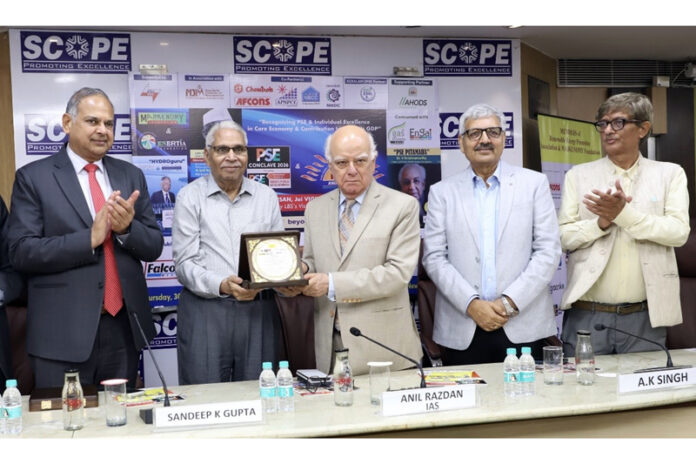
NEW DELHI, May 1: NTPC – INDIA’s largest Public Sector Enterprise in Communications and Public Relations in the Power & Renewable Energy domains today honoured, K M Prashanth, former GM (Corporate Communications) with the prestigious “Indian Public Sector Enterprise (IPSE) Doyen of the Decade (Public Sector)” Award for his Yeomen Contribution.
The prestigious Award was given by Anil Razdan, former Secretary (Power) Govt of India, in gracious presence of Sandeep Gupta, former CMD, GAIL and A K Singh, former CMD, NHPC at SCOPE Convention Centre, New Delhi
K M Prashanth is a seasoned professional with extensive expertise in corporate communication, human resources and corporate affairs.
With a deep understanding of these areas, he has successfully navigated various roles and responsibilities throughout his more than three decades of career with NTPC.
Prashanth’s experience in leading teams and implementing effective communication strategies made him a valuable asset to NTPC where he contributed significantly to the organisation’s success.
During the same event, Razdan also presented the IPSE Life Time Achievement Award for Excellence to J P Sharma, former Deputy General Manager (Corporate Communications), for his immense lifelong contributions to the field of Corporate Communications.
The IPSE Awards are instituted by PSE Journal in association with the ENERTIA Foundation.
The awards aim to recognize excellence within India’s Public Sector Enterprises across core economy sectors and their vital contribution to the Nation’s GDP, covering both Central and State PSEs as well as individual leadership.
Program was anchored and Coordinated by Prof A G Iyer.
NTPC honours K M Prashanth and J P Sharma with top IPSE awards
Patanjali Research Foundation inks MoU with Southern Cross University of Australia
Excelsior Correspondent
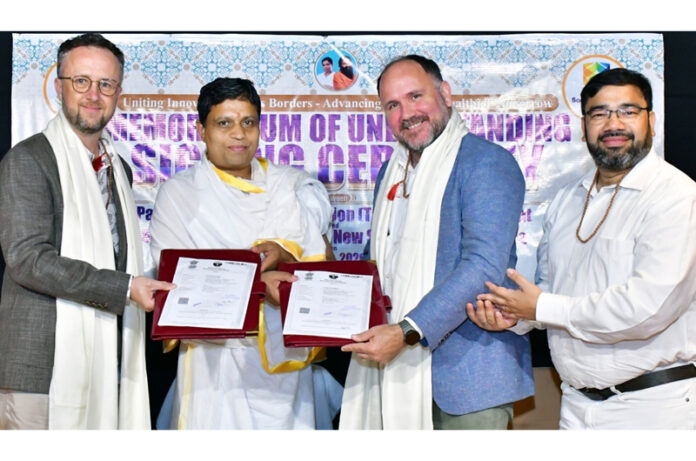
HARIDWAR, May 1: Patanjali Research Foundation inked a Memorandum of Understanding (MoU) with Southern Cross University of Australia.
The MoU signifies a strategic effort to cultivate enduring, impact-oriented and evidence-based collaborations between the two entities facilitating the integration of traditional knowledge systems with contemporary scientific progress on international scale.
On this occasion, Acharya Balkrishna highlighted that Patanjali has been at the forefront towards integrating Ayurveda, naturopathy and modern scientific research. He noted that the collaboration will unite the expertise of both institutions and create a strong foundation for addressing global health challenges.
Balkrishna also highlighted that Ayurveda is not merely a treatment system but a holistic science of life and its impact increases significantly when combined with modern scientific research.
Professor Ben Roche, Pro-Vice-Chancellor (Research & Education Impact), Southern Cross University, stated that the main objective of this agreement is to foster collaboration in research, teaching and student exchange.
Professor Jon Wardle, Foundation Director of the National Centre for Naturopathic Medicine, further explained that under this agreement both institutions will jointly develop research initiatives, seek competitive and Government funding and foster international research publications.
On this occasion, Patanjali’s lead scientist, Dr. Anurag Varshney stated that presenting traditional knowledge with scientific evidence is the need of the hour.
“This MoU marks an inspiring step towards global collaboration, innovation and sustainable development,” he maintained adding: “It sets a powerful example for the world, demonstrating how integrating diverse knowledge systems and cultures can help build a healthier, more prosperous, as well as inclusive future.”
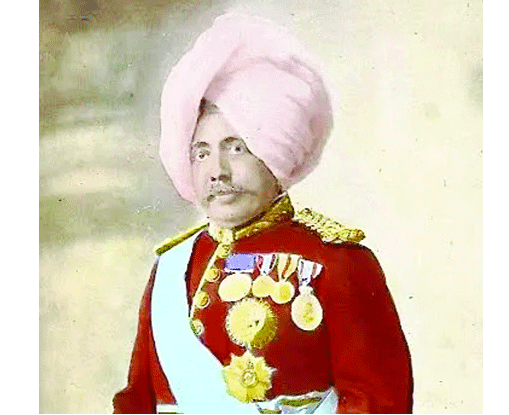
Maharaja Pratap Singh, in History and in Folklore -1
B D Sharma
Jammu and its surrounding areas have remained, to a great extent under the Dogra rulers for centuries. Much of the time the potentates were sovereigns and at other times they remained under the suzerainty of the overlords, be they were the Delhi Sultans, Mughals, Afghans, Sikhs or the English. Out of the numerous rulers we had, some like Raja Jambulochan, Ranjit Dev and Maharaja Gulab Singh and his successors readily catch our imagination. After independence a wave of denigration of the past rulers had swept the country and many of us did also swim with this wave. In the process many of us have forgotten even the names of our rulers of the days by gone. Young generation doesn’t know as to how our State was formed and who created it and who ruled over it for one hundred years before independence. Many of us are unable to even distinguish our three prominent rulers of recent past, namely Ranjit Dev, Ranjit Singh and Ranbir Singh.
Some time however the people show their affection of the past rulers. Your author observed this when it was seen that the mere mention of the name of a Dogra Maharaja got spontaneous applause from the people in a gathering. The year was 2004 when Mufti Muhammad Sayeed, the then Chief minister, against all odds, got the elections to the local bodies conducted under the newly framed Acts. Seventy one corporaters had been elected to the Jammu Municipal Corporation and a function for their taking oath was organized. CM, Dy CM, many ministers, legislators, prominent citizens and family members of the newly elected corporaters were invited for the occasion. Your author in the capacity of Commissioner JMC had to welcome the invitees. While tracing out the history of Jammu Municipality, it was mentioned that Jammu Municipality had been established by Maharaja Partap Singh. The moment name of the Maharaja was mentioned there was so thunderous an applause from the audience that the whole hall reverberated with it. The chief guest Mufti saheb got a bit infuriated and told the Liaison officer deputed with him as to ” why the Commissioner is so hugely glorifying a feudal lord.” The Mufti was by all accounts a modern, secular and progressive political leader despite his having sought the political support from the rabid communal elements in the later part of his career. So it was not surprising that he had a disliking for the autocratic system. But he perhaps forgot that the people had a free will to like or dislike a period, a time or a person. Moreover, our past rulers can not just be wished away. After all they remained an essential part of our history or rather they have made a part of our history and their memories shall always remain in our discourse.
It is true that the monarchy suffers from many inherent flaws like the lack of democracy and accountability, extreme concentration of power, rigid class structure and high costs of maintenance of royal family. But it is also a fact that some rulers have governed kindly despite the inherent vagaries of the system. Maharaja Pratap Singh can be counted as one such ruler. Apart from being a kind hearted person, he was not a even a fraction of spendthrift as were many other princes in India who lead luxurious lives as has been vividly depicted by Dewan Jarmani Dass in his book, The Maharaja. This is another thing that he faced lot of latent criticism when he purchased a car, perhaps the first one in the State and started travelling in it. Our elders used to tell us that many tongues started wagging that the car of the Maharaja burnt the blood of the common people in it instead of petrol. It further got intensified in case of his successor who was much maligned by the political leaders during 1930s/1940s on this count. People, however, later got appalled when they saw their democratically elected leaders overstepping even the Maharajas. People didn’t miss to notice that the Maharaja used to ply only one car but the new rulers, the people’s elected representatives, travelled in the big caravan of cars sometimes consisting of even more than fifty vehicles. Not only that. Even the middle rung officers were not left behind. People in Samba district would wonder how a former Deputy Com had gathered more than five government vehicles for his/his family use, one for the children to go to school, one for his wife to go to market, one for carrying cow milk from Samba to Jammu where his family was putting up, one for Pucca road, one for Kucha road, one for his personal staff and the one for his security staff. Intoxication of power is, perhaps the root cause of this all type of extravagance and arrogance and not being a monarch or a democrat.
Though Maharaja Pratap Singh was, to a great extent, a noble man yet he unfortunately saw many ups and downs during his life. His father Maharaja Ranbir Singh wanted his second son Raja Amar Singh to succeed him, as he thought that Amar Singh was wiser than Pratap Singh. The Governor General, however, decided that Pratap Singh would succeed his father. The English felt that Maharaja Pratap Singh was a simple-minded person and could be handled easily. And it would be easy to promote their interests in the State if he was in power. In fact there was a strong lobby in the English establishment who had not forgotten the costly mistake of Lord Hardinge and company of having handed over the beautiful Valley to Gulab Singh for a measly amount of Rs 75 lakhs. They had made many efforts during the time of Maharaja Ranbir Singh to poke their nose in the affairs of State but their efforts had not succeeded. They, however, were successful in hatching a conspiracy against Maharaja Pratap Singh and alleged that he was working against the interests of the English and had established contact with the Russians. Consequently they drastically reduced his powers and a governing Council was constituted for running the government. After some years the false and concocted allegations against him were exposed by a Calcutta newspaper and there was an uproar in the British Parliament. His powers were thereafter restored. During the last years of his life a feud in the family erupted when he adopted Jagat Dev Singh, a descendant of Raja Dhian Singh as his son and successor in preference to his nephew Raja Hari Singh.
Despite all these turbulences, the State made a lot of progress during his time. Means of Communication like Kohala bridge, Jhelum Cart road, Srinagar-Gilgit road, Srinagar-Leh road, Jammu Sialkot railway line, Banihal Cart road were constructed during his regime. In the field of education SP college Srinagar, Prince of Wales college Jammu, two Technical Institutes, many High schools including the prestigious Ranbir High School Jammu were established. Two Power Stations at Mohra and Ranbir Canal, were constructed during his regime. Many improvements in the fields of healthcare, agriculture and forests management were also made.
The most glorious achievement of the Maharaja was, however, in carrying out of the first Regular Settlement of land where in the land records were prepared on sound footing. In Kashmir valley permanent Assami rights (heritable and transferable) were given to the farmers for the first time, land revenue was fixed at reasonable rates and the much hated Begar system(where by farmers were forced to do work without any wages) was abolished. In this venture the State was fortunate to have the services of WR Lawrence of ICS, Punjab cadre. As Settlement Commissioner he got the Revenue record prepared elaborately and judiciously. The revolutionary changes brought through this Settlement, gave a whiff of fresh air to the poor farmers of Kashmir. Lawrence’s work became the basis for Settlement in other parts of the State. He became very popular with the Kashmir peasantry also and even today the poor illiterate farmers recall and quote their “Larren saheb’s” work/findings to assert a right. Many people opine that he was one of the best civil servants which the State ever had. Lawrence has showered many compliments on Maharaja for his encouragements to him and for having accepted his recommendations. Lawrence further observes that the Maharaja had done much to change the condition of his people. He was kind to all sections of people and had won their affection. It may be of interest to the readers that Lawrence reforms were as significant as the later day Big Landed Abolition Act and Agrarian Reforms Act. In addition his book, the Valley of Kashmir, remains one of the most popular books ever written on Kashmir.
Maharaja Pratap Singh is, however, assailed on account of two decisions he took during his reign. He allowed his Law Minister, Pt Bhag Ram, a Punjabi Brahmin to introduce Urdu as the official language in the State in place of Persian and Dogri. The people, particularly many Dogras think that Maharaja Ranbir Singh had taken many steps in promoting the Dogri language in the official work and Maharaja Pratap Singh should have continued with those efforts so that the Dogras had gotten a fair share in the cake of government services. Introduction of Urdu suited the Punjabis and it facilitated their influx in the State government. But this criticism seems to be somewhat ill founded because the Dogri language had not developed to the level as might have been able to conduct the government work efficiently. It was deficient in an elaborate and adequate script, standardized legal and administrative terminology and had seen only a patchy usage in administration. Secondly it was not acceptable to the people of two out of three regions of the State. Officialisation needed textbooks, dictionaries, legal translations, curricula and examination materials. Dogri lacked it all and strange it may look, it had only one worthwhile book available till 1940s.
The other decision of the Maharaja which was later on deprecated was with regards to his granting rights over some patches of State land exclusively to his clan and kinsmen. Under this Order/Irshad popularly known as Pratap Code some chunks of State land mainly lying vacant in the form of Rakhs and Farms were given, as the Maharaja himself put it, to ” my Rajpoot brethren and relatives” because they “hold no land.” Pratap Code was an eye sore to the political leadership later. Sheikh Abdullah and Afzal Beg attacked it vociferously during the debates on Big Landed Abolition Act in the Constituent Assembly in 1952. Readers might be aware of the fact that the Dogra Rajput community used to be placed in two broad categories, one section was engaged mainly in farming and they owned lot of land. Charak, Manhas, Thakkars/Thakurs etc fell in this category.
The other section consisting of Jamwals, Sambyals, Slathias and Jasrotias etc were mainly engaged in soldiery. Farming particularly putting a hand on a plough was a detestation to them. They never showed any interest to hold land. Though giving preferential treatment to a section of people particularly to one’s own clan/kith and kin is not appreciable in the context of modern norms yet the Maharaja seemed to have a justification for it. When the measurement of land and determination of rights over all of it was being done it became clear that the Mian Rajputs didn’t hold any appreciable amount of land beyond the land under their residential premises. Some poor families had not land even for construction of their houses. So the need for giving land to them might have been felt. Secondly this segment of society had played a major role in extending and preserving the boundaries of the State and the country. And it was a convention during those days that the services of such people were recognized by way of award of grants of land. The English too used to award land by grant of Murabbas(square plots) to the valorous. And the Maharaja did it by promulgating the Code named after him by which unoccupied State land mainly in the form of Rakhs and Farms was given to the Mian Rajputs as a community. In the process land in Rakh Amb Taali was allotted to Sambyals of Samba, in Rakh Barotian and Rakh Sarwa was allotted to Slathias, Rakh Badoi was allotted to the Dalpatias of Badhori etc.
NC struggles for the restoration of statehood

K N Pandita
knp627@gmail.com
In his recent public address in Budgam, Dr Farooq, president of the National Conference, spoke about the historical efforts made by his party in the service of the people and its role in the development of the State. Who can deny the claims he made? That is history.
But the fact is that it is the duty of democratically governed states to serve the broad interests of the nation and divert their efforts to the development of the State. In that sense, the National Conference has played its genuine role. It is no obligation that NC has won. At best, it is an admiration.
He raised the issue of the restoration of statehood of J&K. Again, he cited the Supreme Court as well as the statement of the Home Minister on the floor of the parliament about the restoration of statehood at its proper time. All this is history without bias.
Admittedly, the status of J&K as a state is an important issue when studied from an historical perspective. But the story needs to be told or retold in its entirety and not by piecemeal. There are some vital questions which Dr Farooq should have reflected upon with earnestness.
For example, it is unavoidable for the head of a very important and historical political party like NC to raise the question of why the withdrawal of Article 370 was necessitated in 2019, while from the date of its enactment till 2019, the article was not touched by the governments at the centre. He should have told the people what the compulsions were for the NDA government to bring about the State Reorganisation Act even if the home ministry’s arguments were not acceptable to him.
From the early 1980s, separatist and secessionist elements in J&K, particularly in the Kashmir Valley, had become active. The election of 1986 was crucial, for it reflected deep polarisation of the Kashmir majority community, the then backbone of the National Conference. The opposition, not only to the NC but to the very concept of accession of the State to the Indian Union, was challenged with the Jamaat-i-Islami in the forefront. How the NC leadership handled this situation is a subject never debated freely and never brought to the public domain by the NC. The result was that the views of the MUF, and later on, the role of MUF leadership that had shifted its base to Muzaffarabad, began to be accepted by the Kashmir observers everywhere.
A decade later, in 1996, through the efforts of the Union government to restore democratic dispensation in J&K, elections were held, and the NC returned to power. Dr Farooq Abdullah took up the reins of the government. With the re-establishment of a democratically elected government, the logic demanded that the elected government instituted a comprehensive inquiry into the most vital issues facing the state such as (a) the exacerbation of separatism and secessionism in Kashmir (b) the fast rising crescendo of Jamat-i-Islami’s fundamentalist ideology in Kashmir (c) the infiltration of Jamati ideology into the organs of the state (d) the cross border terrorism in which Pakistani ISI created its moles in Kashmiri community, (e) terror against Kashmiri Pandit minority – their genocide and ultimately their ethnic cleansing. These were no small and inconsequential happenings for a State that was very strongly projected by Pakistan as a disputed land.
But the state government, perhaps abetted by the then Central government, just put an iron lid on these fundamental issues. Conversely, not only NC, but most of the political parties in Kashmir conveniently adopted double standards of defining their position in the wake of opposition to the accession of the State and extension of many parliamentary rules and regulations to the J&K State. This was the period when the sense of separate identity of the State from the Indian nation identity became deeper and deeper among the people of Kashmir.
The sad part of this story is that the local political parties, NC in the frontline, the opposition in the assembly, the state bureaucracy, the media outlets and prominent opinion-making institutions, all adopted a soft, rather conciliatory attitude towards the separatist ideologues.
During the government of Atal Bihari Vajpayee, the Central government seemed to have envisioned the consequences of this grave situation in the State. It tried a diplomatic prescription to overcome the situation and ensure that saner elements were given a chance to have their say. Omar Abdullah, the son of Dr Farooq Abdullah, was inducted into the Union Council of Ministers as MOS in the External Ministry, and Dr Farooq Abdullah was also inducted in the Union Ministry as Minister-in-Charge of Renewable Energy.
PM Vajpayee also made a very bold (through to some observers a controversial) step of a bus journey to Pakistan in 1998, exclusively with the purpose of improving friendly relations with that country. He was well received, and even during his visit to the memorial of Allama Iqbal, he went to the length of accepting the division of India and the creation of Pakistan in 1947 as a reality. It should be remembered that he was severely criticised by many, including right-wing politicians in India, but he did not flinch. In Kashmir, he had publicly stated that “Kashmir issue ko jamhuriat, insaniyat aur Kashmiriyat ke nate samajhna hoga.” The Kashmir valley leadership of all hues greeted him warmly for this statement. And remember, Vajpayee was the tallest political leader in India of his day.
But alas! While Vajpayee was building the path of peaceful coexistence in Islamabad and Lahore, the Pakistani army chief was secretly planning to control Kargil heights and cut off India’s connection with Leh. This was how the ISI and Pakistan worked to deprive Kashmiris of a peaceful resolution of the Kashmir issue.
In 2002, PDP, largely supported by the Jamati Islami, assumed power, forming a coalition government with the Congress. Its second term of power ensued in 2015 with the BJP coalition, which lasted just one year. The period between 2002 and 2016 was most crucial in modern Kashmir history. It was virtually the Jamati Islami running the show with Congress or BJP as the show boys. This was the period when all political parties of Kashmir, in or out of power, converged on one line of action. It was to play a double game, what we traditionally call hunting with the hare and hunting with the hound. Covert and overt connections grew between local moles and their masters across the border. The slogan of “talk to Pakistan” became louder day by day, and continues even now with a very shrill voice. The Kashmir leadership was eager to make Pakistan a formal partner in the issue.
Whether the terrible event of Iran-Israel-US triangular war has opened the eyes of the Kashmiri people to the catastrophe caused by extremism and Theo-fascism across the globe, will best be answered by their leadership. But to be fair, the fundamental issue is not the restoration of statehood; fundamental issues are of development, of industrialisation, of connectivity, of boosting Kashmir tourism and trade and normalising radicalism, etc., if the real interests of the people of Kashmir are to be served.
Lastly, it has to be remembered that J&K is a deficit state. Its development and progress can take place only with massive funding by the Centre. The Centre is not imposing any obligation by providing developmental funds and schemes. That is an obligation for the Centre not only for Kashmir but for all the federating states of the Union. J&K has the privilege of being included in the hilly region states, which are allocated additional funds for development under the given procedure of the Union Finance Ministry.
Reimagining the Role of Educators in present times
Meenu Gupta
mguptadps@gmail.com
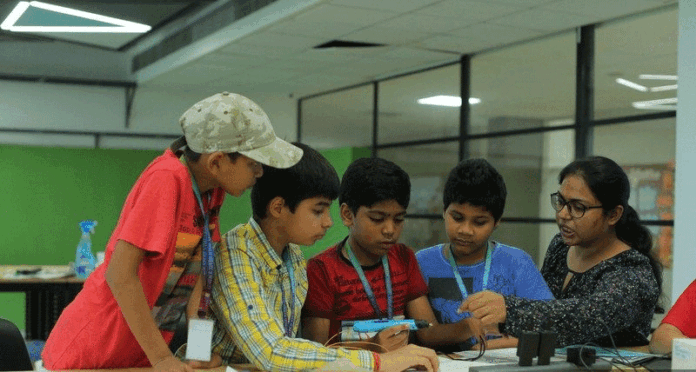
The Indian classroom is at a decisive turning point. For decades, the image of a teacher as the “sage on the stage”- the sole authority delivering knowledge, defined our education system. Today, under the transformative vision of the National Education Policy (NEP) 2020 and the National Curriculum Framework (NCF) 2023, that image is being fundamentally redefined. The teacher is no longer just a transmitter of information but a designer of learning experiences, a mentor, and a co-traveller in the child’s journey of discovery.
This is not merely a pedagogical shift-it is a moral and intellectual reset. For years, classrooms have rewarded speed over depth, silence over curiosity, and correctness over courage. We have produced students who can answer questions, but often hesitate to ask them. The new curriculum challenges this very foundation. It asks: What is the purpose of education in a world where information is everywhere? The answer is clear-education must now focus on meaning-making, not memory; on thinking, not ticking boxes. A classroom that does not provoke thought, dialogue, and doubt is no longer enough. The real transformation will happen when teachers consciously create discomfort for passive learning and replace it with the excitement of exploration.
Redefining the Teacher’s Role
In this new paradigm, the teacher becomes a “learning architect.” Lesson plans evolve into learning experiences. Instead of completing chapters, teachers curate activities, projects, and discussions that connect concepts to life beyond textbooks. Assessment, too, is no longer confined to pen-and-paper tests but is integrated into everyday learning through observation, portfolios, and reflection.
This shift requires teachers to embrace multiple roles: facilitator, assessor, mentor, and even co-learner. It also demands a mindset change-from control to trust, from coverage to depth, and from marks to mastery.
The Expanding Role of School Leaders
Equally critical is the evolving role of school leadership. Principals, Vice Principals , and the core planning team are no longer just managers of systems; they are the drivers of vision. They set the tone for what learning looks like in classrooms and what is valued within the school culture.
These school leaders must ensure that timetables, assessments, and infrastructure align with the new vision. They must create collaborative spaces for teachers, invest in professional development, and actively monitor whether classroom practices reflect policy intent. Without strong leadership, even the best curriculum reforms risk remaining on paper.
A progressive school is not defined by infrastructure or results alone, but by how its leadership empowers its teachers to think differently. When leadership shifts from monitoring compliance to nurturing innovation, classrooms begin to transform organically.
Kaushal Bodh: From Period to Purpose
Perhaps the most misunderstood aspect of the new curriculum is Kaushal Bodh. If treated as just another period in the timetable, it will fail. But if seen as a philosophy, it can redefine schooling itself.
Kaushal Bodh must move from being an “activity slot” to becoming the heartbeat of applied learning in schools. It is where knowledge meets life. Imagine students not just learning about sustainability, but designing waste management solutions within the school. Not just studying financial literacy, but managing a small student-led enterprise. Not just reading about empathy, but engaging in meaningful community work.
For this to happen, schools must rethink implementation:
* Timetables must give Kaushal Bodh/ Vikas protected, uninterrupted time, treated with the same seriousness as core subjects
* Projects should be long-term, interdisciplinary, and rooted in real-life contexts, not one-day activities
* Local community, artisans, professionals can be meaningfully involved to bring authenticity
* Student voice and choice should drive projects, allowing ownership and creativity
* Reflection must be embedded, students should think about what they learned, how they learned, and why it matters
Assessment here should not be about marks, but about growth, problem-solving, collaboration, resilience, and initiative.
If implemented with intent, Kaushal Bodh can quietly solve one of India’s biggest educational challenges- the disconnect between schooling and life. It can nurture dignity of labour, entrepreneurial thinking, and real-world readiness, all within the school ecosystem.
Teacher Training: The Real Game Changer
No reform can succeed without empowered teachers. Continuous Professional Development (CPD) is no longer optional, it is essential. Teachers must be trained in:
* Designing experiential and interdisciplinary lessons
* Conducting competency-based assessments
* Facilitating discussions and inquiry-based learning
* Integrating technology meaningfully
CBSE’s and State board’s Capacity Building Programmes (CBPs) must become a regular and mandatory part of school culture. More importantly, training should move beyond one-time workshops to sustained mentoring, peer learning, and classroom-based support.
The Way Forward
The shift from “sage on the stage” to “guide on the side” is not about reducing the teacher’s importance. It is about redefining it. In fact, the teacher’s role becomes more complex, more demanding, and far more impactful.
The success of NEP 2020 and NCF 2023 will not be measured by how beautifully they are written, but by how deeply they are lived in classrooms. It will depend on whether schools are willing to rethink timetables, whether teachers are willing to unlearn old habits, and whether leaders are willing to prioritise learning over routine.
The question before us is not whether change is coming, it already has. The real question is: will our classrooms continue to produce students who can reproduce answers, or will they nurture individuals who can think, create, and lead?
Because in the end, education is not about who speaks on the stage-
It is about the teacher who ignites minds so fiercely that students don’t just learn, they rise, they question, and they redefine the future.
(The author is Vice Principal DPS Jammu/ CBSE Resourse Person)
Rahul, Nissanka fuel DC’s seven-wicket win over RR
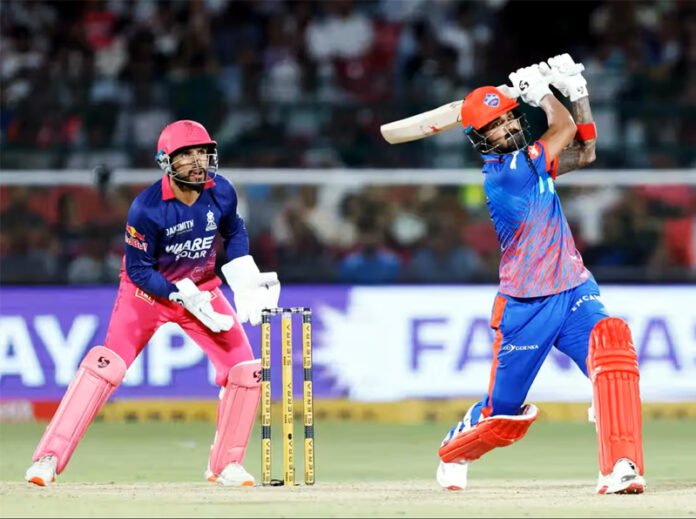
Rajasthan Royals: 225/6 in 20 overs (Riyan Parag 90, Dhruv Jurel 42, Donovan Ferreira 47 not out; Mitchell Starc 3/40).
Delhi Capitals: 226/3 in 19.1 overs (KL Rahul 75, Pathum Nissanka 62, Nitish Rana 33).
CSK V/s MI at
Chennai (7.30 pm)
Saina visits Vaishno Devi Shrine
Excelsior Sports Correspondent
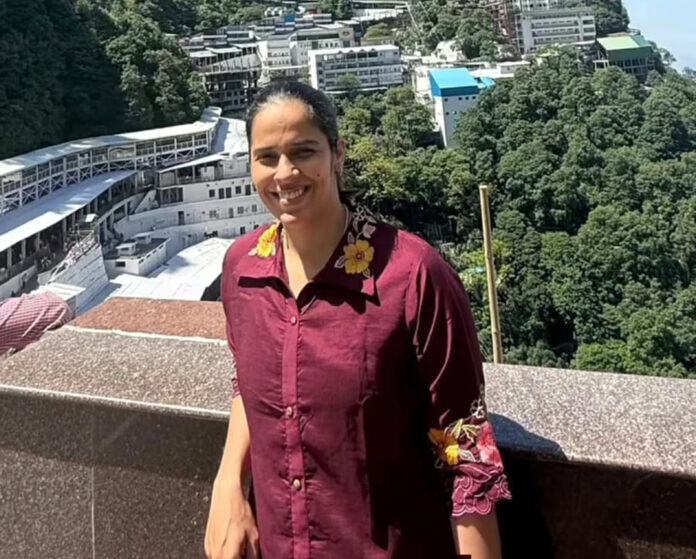
REASI, May 1: Ace Indian badminton player and Olympian Saina Nehwal visited the Shri Mata Vaishno Devi Shrine in Reasi district today and offered prayers along with her father. The Olympic medallist, who reached Jammu on Thursday, also paid obeisance at the famous Bawe Wali Mata Temple in Jammu. She shared pictures of her Jammu visit on social media, where she was seen accompanied by her father. The star shuttler’s visit drew attention from devotees and fans alike at both religious sites. Saina Nehwal is likely to return from Jammu on Saturday after completing her short pilgrimage trip. She expressed gratitude for the warm welcome and spiritual experience during her visit in Jammu.
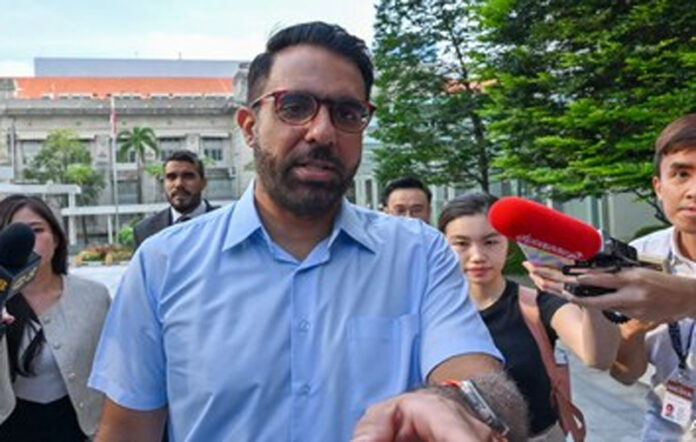
Singapore’s Indian-origin leader reprimanded by party for lying to parliament
Tech integration into judicial processes dismantles geographical barriers, helps litigants: CJI
Dairy sector witnesses 70 pc growth in a decade under PM Modi: Shah