

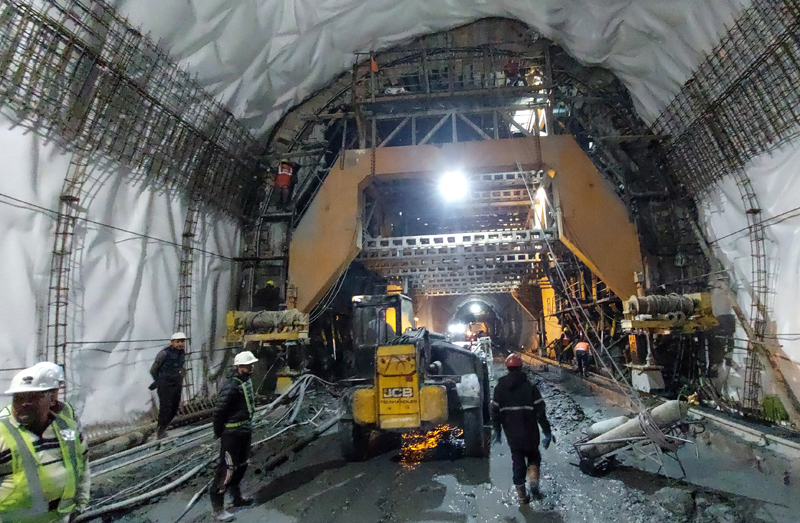
13.15-km project set for June link-up
Irfan Tramboo
Srinagar, May 2: The under-construction Zojila Tunnel is just 210 metres short of a full breakthrough, with engineers targeting the first week of June to connect the two ends.
At 13.15 km in length and an estimated cost of Rs 4,500 crore, the tunnel is set to become Asia’s longest bi-directional road tunnel and transform the connectivity.
Follow the Daily Excelsior channel on WhatsApp
Officials told Excelsior that the tunnel will provide all-weather connectivity across the snow-bound Zojila Pass, which currently remains closed for five to six months each year.
Mehraj ud Din Lone, Construction Manager overseeing execution at the east portal in Ladakh, said that from the Ladakh side, 6.3 km of heading excavation and 4.4 km of benching have been completed, while 2.8 km of final lining has also been achieved.
He said tunnelling is being carried out in two stages, heading and benching, with work progressing round the clock from both ends, including the west portal in Ganderbal.
The overall project is being executed by Megha Engineering & Infrastructures Limited, and its deadline has been extended to February 2028 from the earlier September 2026 timeline for the full completion.
Officials said the east portal presents greater challenges than the western side due to extreme weather conditions and difficult geological formations.
They said that on the eastern side, the tunnel alignment is on a downgrade, requiring continuous dewatering beyond 750 metres through pumping systems to tackle persistent water ingress.
Maintaining electricity supply and voltage stability more than 6 km inside the tunnel, along with ensuring adequate ventilation for heavy machinery and workers, remains a major operational challenge, they added.
Officials stressed that temperatures in the area drop to between -35°C and -45°C during winter, further complicating construction.
Further, of the three planned ventilation shafts, officials said two have already achieved breakthrough and are now open to the surface.
One of the shafts involved a 430-metre pilot excavation carried out using raise climber technology for the first time in India, with enhanced safety protocols, officials said.
The project currently employs over 1,400 personnel, including engineers, supervisors, foremen and labourers, with around 79 per cent drawn from the local population.
Construction is supported by more than 400 machines and equipment units, enabling continuous operations.
The project has also faced significant risks. In January 2023, an avalanche struck the site, killing two workers and forcing a suspension of work for about one and a half months.
Another avalanche during the same period damaged a primary workshop and equipment, causing substantial losses, officials said.
Despite these setbacks, officials noted, engineers have continued work using advanced techniques such as the New Austrian Tunnelling Method to ensure safe and efficient excavation.
“The tunnel has a horseshoe-shaped profile, with a width of 9.5 metres and a height of 7.57 metres, designed to support two-way traffic in high-altitude conditions,” Lone said.
Officials said improved snow-clearance efforts by the Border Roads Organisation, particularly under Project Vijayak, have reduced closure periods at the pass in recent years, although winter disruptions continue.
Once completed, the tunnel will eliminate the seasonal isolation of Ladakh, ensure uninterrupted connectivity, and significantly improve the movement of civilians, goods and emergency services.
Officials noted that the project is also of strategic importance, as it will enable faster deployment of troops and heavy equipment to forward areas-a need highlighted during recent border tensions.
It forms part of a broader network of high-altitude infrastructure projects aimed at strengthening all-weather connectivity across India’s northern frontier.
For civilians, the tunnel is expected to reduce travel time, boost tourism, improve access to healthcare, and ensure a more reliable supply of essential goods to remote areas such as Drass and Kargil.
Zahoor Ahmad, a resident of Drass, said the project would ease long-standing hardships.
“It is nearing breakthrough and will help us a lot, as we have faced many difficulties so far. In emergencies, we had to travel to Leh and then take a flight to Srinagar. The tunnel will ease these hardships and bring transformative change,” he said.
Mukhtar Hussain, another resident of Drass, said better connectivity had long been a pressing need.
“We are happy that we are finally moving towards reliable connectivity. It will ensure a steady supply of essential goods and boost tourism as well as other sectors,” he said.
 Follow our WhatsApp channel
