

Meenu Gupta
mguptadps@gmail.com
The Indian classroom is at a decisive turning point. For decades, the image of a teacher as the “sage on the stage”- the sole authority delivering knowledge, defined our education system. Today, under the transformative vision of the National Education Policy (NEP) 2020 and the National Curriculum Framework (NCF) 2023, that image is being fundamentally redefined. The teacher is no longer just a transmitter of information but a designer of learning experiences, a mentor, and a co-traveller in the child’s journey of discovery.
This is not merely a pedagogical shift-it is a moral and intellectual reset. For years, classrooms have rewarded speed over depth, silence over curiosity, and correctness over courage. We have produced students who can answer questions, but often hesitate to ask them. The new curriculum challenges this very foundation. It asks: What is the purpose of education in a world where information is everywhere? The answer is clear-education must now focus on meaning-making, not memory; on thinking, not ticking boxes. A classroom that does not provoke thought, dialogue, and doubt is no longer enough. The real transformation will happen when teachers consciously create discomfort for passive learning and replace it with the excitement of exploration.
Redefining the Teacher’s Role
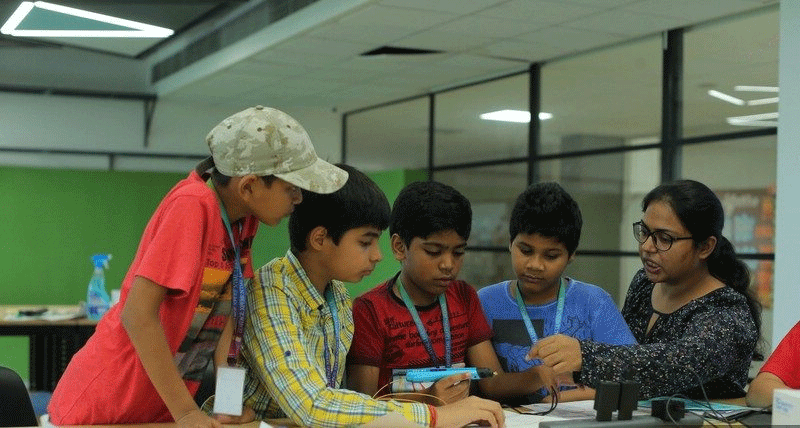
In this new paradigm, the teacher becomes a “learning architect.” Lesson plans evolve into learning experiences. Instead of completing chapters, teachers curate activities, projects, and discussions that connect concepts to life beyond textbooks. Assessment, too, is no longer confined to pen-and-paper tests but is integrated into everyday learning through observation, portfolios, and reflection.
This shift requires teachers to embrace multiple roles: facilitator, assessor, mentor, and even co-learner. It also demands a mindset change-from control to trust, from coverage to depth, and from marks to mastery.
The Expanding Role of School Leaders
Equally critical is the evolving role of school leadership. Principals, Vice Principals , and the core planning team are no longer just managers of systems; they are the drivers of vision. They set the tone for what learning looks like in classrooms and what is valued within the school culture.
These school leaders must ensure that timetables, assessments, and infrastructure align with the new vision. They must create collaborative spaces for teachers, invest in professional development, and actively monitor whether classroom practices reflect policy intent. Without strong leadership, even the best curriculum reforms risk remaining on paper.
A progressive school is not defined by infrastructure or results alone, but by how its leadership empowers its teachers to think differently. When leadership shifts from monitoring compliance to nurturing innovation, classrooms begin to transform organically.
Kaushal Bodh: From Period to Purpose
Perhaps the most misunderstood aspect of the new curriculum is Kaushal Bodh. If treated as just another period in the timetable, it will fail. But if seen as a philosophy, it can redefine schooling itself.
Kaushal Bodh must move from being an “activity slot” to becoming the heartbeat of applied learning in schools. It is where knowledge meets life. Imagine students not just learning about sustainability, but designing waste management solutions within the school. Not just studying financial literacy, but managing a small student-led enterprise. Not just reading about empathy, but engaging in meaningful community work.
For this to happen, schools must rethink implementation:
* Timetables must give Kaushal Bodh/ Vikas protected, uninterrupted time, treated with the same seriousness as core subjects
* Projects should be long-term, interdisciplinary, and rooted in real-life contexts, not one-day activities
* Local community, artisans, professionals can be meaningfully involved to bring authenticity
* Student voice and choice should drive projects, allowing ownership and creativity
* Reflection must be embedded, students should think about what they learned, how they learned, and why it matters
Assessment here should not be about marks, but about growth, problem-solving, collaboration, resilience, and initiative.
If implemented with intent, Kaushal Bodh can quietly solve one of India’s biggest educational challenges- the disconnect between schooling and life. It can nurture dignity of labour, entrepreneurial thinking, and real-world readiness, all within the school ecosystem.
Teacher Training: The Real Game Changer
No reform can succeed without empowered teachers. Continuous Professional Development (CPD) is no longer optional, it is essential. Teachers must be trained in:
* Designing experiential and interdisciplinary lessons
* Conducting competency-based assessments
* Facilitating discussions and inquiry-based learning
* Integrating technology meaningfully
CBSE’s and State board’s Capacity Building Programmes (CBPs) must become a regular and mandatory part of school culture. More importantly, training should move beyond one-time workshops to sustained mentoring, peer learning, and classroom-based support.
The Way Forward
The shift from “sage on the stage” to “guide on the side” is not about reducing the teacher’s importance. It is about redefining it. In fact, the teacher’s role becomes more complex, more demanding, and far more impactful.
The success of NEP 2020 and NCF 2023 will not be measured by how beautifully they are written, but by how deeply they are lived in classrooms. It will depend on whether schools are willing to rethink timetables, whether teachers are willing to unlearn old habits, and whether leaders are willing to prioritise learning over routine.
The question before us is not whether change is coming, it already has. The real question is: will our classrooms continue to produce students who can reproduce answers, or will they nurture individuals who can think, create, and lead?
Because in the end, education is not about who speaks on the stage-
It is about the teacher who ignites minds so fiercely that students don’t just learn, they rise, they question, and they redefine the future.
(The author is Vice Principal DPS Jammu/ CBSE Resourse Person)
 Follow our WhatsApp channel
