

K D Maini
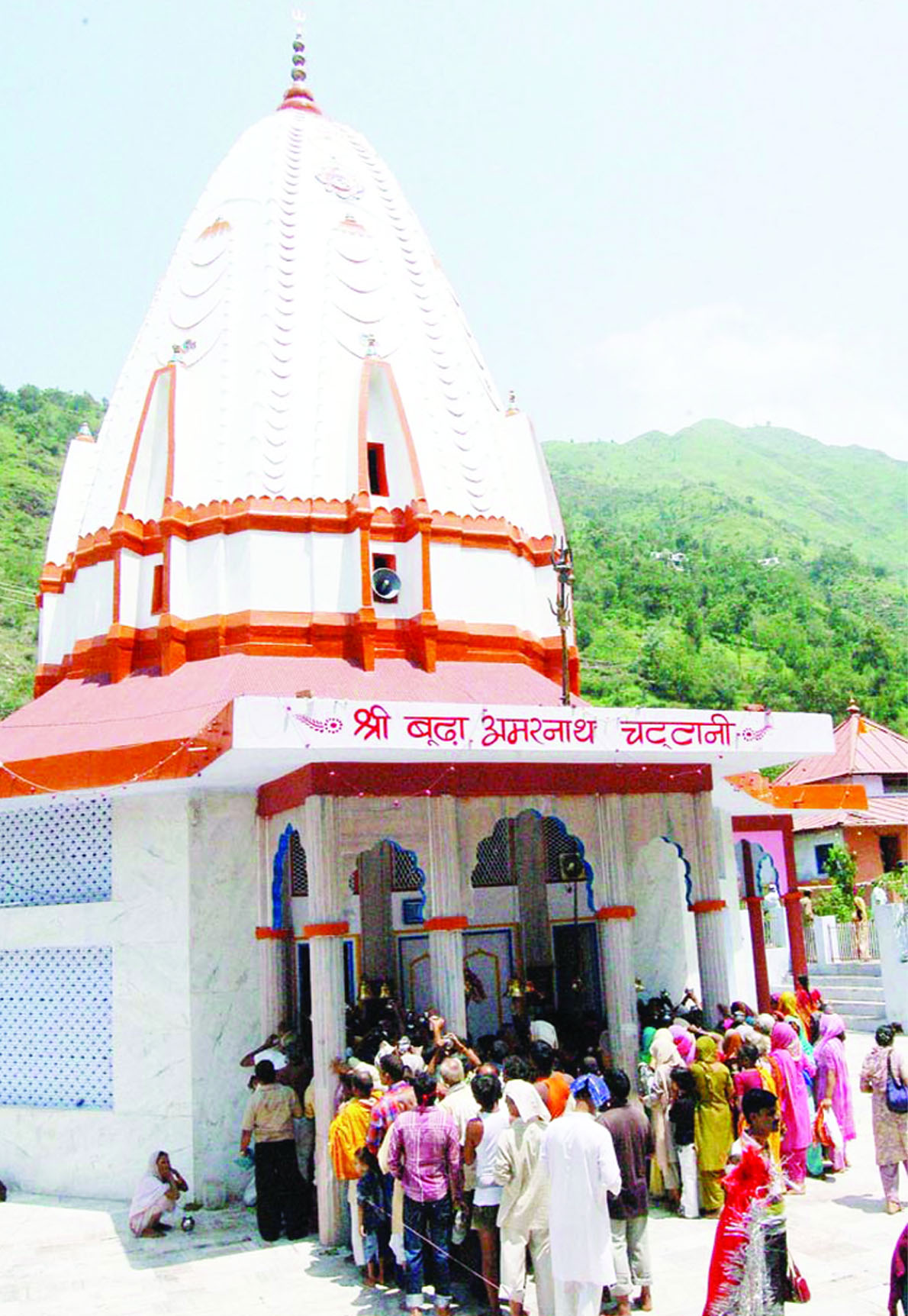
Swami Budha Amarnath Temple Mandi is one of the important and oldest Hindu Shrines of Jammu, which is located on left bank of Pulsta stream in between snow capped peaks of Pir Panchal mountain range in the village Rajupra.
Chaddi Mubarkh traditional Yatra starts from Dashnami Akhara Poonch two days before the Shravan Purnima. It reaches the shrine after walking 23kms long journey on the same day. On Raksha Bandhan festival, a big Mela is organized in which the pilgrims from various parts of Jammu and abroad participate and get the blessing of Lord Shiva. It is also believed that Lord Shiva fulfills the desires of devotees who visit this shrine on Shravan Purnima.
This place remained the summer capital of Dogra Raja Moti Singh in between 1852-92 AD. During this period the oldest temple of one stone with natural Shivlinga was renovated properly because there was no Hindu population in this area. The Yatra of holy mace (Chaddi Mubarkh) was also started in this period firstly from Tetrinote temple (now in POK) and then from Dashnami Akhara Poonch. There are a number of legends popular in Poonch about this ancient shrine. It is said that Lord Shiva had narrated Amar Katha to Parvati Ji from this very place which ended at Swami Amarnath ji Kashmir. This indicates the relation between the Shrine of Baba Barfani (Ice Shiva Lingam) and Baba Chattani (Natural Shivling of Chakmak stone). It is also believed that this shrine is the oldest than Swami Amarnath ji Kashmir, that is why this temple is known as Swami Budha Amarnath.
Normally the pilgrims visit this shrine throughout the year and there remains religious hustle bustle in the shrine. However in the month of June-July, the pilgrims come in large numbers every day to have a Darshan of Baba Chattani, to enjoy the scenic beauty of the area and to relax in cool climatic conditions and natural atmosphere. After 2005, a 10 days country level Yatra of Swami Budha Amarnath was started by Bajrang Dal and Vishav Hindu Parishad in which the yatris from all over the country like Delhi Punjab, UP, Bihar, MP, Rajasthan and Himanchal Pardesh come the shrine on the pattern of Yatra of Swami Amarnath ji of Kashmir. These Yatris are received by the reception committee comprising of Hindus, Muslims and Sikh communities in Degree college Poonch. After light refreshment these Yatris are taken to Dashnami Akhara where all necessary boarding lodging arrangements are made for their stay. One thousand Yatris are accommodated in the buildings, guest houses and sarias of Dashnami Akhara at a time. These Yatris are treated as guests of Poonchis and looked after properly by the volunteers of Poonch city. Next day the Yatris leave for the Darshan of Swami Budha Amarnath and after that they return to their native places.
This year the traditional Chaddi Mubarkh yatra shall start on August 13, from Dashnami Akhara Poonch. A large number of sadhus, natives of Poonch towns and surrounding villages and pilgrims from Jammu and abroad participate in this Yatra. At about 8:00 A.M Puja of holy mace and religious ceremonies shall start. After the sermons of prominent speakers of all the religions and Parvachan of Mahant Sri Swami Vishav Atma Anand Sarsvati ji Maharaj, the religious procession shall start foot journey at 9:00 A.M in between the chantings of Bajjan, Kirtan and religious slogans and would lead towards Swami Budha Amarnath along with Chaddi Mubarkh. A numbers of stalls would be installed by various organizations at Kazi Mohla, Gundi, Nangali, Janyar, Chandak, Chakrara, Seklu, Mandi town and Rajpura.
As per routine at Nangali village local Sikhs will serve sweet dishes to Yatris while at Mandi town the Yatra is received by local Muslim representatives who serve light drinks to Yatris as a goodwill gesture, then the Yatra reaches Rajpura where thousands of people of all the religions receive the Yatris and holy mace and this colorful religious function converts into composite cultural heritage of the area. Then Swami ji takes Chaddi Mubarkh in between chanting of Shaloks and installs it in the temple near holy Shivlinga for the Darshans of devotees.
On 15th August, the Raksha Bandan Day, the Darshans starts at 4:00 AM after taking bath in the holy spring, the first batch of Sadhus enter the temple and have the Darshan of holy Shivlinga. After that the Yatris will follow them and have the Darshan of Swami Budha Amarnath ji. On the opposite side of the temple a big Mela is also organized in collaboration with District Administration where apart from numbers of stalls a free langar serves meal to pilgrims.
 Follow our WhatsApp channel
