

MUMBAI, May 3 : The Directorate of Revenue Intelligence (DRI) has busted an international drug smuggling syndicate and arrested two persons including a foreign national for allegedly trafficking in cocaine valued around Rs 7 crore, an official said here on Sunday.
According to the DRI official, on receipt of specific information about the arrival of a passenger at at the Mumbai international airport, Jezreel Luvado, a South African national, was apprehended with 1426 gm of cocaine valued around Rs 7 crore. During interrogation, he revealed the name of his Indian associate A.D. Patel.
A DRI team arrested Patel from Nagpada area of south Mumbai for allegedly aiding and abetting the crime.
UNI)
International Drug Syndicate Busted , DRI Arrest Two With Rs 7 Crore Narcotic

Tallest underwater human stack formed; Andaman sets two Guinness World Records in 2 days

SRI VIJYA PURAM, May 3: The Andaman and Nicobar Islands on Sunday created another Guinness World Record with the formation of the tallest human stack underwater at Swaraj Dweep, formerly known as Havelock Island, officials said.
Fourteen people, including Lieutenant Governor DK Joshi, took part in forming the 22.3-metre-long stack, and they stayed under the water for three minutes, officials said.
The feat comes a day after the Union Territory administration achieved a landmark by unfurling the world’s largest underwater national flag, measuring approximately 60 by 40 metres, in a coordinated operation involving multiple agencies and trained divers near the same island.
The Lieutenant Governor, who is also the Vice Chairman of the Islands Development Agency, also participated in Saturday’s event.
Officials said the back-to-back achievements are part of a larger initiative to showcase the islands as a premier global diving destination, highlighting their pristine marine ecosystem and advanced diving capabilities.
They said the initiative has been planned in coordination with multiple departments and involved trained divers, technical experts and support teams to ensure compliance with international safety norms and Guinness World Records guidelines.
Both the Guinness World Records are expected to draw national and international attention and will boost the profile of the Andaman and Nicobar Islands as a hub for scuba diving and eco-tourism. (PTI)
Woman director of IAS coaching institute held captive, robbed of Rs 1.89 cr in Bhopal; 6 held

BHOPAL, May 3: The Crime Branch in Madhya Pradesh capital Bhopal has arrested six persons for allegedly robbing an IAS coaching institute director of Rs 1.89 crore at gunpoint after holding her captive for two days, an official said on Sunday.
A police statement said the accused lured Shubhra Ranjan, director of a Delhi-based IAS academy, to Bhopal on Wednesday under the pretext of opening a new centre and organising a seminar.
“They invited her to a rented house, held her hostage using armed accomplices, and forced the transfer of Rs 1.89 crore into various bank accounts under threat to life. The accused organised a Sundarkand recital at the place to ensure the victim’s call for help would not be heard,” the statement said.
The main conspirator is Priyank Sharma, a former student of the victim’s institute, while other accused are from Datia and Rewa, it added.
After Ranjan approached police on Thursday, her bank account was frozen as part of efforts to retrieve the money, the official said.
Incidentally, main accused Priyank Sharma admitted himself to AIIMS Bhopal citing illness to evade arrest on Sunday, the official said.
“Sharma was held from the hospital, where his mother and wife created a ruckus on the premises. A police team under Commissioner Sanjay Kumar and Additional Commissioner Monica Shukla arrested the accused from multiple locations using technical evidence. The pistol used in the crime and other materials have been recovered,” he said.
Apart from Sharma, the official identified the other arrested accused as Rohit Malviya, Deepak Bhagat, Vikas alias Vicky Dahiya, Kunal Yadav and Pankaj Ahirwar. One person is on the run, while the role of another is being probed, he added. (PTI)
Rains in several northern states provide relief from scorching heat
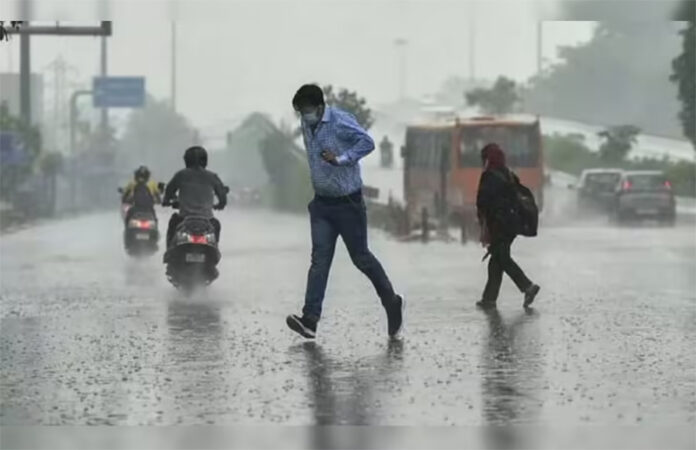
NEW DELHI, May 3 : Rainfall in several states in north India brought down temperatures by a few notches on Sunday, providing much-needed relief from scorching heat.
Delhi recorded a minimum temperature of 24.6 degrees Celsius and is likely to witness thunderstorms with rain, according to the India Meteorological Department (IMD).
The IMD on Saturday issued a ‘yellow’ alert for the national capital for the next two days, warning of rain, thunderstorms and gusty winds. The cloudy skies and intermittent rain are expected to persist till May 6.
The Safdarjung Observatory, which provides representative data for Delhi, recorded a minimum temperature of 24.6 degrees Celsius, a notch below normal.
Heavy rain and hailstorms accompanied by strong winds lashed several districts of Uttarakhand on Sunday morning, prompting the state administration to put all district authorities on high alert.
The sudden change in weather caused uprooted trees to block roads and disrupt power supply at various locations.
The IMD has forecast light to moderate rain and thunderstorms at most places across all districts for Monday and Tuesday. Snowfall is expected in regions situated at altitudes of 4,000 metres and above.
An ‘orange alert’ remains in place for Dehradun, Haridwar, Tehri, Pauri, Nainital, Champawat, and Udham Singh Nagar. These districts are likely to witness isolated heavy rain, hailstorms, and intense to very intense spells of rain accompanied by gusty winds reaching speeds of 40-50 kmph, the IMD said.
The weather office predicted that maximum temperatures across the state are likely to fall by 3-5 degrees Celsius over the next three to four days.
Rain, thunderstorms and gusty winds were reported across Uttar Pradesh over the past 24 hours, with several parts of central and eastern regions recording measurable precipitation, according to the IMD.
Isolated places in central Uttar Pradesh recorded up to 5 cm of rainfall, while eastern parts witnessed light to moderate showers and western regions reported light rainfall accompanied by thunder and lightning.
Day temperatures across the state remained below normal at all places on Sunday, with some areas recording a drop of 5 to 7 degrees Celsius below average. No heatwave conditions were reported anywhere in the state, and such conditions are unlikely to develop over the next week, the weather office said.
The Met department has issued a warning for thunderstorms accompanied by lightning and gusty winds with speeds of 40-50 kmph, gusting up to 60 kmph, at isolated places across the state.
In Sultanpur, one person died and another was injured after a tree fell on a flour mill due to a severe storm accompanied by rain in a village on Sunday morning, police said.
Rain also lashed Chandigarh and parts of Punjab and Haryana. In Chandigarh, people woke up to dark clouds blanketing the sky followed by strong winds, a dust storm and a sharp spell of rain. Power supply was also disrupted at a few places.
Rain was also reported from Mohali, Rupnagar and Ludhiana in Punjab. The minimum temperature dropped by a few notches, providing relief to the people from hot weather conditions.
Power supply was disrupted at a few places, while strong winds uprooted some trees and fell several branches.
Chandigarh Power Distribution Limited (CPDL) said, “Due to high wind speed (in the morning) and falling of power lines, the electricity supply in some of the areas has been affected for longer than expected. Our team is continuously working on the restoration of the supply.”
In Hoshiarpur, a local industrialist was injured when a sudden squall accompanied by rain in the early morning uprooted some electricity poles and trees in the Industrial Focal Point at Purhiran area, officials said.
Phagwara and its surrounding areas were lashed by a dust storm and downpour in the morning.
In Haryana, Panchkula, Ambala and Yamunanagar received rain.
In Rajasthan, several areas continued to reel under heat on Sunday.
Phalodi recorded the highest maximum temperature at 44.8 degrees Celsius, followed by Chittorgarh at 43.4 degrees Celsius. Sri Ganganagar and Jaisalmer recorded 42.8 degrees Celsius each, while Kota registered 42.3 degrees Celsius, according to the Met department.
Bikaner recorded a maximum of 42.2 degrees Celsius, followed by Ajmer 40.3 degrees Celsius and Churu 40.1 degrees Celsius. The state capital Jaipur recorded a maximum temperature of 38.3 degrees Celsius.
However, light to moderate rainfall accompanied by thunderstorms and dust storm was recorded at isolated places across the state in the last 24 hours.
Thunderstorms and rains also lashed in Himachal Pradesh’s capital Shimla, while hailstorms were reported in Dharamshala. Thunderstorm and lightning were also witnessed in Jubberhatti, Kangra, Sundernagar and Bhuntar.
Light to moderate rainfall was recorded in several parts of the state in the 24 hours since Saturday evening.
The MeT on Sunday issued an alert for thunderstorms accompanied by lightning and gusty winds at 40-50 kmph at isolated places in six districts of Himachal Pradesh. The alert has been issued for Kangra, Kullu, Mandi, Shimla, Solan and Sirmaur districts for May 4, and for Mandi and Shimla for May 5. (PTI)
Guide assaults tourists in Uttarakhand’s Pauri; police takes action
PAURI GARHWAL, May 3 : Uttarakhand Police rescued a 19-member Char Dham tourist group after they were allegedly harassed and physically assaulted by a travel guide near a food joint here, officials said on Sunday.
According to the police, the Delhi-based group booked a vehicle through the online agency “Your Tripmate” for the pilgrimage and paid an advance of Rs 1.14 lakh.
The guide allegedly assaulted the tourists during a stop at Jyoti Dhaba for dinner on Saturday night. One passenger suffered facial injuries while another had his clothes torn during the scuffle, a police officer said.
The tourists belonged to various states, including Madhya Pradesh, Karnataka, and Kolkata. Both the driver and the guide, Anmol, are Delhi residents, a police officer said.
Anurag Patel, a group member, contacted the police at 11 pm, complaining that the guide behaved rudely throughout the journey from Delhi.
A team of Pauri Police reached the spot immediately and moved the group to the Srinagar police station for safety.
The group included women and girls who were visibly shaken. One girl fainted at the station but recovered after receiving assistance from the police team, they said.
Police contacted the travel agency and coordinated a full refund of the Rs 1.14 lakh advance payment, the officer said, adding that the staff also offered food and lodging to the stranded group.
The tourists chose to continue their journey. Police ensured their safe departure for the onward journey, the officer said.
Authorities took action against the guide under the Police Act and sent him back to Delhi.
Pauri police advised tourists to verify the registration and terms of travel agencies before booking. They urged travellers to keep all payment documents safe to avoid fraud. (PTI)
MUTA condemns bomb threat, blasts at Manipur University

IMPHAL, May 3 : The Manipur University Teachers’ Association (MUTA) on Sunday strongly condemned the recent bomb threat and twin bomb blasts reported inside the Manipur University campus, terming the incidents a serious threat to academic life and institutional safety.
In a press release issued today following an emergency general body meeting held on May 1, MUTA expressed grave concern over the climate of fear created by the incidents, stating that such acts endanger the lives of students, teachers and staff while disrupting the academic environment.
Highlighting that around 10,000 students from across the country and abroad are enrolled in the university, many of whom reside in hostels and staff quarters, the association said the incidents could severely affect academic careers and damage the reputation of the institution. It also noted that the prevailing situation has led to an increasing number of students and employees from outside the state leaving in search of safer opportunities.
Describing educational institutions as sanctuaries of learning, MUTA stressed that campuses must remain free from violence, intimidation and any acts capable of spreading panic or terror.
The association urged the authorities to conduct a prompt, impartial and comprehensive investigation into the bomb threat and explosions and to take appropriate legal action against those responsible. It also called for strengthening campus security through deployment of trained personnel, installation of modern surveillance systems and establishment of effective emergency response
mechanisms.
Further, MUTA demanded that accountability be fixed for any lapses in campus security, if established upon inquiry. It also appealed to the authorities to review any reported declaration of the university as a “Red Zone” and withdraw such measures at the earliest to ensure normal academic functioning.
The association additionally urged the university authorities to issue a clear and transparent clarification regarding allegations linked to recent recruitment processes, in order to prevent misinformation and safeguard institutional credibility.
Reiterating its commitment to a corruption-free academic environment, MUTA called on concerned parties to address grievances through established legal and institutional mechanisms without disturbing the peaceful functioning of the university.
Appealing to all stakeholders, MUTA urged restraint from actions or statements that could create panic and called for collective efforts to restore peace and a conducive academic atmosphere on campus.
The association reaffirmed its commitment to academic integrity, transparency and the rule of law, while expressing solidarity with the university community in ensuring safety and uninterrupted functioning of the institution.
(UNI)
Unregulated Rural Construction
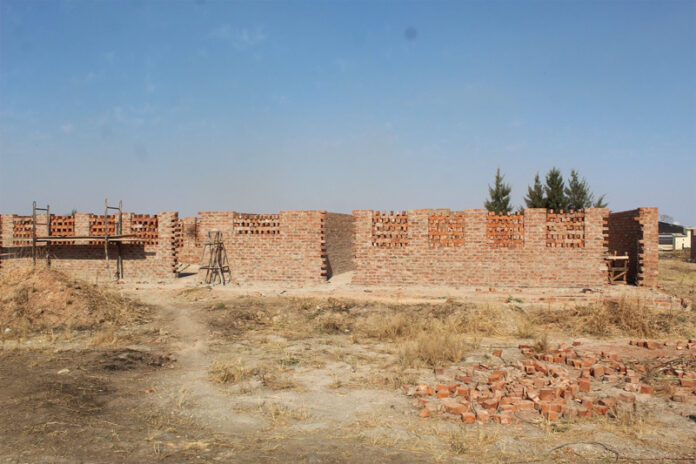
Rules framed last year to bring order to construction activity in rural Jammu & Kashmir went largely unnoticed – until the High Court took a hard look and found them wanting in critical ways. In a pointed judgement, the Division Bench has done what the administration singularly failed to do: ask the hard questions. What use is a set of rules when the institution tasked with enforcing them possesses neither the manpower, the infrastructure, nor the statutory authority to do so? The court’s observations ought to serve as an urgent wake-up call to the Government. The common notion that J&K’s villages are idyllic, slow-moving settlements where construction is self-regulated by generations of custom and tradition is, frankly, obsolete. The ground reality could scarcely be more different. Srinagar and Jammu – already bursting at their administrative seams – are expanding outward with a ferocity that no master plan has adequately anticipated. The cities are full; the peripheries are the new frontier. Villages that once lay at a comfortable distance from the urban sprawl now find themselves swallowed whole, transformed almost overnight into colonies of multi-storeyed structures, commercial establishments, and housing developments. The same story, with local variations, repeats itself across every town of consequence in the Union Territory.
Into this dynamic, the Halqa Panchayats have been thrust-theoretically empowered, practically helpless. The High Court has been unambiguous in its assessment of this contradiction. Halqa Panchayats are not authorised under the existing Panchayati Raj Act to frame building bye-laws for individual constructions, nor are they equipped to prepare zonal or development plans. They have no enforcement machinery, no technical cadre of engineers or planners, and no mechanism to compel compliance. They can, at best, earmark broad zones – residential here, commercial there – but they possess no legal instrument to stop a builder from flouting every norm within those zones. The result, as one sees in village after expanding village, is a free-for-all: construction that proceeds according to individual convenience, with little regard for shared infrastructure, future sewage requirements, road widths, or basic civic amenity.
Compounding this vacuum is the problem of legislative overlap. The Development Act, the J&K Municipal Act 2000, the Municipal Corporation Act 2000, and the Panchayati Raj Act 1989 all occupy the same regulatory space in different, often contradictory ways. The court has rightly pointed out that Section 54 of the Development Act requires fresh amendment to exclude the applicability of inconsistent provisions in overlapping legislation. Where three or four laws claim jurisdiction, the practical outcome on the ground is that none is followed with any rigour. Worse, the ambiguity is actively exploited by builders who play one authority against another and by vested interests that understand that legal grey zones are highly profitable. Litigation, predictably, proliferates. Courts become the de facto planning authority by default, which is precisely where they should not have to be.
The solution the High Court has gestured towards is not complex in principle. The Panchayati Raj Act must be revisited and strengthened with provisions analogous to those in the Municipal Corporation Act-granting Halqa Panchayats genuine regulatory authority over construction within their jurisdictions, backed by qualified personnel and enforcement mechanisms. Simultaneously, Section 54 of the Development Act must be amended to draw clear, unambiguous lines of authority between municipal bodies and panchayats, eliminating overlapping provisions that currently create confusion and invite abuse. A single, clear chain of command – with technical capacity at the panchayat level – is not a luxury; it is the minimum condition for any meaningful enforcement.
Every month of inaction is a month of irreversible construction. Concrete, once done, does not yield easily to belated regulation. The villages encircling J&K’s cities are being shaped right now – their street widths determined, their drainage futures decided, their density locked in – by the absence of the very authority the law was meant to provide. If the Government does not act swiftly on the High Court’s counsel, it will be bequeathing to the next generation not thriving rural communities but a sprawling archipelago of unplanned, underserved, and ungovernable concrete. The choice, as always, is between the inconvenience of governance today and the catastrophe of ungoverned growth tomorrow.
Pak targets J&K youth with drugs, its designs will be foiled: LG
‘Narco-terror big challenge for internal security’
Fayaz Bukhari
SRINAGAR, May 3: Without naming Pakistan, Lieutenant Governor Manoj Sinha today said that the neighbouring country has targeted youth of Jammu and Kashmir with drugs and asserted that designs of the “dangerous enemy” will be foiled.
Follow the Daily Excelsior channel on WhatsApp
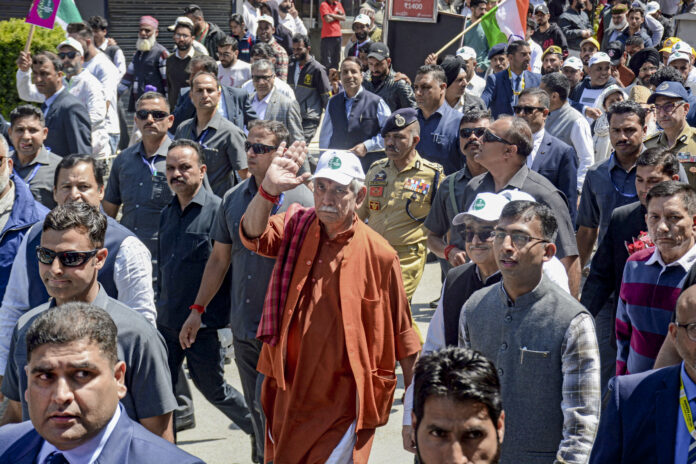
Addressing the participants of the ‘Padhyatra’ for Nasha Mukt Jammu and Kashmir at Football Stadium Tourist Reception Centre here, Sinha said the “inimical neighbour” has targeted J&K’s youth by filling the streets here with drugs. “Government and security forces will foil the designs of the dangerous enemy,” he asserted.
Click here to watch video
The LG said that the nexus between narcotic dealers and terrorists had become a challenge for the country’s internal security.
“Narco terrorists have targeted our most valuable asset, our youth. They flooded our streets with drugs. We are facing a dangerous enemy, our neighbour which gave birth to terrorism in the world,” he added.
Sinha described drug trafficking as “silent terrorism” and vowed that peddlers will be treated as “enemies of the nation” with no mercy under the law.
“This is not just a crime. This is terrorism – silent terrorism. It is poisoning lives, weakening families, and bleeding J&K dry,” he said.
“Terrorists and drug dealers share the common goal of disrupting the country’s peace, unity, and security. The proceeds of drug trade are used to fuel terrorism. The time to remain silent is over,” he added.
The LG issued a stern warning to narco-terror networks stating that drug syndicates, and anti-national elements time on Jammu Kashmir’s soil is over.
“Financial transactions of drug syndicates are being tracked. Each link of the network is being broken,” he said.
“Our agencies, our administration, and our people stand united to dismantle every smuggling ring and peddler operation. We are tracking the financial trails of drug cartels. Every link will be broken, every mechanism destroyed. I pledge to the people that every trafficker will be exposed, every criminal will face justice, and anyone, inside or outside Jammu Kashmir, who has aided the drug network will be held accountable under the full force of law,” he said.
Sinha said while the government, security forces and police are doing their job, the strongest weapon in the war on drugs is the people’s cooperation.
The anti-drug campaign, he said, has turned into a “Jan Andolan” in just 22 days. “This war is being fought in every home, every mohalla, every lane – because drugs are draining the life force of our youth. It is cry of every mother who has seen her child consumed by addiction, and solemn commitment of every father who has watched dreams collapse under weight of drug abuse,” he said.
The LG said 481 FIRs have been registered, 518 drug smugglers arrested, and 24 narco-properties attached – including in Kashmir districts. Nearly 300 driving licences suspended, five passports cancelled, 325 vehicles seized, and over 3,000 drug stores inspected.
Sinha warned that police stations will maintain photo galleries of peddlers and lookout notices will be issued against absconders. “Where there is guilt, there will be no mercy. Drug smugglers will be treated like enemies of the country,” he added
The LG called upon religious leaders, teachers, women and youth groups to act as the administration’s “eyes and ears”. “Prepare lists of drug traffickers. The time for silence is over,” he said, noting that over 70,000 people have already joined the movement.
Taking drugs is not “cool”, he added, stressing that addicts are victims who need treatment – but peddlers will face the strictest law. “The days of those trying to destroy Jammu and Kashmir are over. We have taken a pledge to make J&K drug-free – and we will achieve it.”
“Together, let us envision a Jammu Kashmir where no child is lost to drugs, no family is broken by addiction, no community suffers under traffickers, and every citizen thrives in health and strength,” he said.
“This is the vision we pursue, the dream we must fulfil, and the legacy we owe future generations. It is about Jammu Kashmir’s destiny, the society we aspire to build, the values we uphold, and the lives we safeguard. Today, let us pledge that we will not rest until Jammu Kashmir is completely drug-free,” the LG said.
Speaker of Jammu and Kashmir Legislative Assembly Abdul Rahim Rather, Minister Javed Ahmad Dar, several MLAs, sportspersons and religious leaders were among thousands of people who participated in the function held at the football stadium at Tourist Reception Centre here.
Heavy-lift logistic drones, AI-based surveillance systems to be on display

Rajnath to inaugurate North Tech Symposium today
Union Ministers, UP CM, 284 companies to participate
Sanjeev Pargal
JAMMU, May 3: The Northern and Central Commands of the Indian Army and the Society of Indian Defence Manufacturers (SIDM) will jointly host three-day North Tech Symposium at Prayagraj in Uttar Pradesh beginning tomorrow.
As many as 284 companies are participating in North Tech Symposium and will display their latest and modernized weaponry, official sources told the Excelsior.
Follow the Daily Excelsior channel on WhatsApp
Defence Minister Rajnath Singh will inaugurate the Symposium tomorrow morning with the theme ‘Raksha Triveni Sangam – Where Technology, Industry & Soldiering Converge’, in Prayagraj, Uttar Pradesh, in the presence of Army chief Gen Upendra Dwivedi.
Rajnath will address the symposium and witness the latest weaponry displayed by the companies.
On May 5, Union Minister of State for Defence Sanjay Seth will attend the symposium in first half while Union Minister of State in the Prime Minister’s Office and Incharge Science and Technology (PMO) Dr Jitendra Singh will join during second half. Uttar Pradesh Chief Minister Yogi Adityanath will attend the tech symposium on last day i.e. May 6.
The three-day event is being jointly organised by the Northern Command, headquartered at Udhampur in Jammu division, Central Command and the SIDM.
“This symposium will serve as a vibrant platform to showcase and integrate state-of-the-art indigenous technologies to overcome operational challenges. The exhibition will feature an array of participants including MSMEs, private Defence Tech firms, start-ups and innovators in uniform from across the country. As many as 284 companies are setting-up stalls showcasing their latest innovations and technologies,” the officials said.
They added that the event aims to identify technologies suited for field deployment; maintenance processes and streamline procurement to promote a sustainable and self-reliant defence ecosystem for the Indian Army.
“The Indian Army has been highlighting the operational relevance of cutting-edge technologies and the need for continuous innovation to address the evolving security challenges. The North Tech Symposium is expected to serve as a bridge between defence forces, scientists, industry leaders and the academic community, fostering collaboration aimed at strengthening national security & technological excellence,” the officials said.
Major highlight of the event will be focus on future of defence mobility. Live demonstrations will showcase cutting-edge technologies designed to enhance troop safety and operational efficiency, even in extreme geographical conditions.
These include AI-based surveillance systems and heavy-lift logistics drones capable of supporting military operations in remote and difficult areas, the officials said, adding the symposium will also feature indigenous artillery systems and new prototypes developed to reduce dependence on foreign defence equipment, in line with the Government of India’s push for self-reliance.
Meanwhile, Northern Command chief Lt Gen Pratik Sharma today conducted a comprehensive final review of the ongoing preparations for the North Tech Symposium. He interacted with key stakeholders, organizers, and participating agencies to assess the level of readiness and coordination for the mega event and was briefed on various aspects of planning, logistics, technological exhibits, and security arrangements to ensure the smooth conduct of the symposium.
The Army Commander expressed satisfaction over the meticulous planning and emphasized the importance of seamless coordination among all stakeholders to make the event a grand success. He highlighted that the symposium will serve as a significant platform for showcasing cutting-edge defence technologies and fostering collaboration among the armed forces, industry, and academia.
The North Tech Symposium 2026 symbolizes the convergence of innovation, collaboration, and technological advancement in the defence sector.
The event is expected to witness participation from senior military officials, defence experts, industry leaders, and academic institutions from across the country, further strengthening India’s vision of self-reliance in defence and technological excellence.
Govt panel seeks road safety audit from all agencies by month end

NHAI, NHIDCL, BRO, PMGSY, R&B to flag black spots, suggest fixes
AI-based monitoring, ITMS expansion in pipeline
Mohinder Verma
JAMMU, May 3: As there is no let-up in tragic road accidents, a high-level committee constituted for monitoring and implementation of the Road Safety Policy in the Union Territory has directed key infrastructure agencies—National Highways Authority of India (NHAI), National Highways and Infrastructure Development Corporation Limited (NHIDCL), Border Roads Organisation (BRO), Pradhan Mantri Gram Sadak Yojana (PMGSY wing) and the Roads and Buildings Department to submit comprehensive road safety audit reports for all stretches under their jurisdiction by the end of the current month.
Follow the Daily Excelsior channel on WhatsApp
The directions were issued by the committee comprising the Administrative Secretary, Public Works Department; Administrative Secretary, Transport Department; Inspector General of Police (Traffic), J&K and the Transport Commissioner, during a recent meeting held to deliberate on the progress made by the concerned departments and agencies in achieving the objectives of the Road Safety Policy, official sources told EXCELSIOR.
“The audits will focus on identifying vulnerable spots, accident-prone zones and lapses in existing infrastructure. Moreover, these agencies will analyse whether the existing traffic management measures, signage, road markings and other interventions are sufficient to check road accidents”, sources said, adding, “after this detailed exercise, the agencies will recommend corrective measures to the committee, which will subsequently issue necessary directions for implementation on a war-footing basis”.
Stating that the move is part of a coordinated strategy to reduce fatalities and enhance road safety standards across highways and rural road networks, sources said, “in parallel, all Deputy Commissioners, who head the District Road Safety Committees (DRSCs), have been instructed to conduct on-spot inspections of locations where major accidents have occurred in the past within their respective districts and assess areas where road safety management and emergency response need improvement”.
The Deputy Commissioners have further been asked to ensure immediate initiation of remedial measures, including improved signage, road engineering corrections and installation of crash barriers wherever required by utilising funds available under different resources.
“The committee, which is supervising the implementation of the Road Safety Policy, is of the opinion that fragmented efforts will not suffice and has called for seamless coordination among departments”, sources said, adding, “installation of crash barriers at critical stretches, better road marking and stricter enforcement have been identified as urgent priorities”.
Addressing the issue of negligent driving, the committee, as per sources, has outlined a two-pronged approach. Advanced driver training programmes through Institutes of Driving Training and Research (IDTRs) are likely to commence by June this year, focusing on technology-driven and camera-monitored modules. Simultaneously, enforcement measures have been intensified, including large-scale campaigns for suspension of Driving Licences (DLs) and Registration Certificates (RCs) in cases of serious violations.
Regarding the Intelligent Traffic Management System (ITMS), currently being implemented under the Smart City initiative in both capital cities, the committee has stressed the need to expand its coverage and upgrade the system. “An exercise has also been set into motion to plan expansion of ITMS to major towns of the Union Territory, where vehicular traffic has increased over the years and the need for intelligent management is being felt,” sources informed.
“Moreover, proposals are being drafted for deploying Artificial Intelligence-based surveillance and automated enforcement mechanisms on National Highways to ensure human-less monitoring. However, preparation of a concrete action plan will take some time”, sources said, adding that the high-level committee favours data-driven traffic regulation and real-time intervention systems.
“A sustained, technology-backed and enforcement-driven approach, combined with infrastructure upgrades, will be key to significantly reducing road accidents in Jammu and Kashmir,” sources said. However, they stressed that all planned measures must be implemented in a time-bound manner, given the frequent occurrence of tragic road accidents across the Union Territory claiming innocent lives.