Friday, June 5, 2026
E-Paper
Home Blog

Environmental Neglect and the Decline of Civic Responsibility

A Reflection on Environmental Responsibility and Sustainable Communities

Divya Sharma
biotech.divyakhajuria@gmail.com

Earth is my mother and I am her child.
As the world prepares to observe World Environment Day, humanity is once again reminded of a truth that is both simple and profound: Earth is not merely a physical space where life exists—it is our only home. It is the silent foundation of our survival, the source of every breath we take, every drop of water we drink, and every form of life that sustains our existence.
Yet despite depending entirely upon nature, modern society has increasingly distanced itself from it. In the race for urbanization, industrial growth, convenience, and consumption, we have forgotten that human progress can never exist separately from environmental well-being. The environmental crisis we witness today is not the result of a single event—it is the cumulative outcome of years of negligence, unsustainable practices, and weakening civic responsibility.
There was once a time when nature was deeply woven into everyday human life. Childhood meant running barefoot on soft green grass, climbing trees without fear, sitting beneath open skies, and playing near rivers untouched by pollution. The air felt cleaner, surroundings appeared healthier, and public spaces reflected a stronger sense of collective care. Nature was not viewed as a separate entity to be exploited; it was respected as a companion and protector of life itself.
Today, however, those memories stand in sharp contrast to the reality surrounding us.
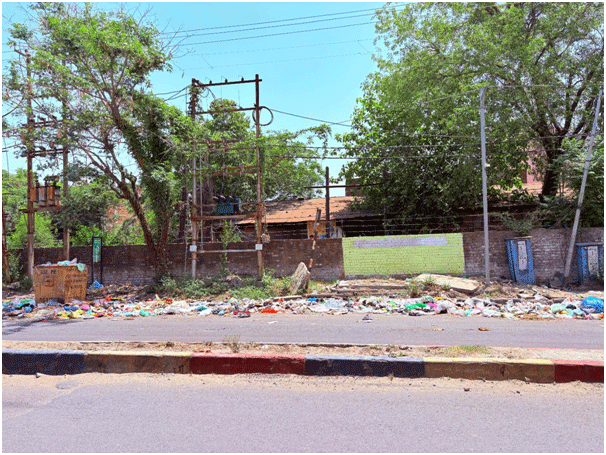
The image from Ward No. 1, Jawahar Nagar, Kathua, showing unchecked garbage accumulation along the roadside, is not merely an unpleasant visual—it is a disturbing reflection of a much deeper societal problem. At first glance, it may appear to be a simple sanitation issue or an instance of inefficient waste management. But in reality, it symbolizes the gradual decline of civic consciousness and the normalization of environmental neglect within our communities.
The waste scattered outside residential areas does not emerge overnight. It accumulates slowly through repeated acts of carelessness—plastic wrappers thrown casually onto roads, household garbage dumped in open spaces, and a collective tendency to assume that cleanliness is solely the responsibility of municipal authorities. Over time, these seemingly “small” actions create serious environmental and public health consequences.
What we often dismiss as “just garbage” becomes a source of pollution, disease, and ecological damage. Open waste attracts stray animals, creates breeding grounds for flies and mosquitoes, contaminates soil and water sources, and produces foul odours that affect the quality of life of nearby residents. During rainfall, this waste blocks drainage systems, resulting in waterlogging and unhygienic conditions that can quickly escalate into larger public health crises.
However, perhaps the most alarming aspect is not the existence of garbage itself, but our growing acceptance of it.
Repeated exposure to polluted surroundings gradually desensitizes society. Streets filled with waste become ordinary sights rather than matters of concern. Public spaces lose their value, and environmental degradation slowly becomes normalized. When people stop questioning polluted surroundings, society enters a dangerous state of indifference where negligence replaces accountability.
This raises deeply important questions:
• Why does civic responsibility often end at the boundaries of our homes?
• Why are public spaces treated as somebody else’s responsibility?
• Why do we continue blaming systems while ignoring our own daily behaviour?
• And most importantly, what kind of environment are we leaving behind for future generations?
The truth is uncomfortable but unavoidable: environmental destruction is not caused only by industries, governments, or large-scale systems. It is also shaped by everyday human behaviour. Every act of littering, every unnecessary use of plastic, every tree cut without replacement, and every instance of environmental ignorance contributes to a crisis that eventually affects everyone equally.
The environmental challenges faced globally today—including climate change, pollution, deforestation, biodiversity loss, rising temperatures, shrinking water resources, and extreme weather events—are all interconnected consequences of human actions.
In ecologically sensitive regions like Jammu & Kashmir, these impacts are becoming increasingly visible. Irregular rainfall patterns, landslides, rising temperatures, changing seasons, and environmental instability clearly indicate how fragile our ecosystem has become. Nature continuously sends warnings, yet human society often responds only after disasters occur.
One of the greatest environmental threats today is plastic pollution. Single-use plastics have entered every corner of human life—from streets and drains to rivers, oceans, and even food chains. Plastic waste not only pollutes ecosystems but also harms animals, destroys soil fertility, and remains in the environment for hundreds of years. Similarly, uncontrolled urbanization and deforestation are reducing green spaces and weakening nature’s ability to restore ecological balance.
Despite these alarming realities, hope still exists.
Across the world, growing environmental awareness among students, educators, youth groups, and local communities demonstrates that positive change is still possible. Educational institutions can play a transformative role by nurturing environmentally conscious citizens through eco-clubs, plantation drives, awareness campaigns, waste management education, and sustainable practices.
Environmental education must move beyond textbooks and become part of everyday behaviour. Cleanliness should not be limited to symbolic campaigns conducted once a year; it should become a social habit rooted in responsibility and respect for shared spaces.
True environmental change begins with simple but consistent actions:
• Avoiding littering in public places
• Segregating household waste responsibly
• Reducing plastic consumption
• Conserving water and electricity
• Planting and protecting trees
• Participating in community cleanliness initiatives
• Encouraging environmental awareness among children and families
Individually, these actions may appear small. Collectively, however, they possess the power to transform communities and protect ecosystems.
A truly developed society is not measured solely by modern buildings, roads, or technological advancement. Real development is reflected in the behaviour of its citizens—their respect for public spaces, their awareness towards environmental protection, and their willingness to act responsibly even when nobody is watching.
The image from Kathua should therefore not be viewed as just another instance of urban waste. It should serve as a mirror for society—a reminder that environmental degradation often begins with ordinary negligence and silent acceptance.
It should compel every reader to pause and reflect:
Am I contributing to this problem in any way?
Because the environmental crisis of today is not created by one major act alone. It is the outcome of countless small acts of irresponsibility repeated over time until they become normalized within society.
A truly developed society is not measured solely through infrastructure, technology, or urban growth. Real development is reflected in the awareness, civic sense, and responsibility of its people towards the environment they share.
The Earth does not need temporary speeches or symbolic campaigns—it needs genuine awareness, responsible action, and collective accountability. The garbage lying outside residential areas is not merely waste on the roadside; it is a reminder of what happens when society ignores its environmental responsibilities.
If we continue neglecting nature today, future generations will inherit not a healthy planet, but a polluted and weakened world struggling to sustain life. Therefore, environmental protection can no longer remain optional—it has become a necessity and a shared responsibility of every citizen.
Because when nature suffers, humanity cannot remain untouched.
And when Earth is gone, there will be no second home left for us to return to.
LG Manoj Sinha Attends Rang-E-Kashmir Cultural Festival

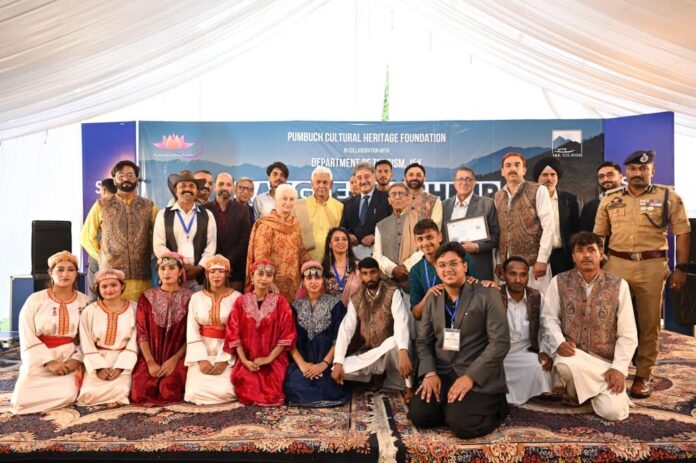
SRINAGAR, Jun 4: The Lieutenant Governor, Manoj Sinha today attended the ‘Rang-e-Kashmir Cultural Festival’ in Srinagar today. This week-long event showcases J&K’s priceless handlooms and handicrafts and draws both art lovers and buyers. Speaking on the occasion, the Lieutenant Governor said that Jammu Kashmir is a living canvas, painted with centuries of wisdom, innovation, artistry, and craft.
“A nation’s true strength lies not only in its wealth or might, but also in richness of its spirit, depth of its traditions and the vitality of its culture. India is a land where knowledge blossomed, traditions endured, and culture remained the soul that bound its people together,” the Lieutenant Governor said.
The Lieutenant Governor applauded the efforts of Pumbuch Cultural Heritage Foundation and its Director Mrs. Superna Sapru, for conserving, nurturing, and reviving Jammu Kashmir’s abundant cultural heritage. He said the mission of foundation, injects new energy into traditions so the voices of our artisans, craftsmen, and traditional artists will continue to resonate for generations to come.
Culture is not the static artifact of history but in fact it is a living force that shapes our present and guides our future. Jammu Kashmir is home to exceptional artisans who can turn an ordinary piece of wood into something timeless. There are hundreds of esteemed craftspeople who weave thousands of years of cultural stories into fabric. There are papier-mache artisans who carve the very soul of Jammu Kashmir into each piece,” the Lieutenant Governor said.
The Lieutenant Governor stated that there are renowned musicians in Jammu Kashmir who are carrying the region’s melodic traditions.
“These musicians are guardians of our identity, keepers of our memories, and the makers of our tradition’s continuity. This event is a vibrant classroom where tradition and innovation converge, where the old inspires the new, and where people come together to celebrate the diversity that defines us. I believe one of our foremost responsibilities is to connect Jammu Kashmir’s youth with handloom, handicraft, and the arts. The future of our culture rests in youth’s hands and they must be made aware of the invaluable heritage,” the Lieutenant Governor said.
The Lieutenant Governor felicitated various renowned artists for their significant contribution at the event organised by Pumbuch Cultural Heritage Foundation in collaboration with Department of Tourism J&K.
Vikramjit Singh, Commissioner Secretary Industries & Commerce; Superna Sapru, Director, Pumbuch Cultural Heritage Foundation; Akshay Labroo, Deputy Commissioner Srinagar; Masrat-ul-Islam, Director Handicrafts and Handloom, Kashmir; senior officials of police and civil administration, members of Pumbuch Cultural Heritage Foundation and prominent artists and artisans were present.

J&K PDD Secures National Recognition Under Pm Surya Ghar: Muft Bijli Yojana

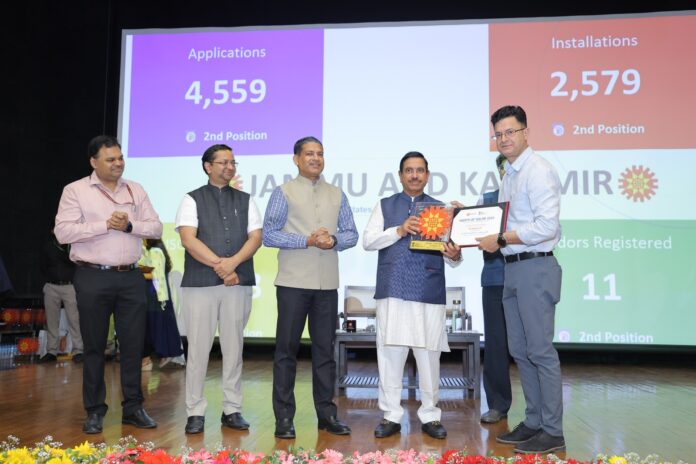
SRINAGAR, Jun 4 : Jammu & Kashmir Power Development Department (PDD) has achieved a significant milestone in the implementation of the PM Surya Ghar: Muft Bijli Yojana, securing 2nd position (First Runner-Up) in the country for the month of May 2026 for RTS Applications, Installations and Inspections.
The award was conferred by the Ministry of New and Renewable Energy (MNRE), Government of India, during the national event “2 years of PM Surya Ghar: Muft Bijli Yojana” held at New Delhi.
The award, on behalf of the Union Territory of Jammu & Kashmir was received by Mahmood Ahmad Shah, Managing Director, Kashmir Power Distribution Corporation Limited. The prestigious recognition reflects the collective efforts of the J&K Power Development Department, DISCOMs (KPDCL & JPDCL), field functionaries, district administrations, empanelled vendors and consumers in advancing the objectives of PM Surya Ghar: Muft Bijli Yojana across the Union Territory.
The Government of India’s flagship PM Surya Ghar: Muft Bijli Yojana aims to provide rooftop solar systems to one crore households across the country within a three-year implementation period from April 2024 to March 2027. At the national level, the scheme has achieved remarkable progress with 33,57,505 rooftop solar installations completed so far. In the Union Territory of Jammu & Kashmir, although the scheme gained momentum slightly later, with on-ground implementation commencing in July 2024, rooftop solar adoption has witnessed a consistent upward trajectory since its launch. The growing public response reflects increasing awareness of renewable energy benefits and the attractiveness of the financial incentives available under the scheme.
As of date, a total of 98,601 applications have been registered on the National Portal from J&K, comprising 29,402 applications under Jammu Power Distribution Corporation Limited (JPDCL) and 69,184 applications under Kashmir Power Distribution Corporation Limited (KPDCL). Against these registrations, 33,987 rooftop solar installations have been successfully commissioned, including 12,730 installations in the Jammu region and 21,255 installations in the Kashmir region. The increasing deployment of rooftop solar systems has resulted in the addition of 121.61 MW of renewable energy generation capacity across the Union Territory, with 44.68 MW contributed by JPDCL and 76.92 MW by KPDCL. This significant capacity addition is expected to contribute substantially towards reducing dependence on conventional power sources while promoting sustainable energy generation at the consumer level.
A cumulative central subsidy (CFA) amount of ₹258.18 crore has been disbursed directly to beneficiaries across J&K and additional ₹10 Crore UT subsidy has been given as well.
A key feature of PM Surya Ghar Yojana is the availability of affordable bank financing, with loan facilities offered at interest rates as low as 6 percent. In Jammu & Kashmir, J&K Bank has emerged as the principal financing institution supporting the scheme. A total of 45,321 loan applications have been received under the scheme, out of which 27,075 applications have already been sanctioned/disbursed. The support extended by financial institutions has been instrumental in the successful implementation of the programme, with more than 80 percent of rooftop solar installations in the Union Territory being financed through low-interest loan facilities.
Simultaneously, vendor participation under the scheme has expanded considerably. Out of approximately 900 vendors registered nationally on the PM Surya Ghar portal, Jammu & Kashmir presently has over 300 active State-level empanelled vendors. These vendors compete alongside national-level service providers, ensuring competitive pricing, improved service delivery and quality installations. The growing vendor ecosystem has also generated significant employment and entrepreneurship opportunities within the renewable energy sector across the UT
The progress achieved during the month of May 2026 has been particularly encouraging with 4,559 new applications registered on national portal, 2,579 rooftop solar installations completed and 2,688 DISCOM inspections subsequently carried out to facilitate timely processing of subsidy claims and subsidy disbursal to beneficiaries.
The rooftop solar programme in Jammu & Kashmir has witnessed remarkable growth over the past year. Compared to May 2025, the Union Territory recorded an impressive 77% increase in rooftop solar installations, reflecting the growing confidence of consumers and adoption of green energy under PM Suryaghar Muft Bijli Yojana.
Expressing gratitude on the occasion, the J&K Power Development Department conveyed its heartfelt appreciation to the Ministry of New and Renewable Energy for recognizing the achievements of the Union Territory. The Department reaffirmed its commitment towards the successful implementation of PM Surya Ghar: Muft Bijli Yojana and towards achieving the larger national objective of promoting clean, affordable and sustainable energy.

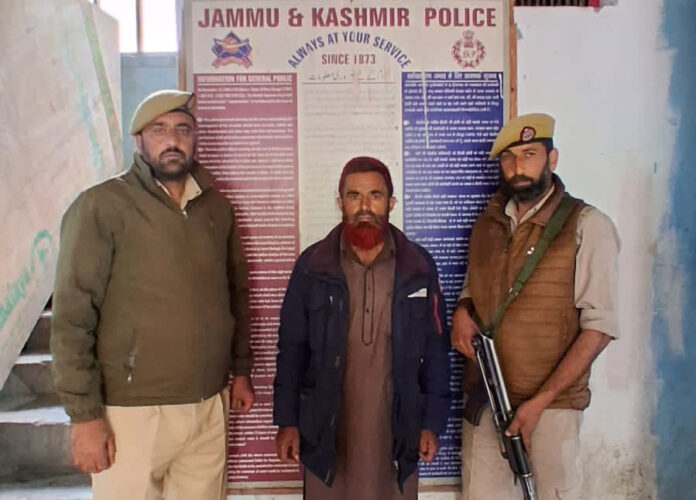
Fake Amarnath Yatra Facilitation Racket Busted In Ganderbal; Fraudster Arrested

GANDERBAL, Jun 4: In a major crackdown ahead of the annual Shri Amarnath Ji Yatra, Ganderbal Police have foiled an alleged fraud racket and arrested a man accused of impersonating a government employee to deceive vendors and service providers associated with the pilgrimage.
According to police, Police Station Sonamarg received credible information on May 27 that a person identified as Mohd Ayob Jara, son of Abdul Rehman Jara and a resident of Androola, Poonch, was operating in the Domail area while falsely claiming to be a government official deployed along the Domail axis of the Amarnath Cave route.
Investigations revealed that the accused allegedly approached visiting vendors and service providers, offering to facilitate their pilgrimage-related arrangements and access in return for money. Police said he used his false identity to gain the confidence of prospective victims and extract financial benefits.
Acting swiftly on the information, Police Station Sonamarg registered an FIR under relevant provisions of the Bharatiya Nyaya Sanhita (BNS) and launched an investigation into the matter.
The accused was apprehended on the evening of June 3, 2026, police said, adding that further investigation is underway to ascertain the extent of the fraud and identify any possible associates or victims linked to the case.
Police have urged the public, particularly vendors and service providers connected with the Shri Amarnath Ji Yatra, to remain vigilant and verify the credentials of individuals claiming to represent government agencies before engaging in any financial transactions.

J&K Govt Constitutes UT-Level Panels For Urban Challenge Fund Scheme

JAMMU, Jun 4: The Jammu and Kashmir Government has constituted a UT-Level High Powered Steering Committee (UTHPSC) and a UT-Level Technical Committee (UTLTC) for implementation, monitoring and review of the Urban Challenge Fund (UCF) Scheme across the Union Territory.

See Order Copy Click Here……

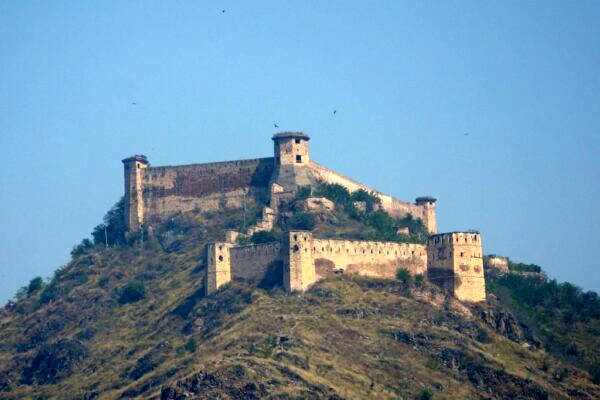
Panel Framed For Inspection Of Hari Parbat Light And Sound Show Project

SRINAGAR, June 4: The Jammu and Kashmir Government has constituted a Technical Committee to carry out a Third Party Inspection (TPI) of the Light and Sound Show System installed inside Hari Parbat Fort, Srinagar.

See Order Copy Click Here……

Aamir Khan Confirms Marriage To Gauri Spratt, Couple Set To Tie The Knot On July 5

FILE PHOTO- Aamir Khan

MUMBAI, Jun 3: Superstar Aamir Khan has confirmed that he will tie the knot with partner Gauri Spratt on July 5.
Several reports on Wednesday claimed that Aamir and Spratt are planning an intimate wedding next month. However, the actor hadn’t responded to the speculation.
On Thursday, Aamir confirmed the news. (Agencies)

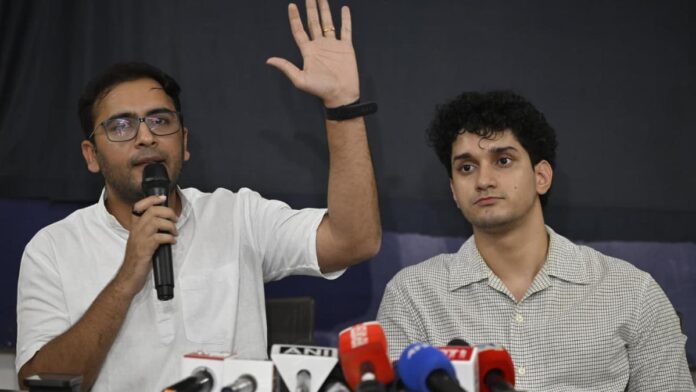
CJP Attacks Govt On JEE Data Exposure, Calls For Pradhan’s Sacking

NEW DELHI, Jun 4: The Cockroach Janata Party (CJP) on Thursday said the reported exposure of JEE (Advanced) 2026 candidate data due to a cloud storage configuration issue in the results portal showed how “incompetent” people were running the country’s education system and digital infrastructure.
The leaders of the campaign, which began on social media and went on to take a life of its own, also appealed to Prime Minister Narendra Modi to immediately sack Union Education Minister Dharmendra Pradhan, saying he had failed to ensure accountability in the education sector.
Addressing a press conference here, CJP leaders said the incident had raised fresh concerns about the security of student data and the government’s handling of examination systems.
CJP spokesperson Ashutosh Ranka, an alumnus of IIT Kanpur and the London School of Economics who was appointed the campaign’s spokesperson on Wednesday, said the exposure of candidate information reflected the poor state of cybersecurity safeguards.
“Names, phone numbers and images of nearly two lakh students got exposed. In a country that has produced techies leading top technology companies across the world, the education minister and the government are so incompetent that they are unable to run basic systems securely,” Ranka said.
“The education minister is totally incompetent. He has run the education system into the ground. We appeal to the Prime Minister to sack Dharmendra Pradhan immediately. This is about the future of our students and a lot is at stake,” he added.
He also said public institutions required individuals with scientific temper and technical competence.
Questioning the response of IIT Roorkee, which conducted the exam this year as its nodal body, Ranka said the institute’s assertion that the exposed data was in a “read-only” format did not diminish the seriousness of the issue.
“IIT Roorkee said the data was read-only. Is this a joke? You are saying it could be read but not edited. One basic IIT portal cannot be run securely. Sixteen, 17 and 18-year-olds are discovering vulnerabilities and alerting CERT. This shows the level of competence of the people running the system,” he said.
On Tuesday, IIT Roorkee acknowledged a cloud storage configuration issue linked to the JEE (Advanced) 2026 results portal after a teenage cybersecurity researcher reported that candidate records and admit-card documents were accessible without authentication.
The institute said corrective action was being taken on priority and maintained that the exposed data was in read-only mode, ruling out any possibility of alteration of records. Ranka demanded that the government disclose details of all data exposure incidents and cybersecurity lapses under its watch.
“We want to know where this country’s data has landed and who all have access to it. Details of all such breaches, especially those that could impact national security, should be made public,” he said.
Ranka sought to dispel speculation that the CJP’s proposed June 6 agitation could turn violent and reiterated its commitment to peaceful protest. “Rumours are being spread about violence. The Cockroach Janata Party calls for peaceful and democratic protests in line with law and order. We urge people to shun violence,” he said.
The press conference came a day after the outfit held its first media interaction at the Constitution Club of India, where it said it was open to dialogue with both the government and the Opposition over its demands while continuing to seek Pradhan’s resignation.
CJP founder Abhijeet Dipke, who is pursuing higher education in the United States, is expected to arrive in Delhi on June 6 and seek permission for a protest at Jantar Mantar. The party has said climate activist Sonam Wangchuk will also join the proposed demonstration
The CJP traces its origins to a controversy sparked by remarks made by Chief Justice of India Surya Kant last month, when he referred to certain individuals as “cockroaches” and “parasites” during a court hearing.
The remarks triggered a backlash on social media, with CJP founder Dipke and his supporters appropriating the term “cockroach” as a political symbol and launching what began as an online youth movement before evolving into an organised campaign. (Agencies)

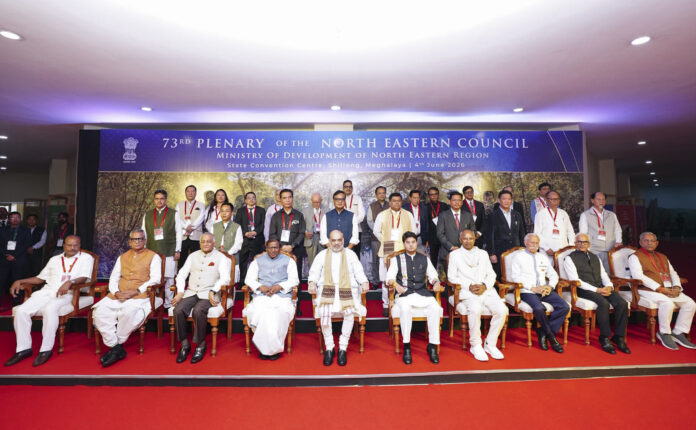
Shah chairs NEC plenary in Shillong, leaders discuss North East Vision Plan 2047

Union Home Minister Amit Shah in a group photograph with Assam Governor Lakshman Prasad Acharya, Union Communication Minister Jyotiraditya Scindia, MoS Sukanta Majumdar, state Chief Minister Himanta Biswa Sarma, Tripura CM Manik Saha, Sikkim CM Prem Singh Tamang, Meghalaya CM Conrad Sangma, Arunachal Pradesh CM Pema Khandu, Manipur CM Yumnam Khemchand Singh, Nagaland CM Neiphiu Rio and others during the 73rd Plenary of the North Eastern Council (NEC), in Shillong, Meghalaya.

SHILLONG, Jun 4: Union Home Minister Amit Shah on Thursday chaired the 73rd plenary session of the North Eastern Council, where leaders from the eight northeastern states resolved to work towards a stronger and more prosperous region and deliberated on the North East Vision Plan 2047.
The session brought together governors, chief ministers, deputy chief ministers and senior officials from across the Northeast.
“Union Home Minister Amit Shah, Union Minister for DoNER Jyotiraditya M Scindia, governors, chief ministers, deputy chief ministers, and senior officials assembled ahead of the plenary deliberations,” the NEC said in a post on X.
All the leaders reaffirmed their collective commitment to the growth, connectivity and prosperity of the region, it added.
Union Minister of the Development of North Eastern Region (DoNER) Scindia said all the leaders are united in their resolve to create a “stronger and more prosperous” Northeast.
According to an official communique, stakeholders from all eight northeastern states discussed the North East Vision Plan 2047 and key regional development priorities.
“The plenary session discussed and deliberated on progress made by the CM High-Level Task Forces constituted for critical sectors of regional development,” the DoNER Ministry said on X.
The session also reviewed important initiatives of the DoNER ministry, including updates on major schemes and programmes, outcomes of the North East Investment Summit and Bankers’ Conclave, it added.
The ministry said leaders analysed youth-focused initiatives, efforts related to tourism and logistics, and the region’s unique selling proposition (USP) projects.
Presentations were made on tourism, agriculture and horticulture, investment promotion, self-reliance in milk, eggs, fish and meat production, sports promotion, economic corridor development, infrastructure and connectivity, and handloom and handicrafts.
“The deliberations are expected to facilitate coordinated action among states and stakeholders for achieving shared development goals,” an official said.
The North East Vision Plan 2047 seeks to provide a long-term roadmap for transforming the region into a vibrant hub of economic growth, connectivity, innovation, sustainability and cultural prosperity by the centenary year of India’s independence.
Earlier in the day, Meghalaya Chief Minister Conrad K Sangma welcomed Shah to Shillong for the meeting.
“Glad to welcome Hon’ble Union Home Minister and Chairman of the North Eastern Council, Shri @AmitShah ji to Shillong for the 73rd NEC Plenary Session,” he said.
Ahead of the main session, a pre-Plenary meeting was held, bringing together senior officials from the government of India and all eight Northeastern states on Wednesday.
The meeting was attended by chief secretaries, state planning secretaries, senior officers of DoNER ministry, NEC officials and other key stakeholders. The North Eastern Council, established under the North Eastern Council Act, 1971, serves as the apex regional planning body for the Northeastern region and plays a pivotal role in fostering coordinated development and strengthening cooperative federalism in the region.
It is the nodal agency for the economic and social development of the region, which consists of Arunachal Pradesh, Assam, Manipur, Meghalaya, Mizoram, Nagaland, Sikkim and Tripura. (Agencies)

BJP Announces Candidates For RS Polls In Five States, Fields Tarun Chugh From MP

NEW DELHI, Jun 4: The BJP on Thursday announced candidates for upcoming Rajya Sabha polls in five states, fielding party national general secretary Tarun Chugh from Madhya Pradesh and Satish Poonia from Rajasthan.
The names of Union ministers Ravneet Singh Bittu and George Kurian did not figure in the list of BJP candidates. Both ministers’ term in the Upper House ends on June 21.
While Bittu is a Rajya Sabha member from Rajasthan, Kurian represents Madhya Pradesh currently in the Upper House.
The BJP’s central election committee has named Debashish Samantaray as its candidate for Rajya Sabha poll from Odisha.
Samantaray had recently joined the BJP, quitting the BJD. He was a Rajya Sabha MP from Odisha before he quit the party and resigned from the Upper House.
According to the list released by the party, Rajubhai Shukla, Mukeshbhai Rathwa, Mansingh Parmar and Jitendra Meghjibhai Kanzariya will contest as BJP candidates from Gujarat, while Rajneesh Agrawal will join the fray from Madhya Pradesh.
Alka Gurjar and Satish Poonia will contest as BJP candidates from Rajasthan. The party has fielded A Sharda Devi as its candidate from Manipur and Tai Tagak from Arunachal Pradesh, according to the list released by party national general secretary Arun Singh.
The Rajya Sabha polls in 10 states including Arunachal Pradesh, Gujarat, Madhya Pradesh, Rajasthan and Manipur will be held on June 18. Bypoll to the Upper House from Odisha will also be conducted the same day. (Agencies)