

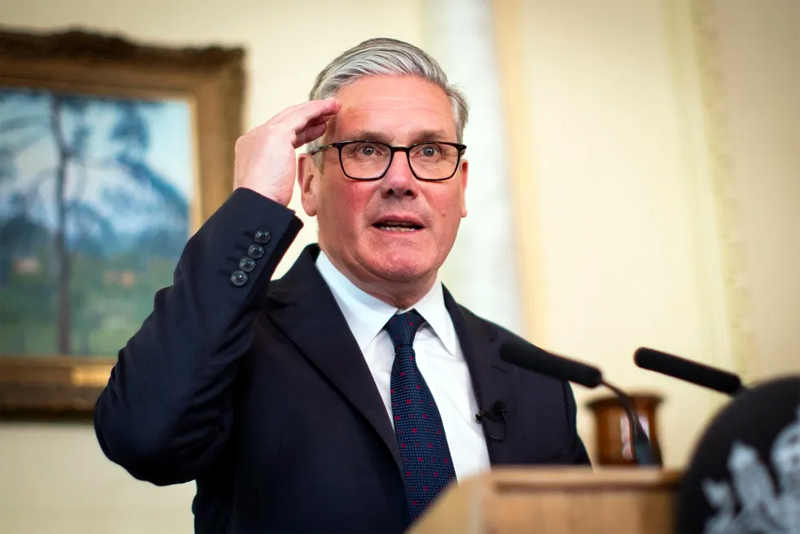
LONDON, May 24: UK Prime Minister Keir Starmer on Sunday welcomed “the progress towards an agreement between the US and Iran,”shortly after US Secretary of State Marco Rubio signalled significant advances in ongoing negotiations and hinted that further announcements could be made later in the day.
Echoing the views and decisions of the US, Starmer asserted, “Iran must never be allowed to develop a nuclear weapon.”
Writing on X shortly after Marco Rubio spoke in India, Starmer said: “We need to see an agreement that brings the conflict to an end and reopens the Strait of Hormuz, with unconditional and unrestricted freedom of navigation.”
The Prime Minister added that the UK government would do “everything UK can” to protect British citizens from the impact of the conflict and said Britain would work with international partners “to seize this moment and achieve a long-term diplomatic settlement.”
The remarks came after Rubio, speaking at a joint press conference with External Affairs Minister Subrahmanyam Jaishankar in New Delhi, said “significant progress” had been made in discussions involving Iran, although negotiations had not yet reached a final stage.
“There has been significant progress made, but not final progress. There’s still work to do,” Rubio said.
The U.S. Secretary of State also hinted at positive developments concerning the Strait of Hormuz, saying that diplomatic efforts over the past 48 hours could potentially result in “a completely open Strait of Hormuz without tolls” if current progress holds.
Meanwhile, US President Donald Trump said on Saturday that a broader agreement between the United States and Iran had been “largely negotiated” and that the Strait of Hormuz would be reopened, signaling possible momentum toward ending the months-long conflict.
“An agreement has been largely negotiated, subject to finalization between the United States of America, the Islamic Republic of Iran, and various other countries,” Trump wrote on Truth Social.
Countering US narrative, Iran’s state-affiliated Fars News Agency disputed Trump’s characterization, reporting that the Strait of Hormuz would remain under Iranian control under the latest version of the proposal exchanged between Washington and Tehran.
According to a person familiar with the matter, recent drafts of the memorandum of understanding being finalized by the US and Iran would end hostilities while gradually reopening the Strait of Hormuz and lifting the US blockade on Iranian ports.
The agreement would also unfreeze some Iranian assets held in overseas banks and initiate a negotiation period of at least 30 days aimed at resolving remaining disputes over Iran’s nuclear programme, including the future of Tehran’s stockpile of near-weapons-grade uranium.
Trump said some final details were still being worked out and acknowledged that aspects of the memorandum could still change.
Fars News rejected Trump’s claims about the Strait of Hormuz reopening, calling them “not true” and “inconsistent with reality.”
“Although Iran has agreed to allow the number of passing vessels to return to pre-war levels, this in no way means ‘free passage’ as it existed before the war,” the agency reported.
According to regional sources familiar with the negotiations, the agreement is expected to unfold in two phases.
In the first phase, Iran would restore shipping through the Strait of Hormuz to pre-war levels, guarantee maritime security in the region, and provide assurances that it would not pursue nuclear weapons. Iran would also be permitted to resume fuel and oil exports.
The second phase, expected to last between 30 and 60 days, would focus on detailed negotiations over Iran’s nuclear programme and broader regional issues.
Pakistan Prime Minister Shehbaz Sharif congratulated Trump on his “extraordinary efforts to pursue peace” in a post on X early Sunday, though he did not directly mention any agreement or reopening of the Strait of Hormuz. Pakistan has played a significant mediating role in discussions between Washington and Tehran.
Sharif referred to a “very useful and productive telephone call” between Trump and leaders from Gulf nations, Turkey, Egypt, Jordan, and Pakistan, represented by Army Chief Asim Munir.
“The discussions provided a useful opportunity to exchange views on the current regional situation and how to move the ongoing peace efforts forward,” Sharif said.
Trump later confirmed that the call focused on negotiations involving Iran and what he described as a memorandum of understanding tied to “peace.”
According to sources briefed on the discussions, regional leaders urged Trump to support the proposed framework with Iran. One regional diplomat described the talks as “very positive,” adding that “good progress is being made.”
Trump also said he held a separate conversation with Israeli Prime Minister Benjamin Netanyahu, which he described as productive.
“Final aspects and details of the deal are currently being discussed and will be announced shortly. In addition to many other elements of the agreement, the Strait of Hormuz will be opened,” Trump said.
Israeli officials, however, remain concerned that a limited interim agreement could extend the ceasefire and ease sanctions on Iran without fully addressing Tehran’s nuclear programme and enriched uranium stockpile.
According to Israeli sources, the United States has continued to reassure Israel regarding concerns over uranium enrichment. Netanyahu is expected to hold a high-level security consultation with senior ministers and officials to review developments in the Iran negotiations, CNN reported.(UNI)
 Follow our WhatsApp channel
