

‘Kishtwar, Ramban to be 4000 mw power hub’
Avtar Bhat
KATHUA, May 24 : Terming Kathua as fountain head of Bharatiya Jan Sangh (BJS), Union Minister in PMO with independent charge of Science & Technology and Earth Sciences Ministries, Dr Jitendra Singh today said that abrogation of controversial Article 370 and 35 A vindicated the legacy of the founder president of Jan Sangh, Dr Syama Prasad Mukherjee who had started his struggle for total integration of J&K into India from here.
Follow the Daily Excelsior channel on WhatsApp
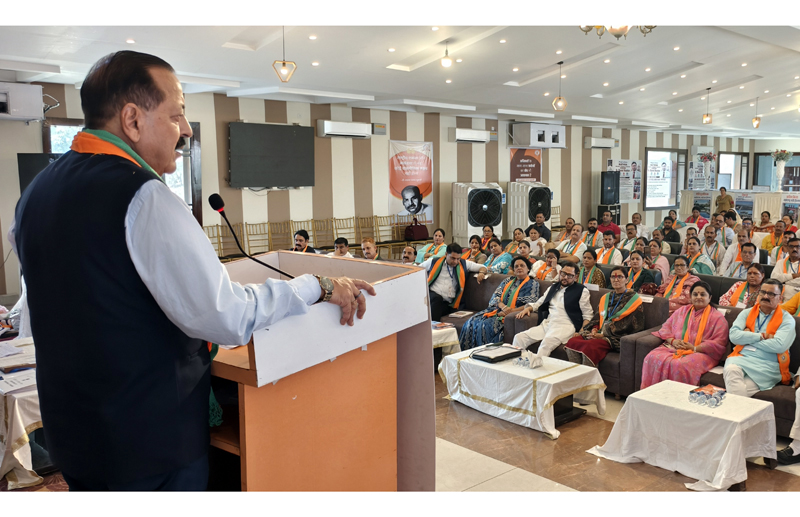
The Minister, while talking to reporters on the sidelines of training camp held under the Pandit Deendayal Upadhyay Prashikshan Mahabhiyan–2026 by BJP at Lakhanpur near here on Sunday, said Dr Mukherjee who had launched the movement from this place was arrested after crossing the Lakhanpur bridge to break the permit system.
Click here to watch video
The Minister said “The late Jan Sangh leader was later taken to Srinagar jail where he died under suspicious circumstances and his death is still a mystery,. This way he gave supreme sacrifice for a great national cause,. But with the abrogation of Article 370 and 35 A his legacy was vindicated’’.
Dr Jitendra Singh highlighted the transformative changes witnessed in Jammu & Kashmir under the leadership of Prime Minister, Narendra Modi especially after August 5, 2019.
He said that the abrogation of Article 370 brought not only developmental transformation in Jammu & Kashmir but also a profound change in mindset, giving people the feeling of belonging as equal citizens of India. This, he said, resulted in renewed self-confidence, self-esteem and aspirational resurgence among the people.
He observed that in recent years, young boys and girls from Jammu & Kashmir have overcome their fears and excelled in various fields across the country.
Recalling the passage of the legislation on Article 370, he said they had considered themselves fortunate to witness a historic moment that ushered in complete transformation in the region. He described Article 370 as contradictory to democratic values and a tool that enabled exploitation by vested interests.
Dr. Jitendra Singh pointed out that although interviews for several Government posts had been abolished nationally from 2016, the reform could not be implemented in Jammu & Kashmir due to Article 370. He also referred to the issue of regional discrimination in earlier years, noting that people are now witnessing positive changes.
Highlighting the journey of governance since 2014, the Minister said the country had moved from an atmosphere of pessimism, negativity and corruption towards optimism, development and nation-building. He remarked that the last 12 years have significantly enhanced India’s value and standing.
Remembering the contribution of Dr. Syama Prasad Mukerjee, Dr. Jitendra Singh said the Modi Government ensured that he received due recognition by naming the Chenani–Nashri Tunnel in Jammu & Kashmir after him – the first major project in the region to bear his name.
Dr Jitendra Singh informed that twin districts of Kishtwar and Ramban will turn into power hub with 4000 mw additional power being generated from various projects taken up in hand by the Government. They included 1000 mw Pakal Dul Hydero Electric Project, 850 mw Ratle Hydraulic Power Project, 624 mw, Kiru Hyderaulic Power Project, 540 mw Kawar Hydroelectric Project, 260 mw Dulhasti Hyderaulic Project Stage iind while 390 mw Dulhast Stage first is already in operation. These all projects are in Kishtwar district, he added.
Dr Jitendra Singh said in addition to it the Baglihar Hydraulic Project in Ramban district is generating 900 mw power at present. He said with the commissioning of all these projects over 4000 mw electricity will be generated from the twin districts of Kishtwar and Ramban turning J&K into North India’s power hub.
Dr Jitendra Singh said that work will begin on Dulhasti IInd as the Project authorities will have now the entitlement to store the water of river Chenab. He said under Gadil formula 50 percent power generated will be utilised by the UT , 35 percent by neighbouring states and 15 percent will go to Central Grid. He said with the completion of these projects the J&K will not only be self sufficient in power generation but will be feeding other states as well and also add to National Grid.
Earlier addressing party activists at the meeting, Dr Jitendra Singh listed key development initiatives in Kathua and Jammu & Kashmir. The Minister referred to the upcoming Biotech Park in Kathua, stating that it would enable around 25 entrepreneurs to generate employment opportunities. He noted that three out of the 14 medical colleges established in Jammu & Kashmir are located in Kathua district.
Dr Jitendra Singh highlighted the establishment of two AIIMS institutions in the Union Territory and said Prime Minister, Narendra Modi had accorded special priority to the region in view of the neglect it had suffered under earlier regimes.
Speaking about sports infrastructure, he said efforts are underway for the development of an International Stadium at Hiranagar on around 300 Kanals of land, with discussions being held with the J&K administration regarding land transfer.
He lauded the success of the Aroma Mission in Jammu & Kashmir, saying it is creating remarkable opportunities for livelihoods and entrepreneurship. He asserted that the present dispensation has completed several unfinished projects left pending by previous governments.
Calling the present phase of governance both a matter of pride and a responsibility, Dr. Jitendra Singh urged people to maximise the opportunities created by good governance and work collectively towards realising the vision of Viksit Bharat. He expressed confidence that future generations would look back with pride and gratitude for the work accomplished during this period.
Former Minister and party vice president, Priya Sethi, MLA Jasrota, Rajiv Jasrotia, Party general secretary, Gopal Mahajan, senior BJP leaders, Sanjay Baru and Prem Nath Dogra were among others present.
 Follow our WhatsApp channel
