

*Major boost to power generation after IWT kept in abeyance
NHPC to execute Rs 2600 cr worth twin ventures
Sanjeev Pargal
JAMMU, May 24: In a major step to prevent flow of water to Pakistan after India kept the Indus Water Treaty (IWT) in abeyance following Pahalgam terror attack in April last year, the Central Government has cleared work on two infrastructure projects linked to the Chenab river system with an estimated cost of nearly Rs 2,600 crore.
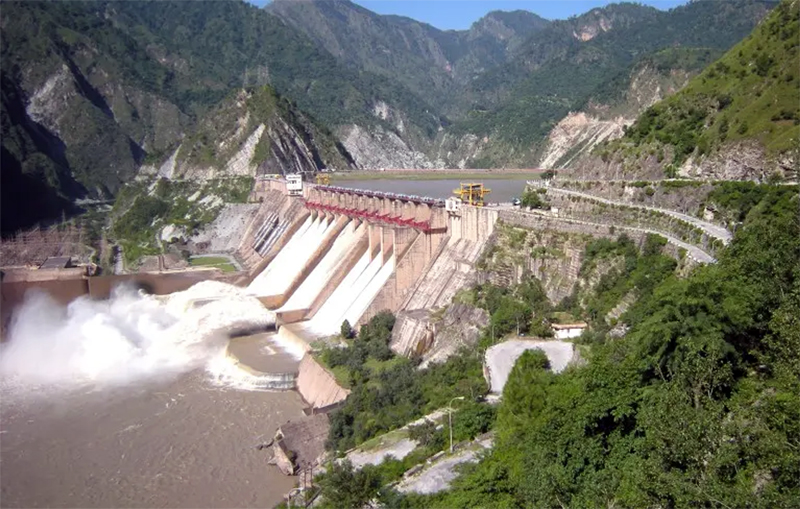
“The projects include Rs 2,352 crore Chenab-Beas Link Tunnel in Himachal Pradesh and the Rs 268 crore sediment-bypass tunnel at the Salal Dam in Reasi tehsil of Jammu region,” the officials told the Excelsior.
The Chenab is one of the western rivers of the Indus basin and flows through India and Pakistan. In India, major hydropower projects on the Chenab are located in Jammu and Kashmir and Himachal Pradesh.
Follow the Daily Excelsior channel on WhatsApp
Elaborating on construction of sediment-bypass tunnel, the officials said, it is an engineering structure used to divert silt-laden water away from a dam reservoir.
The Salal project carries additional significance because desiltation work there was among the first operational measures taken after India placed the Indus Waters Treaty in abeyance.
“A link tunnel is used to transfer water between river basins or river systems for irrigation, power generation or water management,” they said, adding this will increase power generation as silt will be removed automatically through the tunnel, resulting into availability of more water.
The projects will be undertaken by National Hydroelectric Power Corporation and come at a time when New Delhi has sharpened its approach toward utilisation of waters from the western rivers governed under the Indus Water Treaty which was kept in abeyance by India in April 2025 after Pahalgam terror attack in which 26 civilians including 25 tourists and a local guide were killed.
Another project is Rs 2,352 crore Chenab-Beas Link Tunnel Project in Lahaul-Spiti, Himachal Pradesh, which envisages an 8.7-km tunnel to carry surplus water from the Chandra river, a tributary of the Chenab, into the Beas basin.
A 19-metre-high barrage is also proposed across the river in the Lahaul valley as part of Phase-I construction.
The diversion site is located near Koskar village, upstream of the north portal of the Atal Tunnel in Rohtang.
The IWT allocates the eastern rivers, Ravi, Beas and Sutlej, to India, while the western rivers, Indus, Jhelum and Chenab, are assigned for use by Pakistan, subject to limited Indian rights for non-consumptive uses and hydropower generation.
After keeping the treaty in abeyance, India has fast-tracked four major Chenab hydropower projects in Jammu and Kashmir including Pakal Dul with a planned capacity of 1,000 MW, Kiru 624 MW, Kwar 540 MW, and Ratle 850 MW.
The Sawalkote Hydroelectric Project on the Chenab has a planned capacity of 1,856 MW and an estimated cost of Rs 5,129 crore. The Dulhasti Stage-II project on the Chenab has a planned capacity of 260 MW and an estimated cost of Rs 3,277.45 crore.
According to officials, both projects are aimed at improving long-term infrastructure resilience and maximising India’s hydroelectric and water-management potential in the Himalayan region.
 Follow our WhatsApp channel
