

Dhurjati Mukherjee
India’s energy future is challenging with fuel prices quite high and availability a matter of concern. If oil prices stay at around $95-$100 a barrel, over last year’s average of $70 a barrel, the impact would be a little above $40 billion or above 1.5% of GDP. The government’s economic stabilisation fund of $1 trillion should last not more than three months at the current pace.
In this backdrop, it’s heartening to hear that India’s crude capacity is all set to get a boost with its reserve likely to increase by nearly 70% from 3.3 million tonnes to as much as 30 million barrels as the UAE’s Abu Dhabi National Oil Company (ADNOC) has agreed to ramp up crude oil storage. Ramping up the storage to 30 million barrels will add over four million tonnes of crude to India’s overall strategic reserves. The Abu Dhabi-based energy giant’s agreement with Indian Strategic Petroleum Reserves Ltd. comes at this time when India faces disruption in energy supplies amid the West Asia crisis.
Notably, India has a refining surplus and given that refining margins are up sharply as the Strait’s blockade has affected not just crude oil supply but also refining capacity, Indian refiners are able to source crude and sell the product locally. In fertilisers, farmers most impacted will be from countries that do not subsidise like the US.
It is pertinent to refer to Union Minister of Road Transport and Highways Nitin Gadkari’s caution that there’s no future of petrol and diesel vehicles as concerns around air pollution and country’s heavy dependence on fossil fuel imports continue to rise. Amid the widespread debate on whether alternative fuels will gain a significant share in auto supply chains, he said that Original Equipment Manufacturers (OEMs) must mull switching from fossil fuels towards cleaner alternatives.
“If you (OEMs) are planning to expand only in that direction, then as a friend, I can say your future is not good,” Gadkari stated at the Busworld India 2026 summit, urging manufacturers and fleet operators to accelerate the shift towards the cleaner fuels such as hydrogen, ethanol, CNG, LNG and electric-powered fleet. “We import fossil fuels worth ₹22 lakh crore. This is not only an economic challenge, but also a major pollution problem. Our policy is: import substitute, cost-effective, pollution-free and indigenous,” Gadkari noted.
He also highlighted that hydrogen is the “fuel of the future” and the ministry has started pilot projects with hydrogen trucks and hydrogen buses, in collaboration with Tata Motors, Volvo, Indian Oil, BPCL and NTPC across 10 routes. Additionally, the minister asserted the use of ethanol is a key alternative fuel, noting that India is producing ethanol from broken rice, corn, bamboo, rice straw, sugarcane and molasses.
Gadkari’s comments come at a time when the Centre has proposed to cut dependence on imported petroleum but, on the other hand, rating agency, ICRA indicated that power demand will rise by 5 to 5.5% in the current fiscal against a tepid 1% growth in 2025-26 due to continued momentum in industrial and commercial activity. The power demand growth in the current fiscal is likely to be supported by agricultural and household sectors, given the expectation of sub-par rainfall amidst a potential El Nino along with demand from industries as well as from emerging sources like electric vehicles and data centres, ICRA stated in a statement.
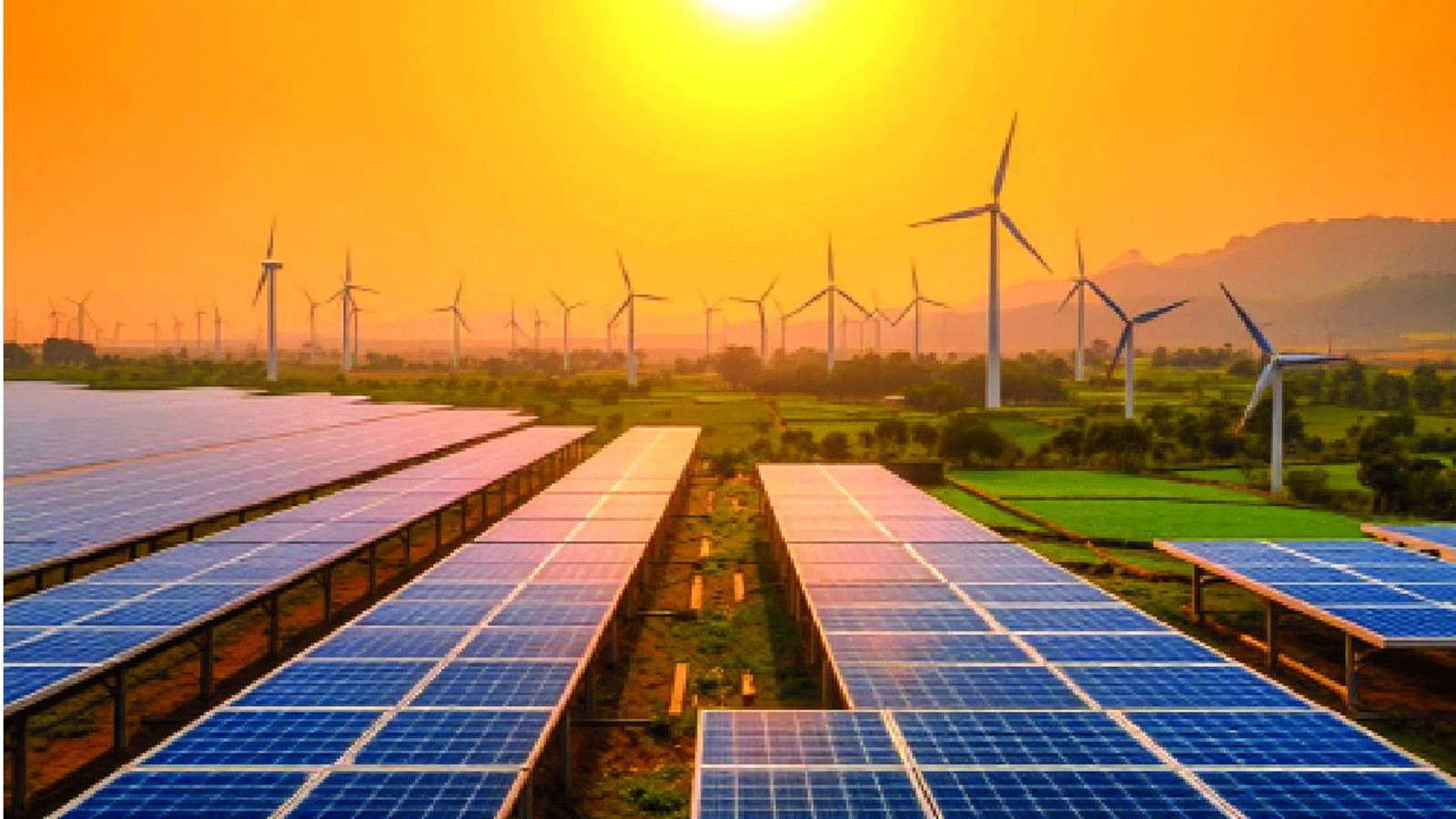
Thus, it is good to note that India’s renewable energy capacity has expanded sharply over the past five years with several states accelerating installations to meet rising clean energy targets. This is indeed encouraging in the present geopolitical situation with oil and gas imports being badly affected, not just for India but many other countries. Data from FY22 to FY26 highlighted a strong ramp-up led by western states while some early leaders in the south showed signs of moderation. Experts have been championing a radical shift in energy consumption towards renewable sources through more focus on solar, wind, and nuclear.
Rajasthan and Gujarat continued to dominate India’s renewable landscape (excluding large hydro), accounting for the largest absolute capacity additions over the past five years. Rajasthan now leads the country with 46.6GW of installed capacity in FY26, up from 17 GW in FY22, an addition of nearly 30 GW, largely driven by solar. Its solar capacity surged from 12.6 GW to over 41 GW, reinforcing the position as India’s solar powerhouse. Gujarat followed closely with total renewable capacity rising from 16.6 GW to 45.2 GW. Its solar capacity more than tripled from 7.2 GW to 29.3 GW, with strong acceleration in the past two years supported by large solar parks and policy backing.
India has, no doubt made rapid progress in installed solar capacity of barely 3GW in 2014 in 2014 to over 135GW mark today. This growth has been successful due to political resolve and sustained capital investment. Undeniably, reducing dependence on fossil fuels, cutting carbon dioxide and other greenhouse gas emissions and strengthening energy security are all necessary goals tied to the expansion of solar capacity.
While efforts towards gearing up renewable energy needs to be encouraged, coal gasification which happens to be a thermos-nuclear process converting coal into synthetic gas is a viable option for India as it has enough resources of this black diamond. For a country like ours, which imports over 88 percent of crude oil, being the third largest importer in this sector, such alternatives are strategically significant for generation of electricity. The Centre launched the Coal Gasification Mission in 2020, aiming to gasify 100 million tonnes of coal by 2030. But six years on, the commercial output remains tardy.
Strikingly, in this respect at least, the constraints cannot be attributed to the lack of funding. The government allocated Rs 300 crore to the project in the 2025-26 budget estimates. But, according to unofficial records, much of this fund remained unspent as no progress was made in this direction. In the present fiscal, the Centre raised the budget for the mission by over Rs 1075 to Rs 3525. The NITI Aayog has flagged the issue of incompatible gasification technology for the high ash-content coal available in the country. Keeping in view the present situation, the government must make gasification a priority measure.
Besides, funds are a vital necessity for India and many other such countries and though at the Baku summit, the UN process had set the annual climate finance goal at $1.3 trillion, developed countries agreed to only one-third of it. Though climate fund support for new adaptation projects rose in 2024, this was much below actual needs and emerging financial constraints make the future unclear. Both public and private finance must step up to increase adaptation, taking care not to increase the proportion of debt instruments used by vulnerable nations. However, the amount agreed at COP29 at Baku last year, developed countries, including India, expressed strong objections to it as they wanted it to be raised to $1.3 trillion per year by 2035. Even the agreed amount has not reached the developing nations.
Energy requirements for a country like India has been expanding and this trend will obviously continue in the foreseeable future due to rapid industrialisation and increasing urbanisation. The need for energy security is crucial for the country as the finance minister recently pointed out, reiterating that India would continue to source crude, fertiliser etc. pragmatically to protect domestic needs.—INFA
 Follow our WhatsApp channel
