

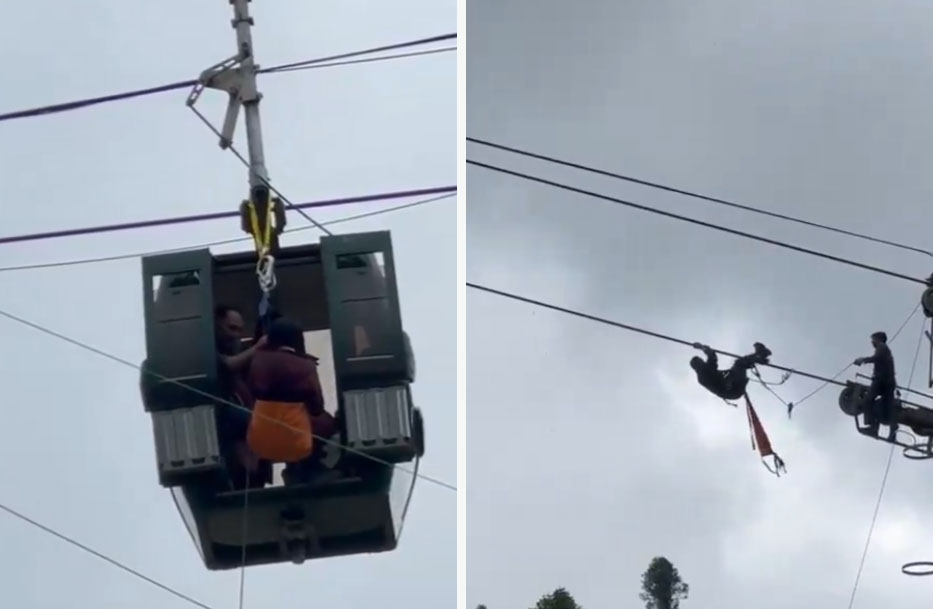
High above the pine-clad slopes of Gulmarg, on a quiet Sunday afternoon, time stopped for over 320 tourists dangling in 65 cabins of the world-renowned Gulmarg Gondola. What should have been a cherished memory – a breathtaking aerial journey across one of Kashmir’s most celebrated landscapes – turned into an eight-hour ordeal of fear, uncertainty and desperate waiting. A gearbox malfunction, the first of its kind in the cable car’s 28-year history, had brought one of India’s most iconic tourist attractions to a frightening standstill. The Gulmarg Gondola is not merely a cable car. It is the crowning jewel of Kashmir’s tourism industry, the single most sought-after experience for millions who visit the Valley each year. Since the extension of its second phase to Apharwat Peak, it has become even more irresistible – a ride that promises not just altitude but a perspective of the Himalayas that is simply unmatched. On any given day, thousands queue patiently for their turn, hoping to carry home a memory that will last a lifetime. That aspiration, ironically, has become part of the problem.
The rescue operation that followed the breakdown was, by any measure, a remarkable achievement. Teams from the State Disaster Response Force, the National Disaster Response Force, the Indian Army, J&K Police, and the District Administration converged on Gulmarg under rain-soaked skies and biting cold. Some cabins were suspended at heights exceeding 500 feet – a vertical rescue challenge that would test the most seasoned emergency responder. That every single tourist was brought to safety, without fatality, is a tribute to the courage and coordination of everyone involved.
But praise must not become a veil that obscures hard questions. The same images that celebrated the rescue also revealed its improvised nature. Makeshift rope ladders and jury-rigged stairways fashioned on the spot are not the stuff of a robust emergency response protocol for a facility handling thousands of tourists daily. The Cable Car Corporation needs to acknowledge honestly that rescuing 65 cabins simultaneously at extreme heights in deteriorating weather is beyond the scope of improvisation. Dedicated vertical evacuation equipment, trained rapid-response teams, night-time rescue capability, and clearly rehearsed protocols must be standard, not aspirational. Had this breakdown occurred closer to dusk, the outcome could have been a great deal darker.
The technical dimension demands equal candour. The Gondola has been operating beyond its carrying capacity for over a year. That a machine pushed relentlessly beyond its design limits eventually breaks down is not a surprise – it is a certainty. The Gondola’s centralised control room monitors cable tension, sensor feedback, vertical drift and structural load in real time, yet the system’s formidable monitoring capability cannot substitute for the rest that every machine eventually requires. Twenty-eight years of near-continuous operation is a testament to Swiss-Austrian engineering excellence; it is not a licence for indefinite, uninterrupted use without deep-maintenance intervals.
The J&K Cable Car Corporation must explore a mandatory weekly non-operational day devoted entirely to inspection, maintenance and component replacement. The revenue foregone on that single day would be a fraction of what a serious accident would cost – in lives, in litigation, in the irreversible damage to Kashmir’s tourism reputation. Puma engineers have already been summoned for the current repair; the safety audit that follows must be comprehensive, independent and transparent, with its findings made public. Chief Minister’s commitment to a thorough inquiry and to fixing accountability is a necessary first step. The Cable Car Corporation must emerge from this crisis with a new operational philosophy: that the Gondola is a public safety infrastructure first and a revenue generator second.
Kashmir’s tourism has fought hard to reclaim its place in the national imagination. Visitors who choose Gulmarg are not merely buying a ticket – they are placing their trust in the state’s promise of safety and hospitality. One incident of this magnitude, handled well, can be weathered. A second one can undo years of patient recovery. The mountain was merciful this time. Policymakers and Administrators cannot afford to assume it always will be. The lesson is simple and non-negotiable: no tourism economy is worth a single preventable life. Foolproof systems require time, investment and the humility to prioritise maintenance over maximising footfall. Gulmarg’s Gondola deserves nothing less.
 Follow our WhatsApp channel
