

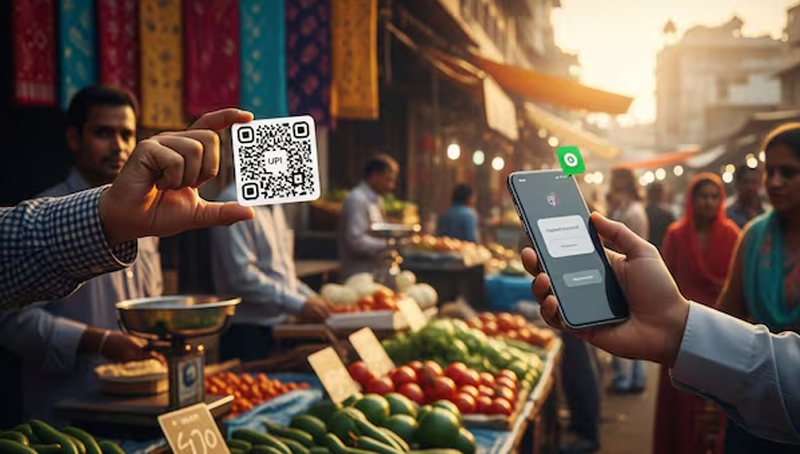
NEW DELHI, May 3 : The government plans to expand its central bank digital currency (CBDC)-based food subsidy programme to Chandigarh, Dadra and Nagar Haveli, and Daman and Diu by June, following its implementation on a pilot basis in Gujarat and Puducherry, official sources said.
Under the scheme, beneficiaries receive their Public Distribution System (PDS) entitlement as a digital token in a wallet issued through the Reserve Bank of India’s central bank digital currency (CBDC) framework, instead of collecting physical grain at a ration shop.
“Once implemented effectively, this initiative could generate subsidy savings of around 4 to 5 per cent, while making delivery more transparent, targeted, and efficient. This could become a revolutionary reform in the way food subsidies are delivered,” the official sources told PTI.
The move seeks to address a longstanding weakness in the current distribution system, where beneficiaries often face stock shortages or receive less than their full entitlement if they arrive at the fair price shop or ration shop late in the monthly cycle, leaving them dependent on the dealer with little recourse.
Section 12 of the National Food Security Act provides for shifting toward more efficient delivery systems, including cash transfer and direct benefit transfer, in recognition of such gaps in physical distribution.
However, a plain cash or DBT transfer carries its own risks. If money is transferred directly into a beneficiary’s account without restrictions, it may be spent on non-food items, undermining the food security objective that the subsidy is meant to serve, sources said.
CBDC is being positioned as a “middle path”, the sources said. Being sovereign digital money issued and guaranteed by the RBI, it carries the same legal status as regular currency but can be programmed for a specific purpose – in this case, the purchase of eligible foodgrains such as wheat and rice.
The token functions somewhat like a digital coupon. The entitlement stays in the beneficiary’s control, can be redeemed at a ration shop or any permitted outlet, and is programmed to reject purchases outside the approved category, sources said.
On access, beneficiaries with smartphones can use a digital wallet, those with feature phones can receive a redemption code, and those without any device can continue under the existing physical distribution channel, the sources added.
In the current pilot, the token validity period is set at one month, though this can be extended if needed. Officials indicated that a window of up to three months may be reasonable in principle, but extensions beyond that are not being considered.
The scheme also benefits fair price shop dealers. Under the existing system, dealers are paid only after dues accumulate. Under the CBDC model, payment flows automatically into the dealer’s wallet on each transaction, making settlement faster and more transparent, sources said.
Dealer stock management also becomes more dynamic. If a dealer receives 1,000 tonnes and distributes 980 tonnes, the next allocation can be linked to actual offtake rather than a fixed schedule, preventing unnecessary inventory pile-up at the last mile.
According to sources, the initiative is a structural reform in subsidy administration and not a substitute for procurement-side protections, minimum support price guarantees or statutory entitlements under the National Food Security Act.
The physical ration distribution channel will continue to remain available alongside the digital system, the sources said. (PTI_
 Follow our WhatsApp channel
