

Commodore DS Sodhi (Retd.)
sodhidalbir7777@gmail.com
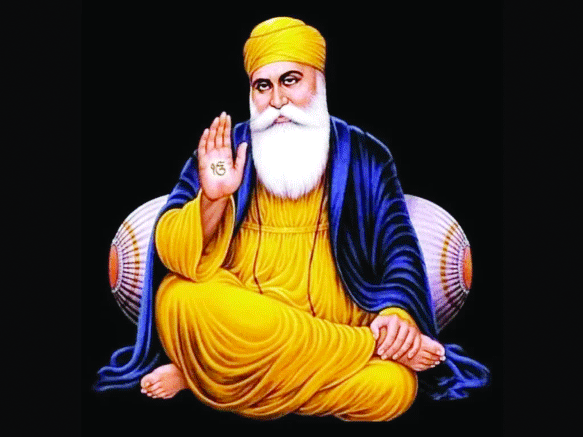
Guru Nanak Dev Ji was a great unifier of humanity who worked for interfaith peace and harmony. Born to Mata Tripta and Kalyan Chand Das Bedi (Mehta Kalu) at Rai Bhoi ki Talwandi, Lahore (present-day Nankana Sahib), he lived in an era when people worshipped many gods and followed superstitions and rituals that were often in defiance of the Supreme Lord’s teachings. Guru Nanak Dev Ji had his first mystic experience at Sultanpur while taking bath in a river. It was here that Nanak was charged by the Supreme Lord with a mission to spread the message of God. Go into the world to pray and teach mankind how to pray.
Guru Nanak this proclaimed, “There is no Hindu, there is no Musalman,” and commenced his travels to spread the message of the Almighty. His first travel (Udassi) was towards the East, the second towards the South, the third towards the North, and the fourth towards the West. Guru Nanak visited Jammu and Kashmir, entering through Ladakh after visiting Tibet during his Third Udassi. Accounts of his travels to Jammu and Kashmir have been documented by Giani Gian Singh Ji, Bhai Santokh Singh Ji, Bhai Vir Singh, Prof. S.S. Kohli, McAuliffe, and many others. Nanak entered Jammu after visiting Shri Amarnath Cave and crossing over the Kishtwar Ridge near the Machail Temple. Jammu is home not only to revered shrines linked to Lord Shiva and Mata Parvati-who, according to tradition, are regarded as the divine guardians of Jammu and Kashmir-but also to sacred sites associated with many other deities. With its wide array of sacred destinations across faiths, Jammu stands poised to emerge as one of India’s most inclusive and spiritually vibrant regions. While Guru Nanak visited many sacred shrines in the Jammu region, there are several other places believed to have been blessed by him during his travels, though they do not find direct mention in historical texts. Local legends and oral traditions, however, continue to preserve these associations.
Important Shrines / Places Visited by Guru Nanak Dev Ji
Machail Temple : After crossing the Kishtwar Ridge, Guru Nanak visited the famous Machail Mata Temple (also referred to as Chandi Mata), a revered shrine dedicated to Goddess Durga in the Padder Valley of Kishtwar. Commemorating Guru Nanak’s visit to this area, a Gurdwara once existed in Padder; however, it was destroyed during one of the fierce floods of the Chanderbhaga River. Presently, a Nishan Sahib stands hoisted on the riverbank.
Chenani: Guru Nanak blessed this place and visited many temples in the area.
Mata Vaishno Devi: Guru Nanak visited the Mata Vaishno Devi shrine (Garb Yoni) and held discussions with the priests and local people. Upon learning about the rituals practised there, Guru Nanak recited a hymn that is now an integral part of Shri Guru Granth Sahib Ji.
Place Known as Mehndi Pagambar
Guru Nanak visited a place known by a person Mehndi Pagambar. The people there used henna to dye their hair and also performed rituals using horsehair, which they considered sacred, to help those in distress. Guru Nanak spoke to them about the true Naam and recited an hymn that again finds mention in Shri Guru Granth Sahib Ji.”
Jamavant Di Gufa (Peer Kho): The Pandits in this cave used to tell people that Jamavant was in deep sleep and snoring, though the sound actually came from water flowing inside the cave. The cave was also believed to have a tunnel connecting it to the Shri Amarnath Cave.
Guru Nanak gave discourses to the Pandits and urged them to follow the true Lord. Guru Nanak Dev Ji here again recited a hymn that too is part of Shri Guru Granth Sahib Ji.
Bahu Fort: After crossing the River Tawi, Guru Nanak visited the famous Bave Wali Mata Temple situated within Bahu Fort and dedicated to Goddess Kali, the presiding deity of Jammu.
Purmandal Shiv Temple: Guru Nanak visited the famous Purmandal Shiv Temple, often referred to as “Chota Kashi,” situated on the banks of the River Devak. This temple is linked to the legend of a she-jackal that was accidentally killed by Raja Veni Dutt. Guru Ji took a holy bath in the sacred river and held discussions with the priests there.Later, Maharaja Ranjit Singh visited the temple and had its top gold-plated. He also granted 10,400 kanals of land to Mahanta Motigar Ji, a Shiva Sanyasi.
Jasrota, Kathua: Guru Nanak also visited the lakes Sanasar and Mansar and held discussions with the people of Bakhta (Jasrota). Guru Ji visited the Kali Mata Temple near Jasrota Fort as well. In 2012, the author of the book Historical Sikh Shrines of Jammu and Kashmir, along with late S. Swaran Singh and Master Gurnam Singh, held discussions with the Hindu residents of Jasrota, who confirmed Guru Ji’s visit to the area. Thakur Hurmat Singh Chambayal donated land, where a sacred tree stood, for the construction of a Gurdwara Sahib. Today, a magnificent Gurdwara Sahib commemorating Guru Nanak Dev Ji’s visit stands there and is visited by pilgrims from Jammu, Kashmir, and Punjab.
Peer Baba Shrine, Satwari: During his first Udassi, Guru Nanak Dev Ji met a revered Sufi saint, Sayyed Shamsuddin, popularly known as Pir Budhan Shah. The saint lived a deeply ascetic life and survived on goat’s milk, while his goats were said to be guarded by a lion. During their spiritual discussions, Pir Budhan Shah recognised Guru Nanak’s divine wisdom and offered him milk. Guru Nanak drank half and asked the Pir to preserve the remaining half, saying he would consume it during his “sixth avatar.” This prophecy was fulfilled when the Sixth Guru, Guru Hargobind Sahib Ji, later visited Budhan Shah in Kiratpur along with Baba Gurditta. Guru Hargobind Sahib asked for the preserved milk, which Budhan Shah joyfully offered.
A highly revered shrine dedicated to Pir Budhan Shah exists near Jammu Airport at Satwari and is frequented by people of all faiths. It is believed that pilots of various airlines bow their heads in reverence while taking off and landing at Jammu.
Gurdwara Shri Guru Nanak Dev Ji, Chand Nagar: To commemorate Guru Nanak Dev Ji’s visit to various places in Jammu, a magnificent historical Gurdwara Sahib has been constructed at Chand Nagar in Jammu City.
Gurdwara Charan Kamal Asthan Guru Nanak Dev Sahib, Ser Manjla, Ramnagar, Udhampur: During his travels through Chenani and Udhampur, Guru Nanak Dev Ji visited Ser Manjla in Ramnagar. Guru Ji delivered spiritual discourses to the local people and blessed them.
According to local legend, the people revered Guru Nanak by the name “Ogen Devta.” One resident of Ser Manjla claims to possess a Rabab believed to have belonged to Bhai Mardana, although its authenticity is yet to be established. Guru Nanak is also believed to have helped villagers cure their cattle by sprinkling sacred water from a nearby spring. Some residents of the area identify themselves as Megh Sikhs and recite a prayer resembling the Mool Mantar.
A historical Gurdwara commemorating Guru Nanak’s visit was constructed there in 1983.
Unfortunately, during the anti-Sikh riots of 1984, some miscreants burnt down the Gurdwara. Subsequently efforts by the Sikh community to reconstruct the Gurdwara did not materialise due to various reasons. Persistent efforts were later made to bring the issue to the attention of the State Authorities. The then State Revenue Minister directed the Udhampur Administration to submit a detailed report. The Assistant Commissioner Revenue, Udhampur, after visiting the site and interacting with local residents, submitted a detailed report to the Deputy Commissioner, Udhampur, vide No. 3596-97/SQ dated 30 August 2010. The report clearly affirmed local traditions regarding Guru Nanak Dev Ji’s visit and documented statements from residents who continued to revere him as Ogen Devta.
Since then, the Sikh community has continued pursuing the matter with both local residents and the administration. At present, no legal dispute exists. Following sustained dialogue and submission of supporting documentation, the then Deputy Commissioner of Udhampur, along with revenue and police officials, visited the site in 2023 and demarcated 3 kanals and 13 marlas of State land for reconstruction of the Gurdwara Sahib, with the consent of local residents. However, the land has yet to be formally allotted to the Gurdwara Sahib, and the matter remains under consideration. The Gurdwara Committee has also raised the issue with officials of the union territory, most recently through letter No. ACR/SQ/2024-25/1212-16 dated 30 April 2026, forwarded to the Chief Secretary for resolution. A response from the Udhampur Administration and the Government is still awaited.
This matter is being highlighted with the hope and request that the Administration will find a way out for the reconstruction of the historical Gurdwara Sahib at Ser Manjla on priority, especially as nearly three decades have elapsed since efforts for its restoration began.
The author is former Deputy Assistant Chief of Headquarters Integrated Staff (IT)
 Follow our WhatsApp channel
