

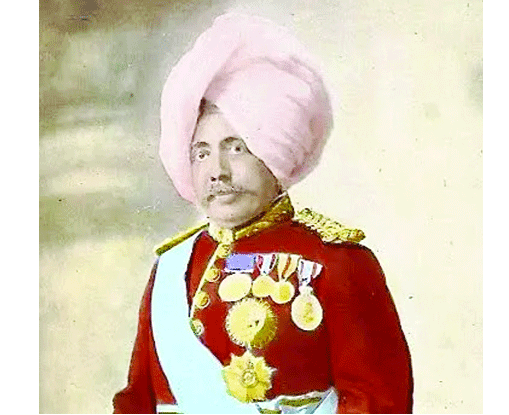
B D Sharma
Jammu and its surrounding areas have remained, to a great extent under the Dogra rulers for centuries. Much of the time the potentates were sovereigns and at other times they remained under the suzerainty of the overlords, be they were the Delhi Sultans, Mughals, Afghans, Sikhs or the English. Out of the numerous rulers we had, some like Raja Jambulochan, Ranjit Dev and Maharaja Gulab Singh and his successors readily catch our imagination. After independence a wave of denigration of the past rulers had swept the country and many of us did also swim with this wave. In the process many of us have forgotten even the names of our rulers of the days by gone. Young generation doesn’t know as to how our State was formed and who created it and who ruled over it for one hundred years before independence. Many of us are unable to even distinguish our three prominent rulers of recent past, namely Ranjit Dev, Ranjit Singh and Ranbir Singh.
Some time however the people show their affection of the past rulers. Your author observed this when it was seen that the mere mention of the name of a Dogra Maharaja got spontaneous applause from the people in a gathering. The year was 2004 when Mufti Muhammad Sayeed, the then Chief minister, against all odds, got the elections to the local bodies conducted under the newly framed Acts. Seventy one corporaters had been elected to the Jammu Municipal Corporation and a function for their taking oath was organized. CM, Dy CM, many ministers, legislators, prominent citizens and family members of the newly elected corporaters were invited for the occasion. Your author in the capacity of Commissioner JMC had to welcome the invitees. While tracing out the history of Jammu Municipality, it was mentioned that Jammu Municipality had been established by Maharaja Partap Singh. The moment name of the Maharaja was mentioned there was so thunderous an applause from the audience that the whole hall reverberated with it. The chief guest Mufti saheb got a bit infuriated and told the Liaison officer deputed with him as to ” why the Commissioner is so hugely glorifying a feudal lord.” The Mufti was by all accounts a modern, secular and progressive political leader despite his having sought the political support from the rabid communal elements in the later part of his career. So it was not surprising that he had a disliking for the autocratic system. But he perhaps forgot that the people had a free will to like or dislike a period, a time or a person. Moreover, our past rulers can not just be wished away. After all they remained an essential part of our history or rather they have made a part of our history and their memories shall always remain in our discourse.
It is true that the monarchy suffers from many inherent flaws like the lack of democracy and accountability, extreme concentration of power, rigid class structure and high costs of maintenance of royal family. But it is also a fact that some rulers have governed kindly despite the inherent vagaries of the system. Maharaja Pratap Singh can be counted as one such ruler. Apart from being a kind hearted person, he was not a even a fraction of spendthrift as were many other princes in India who lead luxurious lives as has been vividly depicted by Dewan Jarmani Dass in his book, The Maharaja. This is another thing that he faced lot of latent criticism when he purchased a car, perhaps the first one in the State and started travelling in it. Our elders used to tell us that many tongues started wagging that the car of the Maharaja burnt the blood of the common people in it instead of petrol. It further got intensified in case of his successor who was much maligned by the political leaders during 1930s/1940s on this count. People, however, later got appalled when they saw their democratically elected leaders overstepping even the Maharajas. People didn’t miss to notice that the Maharaja used to ply only one car but the new rulers, the people’s elected representatives, travelled in the big caravan of cars sometimes consisting of even more than fifty vehicles. Not only that. Even the middle rung officers were not left behind. People in Samba district would wonder how a former Deputy Com had gathered more than five government vehicles for his/his family use, one for the children to go to school, one for his wife to go to market, one for carrying cow milk from Samba to Jammu where his family was putting up, one for Pucca road, one for Kucha road, one for his personal staff and the one for his security staff. Intoxication of power is, perhaps the root cause of this all type of extravagance and arrogance and not being a monarch or a democrat.
Though Maharaja Pratap Singh was, to a great extent, a noble man yet he unfortunately saw many ups and downs during his life. His father Maharaja Ranbir Singh wanted his second son Raja Amar Singh to succeed him, as he thought that Amar Singh was wiser than Pratap Singh. The Governor General, however, decided that Pratap Singh would succeed his father. The English felt that Maharaja Pratap Singh was a simple-minded person and could be handled easily. And it would be easy to promote their interests in the State if he was in power. In fact there was a strong lobby in the English establishment who had not forgotten the costly mistake of Lord Hardinge and company of having handed over the beautiful Valley to Gulab Singh for a measly amount of Rs 75 lakhs. They had made many efforts during the time of Maharaja Ranbir Singh to poke their nose in the affairs of State but their efforts had not succeeded. They, however, were successful in hatching a conspiracy against Maharaja Pratap Singh and alleged that he was working against the interests of the English and had established contact with the Russians. Consequently they drastically reduced his powers and a governing Council was constituted for running the government. After some years the false and concocted allegations against him were exposed by a Calcutta newspaper and there was an uproar in the British Parliament. His powers were thereafter restored. During the last years of his life a feud in the family erupted when he adopted Jagat Dev Singh, a descendant of Raja Dhian Singh as his son and successor in preference to his nephew Raja Hari Singh.
Despite all these turbulences, the State made a lot of progress during his time. Means of Communication like Kohala bridge, Jhelum Cart road, Srinagar-Gilgit road, Srinagar-Leh road, Jammu Sialkot railway line, Banihal Cart road were constructed during his regime. In the field of education SP college Srinagar, Prince of Wales college Jammu, two Technical Institutes, many High schools including the prestigious Ranbir High School Jammu were established. Two Power Stations at Mohra and Ranbir Canal, were constructed during his regime. Many improvements in the fields of healthcare, agriculture and forests management were also made.
The most glorious achievement of the Maharaja was, however, in carrying out of the first Regular Settlement of land where in the land records were prepared on sound footing. In Kashmir valley permanent Assami rights (heritable and transferable) were given to the farmers for the first time, land revenue was fixed at reasonable rates and the much hated Begar system(where by farmers were forced to do work without any wages) was abolished. In this venture the State was fortunate to have the services of WR Lawrence of ICS, Punjab cadre. As Settlement Commissioner he got the Revenue record prepared elaborately and judiciously. The revolutionary changes brought through this Settlement, gave a whiff of fresh air to the poor farmers of Kashmir. Lawrence’s work became the basis for Settlement in other parts of the State. He became very popular with the Kashmir peasantry also and even today the poor illiterate farmers recall and quote their “Larren saheb’s” work/findings to assert a right. Many people opine that he was one of the best civil servants which the State ever had. Lawrence has showered many compliments on Maharaja for his encouragements to him and for having accepted his recommendations. Lawrence further observes that the Maharaja had done much to change the condition of his people. He was kind to all sections of people and had won their affection. It may be of interest to the readers that Lawrence reforms were as significant as the later day Big Landed Abolition Act and Agrarian Reforms Act. In addition his book, the Valley of Kashmir, remains one of the most popular books ever written on Kashmir.
Maharaja Pratap Singh is, however, assailed on account of two decisions he took during his reign. He allowed his Law Minister, Pt Bhag Ram, a Punjabi Brahmin to introduce Urdu as the official language in the State in place of Persian and Dogri. The people, particularly many Dogras think that Maharaja Ranbir Singh had taken many steps in promoting the Dogri language in the official work and Maharaja Pratap Singh should have continued with those efforts so that the Dogras had gotten a fair share in the cake of government services. Introduction of Urdu suited the Punjabis and it facilitated their influx in the State government. But this criticism seems to be somewhat ill founded because the Dogri language had not developed to the level as might have been able to conduct the government work efficiently. It was deficient in an elaborate and adequate script, standardized legal and administrative terminology and had seen only a patchy usage in administration. Secondly it was not acceptable to the people of two out of three regions of the State. Officialisation needed textbooks, dictionaries, legal translations, curricula and examination materials. Dogri lacked it all and strange it may look, it had only one worthwhile book available till 1940s.
The other decision of the Maharaja which was later on deprecated was with regards to his granting rights over some patches of State land exclusively to his clan and kinsmen. Under this Order/Irshad popularly known as Pratap Code some chunks of State land mainly lying vacant in the form of Rakhs and Farms were given, as the Maharaja himself put it, to ” my Rajpoot brethren and relatives” because they “hold no land.” Pratap Code was an eye sore to the political leadership later. Sheikh Abdullah and Afzal Beg attacked it vociferously during the debates on Big Landed Abolition Act in the Constituent Assembly in 1952. Readers might be aware of the fact that the Dogra Rajput community used to be placed in two broad categories, one section was engaged mainly in farming and they owned lot of land. Charak, Manhas, Thakkars/Thakurs etc fell in this category.
The other section consisting of Jamwals, Sambyals, Slathias and Jasrotias etc were mainly engaged in soldiery. Farming particularly putting a hand on a plough was a detestation to them. They never showed any interest to hold land. Though giving preferential treatment to a section of people particularly to one’s own clan/kith and kin is not appreciable in the context of modern norms yet the Maharaja seemed to have a justification for it. When the measurement of land and determination of rights over all of it was being done it became clear that the Mian Rajputs didn’t hold any appreciable amount of land beyond the land under their residential premises. Some poor families had not land even for construction of their houses. So the need for giving land to them might have been felt. Secondly this segment of society had played a major role in extending and preserving the boundaries of the State and the country. And it was a convention during those days that the services of such people were recognized by way of award of grants of land. The English too used to award land by grant of Murabbas(square plots) to the valorous. And the Maharaja did it by promulgating the Code named after him by which unoccupied State land mainly in the form of Rakhs and Farms was given to the Mian Rajputs as a community. In the process land in Rakh Amb Taali was allotted to Sambyals of Samba, in Rakh Barotian and Rakh Sarwa was allotted to Slathias, Rakh Badoi was allotted to the Dalpatias of Badhori etc.
 Follow our WhatsApp channel
