

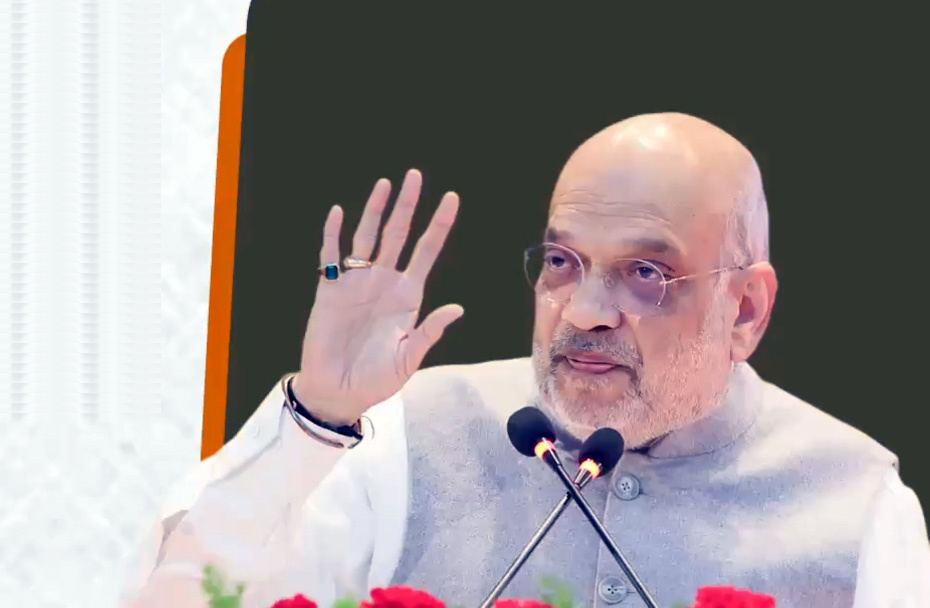
‘Ladakhis took bullets on chest to protect nation’
Return of sacred relics of Buddha
after 75 years historic re-union
LMF, Mother Dairy agreement to
connect UT to national markets
Sanjeev Pargal
JAMMU, May 1: Union Home Minister Amit Shah said today that Ladakh had long pending demand of Union Territory status due to lack of development and the Central Government decision has brought visible changes across different sectors. He declared that the UT remained at the centre of Government’s development agenda.
He said formation of the Sindhu Infrastructure Development Corporation would play an important role in promoting industrial growth in Ladakh in the coming years as we want this border region to become self-reliant.
Follow the Daily Excelsior channel on WhatsApp
On last-day of his two-day visit to the UT of Ladakh, Shah today inaugurated the exposition of sacred holy relics of Tathagata Buddha and the 2569th Buddha Purnima celebrations at Jivetsal in Leh. He also laid the foundation stone of 10,000 liters per day dairy plant in Kargil and launched a series of dairy development initiatives for Ladakh through virtual mode.
He said he has visited the Union Territory after seven years and was glad to be there on Buddha Purnima.
Click here to watch video
“Ladakh is a model of rapid transformation since the 2019 bifurcation of the erstwhile state of Jammu and Kashmir,” the Home Minister said and listed sweeping political, social and economic changes in the Union territory.
Asserting that Ladakh had an old demand to be made a Union territory, he said the basic reason for this demand was that development was not taking place here.
The Leh Apex Body (LAB) and Kargil Democratic Alliance (KDA), the twin bodies of Ladakh, have been agitating for last over five years seeking Statehood and Sixth Schedule status for Ladakh. Though the demand hasn’t been formally rejected by the Centre, the indications are enough that the Government of India is averse to the demands though it was open to giving certain legislative rights and protections through the Hill Development Councils.
Shah was accompanied by Lieutenant Governor of Ladakh Vinai Kumar Saxena, Union Home Secretary Govind Mohan and various other dignitaries.
“Ladakh has now seven districts and 193 Panchayats, with five new districts – Sham, Nubra, Changthang, Zanskar and Drass – created and notifications already issued. Local languages had also been given administrative recognition. Earlier only Hindi and English were in use, but now Bhoti, Purgi and Urdu have also been accorded importance, the Home Minister said, adding the road length has also increased from about 1,799 km before 2019 to 4,040 km now.
He said work on the Zojila tunnel is in progress, construction of the Shinkun La tunnel has started and a new civil airport is also coming up.
Shah said Ladakh’s budget has risen from Rs 1,000 crore when it was part of the erstwhile Jammu and Kashmir State to Rs 6,000 crore now.
Asserting that development in the UT is because of the vision of Prime Minister Narendra Modi, he said that the number of bridges has risen from 19 to 72, a three-time increase while the mobile towers have increased from 344 to 653, and helipads have gone up from seven to 41. The snow-clearing machines, crucial for the region, have increased from 60 to 215. The grid-related works have gone up from 145 to 184, while distribution of have risen from 1,182 to 3,153.
“I am giving these figures on this scale because after becoming a Union Territory, it (Ladakh) has remained the focus of the Narendra Modi Government, the focus of the Prime Minister of the country, and so many development works have taken place together,” he said, adding the impact of better infrastructure was visible in road connectivity, with the Zojila Pass, which earlier remained shut for 127 days, remaining closed for only 19 days this year. Besides, the Kargil-Leh road, which earlier remained closed for nearly 175 days, was shut for only 11 days.
He said that VSAT connectivity has been extended to all Panchayats and major work has been undertaken to upgrade telecom towers. In the education sector, Sindhu Central University has been established, 174 ICT labs set up, 130 smart classrooms created, 40 science laboratories built and 24 Atal Tinkering Labs established.
He said Ladakh became a fully literate administrative unit in 2024 and claimed there was no illiterate person left in the region.
“Nearly 98 per cent households have been provided tap water connections under the Har Ghar Jal scheme, while substantial work has also been carried out in agriculture and horticulture,” he said.
Shah described the return of sacred relics of Lord Buddha to Ladakh after 75 years as a “historic reunion” and said that the UT has remained a “living land of dharma” that preserved and nurtured Buddhist knowledge for centuries.
Stressing the relevance of Buddha’s teachings in modern times, Shah said the message of peace, compassion and the middle path was even more important today than it was 2,500 years ago.
“Ladakh has been a living land of dharma for centuries. When the Dalai Lama comes here, he says this land is not merely a geographical land but a living laboratory of Buddhist culture and compassion,” Shah said in his address after inaugurating the exposition of sacred holy relics of Tathagata Buddha.
He said the land of Ladakh has preserved and nurtured knowledge.
“Whenever Buddhism faced crises, this land worked to protect the teachings of Buddha. And when peace returned, it helped to expand and carry forward that preserved wisdom. Unless one internalises knowledge and makes it a part of oneself, liberation is not possible. Knowledge is incomplete without spiritual practice, while spiritual practice without knowledge is blind. Therefore, the union of spiritual practice and knowledge is the right path. Even with these, if there is no moral discipline, one cannot lead a truly wise life. The basis of a life of wisdom is moral discipline,” the Home Minister said.
Highlighting Ladakh’s role in the spread of Buddhism, Shah said Kashmir was once an ancient centre of Buddhist studies, Mahayana philosophy and Buddhist art, from where Ladakh first came into close contact with Buddhism. Emperor Ashoka’s envoys laid the foundation of Buddhist influence in Ladakh through Kashmir and Gandhara, while Mahayana Buddhism expanded in the region during the Kushan period between the first and third centuries CE.
The Silk Route linking Kashmir, Leh, Yarkand, Khotan and Tibet became a channel not only for trade but also for ideas, monks, manuscripts and artistic traditions. Later, Tibetan influence between the seventh and tenth centuries further enriched Ladakh through Mahayana and Vajrayana traditions, Shah added.
He said it was through Ladakh and adjoining routes that the teachings of Tathagata Buddha, which originated in India, spread to China and several other countries.
“The message that emerged from the land of Ladakh has become a guiding force that helps many people around take their lives forward. The presence of these sacred relics in Ladakh reminds us that India’s civilisation has, for thousands of years, given the message of peace and coexistence,” he said, adding that in a diverse region like Ladakh, this message becomes even more relevant.
He said the return of the relics has boosted the significance of Buddha Purnima for the people of Ladakh.
“These sacred relics have come to Ladakh after 75 years. It is as if Buddha himself is present here today,” Shah said, adding that the followers of Buddhism and other religions in Ladakh and Kargil would draw spiritual energy from the relics alike.
Extending Buddha Purnima greetings to the locals, the minister said that the teachings of Lord Buddha, especially the message ‘Appo Deepo Bhava’ (be your own light), continue to inspire people towards self-reliance and higher purpose.
Stressing the relevance of Buddha’s teachings in modern times, Shah said the message of peace, compassion and the middle path was even more important today than it was 2,500 years ago.
“Amid conflict and unrest, only the path of peace and compassion can provide solutions,” he said.
Shah also appealed to the Ladakh administration to ensure smooth arrangements so that followers of all faiths, especially Buddhists, could visit and pay obeisance to the relics.
Later, addressing another gathering in Leh after launching several dairy projects, Shah praised the people of Ladakh and Kargil for their patriotism and sacrifices in safeguarding the country’s borders.
“Whenever danger came from across the border, the people of Ladakh stood in defence of the nation before the Army reached. The Army reached later. First, the people of Ladakh took bullets on their chests to protect the nation,” Shah said, adding that the whole country — from Kashmir to Kanyakumari and from Dwarka to Kamakhya — knows and appreciates this history.
Union Minister of Fisheries, Animal Husbandry and Dairying Rajiv Ranjan Singh alias Lalan Singh, Ministers of State SP Singh Baghel and Goerge Kurien and LG Ladakh Vinai Kumar Saxena were also present in the function.
Maintaining that ITBP and the Army are major buyers in Ladakh, with around 18,000 soldiers stationed at the borders, he expressed confidence that their requirements of milk, curd, and paneer will be met by this plant. He further stated that a mobile laboratory costing Rs 45 lakh has also been launched, which will greatly help in maintaining milk quality.
“The Android-based AMCS app too has been launched, enabling dairy farmers to transparently monitor their milk accounts on a single platform. This will also boost their confidence,” he said, adding that five livestock farmers who were honoured today are an inspiration for all livestock farmers of Kargil and Leh.
Shah said that Ladakh Milk Federation (LMF) and Mother Dairy have signed an agreement, which will connect Ladakh to national markets. He said that Ladakh’s organic products should get access to the large market of Delhi. He urged the National Dairy Development Board (NDDB) to facilitate a tripartite MoU with the National Cooperative Organic Limited. He added that while Mother Dairy products should be sold here, arrangements should also be made for marketing Ladakh’s products across the country through Mother Dairy and other cooperatives.
He announced plans for a major expansion of the dairy sector in Ladakh and Kargil, including the setting up of a 50,000 liter-per-day milk processing plant in Leh.
The Government is committed to strengthening dairy infrastructure in Ladakh and Kargil to ensure sustainable livelihood and enhance the income of dairy farmers, Shah said.
“We are also working to further strengthen infrastructure in Ladakh as well as in Kargil. In the coming days, a new dairy plant with a processing capacity of around 50,000 liters per day will be set up in Leh at an estimated cost of Rs 70 crore,” he said.
Shah said that cattle breeding centers will also be established in Leh and Kargil at a cost of around Rs 4 crore each to provide high-yielding breeds suited to local climatic conditions and around 500 improved cattle are planned to be introduced annually, with a long-term goal of nearly tripling livestock numbers in the region over the next decade.
 Follow our WhatsApp channel
