

Monthly data tracking flags vulnerable hotspots
Guidelines, multi-agency action plan to curb climate risks
Mohinder Verma
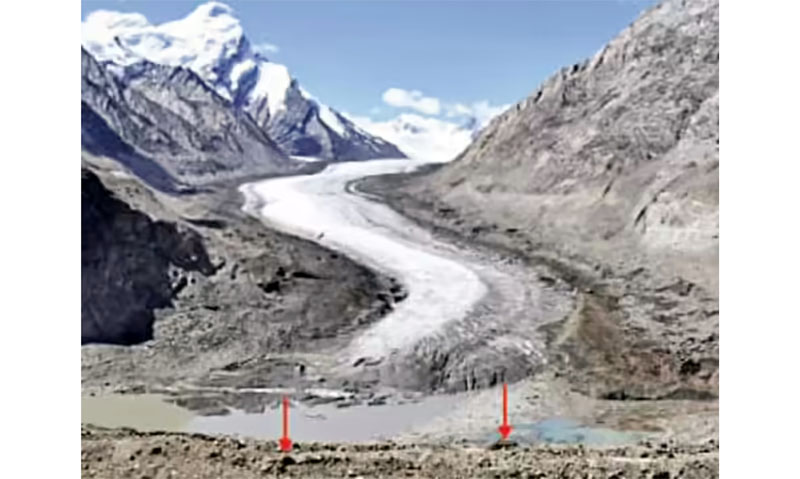
JAMMU, May 1: Amid growing focus on climate resilience, 179 high-altitude glacial lakes in Ladakh are under continuous scientific watch, with experts closely tracking their behaviour through monthly monitoring. The initiative aims to detect temporal changes in water spread area, identify vulnerable lakes and support timely action to safeguard downstream areas from potential hazards.
This has been conveyed by the Central Water Commission (CWC) to the National Green Tribunal (NGT), which is examining the issues of climate crisis, water scarcity and glacier retreat in Ladakh region.
Informing that it is undertaking extensive and systematic monitoring activities, the CWC said, “we are monitoring a total of 2843 glacial lakes and water bodies in the Himalayan Region using advanced Remote Sensing Techniques. Specifically, for Ladakh, we are monitoring 179 glacial lakes and 26 water bodies (with a water spread area of above 10 Hectares. This monitoring is being conducted on a monthly basis from June to October each year, providing crucial data on the behaviour of these water bodies”.
Follow the Daily Excelsior channel on WhatsApp
Claiming that monitoring programme in Ladakh is being progressively expanded, the CWC further informed the National Green Tribunal that while monitoring of 3 large glacial lakes and several water bodies commenced in 2011, an additional 12 glacial lakes were brought under monitoring in 2022. The monitoring of remaining 164 glacial lakes in Ladakh commenced from June last year, demonstrating a phased and comprehensive approach to cover the entire region.
In response to the need for strengthening water management and monitoring glacier dynamics, the CWC has developed and finalized a criterion for risk indexing of the Glacial Lakes. “This scientific framework has been designed to identify and rank glacial lakes based on their likelihood of failure and the potential from a Glacial Lake Outburst Flood (GLOF) event”, the CWC said, adding “the criteria evaluates 12 key factors including the lake’s size, change in size over time and stability of slopes and downstream vulnerabilities”.
Based on the risk indexing, a detailed assessment of 15 glacial lakes in Ladakh was conducted. The results reveal that none of the lakes fall under the high risk category so far. Only, two lakes fall under the moderate risk category and 12 lakes fall under the low risk category. This data driven risk assessment allows for targeted and prioritized mitigation and management strategies ensuring that resources are directed towards areas of genuine concern.
To standardise safety measures, the Central Water Commission has issued two crucial guidelines—Guideline for assessment of GLOF specific to river valley projects in Indian Himalayan Region (IHR), which provide a comprehensive framework for identifying vulnerable glacial lakes and simulating GLOF scenarios to ensure the safety of infrastructure projects.
Similarly, guideline for structural measures to mitigate adverse effect of GLOF on dams/barrages has been designed for engineers and planners and support the integration of risk reduction strategies into infrastructure design.
“These guidelines are instrumental in ensuring that development activities in the fragile Himalayan region are conducted with the best standards of safety and environmental consideration”, the CWC said.
Moreover, the CWC has initiated inter-agency coordination to address these complex environmental challenges. A Steering Committee for Monitoring of Glaciers has been constituted under the chairmanship of the Secretary, Department of Water Resources, RD & GR, MoJS. This committee brings together key national agencies such as National Institute of Hydrology (NIH), National Remote Sensing Centre (NRSC), Wadia Institute of Himalayan Geology, Geological Survey of India (GSI) and CWC, among others, to unify efforts in glacier studies, consolidate data on a GIS-based web portal and develop predictive models for the behaviour of Himalayan glaciers.
“The CWC is not only aware of the challenges in Ladakh but has also implemented a robust, scientifically-grounded and institutionally backed framework to monitor, assess and mitigate the risks associated with climate change and its impact on water resources”, read an official document submitted to the National Green Tribunal.
 Follow our WhatsApp channel
