

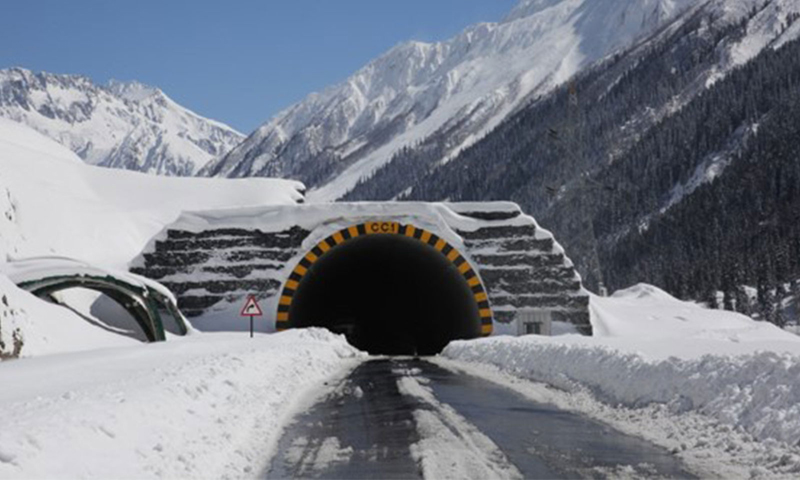
HYDERABAD, , June 7: One of India’s most ambitious mountain infrastructure projects, the ‘Zojila Tunnel’, is set to achieve a historic milestone with its final breakthrough scheduled on June 9, marking the completion of the most critical excavation phase of the project.
The breakthrough ceremony will be attended by union Minister for Road Transport and Highways Nitin Gadkari.
The project is being executed by Hyderabad based Megha Engineering & Infrastructure Ltd. (MEIL) on behalf of the National Highways & Infrastructure Development Corporation Ltd. (NHIDCL).
At 13.153 kilometres, the Zojila Tunnel is described as the world’s longest single-tube bi-directional road tunnel being constructed at such a high altitude, according to Hyderabad based company.
The tunnel stretches from Baltal near Sonamarg to Meenamarg in the Drass-Kargil region and is being built at an elevation of approximately 11,578 feet above sea level.
The project is expected to provide a permanent solution to the long-standing connectivity challenges posed by the Zojila Pass, which remains inaccessible for several months every year due to heavy snowfall, avalanches and extreme weather conditions.
Constructed using the New Austrian Tunnelling Method (NATM), the tunnel is regarded as one of India’s most significant engineering achievements in the Himalayan region.
Besides the main tunnel, the project includes approach roads, bridges, cut-and-cover structures, snow protection galleries and the Nilgrar twin tunnels.
Once completed, it will provide uninterrupted connectivity between Srinagar and Ladakh, significantly improving access to Drass, Kargil and Leh while enhancing civilian mobility, logistics and strategic military movement in the sensitive border region.
The tunnel is also expected to boost tourism, trade and economic development in the region.
Work on the project commenced on October 1, 2020, under some of the most challenging geographical and climatic conditions in the Himalayas.
Temperatures at the site frequently plunge to between minus 20 C and minus 30 C for nearly 100 days each year.
More than 1,200 personnel have been involved in the construction, with nearly 80 per cent of the workforce drawn from local communities.
Over the past five years, the project site has witnessed five major avalanche incidents.
One of the most severe occurred in January 2023, when 172 workers stranded in the area were rescued by the Indian Army.
Despite such challenges, the project has recorded 10 million safe man-hours.
Engineers also faced highly unpredictable geological conditions, with rock classifications changing as many as 67 times along the tunnel alignment. These challenges were addressed through continuous geotechnical monitoring and advanced tunnelling techniques.
To support construction activities, MEIL established a fully equipped base camp capable of accommodating over 1,100 personnel and deployed extensive machinery, including trucks, excavators, loaders, batching plants, crushing units and modern drilling equipment.
The project has also assisted the annual Amarnath Yatra by providing parking facilities, mobile sanitation units and other infrastructure support in coordination with NHIDCL.
The overall project spans 30.894 kilometres, including roads and bridges.
Apart from the main tunnel, it includes the 457.35-metre Nilgrar Tunnel T1, 1,953.63-metre Nilgrar Tunnel T2, three bridges with a combined length of 460 metres, seven cut-and-cover structures extending 2,350 metres, and a 450-metre snow gallery.
The project also features India’s longest vertical shaft measuring 474.3 metres, along with two additional shafts of 367.38 metres and 213.5 metres, designed to support ventilation and emergency safety systems.
Officials said the final breakthrough marks a decisive step towards achieving seamless, all-weather connectivity between Kashmir and Ladakh and represents a landmark achievement in India’s transport infrastructure development.
(UNI)
 Follow our WhatsApp channel
