

By T N Ashok
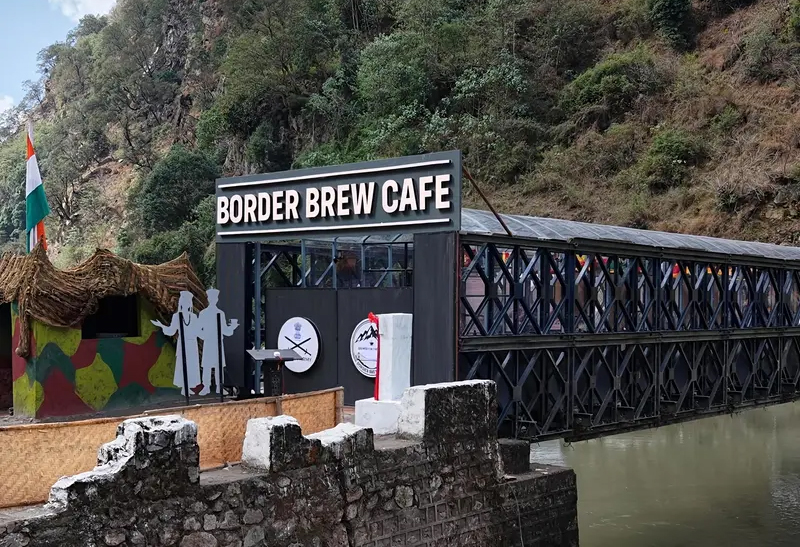
In Tawang in Arunachal Pradesh, there is a café where coffee is excellent. The altitude is 10,000 feet. And beneath your chair, under riveted steel plates that once shook with the boots of soldiers retreating in the bitter winter of 1962, a stream murmurs through one of the most geopolitically charged valleys on earth.
Welcome to what may be the world’s most dramatically situated café — a converted Bailey bridge in Tawang, Arunachal Pradesh, perched in India’s remotest northeast, a land of cloud-draped monasteries and contested borders with China. The aroma of fresh-ground coffee drifts across a wall where the photographs of war heroes stare down at tourists snapping selfies. History and hashtags, occupying the same square footage.
Call it the battlefield-to-Instagram pipeline. A quiet revolution is sweeping the world’s war relics — decommissioned bunkers, bombed-out bridges, forgotten jungle roads — as governments from Delhi to Berlin to Hanoi ask a pointed question: what if the ruins of our darkest hours could become magnets for our youngest citizens?
“A bunker turned café doesn’t erase its past. It reframes it. The cold concrete stays — but instead of fear, visitors feel curiosity.”
The Bailey bridge in Tawang — a modular military design born in World War II, intended as temporary, expendable, urgently useful — was assembled in haste during the 1962 Sino-Indian War, a conflict in which India lost badly, ceding vast territories to Chinese forces. The bridge survived. Thousands of Indian soldiers did not: the nearby Tawang War Memorial bears testament to over 2,000 who gave their lives. That memorial, solemn and granite-grey, stands just a few winding kilometres from the café. The juxtaposition is jarring, then quietly profound. You can grieve and drink good coffee on the same afternoon. Somehow, that feels right.
India is not alone in this reinvention. Across continents, governments and preservationists are transforming sites built for destruction into spaces of education, art, and yes, entertainment — and discovering that Generation Z, a cohort often accused of historical indifference, actually shows up in extraordinary numbers when history is curated rather than merely lectured.
Arunachal Pradesh, long overlooked in mainstream war narratives, is discovering the economic and cultural power of its layered history. During World War II, this region was a critical artery of the Burma Campaign. The legendary Stilwell Road — hacked through unforgiving jungle terrain by Allied engineers — once served as a lifeline between India and China. Today it is being reimagined as a heritage corridor, drawing adventure tourists and history buffs in equal measure.
At Pasighat, the Hump World War II Museum holds wreckage from aircraft that flew the treacherous Himalayan “Hump” route. In Changlang district, a state-of-the-art memorial museum is under development. Forgotten bridges — Laal Pool, Hell Gate, Hamilton Bridge — are being catalogued, restored, given signage, given meaning. The state government is explicitly linking historical preservation to employment generation: memory, when curated thoughtfully, becomes an economic engine.
“You are not simply consuming a beverage. You are inhabiting a narrative — standing on steel that once bore the weight of artillery, fear, and survival.”
Ask any curator at Berlin’s repurposed Tempelhof bunker complex or Hanoi’s War Remnants Museum: the visitors who engage most deeply, who linger longest, who buy the books and share the content, are often the youngest in the room. Something about encountering history in its raw physical form — in a real structure, in real terrain — cuts through the noise of digital saturation in a way no documentary can.
There’s a reason experiential travel dominates Gen Z’s spending priorities. This is a generation that grew up processing the world through screens and developed, perhaps as compensation, a fierce hunger for the tactile and the real. Standing on a Bailey bridge at 10,000 feet above sea level, coffee in hand, staring at mountains that witnessed both catastrophe and courage, delivers something the algorithm cannot: immediacy. The weight of history, felt through your feet.
The world’s most successful examples maintain their power precisely because they refuse to sanitize. Berlin’s bunker galleries keep the concrete raw. Hiroshima’s memorial preserves the skeletal dome of the bombed-out Prefectural Industrial Promotion Hall exactly as it stood after the blast. Tawang keeps its war memorial in full view of the café. The grief and the gentleness are not separated. They coexist, and in coexisting, they tell a more complete human story than any textbook chapter could.
Not everyone is comfortable with lattes next to memorials. The question — where does remembrance end and commodification begin? — is real, and worth asking aloud. Critics of “war tourism” worry that the lightness of leisure bleaches the gravity of sacrifice; that a generation schooled in Instagram aesthetics might photograph a war relic without feeling what it represents.
But the evidence from the most thoughtfully executed projects suggests the opposite. When physical context is preserved — when walls are left raw, when plaques tell honest stories, when the war memorial is not bulldozed for a car park — the café does not trivialize the history. It translates it. It makes it liveable. And a history that is livable is a history that survives into the next generation, which is the only history that ultimately matters.
The Bailey bridge café in Tawang does not replace the War Memorial. It creates a reason to visit the region, to walk down to the memorial, to stand in the thin Himalayan air and read the names. The coffee is the gateway. The grief is the destination.
This is the real genius of what is quietly unfolding in places like Tawang, Berlin, Hanoi, and Normandy. History is no longer being locked in glass cases for dutiful schoolchildren. It is being inhabited. You sleep in a repurposed bunker in Edinburgh. You eat brunch in a WWII hangar in Texas. You sip your morning coffee on a bridge that once bore soldiers into battle in the Himalayas.
And in each of these spaces, the past is not distant. It is beneath your feet. Warm in your hands. Alive in the altitude, in the art on the wall, in the face of the veteran in the photograph who stares back at you with absolute seriousness as you raise your cup.
For Generation Z — a generation of world-builders raised on possibility — that seriousness is not a deterrent. It is an invitation. It says: this happened. Here. On this steel, in this valley, in this world that is still yours to shape.
Drink up. Look around. Remember. (IPA Service)
 Follow our WhatsApp channel
