

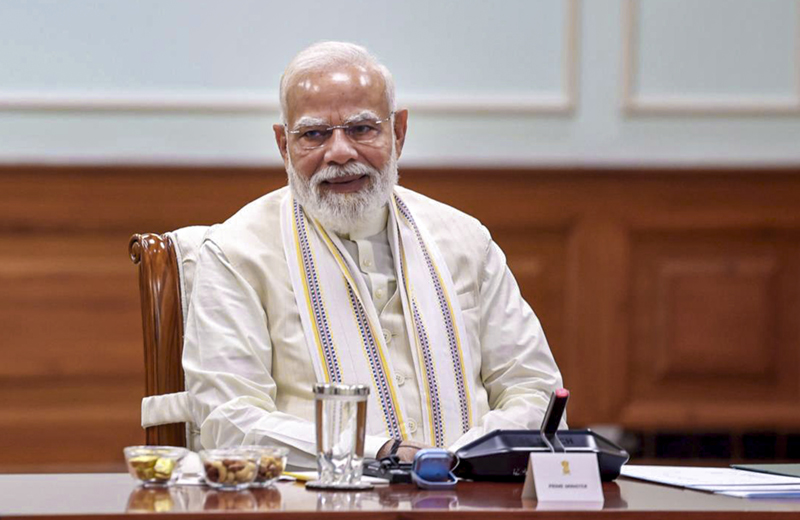
Discusses strategy to sustain growth at EAC meet
NEW DELHI, June 6:
Prime Minister Narendra Modi on Saturday chaired a meeting of the Prime Minister’s Economic Advisory Council, holding extensive deliberations on India’s economic transformation, long-term development priorities and strategies to sustain growth amid rising global uncertainty triggered by escalating tensions in West Asia.
Sharing details of the meeting in a post on X, Modi said, “Chaired a meeting of the Economic Advisory Council to the Prime Minister. Deliberated on a wide range of issues relating to India’s economic transformation and long-term development priorities. Also shared perspectives on adding more momentum to the reforms journey and ensuring ‘Ease of Living’ as well as ‘Ease of Doing Business.'”
Follow the Daily Excelsior channel on WhatsApp
The high-level review comes as geopolitical tensions in West Asia raise concerns over global trade flows, energy supplies and financial market stability.
Against this backdrop, the meeting focused on assessing the potential impact of external shocks on India’s economy and identifying measures to strengthen resilience while maintaining the country’s strong growth momentum.
According to officials familiar with the discussions, the council undertook a comprehensive assessment of risks arising from the conflict in West Asia, particularly its implications for crude oil supplies, international shipping routes and global commodity markets.
Given the region’s strategic importance to India’s energy security and maritime trade, policymakers examined contingency measures to minimise disruptions and protect domestic economic stability.
The Prime Minister is understood to have emphasised the need for preparedness in the face of a volatile international environment, stressing that India must continue advancing its development agenda despite global challenges.
The discussions centred on safeguarding supply chains, containing inflationary pressures and ensuring that economic growth remains on a stable trajectory.
The meeting also reflected the Government’s broader approach of combining short-term crisis management with long-term structural reforms.
Participants reviewed the outlook for inflation and the possible effects of higher energy costs, rising freight charges and supply-chain bottlenecks on the domestic economy. Policymakers noted that while India has demonstrated resilience through successive global disruptions in recent years, sustained vigilance remains necessary as geopolitical tensions continue to evolve.
A key theme of the discussions was strengthening domestic capabilities through greater self-reliance, energy diversification and infrastructure development.
Officials pointed to the Government’s ongoing efforts to reduce dependence on imported fuels through expanded renewable energy capacity, nuclear energy investments and initiatives such as the PM Surya Ghar rooftop solar programme. These measures are viewed as critical to enhancing long-term economic security and reducing vulnerability to external shocks.
The Prime Minister has repeatedly highlighted the importance of sustainable consumption patterns and reduced dependence on imports. In recent weeks, he has urged citizens to adopt measures that contribute to economic stability, including lower fuel consumption, greater use of indigenous products, natural farming practices, public transport, rail freight, carpooling and electric vehicles.
The Economic Advisory Council also reviewed measures aimed at preserving investor confidence and strengthening India’s attractiveness as a long-term investment destination. Discussions reportedly covered policy initiatives to deepen financial markets, improve the investment climate and support continued capital inflows.
These efforts complement the Government’s wider reform agenda focused on improving the ease of doing business and enhancing the quality of life for citizens. Saturday’s meeting took place against the backdrop of robust economic performance.
Official estimates released on Friday projected India’s real GDP growth at 7.7 per cent for the financial year 2025-26, with growth accelerating to 7.8 per cent in the fourth quarter.
According to official data, real GDP in the fourth quarter of FY 2025-26 is estimated at Rs 87.77 lakh crore compared with Rs 81.40 lakh crore in the corresponding period a year earlier. Nominal GDP is projected to have risen by 9.1 per cent to Rs 94.65 lakh crore, while full-year real GDP is estimated at Rs 323.12 lakh crore, supported by strong performances in manufacturing, services and other key sectors.
Economists have noted that India’s growth outlook remains stronger than that of many advanced and emerging economies, but caution that prolonged instability in West Asia could influence oil prices, shipping costs and global investor sentiment, with implications for inflation management, trade competitiveness and fiscal planning.
Against this backdrop, the EAC-PM meeting underscored the government’s determination to remain ahead of emerging challenges through proactive policymaking and long-term planning. By coupling contingency measures for external disruptions with continued investments in energy security, infrastructure and economic reforms, the Government is seeking to reinforce India’s position as a resilient growth engine in an increasingly uncertain global environment.
As geopolitical tensions continue to test economies worldwide, the discussions highlighted New Delhi’s strategy of leveraging strong domestic fundamentals, accelerating reforms and strengthening economic resilience to sustain growth and advance its long-term development ambitions. (UNI)
 Follow our WhatsApp channel
