

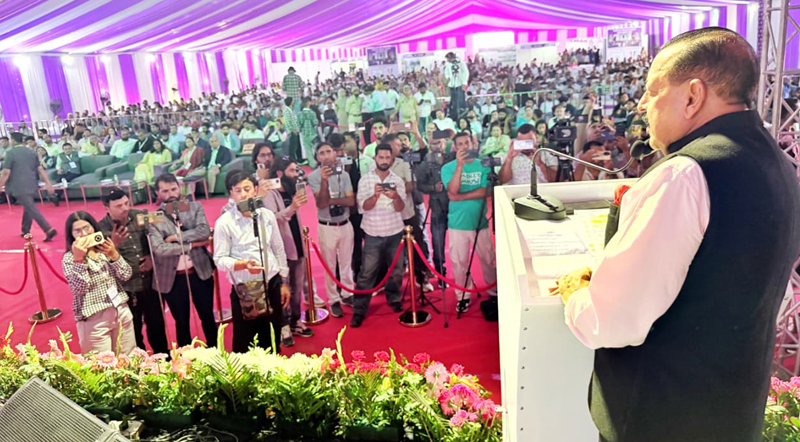
2-day Lavender Festival at Bhaderwah
*Azad lauds Union Minister’s efforts
Avtar Bhat
BHADERWAH, June 6: Union Minister of State in PMO with Independent charge of Science & Technology and Earth Sciences Ministries, Dr Jitendra Singh today said highlight of 12 years of Narendra Modi Government is prioritizing unexplored sectors including Himalayas.
Talking to reporters on the sidelines of inauguration of 4th two-day Lavender Festival 2026 under the theme “Lavender goes Global’’ in Bhaderwah today organised by CSIR Indian Institute of Integrative Medicines (IIIM), Dr Jitendra Singh said exploring of Himalayas has emerged as new avenue of economic generation and transformation particularly in Agriculture and rural sectors.
CLICK HERE TO WATCH VIDEO
The Union Minister said “The value addition will come from unexplored sectors and we have to explore them tremendously for economic transformation both in Agriculture and rural sectors’’.
Follow the Daily Excelsior channel on WhatsApp
Dr Jitendra Singh said though the Bhaderwah has emerged as hub of Aroma Mission and Lavender cultivation, there is need of increasing quantity to export its products to other countries.
Meanwhile, former Chief Minister of J&K Ghulam Nabi Azad, who hails from Bhaderwah, has congratulated Union Minister Dr Jitendra Singh and farmers for Lavender Festival and making it an annual feature. He urged the Central Government to take steps for marketing of Lavender. He said when he was the Chief Minister of J&K in 2007, he too had taken steps to this effect and added that Dr Jitendra Singh has taken keen interest and campaigned for Lavender.
He said the CSIR has 37 branches in the country and every branch has one success story to tell during last 12 years. “Modi gave an impetus to this mission by making the mention of Remote area of Bhaderwah and this mission in his Mann Ki Baat. He said CSIR Lucknow has grown 108 leaves of Lotus and Modi gifted it to the visiting President of Vietnam at Ayodhya.
He said likewise IIIM Jammu gave birth to purple revolution and Lavender cultivation. He said 6000 youth are involved in Lavender cultivation and Aroma Mission in J&K and earlier a farmer earning Rs 15,000 to 20,000 from agriculture is earning in lakhs from Aroma Mission and Lavender cultivation.
He said the startups are not only linked to IT Sector but other fields also. The distillation is done in fields and Government provides market support also. “The Lavender Oil produced by us is better in quality than other nations’’, he added.
Earlier addressing the function, he said “Lavender has given the small town of Bhaderwah a national identity and a national role in India’s economic growth, he said,. What was once considered a remote hill town has today emerged as a beacon of India’s rural StartUp movement”.
BCCI President, Mithun Manhas, who also happens to be a son of the soil, was guest of honour on the occasion. The festival was held to celebrate the remarkable transformation of Bhaderwah from a traditional agrarian region into India’s leading Lavender cultivation and Aroma entrepreneurship hub.
Dr Jitendra Singh described Bhaderwah as one of the most successful examples of technology-led rural transformation in the country. He said the Purple Revolution has demonstrated how scientific research can be translated into sustainable livelihoods and entrepreneurship in remote mountainous regions.
The Union Minister credited Prime Minister, Narendra Modi’s vision of Startup India and science-driven development for the success of the Lavender Mission. He recalled that Modi had dedicated a significant portion of the 99th episode of Mann Ki Baat to Bhaderwah’s lavender success story.
Highlighting the economic impact of the mission, he noted that several young entrepreneurs associated with Lavender cultivation are earning substantial incomes through cultivation, processing and marketing of value-added products. He said Bhaderwah’s model is now being studied and replicated in other Himalayan and Northeastern states.
Dr Jitendra Singh said that Bhaderwah and the entire Doda region have witnessed remarkable developmental progress over the last 12 years. He highlighted the ongoing work on National Highway-244, stating that improved connectivity is transforming the socio-economic landscape of the region and opening new avenues for growth and opportunities.
Dr. Jitendra Singh attributed the success of the Lavender Mission to the active involvement of scientific institutions, industry experts and capacity-building initiatives. He said that sustained handholding, technology support and global-level conferences helped expand the model to other parts of the country.
Emphasising the vision of Viksit Bharat, he said that while the nation celebrates 12 years of transformative governance, planning is already underway for the next two decades. He stressed the need to unlock the potential of unexplored regions, particularly the Himalayan belt, and said that the Aroma Mission is inherently linked to the Himalayan ecosystem and will continue to play an important role in the region’s sustainable development.
In her address, Director General CSIR Dr. N. Kalaiselvi said the Purple Revolution represents one of the most impactful examples of science reaching grassroots communities. She noted that the initiative has successfully linked laboratory research with rural livelihoods and has emerged as a model for sustainable agricultural development across the country.
Professor V.K. Singh of IIT Lucknow highlighted the role of science and innovation in driving rural transformation and praised the CSIR Aroma Mission for successfully translating research into livelihood opportunities for farmers.
Earlier, welcoming the guests, Director CSIR-IIIM Dr. Zabeer Ahmed highlighted the achievements of the CSIR Aroma Mission and its transformative impact on rural communities across the country. Dr. Ahmed said that Lavender cultivation under the Aroma Mission has emerged as one of the most successful examples of science-led rural development in India.
“Over the last three phases of implementation, lavender cultivation has expanded to nearly 1,500 hectares, benefiting more than 4,500 farmers and farming families,” he said. “The initiative has led to the extraction of over 4,000 kilograms of high-value lavender oil and generated cumulative revenues exceeding Rs 18 crore, significantly enhancing rural incomes and creating sustainable livelihood opportunities,” he added.
The venue of the festival witnessed a display of innovation and entrepreneurship with dozens of stalls showcasing lavender oil, perfumes, cosmetics, soaps, incense products, herbal formulations, value-added aroma products, agri-technologies and startup innovations developed under the CSIR Aroma Mission.
The event also featured institutional presentations on the progress of the Purple Revolution, signing of Memorandums of Understanding (MoUs), launch of new lavender-based products, and felicitation of progressive farmers and successful startups who have contributed significantly to the growth of the aroma industry in Jammu and Kashmir.
Among those present on the occasion were MLA Bhaderwah Daleep Singh Parihar, MLA Doda West Shakti Raj Parihar, Prof. Vinod K. Singh, Institute Chair Professor, Department of Chemistry, IIT Kanpur, Chairman, CSIR-Research Advisory Board (RAB) and Mentor, CSIR-IIIM, Director of CSIR-Indian Institute of Chemical Technology (IICT) Dr. D. Srinivasa Reddy, Director CSIR-National Botanical Research Institute (NBRI) Lucknow Dr. Ajit Kumar Shasany, Deputy Commissioner Doda, Krishan Lal, senior scientists, officials, and representatives of startups and farmer groups.
Senior scientists Dr Suphla Gupta, Senior Principal Scientist and Nodal Officer, CSIR Aroma Mission, and Dr Saurabh Saran, Senior Principal Scientist CSIR-IIIM, were also present during the programme along with scientists, researchers, startup founders and representatives from the aroma industry.
 Follow our WhatsApp channel
