

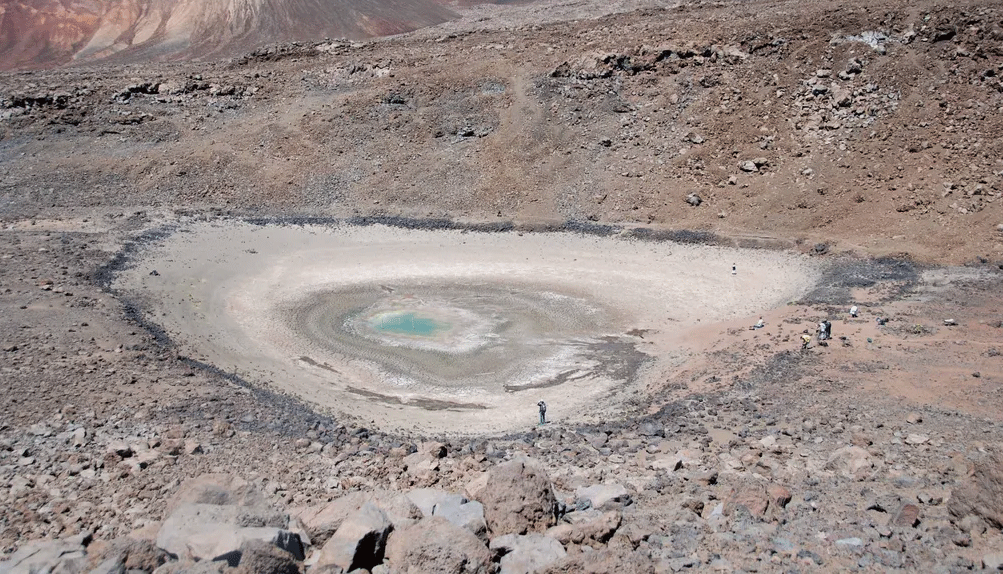
There are crises that unfold with a thunderclap – earthquakes, floods, fires – and then there are those that advance with the quiet, inexorable cruelty of a slow bleed. The vanishing of lakes across J&K belongs emphatically to the latter. No siren has wailed. No emergency has been declared. And yet, according to a damning report by the Comptroller and Auditor General of India, 315 lakes – nearly half of all catalogued water bodies in J&K – have disappeared entirely, while a further 203 have shrunk beyond recognition. In total, 518 of 697 lakes, a staggering 74 per cent, are either gone or gravely diminished. This is not a statistic. It is an ecological catastrophe, and the silence surrounding it is nothing short of scandalous.
Lakes are not merely scenic adornments in a landscape. They are the lifeline of entire ecosystems. They replenish groundwater aquifers that millions depend upon for drinking water. They absorb the fury of monsoon rainfall and release it slowly, functioning as nature’s own flood-control infrastructure. They sustain rich webs of aquatic biodiversity, support avifauna, moderate local microclimates, and nourish the agricultural soils that feed communities. When a lake vanishes, it does not simply leave behind a dry depression in the earth. It leaves behind a wound in hydrology, forest cover, the food chain, and, ultimately, the resilience of human civilisation itself.
The devastating floods of 2014 that ravaged the Kashmir Valley were widely attributed to extreme rainfall. But a closer, more honest reckoning must ask: how much of that catastrophe was amplified by the systematic destruction of the very water bodies designed by nature to absorb such excess? Fewer lakes mean fewer buffers. Fewer buffers mean that a single heavy downpour is sufficient to overwhelm the plains below. The communities that paid with their homes, their livelihoods, and their lives in 2014 were, in part, victims of decades of unchecked ecological negligence.
What makes this crisis particularly unconscionable is human appetite – specifically, the insatiable hunger for land. Wetlands and water bodies have been drained, encroached upon, and filled to make way for construction, agriculture, and commerce. In compromising the ecological systems that regulate climate, water, and biodiversity, we are not simply damaging the environment – we are undermining the very conditions that make life on this planet possible for every species, including our own. Hundreds of crores of public money have been poured into the conservation of J&K’s most celebrated lakes – Dal, Wular, Manasbal, and Hokersar, among others. And yet even these flagship water bodies continue to shrink year upon year. If the nation’s best-funded, most closely watched lakes cannot be saved, what hope exists for the hundreds of unnamed, unprotected water bodies that receive neither funds nor attention?
Equally alarming is the absence of any credible scientific investigation into why so many lakes have vanished. Without understanding the causes – be they encroachment, siltation, deforestation, changing rainfall patterns, or administrative failure – no meaningful corrective action is possible. That lakes within forested areas, where human interference should theoretically be minimal, have also disappeared makes this mystery all the more urgent. An independent expert panel must be constituted immediately to investigate the root causes and prescribe remedial measures.
The NGT’s decision to take suo motu cognisance of this crisis is, therefore, both welcome and overdue. The respondents must now answer for their failure. It will be instructive, indeed, to hear what explanations these departments offer for the disappearance of nearly half the region’s lakes on their collective watch. The Chief Secretary’s recent directive for geo-mapping of all lakes and water bodies is a necessary first step, but it must not become an end in itself. Mapping identifies what is lost; only accountability determines that it shall not be lost again. The Revenue and Forest Departments, as the principal custodians of these water bodies, must be held to that standard. A mandatory annual environmental audit of J&K’s lakes should become a permanent feature of governance – not a response to crisis, but a safeguard against the next one. The drying of J&K’s lakes is a man-made catastrophe. It demands man-made solutions, pursued with the urgency that this silence has, for far too long, denied them.
 Follow our WhatsApp channel
