

Rajeshwar Singh ‘Raju’
rajeshwar68@gmail.com
A True Theatre Actor or Director does not merely perform or command the stage, he breathes life into silence, shapes raw emotions into living stories, and transforms every performance into a soulful dialogue between vision and audience.
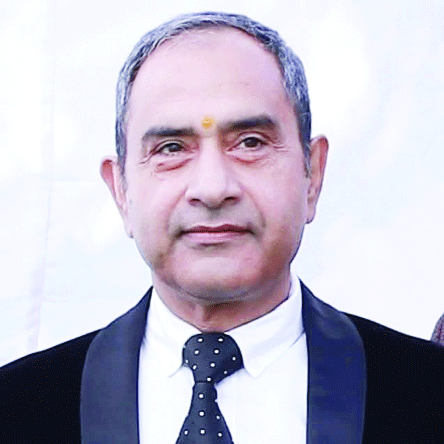
Now, if we talk of Jammu region of UT of Jammu & Kashmir, then undoubtedly it has never lacked talent. Whenever artists from the region have got an opportunity, they have proved their potential and earned recognition not only at the national level but internationally also. It may be attributed to the fact that Theatre in Jammu had a rich and healthy tradition and many theatre groups from the region have brought laurels to it. The credit for this goes to the dedicated theatre practitioners who have continuously contributed to its growth. Among such committed personalities, Anoop Verma is a name that commands respect. For more than four decades now, he has been actively contributing to the cultural life of Jammu with dedication, continuity, and creativity.
Anoop Verma was born on February 01’ 1963 in Jammu. His father Hiralal Verma was a renowned actor and director associated with the Ramleela staged at Billu Mandir, Panjtirthi, Jammu. Anoop Verma received his early education in Jammu and later pursued a career in engineering. He served as a Mechanical Engineer and eventually retired as an Executive Engineer.
Although he worked as an engineer, his passion always remained with theatre and acting. From very childhood, he had a strong interest in performing arts. Like many actors of his time, he first stepped onto the stage through Ramleela. At the age of 12, in 1975, he began his artistic journey with the Saraswati Dramatic Club, Billu Mandir Jammu, performing roles such as Kamdev and Prithvi in Ramleela. This was not just a beginning in acting but the foundation of a lifelong dedication to theatre. In 1979–80, he successfully passed the Radio Kashmir Jammu drama audition and soon became an A-Grade artist of All India Radio, Jammu. His expressive voice and performances made him popular among listeners. He acted in more than 150 radio plays covering social, historical, and psychological themes, working alongside many senior and renowned artists. In 1980, he formally entered regular theatre and founded the Shivani Cultural Society, which later became an important institution in the theatre movement of Jammu.
While performing to dictates of others, he got inclined to Direction. Along with acting, Anoop Verma gradually moved into theatre direction. His first directed play, TASVEER was staged in 1988. From then onwards, he established himself as a thoughtful and capable director. He directed many significant plays such as Baki Itihas, Mahasagar, Ant Nahin, Raktbeej, Kahan Ho Fakir Chand, Othello, Oedipus And Caligula. These productions were appreciated not only for their artistic quality and strong social themes but for skillful direction also. Under the banner of Shivani Cultural Society, Anoop Verma directed many plays. His group has received more than 50 awards at theatre festivals organized by the Jammu & Kashmir Academy of Art, Culture and Languages.
He has received awards and honors from different Government and Non-Government Organizations for his colossal contributions in the field of theatre from time to time. As an actor, he received an award in 1981–82 for the play Gharonda. As a director, he was honoured eight times with the Best Director Award for plays such as Baki Itihas, Mahasagar, Ant Nahin, Mahanirvan, Raktbeej, Kahan Ho Fakir Chand, Othello And Oedipus. He also received appreciation certificates for productions like Ek Aur Dronacharya, Ek Sapne Ki Maut And Caligula.
One of his most notable achievements came in 2024, when the Saraswati Dramatic Club, Billu Mandir, Panjtirthi, Jammu entrusted him with directing the Ramleela. He decided to stage the Dogri Ramayan written by his father, Late Hiralal Verma. This Ramleela was unique because he presented it entirely in a Dogri cultural setting. Instead of traditional Ramleela costumes, he used Dogri attire thus connecting the performance with the local culture. Although this was a bold experiment, audiences warmly welcomed it. The Dogri Ramayan was staged again in 2025, and several local television channels broadcast it live, bringing the production wide appreciation.
When we advocate for preserving and promoting our cultural existence as a proud Dogra, then such efforts become inspiring ones for others and may boost a movement much needed for the survival of mother tongue Dogri and cultural heritage of Dogras. But such steps need not only courage but a basic instinct for exploring self-existence. When we step in search of self, then we encounter our own roots which cannot be denied under the influence of cultural invasion of other regions. Love for all cultures and cultural exchange is good, but we have to take care that such an affection should not make a dent for our own mother tongue and cultural heritage. Anoop Verma has been working with zeal and enthusiasm for promotion of mother tongue and culture through his own expression i.e. Theatre for which he is well known. Now Theatre plays a significant role in fulfilling such commitments. He is of the opinion that there is no dearth of talent in the region, but such talents need a meaningful direction so that the efforts made should yield substantial results also. The theatre groups committed to theatre should focus on one vital point that every production has a reason to be performed. If the productions do not last long in the memories of theatre lovers, then there is no fun of putting in lot of futile efforts to showcase the talent. Every theatre production is teamwork and the performance should reflect it in real sense.
In today’s digital age, when theatre faces many challenges and audiences are gradually declining, dedicated artists like Anoop Verma continue to keep the stage alive. His work shows that art is not just a profession but a form of devotion. His dedication remains an inspiration for future generations, and his contribution will always be remembered in the cultural heritage of Jammu.
 Follow our WhatsApp channel
