

Dr. Akshay Gupta
drakshay.ortho@gmail.com
Competitive examinations have always been associated with hard work, discipline, sacrifice, and ambition. Yet, at certain moments, they begin to test something far deeper than academic preparation alone – emotional resilience, patience, adaptability, and the ability to remain calm during uncertainty.
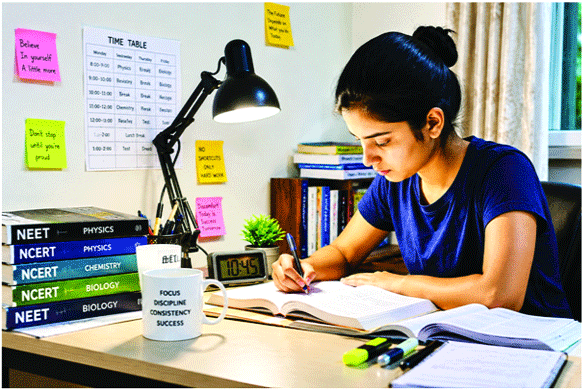
For many young students preparing for examinations like NEET, the journey often becomes emotionally demanding long before they enter the examination hall. Years of preparation bring expectations, comparisons, fear of failure, social pressure, and silent anxiety carried within young minds still learning how to deal with uncertainty.
As teachers and parents, we frequently witness students investing not only time and effort, but also their emotional energy into these examinations. In such phases, maintaining mental balance becomes as important as academic preparation itself.
The emotional challenges faced by students today also remind us of another extraordinarily difficult phase experienced during the COVID-19 pandemic. The year 2020-21 disrupted routines across the world. Educational institutions remained closed, academic sessions were delayed, and students preparing for competitive examinations suddenly found themselves studying in prolonged isolation.
For many aspirants, uncertainty became part of daily life. Examination schedules kept changing, routines lost structure, and prolonged screen exposure gradually affected concentration and emotional well-being. The same mobile phone that enabled online learning also became a source of distraction, fatigue, comparison, and mental exhaustion.
There were days when students prepared alone in their rooms, disconnected from classrooms, friends, libraries, and normal social interaction. Outside, roads were silent during lockdowns; inside homes, young minds were struggling to remain focused while carrying anxiety about their future.
During that challenging period, my son, Tanmay Gupta, presently an MBBS intern at All India Institute of Medical Sciences Delhi, was also preparing for NEET amidst the same uncertainty faced by lakhs of students across the country. Like many others, he too experienced prolonged preparation, delayed schedules, and the challenge of sustaining focus in an increasingly distracting digital environment.
One important lesson that emerged from that phase was that success in competitive examinations depends not only upon intelligence or long study hours, but also upon emotional discipline. Students who maintained routine, protected their mental peace, avoided unnecessary panic, and continued moving steadily despite uncertainty were often able to sustain consistency during difficult times.
Young aspirants today must understand that temporary uncertainty does not define their future. Life itself is filled with unexpected delays, altered plans, and unforeseen challenges. The ability to remain composed and continue working with sincerity despite uncertainty becomes one of the most valuable strengths a person can develop.
At such times, panic can become the greatest obstacle. Endless social media discussions, rumours, comparisons, and constant exposure to emotionally charged conversations gradually drain concentration and confidence. Instead, students should focus on preserving balance in their daily lives.
Simple but important measures can help:
* maintain a disciplined routine,
* continue revision regularly,
* ensure adequate sleep and physical activity,
* limit unnecessary social media exposure,
* speak openly with parents, teachers, or mentors when stress becomes overwhelming,
* and avoid comparing one’s journey continuously with others.
Equally important is the role of parents. Children often absorb parental anxiety more deeply than parents realise. Repeated discussions about uncertainty or fear of failure may unintentionally increase emotional pressure. What students require most during stressful phases is reassurance, emotional stability, encouragement, and confidence that their worth is not determined by a single examination.
As educators, we must also remember that behind every roll number is a young mind trying to build a future while silently dealing with emotional struggles invisible to the outside world. Compassion, balanced communication, and guidance therefore become extremely important during such periods.
Competitive examinations may open doors to professional careers, but resilience, emotional balance, and perseverance shape individuals throughout life. Years later, students may forget the uncertainty surrounding an examination, but they will always remember how they learned to remain steady during difficult times. Often, it is this quiet emotional strength developed during adversity that becomes the real success of life.
(The author is Professor of Orthodontics, IGGDC Jammu)
 Follow our WhatsApp channel
