

Ansh Chowdhari
ansh.choudhari@gmail.com
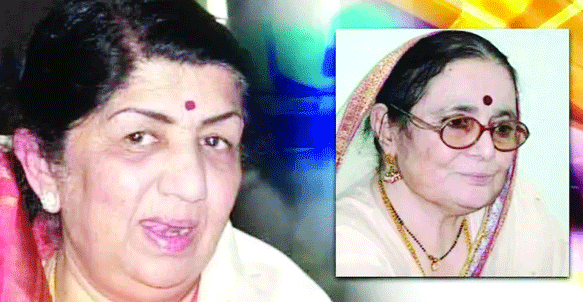
This eponymous title of my write up resonates perfectly with the same book written by Padma Sachdev on Lata Mangeshkar, which explores an entire spectrum of friendship forged in the crucible of love between the two. And here too the relationship that evolved between both of them transcended the conventional meaning of the friendship and assumed the warmth of a sisterhood. And it was this equation that inspired Padma ji to make Lata ji lent her sweet voice to Dogri songs. In Padma ji’s words “I wanted the world’s greatest singer to lend her voice to my mother tongue”.
The story begins in the late 1960s, when Padma ji was living at Darbhanga House in Mumbai, where her husband was posted with the Income Tax Department. Her residence was situated barely a seven-minute walk to Didi’s home on Peddar Road. The yearning of Padma ji to hear Didi singing her Dogri songs mended destiny in a manner that when the former was once visiting her family in Jammu, she got accosted by a man named Inder Goyal at Pacca Danga, a Sitar player, who happened to be a good friend of Baal (Hridyanath). On asking if she has ever met Baal in Mumbai, he met with a coarse expression from Padma ji-unable to access that information.
On reading some puzzled expressions on her face, he clarified that he meant Hridyanath Mangeshkar. Before parting, he entrusted her to give one ‘potli’ to Hridyanath in Mumbai. She carried it with an immense care and excitement, almost as if she had received the key to unlock the doors of the Mangeshkar household and bring her cherished dream within reach. She took that Potli to Mumbai at the Mangeshkars and then saw Lata Baai for the first time in her life in a white Saree. This fleeting encounter would later on, acquire momentous proportions, not least because of the profound bond of affection and admiration that they both had for each other.
Thereafter, when she became a regular at the Mangeshkar household, she ingratiated herself with the entire family due to her jovial nature and extreme devotional deference for Didi. She sang and took part in the wedding ceremony of Hridyanath ji where she, in her own words, brought life to their sangeet ceremonies with her folk songs. Lata ji, in turn, took great care of her. It won’t be an exaggeration to say that she became a extended part of the Mangeshkar family. Her association with Maai (Didi’s mother) was too deeply emotional. She received a lot of fodder material about Didi’s life from her. She had also nurtured a tremendous bond with Hridyanath Mangeshkar and three other Mangeshkar sisters and their families.
Padma ji’s dream finally reached fruition in 1972 when she recorded these four songs in the voice of Lata Mangeshkar. These songs – Bhala Siphaiya Dogra, Toon Malla Toon, Oodhnu rangi de Lalariya and Nikkade Phangdu uchi Udan- were subsequently released in 1973 as an EP HMV record marketed as ‘Dogrein gi milan aayi channani-Lata Mangeshkar. The music of the album was provided by Padma ji and Hridyanath ji worked as an arranger for this record.
The Dogri songs rendered by Lata Mangeshkar have, in many ways, made them immortal for times to come. The magical divinity and spiritual resonance that comes in its wake is too difficult to put in words. Among them, “Bhala Siphaiya Dogreya” has come to occupy an almost anthem like status for the people in J&K and Himachal in general and the Dogra Regiments in particular. The song evokes the millennia old martial tradition of the hills while simultaneously giving voice to the quiet anguish and longing endured by the soldier’s lover, separated from her partner by duty and war.
The other song Tu Malla Tu is essentially a Lori which waxes eloquently about the mother’s lover for her child and the deep connection that they both share. These songs brought forth the timeless melodies of Dogri folk to the national stage a and made them quintessential favourites of everyone.
While the lyrics for Toon Malla Toon and Nikkade Phangdu were written by Padma ji herself, Bhala Siphaiya was penned by Kishan Smailpuri and Oodhnu Rangi de was written by Parmanand Almast ji who incidentally was also present in the recording room that day.
An anecdote that has been recorded in the book says that once when Padma Ji was singing a Dogri Lori for Aadinath (Hridyanath’s son) in their balcony, Didi heard her sing and passed a graceful smile. On another occasion, when both Didi and Padma ji called upon Meena Kumari to enquire about her poor health, went to the latter’s residence, Didi introduced her as the Dogri poetess.
The social capital that Padma ji cultivated in Mumbai was getting further expanded with each passing year. In this regard, a memorable instance was during the making of a light and sound show on Kashmir by Chetan Anand in which he needed a Kashmiri singer. Anand then asked Padma ji to sing one in her own voice and then she sang Mehjoor’s, volaa karayo lolamata laay madno, in the presence of Pandit Shiv Kumar Sharma. Encouraged further by Chetan Anand, she also sang her one in Dogri, Pal Bhar Bai Jaana, which Pandit ji acknowledged with great warmth and grace. Recalling their shared roots, she fondly remarked “jammu ke panjtirthi mohalle mein Shiv ji ka ghar aur mera bhi, inko Shiv ji se Pandit Shivkumar Sharma hotay mainay dekha hai” (“In Jammu’s Panjtirthi locality, Shiv ji’s home and ours were both situated. I have seen him grow from Shiv ji into Pandit Shivkumar Sharma.”)
Not only has she elaborated about her relationship with Didi but has also explored other facets of her life which included a vivid artistic association with varied individuals of multiple fields-from art to media to films. One such association of hers was with Ved Rahi, a veteran Dogra writer and director for whom she wrote songs for the films like Prem Parbat in 1972. Songs like Ye Neer Kahaan se Barse and Mera Chhota sa Ghar Baar became national favourites despite the film never getting released because of some technical issues.
Another touching instance recorded in the book that caught my attention was when the author and Didi met MS Subbulakshmi on the latter’s visit to Mumbai wherein she was introduced by Lata ji as “Padma, meri Saheli hai aur Dogri ki kaviyitri hai”( Padma is my friend and a poetess of Dogri). Subbulakshmi ji, on hearing about Padma ji’s Dogra roots, responded that she had heard Dr Karan Singh singing Dogri songs.
Even after 54 years after these songs were recorded and when both Lata ji and Padma ji have passed away, these timeless melodies continue to evoke deep nostalgia and love for our culture, language and for the singer that graced her voice for the same.
 Follow our WhatsApp channel
