

Chetan Prabhakar
chetanprabhakarassociates@gmail.com
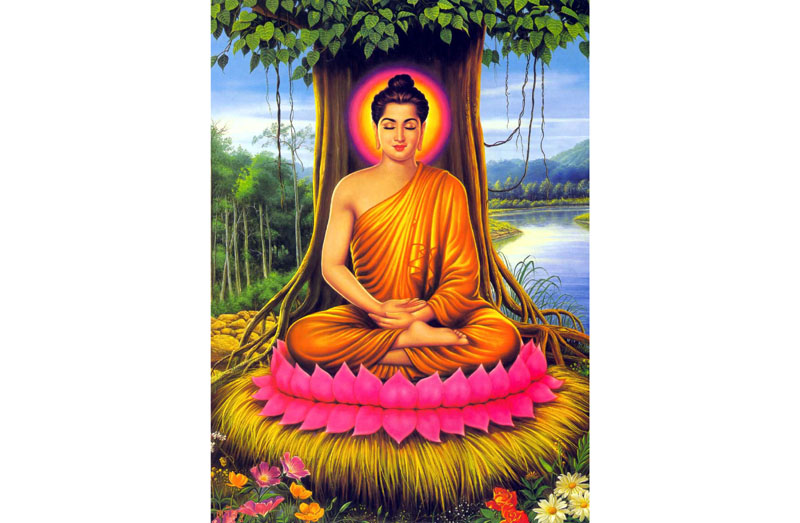
On the luminous occasion of Buddha Purnima, the mind is invited not to celebrate outwardly, but to turn inward-toward stillness, toward awareness, toward that subtle space where identity dissolves. The life of Gautama Buddha is not merely a historical narrative; it is a living inquiry into suffering, perception, and liberation. What he discovered beneath the Bodhi tree was not a belief system, but a direct seeing-an unfiltered recognition of reality as it is.
At the heart of this realization lies Nirvana-not as a mystical heaven, but as the extinguishing of illusion. In Buddhism, Nirvana is the cessation of craving, ignorance, and the false sense of a permanent self. It is not annihilation; it is clarity. The flame of ego is not violently put out-it simply runs out of fuel. This is the essence of Nirvana in Buddhism: freedom not by acquiring something new, but by seeing through what was never real to begin with.
This insight finds a powerful parallel in Zen Buddhism, where the emphasis is even more radical. Zen refuses to indulge in philosophical complexity. It cuts directly to experience. A Zen master might answer a profound question with silence, or a seemingly absurd response-not to confuse, but to break the habitual patterns of thought. Zen points to a truth that cannot be explained, only realized.
In Zen, the concept of no-mind (mushin) is central. It is a state where the mind is not cluttered by Thoughts, judgments, labels, or attachments. It does not mean absence of awareness, but purity of it. When you look at a flower without naming it, without comparing it, without projecting meaning onto it-that is Zen. It is immediate, direct, and free.
Interestingly, this stripping away of identity and illusion is not unique to Buddhism. It resonates deeply with the non-dual philosophy of Kashmir Shaivism. While Buddhism often speaks in terms of emptiness (??nyat?), Kashmir Shaivism speaks of fullness-Chit, pure consciousness. Yet both arrive at a similar experiential truth: the dissolution of the limited self.
Kashmir Shaivism asserts that the individual self is not separate from the universal consciousness, Shiva. The problem is not that we are bound, but that we believe we are bound. Liberation (moksha) is simply the recognition of one’s true nature as infinite awareness. This is not achieved through renunciation of the world, but through a deeper penetration into it-seeing the divine in every perception.
This idea finds poetic and philosophical expression in the Nirvana Shatakam by Adi Shankaracharya. Though rooted in Advaita Vedanta, its essence aligns strikingly with both Buddhist and Shaiva insights. The opening line declares:
“I am not the mind, intellect, ego, or memory…”
With each verse, the seeker negates layers of identity-body, senses, emotions-until nothing remains that can be objectified. What is left is pure awareness, beyond description. The refrain echoes:
“I am of the nature of pure consciousness and bliss – I am Shiva, I am Shiva.”
This is not a declaration of ego, but its dissolution. It is not saying “I, the person, am God,” but rather, “what I truly am is not this limited form-it is the infinite and it is conscious bliss ful”
Thich Nath Hanh, the revered Zen Master said, Happiness is a choice, a habit which we consciously chose by being mindful.
The Buddhist notion of Anatta-no-self. One says “I am everything,” the other says “there is no I.” But both are pointing to the same transcendence of individuality. When the false self is removed, what remains cannot be captured by language. Whether you call it emptiness or consciousness becomes secondary.
The term Nirvana in Buddhism-often understood as the state or principle of Nirvana-emphasizes this lived realization. It is not a concept to be debated, but a state to be embodied. The Buddha did not ask followers to believe in Nirvana; he asked them to observe, to meditate, to see for themselves.
This is where Buddha Purnima becomes more than a ritual. It becomes a mirror. A challenge. Are we living in awareness, or are we trapped in conditioning? Are we reacting, or are we seeing?
Zen would say: drop the question.
Kashmir Shaivism would say: recognize the one who is asking.
Shankara would say: negate everything that is not real.
Buddha would say: observe without attachment.
Different paths. Same direction.
What unites these traditions is not doctrine, but method. All of them demand ruthless honesty. Not belief, not faith, but direct experience. They dismantle the ego-not gently, but completely. And what remains is not emptiness in the negative sense, but a profound stillness, a clarity that is untouched by suffering.
In today’s world, where identity is constantly reinforced-through social roles, achievements, and external validation-these teachings are not just relevant, they are necessary. They remind us that beneath all labels, there is something unchanging. Not a soul in the religious sense, not a personality-but awareness itself.
To touch that awareness, even for a moment, is to understand what Buddha discovered. It is to experience Nirvana-not as an abstract goal, but as a present reality.
So on this Buddha Purnima, instead of seeking inspiration from outside, sit quietly. Watch your breath. Observe your thoughts. Don’t try to control anything. Just see.
And in that seeing, if even for a second, the noise drops, one can understand everything these traditions have been pointing to.
No words. No philosophy. Just silence.
(The author is a Mindfulness Master at Serenity Sphere Foundation)
 Follow our WhatsApp channel
