

Anil Anand
a.anil.anand@gmail.com
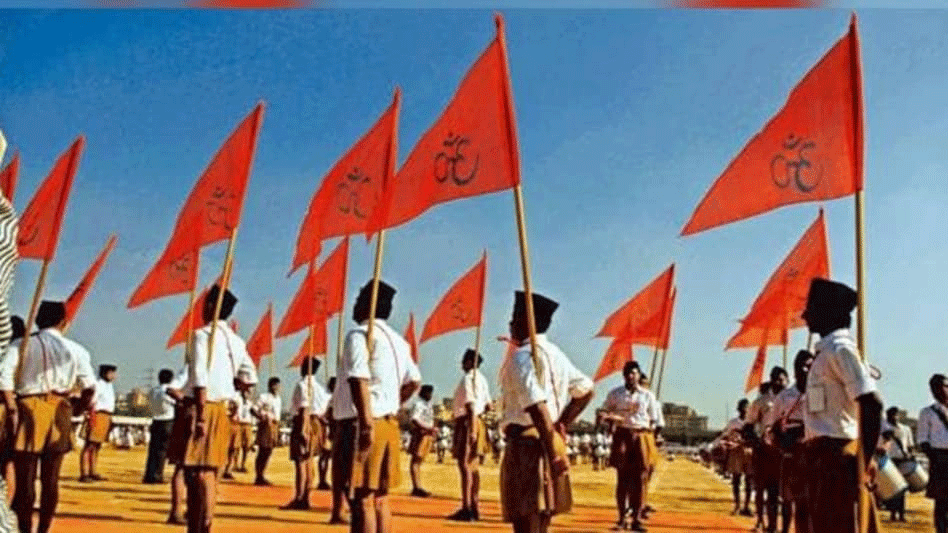
Rashtriya Swayamsevak Sangh (RSS), mentor and strong umbilical link of the ruling Bharatiya Janata Party (BJP), advocating peace efforts with Pakistan! And that too one year after Operation Sindoor was launched by the Indian Armed Forces in retaliation to the April 2025 terrorist attack in Pahalgam, Jammu and Kashmir, which claimed lives of 26 innocent civilians and tourists.
It might sound unbelievable under the gaze of the hardline and anti-Pakistan and Hindutva-agenda driven Narendra Modi regime which had embarked on a hot-pursuit against Islamabad- at least for political consumption- ever since PM Modi’s futile attempt at extending an olive branch by inviting the then Pakistan Prime Minister Nawaz Sharief, to his swearing-in ceremony in 2014. And later a failed unscheduled but certainly not unplanned sudden visit to Lahore to attend a family function at Mr Sharief’s residence.
Even after a decade, the insiders’ story on who advised Mr Modi to visit Pakistan contrary to his hardcore image, based on hyper-nationalism and Hindutva which was for everyone to see in the 2014 Lok Sabha poll campaign, has still to see light of the day. Or who fixed the timing for the same just in the beginning of his innings as Prime Minister. It did pay electoral dividend to the Modi-led BJP as it scored series of poll victories subsequently, pursuing the hardcore anti-Pakistan line.
Nevertheless, it was a welcome move. It amplified the fact that the dialogue has no alternative. The only issue is how and when to hold peace talks. Here comes into play the surprise statement of one of the top leaders of the RSS.
So, RSS general secretary Mr Dattaterya Hosabale’s recent call for peace talks with Pakistan took everyone, including a sizable section within the broader Sangh Parivar and hardcore Hindutva support base of the BJP, by surprise. It has given rise to questions whether the move is of the RSS’s own making or done at the behest of the Narendra Modi dispensation? Or more importantly, the RSS acted under an external pressure, ostensibly the USA given the overriding Donald Trump phenomena dictating terms?
Mr Hosabale’s statement some interesting accompaniments attached to it. It found immediate endorsement in the words of former army chief Gen M M Naravane who underlined the importance of maintaining communication and people-to-people ties between India and Pakistan. Ordinary citizens on both sides share similar everyday concerns and aspirations, he said giving strength to the RSS move.
Indo-Pakistan relation, war or peace, has never been short of theatrics, star-studded shows and high-profile summits. Nehru-Liaquat Pact, Shimla Agreement, Vajpayee-Musharraf summit, or the famous Amritsar-Lahore Bus yatra led by the then Prime Minister Mr Atal Bihari Vajpayee that included prominent persons from diverse fields including the evergreen cine-star, Mr Dev Anand, and last but not the least the controversial Inder Kumar Gujral doctrine.
The Modi government did not dare to undertake a new initiative till the time the international scenario started undergoing dramatic changes particularly after Operation Sindoor and the West Asia conflict involving Iran, USA and Israel directly, and Pakistan, China and Russia by proxy. Is Mr Hosabale’s ice-breaking observation an indication of a fresh peace overture in the offing?
Yet, another significant and related development has taken place across the border with Pakistan, during the same while, deciding to rename some locations in Lahore to their historic Hindu, Sikh, Jain and British colonial era origin. It has been done under the garb of a massive Lahore Heritage Areas Revival project.
If Mr Hosabale’s call for peace talks with Pakistan, and its endorsement by none other than a former army chief, has great significance particularly as it has received a silent endorsement from the Centre, no less important is restoration of old identity of some localities in Lahore. Since the localities, some related to Hindu, Sikh and Jain religions (RSS considers it as part of larger Hindu pantheon despite protestations from the other side), the Pakistani authorities, probably, have done this to pander to the Hindutva agenda vigorously pursued by the BJP with the backing of the RSS, in order to provide them elbow space with their hardcore support base in mind.
Certainly, if RSS, found a fertile ground to establish itself by exploiting the sentiments in the aftermath of the 1947-partition and all-along pursued a hardline against Pakistan and a vice-versa role played by extremist Islamist elements on the other side of the border, and it now authors a peace initiative, its significance cannot be lost on anyone.
Does it reflect a tectonic shift in the Sangh Parivar- Narendra Modi government’s outlook towards Pakistan? What has led to this sudden yearning for peace talks with Islamabad, and the sudden love of Pakistan’s current dispensation for Hindu-Sikh-Jain heritage after its systematic destruction in pandering to the hardcore anti-India and anti-Hindu sentiment?
Past history suggests that no peace effort, including ceasefire after the wars, between India and Pakistan has taken place without external pressure or mediation. It will be a naivete to think that the RSS acted on its own to open a window for the Narendra Modi government to act, thereby shunning the hardcore image of the Sangh Parivar and the central dispensation. By doing so the RSS seems to have not only taken load of Prime Minister Mr Modi’s shoulders but also opened a safe passage for him to wade into hitherto forbidden territory to initiative peace efforts.
Whatever be the reason or compulsion, a peace effort should be welcomed by all desiring peace in the Indian sub-continent. It is important given the vulnerability to become a flash-point and added interest shown by the world-powers due to its strategic location.
Despite the fact that Mr Modi, through his sheer dominance, has created a situation where RSS needs him more than he needs the RSS, the Sangh coming on board on a sensitive issue such as peace-talks with Pakistan, is a tactical move of great significance for him also. These are the starting moments. How would Mr Hosabale’s advocacy for peace with Pakistan or the restoration of old symbols particularly of Hindus, Jains and Sikhs in Lahore to be followed elsewhere in Pakistan also (as claimed in reports from Pakistan), really unfold and lay the table for peace talks, will be keenly watched.
All Prime Ministers, since 1947, including Mr Modi did take initiatives at restoration of peace with Pakistan. In fact, he went a mile ahead, keeping aside his hardcore ideological beliefs and Hindutva based politics, to visit Pakistan which many of his predecessors either avoided (for good reasons) or did not get an opportunity to do so, speaks volumes about the necessity for peace between Indian and Pakistan. This is so given the strategic location of the sub-continent and ever-growing interest of super-powers namely USA, China and Russia. This is not to suggest that hot-pursuit will not be an option if Pakistan indulged in any misadventure, directly or indirectly.
“You can change friends, but not neighbours.” Former Prime Minister Mr Vajpayee’s golden words hold significance and should be rooted in any future peace endeavour with Pakistan. The other side must realise that it needs two to tango and Pakistan has much to deliver to establish its credibility.
 Follow our WhatsApp channel
