

Dr. Banarsi Lal and Dr.Suja Nabi Qureshi
kvkreasi@gmail.com
Union Territory of J&K is endowed with ample natural resources including soil, water, climatic condition, diversity, topography, rich natural flora etc. which are conducive for the cultivation of a wide range of crops.It is a mountainous Union Territory in which Jammu region is predominantly sub-tropical while Kashmir is temperate. Agriculture plays the pivotal role in the economy of J&K. Agricultural sector is very vast and it provides employment directly or indirectly to around 70 per cent of J&K population. Agriculture contributes about the significant amount of J&K revenue which signifies the overdependence of this territory on agriculture. The average size of land holding of J&K is only 0.67 hectare against 1.06 hectares’ land holding size on national basis. About 30 per cent of the area of J&K is under cultivation. The agro-diversity of J&K varies from sub-tropical in Jammu region and temperate in Kashmir region. The average annual rainfall of these three regions is 1069mm and 660mm respectively. The average temperatures of these two regions are 24.5 and 13.3 Centigrade respectively. There is need to increase the income and employment in agriculture and allied sectors for the farmers in J&K. This is possible to increase the production and productivity of the crops and to enable the farmers to diversify their crop production. There is need to promote the diversification in agriculture and move towards high value crops such as saffron, vegetables, aromatic and medicinal plants, mushroom, beekeeping, silk worms, pulses etc.
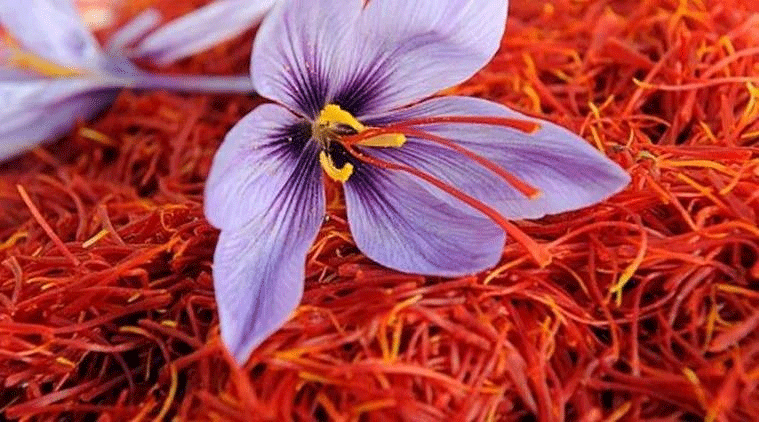
Saffron (Crocus sativus) occupies an important place in the agricultural sector of J&K.It is one of the most important spices in J&K.It is a perennial crop.It is a slender, dried, reddish brown, flattened stigma of cultivated saffron plant. It has various names such as Kesar, Zafran, Kang Posh etc. Saffron flowers are the symbol of freshness and purity. There are various types of flowers grown in J&K but saffron flowers have their own utility and importance. In the Indian agriculture, saffron cultivation is known as the ‘Golden Zest’. In India, 5,707 hectares of land comes under saffron cultivation and out of it 4,496 hectares of land is cultivated in J&K. After fruits production saffron cultivation is the second largest activity in J&K. The diverse climatic conditions, fertile soil, sub-tropical, semi-temperate, temperate and arid climatic conditions in J&K offer an immense scope for cultivation and production of different crops. Among the major horticultural products saffron is one of the most important exporting crops and plays an important role in income and employment generation for the rural people of temperate regions of J&K. The main cultivation areas of saffron are Kharewa, Chandhora, Pampore areas. District Pulwama, commonly known as saffron bowl of Kashmir. It is dominant in saffron production followed by Budgam, Srinagar and Kistwar districts. A hundred Kg of fresh saffron flowers yield about three Kg of dehydrated stigmas. Pure saffron consists of only the orange-red stigmas of the saffron plant.
Saffron is the world’s most expensive spice.India ranks second to Iran in saffron production.Saffron is very famous in the world due to its fine flavour, colour and medicinal value. It is low volume cash crop. It is estimated that about 49 per cent of saffron produce is exported from J&K. The saffron is one of the oldest commodities of Jammu and Kashmir. It has been observed that every year around 2,128 kilograms of saffron is produced from Pampore and its neighbouring areas. But during last few years the production the saffron cultivation is under threat due to uncertain climatic conditions and the insufficient irrigation facilities in J&K. There is need to enhance the area, production and the productivity of this important spice in J&K as it is a good source of earning foreign exchange for the country as a whole. Saffron cultivation in J&K has its historical roots from Iran where world’s largest amount (about70 per cent) of saffron is produced. Saffron has many uses in industries such as food, pharmaceutical, cosmetic and perfumery as well as in the textile dyes. It is very effective in the treatment of various diseases. Saffron stigma has antioxidant activity and thus it prevents the degeneration of cells by free radicals. The components of saffron, crocin and safranal shows role in the suppression of inflammatory pain responses, decreases the number of neutrophils and also possesses strong activity against various bacteria and fungi. It has a protective effect against nephrotoxicity and is cardio-protective. It reduces the fasting blood glucose levels and also exhibits an anti-tumour effect through inactivation or activation of different molecular cascades. It is also used in the manufacture of perfume. It is considered as the panacea for the various diseases of males and females.
Union Territory of J&K has monopoly in the saffron cultivation in India. About 7.3 per cent of world saffron is produced from J&K. India is at third rank saffron production in the world. The matter of concern is that the saffron cultivation has declined over a period of time. However, Saffron production is currently suffering on several counts, especially those relating to productivity as well as post-harvest management. This has resulted in lower production and poor quality. The intense cultivation and monoculture of saffron in saffron grown belts of J&K, together with the continual use of diseased material has resulted in the frequent occurrence of corm rot diseases caused by pathogens such as Rhizoctonia crocorum, Phoma crocophila, Fusarium moniliforme etc. a non-sporulating basidiomycetous fungus. Of these diseases, corm rot of saffron caused by Fusarium oxysporum and Fusarium solani is considered as the most destructive. These infections generally take place through the injury of corms. This disease is quite destructive in saffron and it reduces a considerable yield of saffron crop every year. In order to control saffron corm rot, the corms need to be treated with a fungicidal solution containing Mancozeb 75WP (0.3%), Carbendazim 50WP (0.1%) for 5-10 minutes and then spread on a cloth and allowed to dry in shade for another 10-15 minutes. Most important fungicides such as Blitox, Indofil M-45, Difolatoan, Folpat, Bavistin and Tecto are very effective to manage this disease.
Lack of research and development and irrigation facilities in the saffron cultivation are the major constraints in saffron cultivation because when the corm do not get sufficient water and rainfall at regular intervals it does not grow properly to give good yield. Farmers lack the awareness to tackle these problems. Also there is existence of the various intermediaries in the marketing in the saffron sale leading to its adulteration. There is need to constitute special policies to strengthen the saffron cultivation in the state so that the income of the farmers can be enhanced. Special incentives can also be provided to the saffron growers in J&K. Keeping in view the importance of saffron industry in the J&K, saffron growers can be given more financial support and expertise to protect the future of the saffron cultivation in J&K. Scientific saffron cultivation can generate more employment and income opportunities among the farmers of temperate areas. There is need of quality planting material, co-operative societies,FPOs and proper trainings for its post-harvest management. In Jammu province some temperate areas have the potential for saffron cultivation. There is need to build strong linkage between the farmers, extension workers and scientists to increase the production and productivity of saffron in J&K.
The writers are: Dr.Banarsi Lal,Chief Scientist & Head, KVK Reasi(SKUAST-J) and Dr.Suja Nabi Qureshi, Scientist , KVK Ganderbal(SKUAST-K).
 Follow our WhatsApp channel
