


Vanishing vultures in J&K


Career in Indian Air Force
Gauri Chhabra
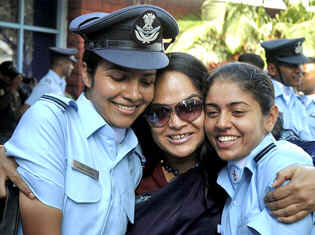 To be in Air Force is about the thrill of seeing formations airborne, bonhomie with fellow colleagues and a deep sense of fulfilment at the end of the day. Working in the Air Force is about being in the middle of supersonic jets, state-of-the-art technology and best of the people. You are where the action is. Air Force provides you with the most modern facilities gives you an unparalleled way of life and creates an environment, where the best in you comes out.
Whether you are a graduate or you have finished your schooling or you have passed your class tenth, Air Force has an exciting career opportunity for you.
As an officer in the Indian Air Force you strategize, lead and manage. Trained in diversified fields and environments you are ready for all the challenges that the fast paced life in the Air Force has in store for you. Be it flying the most advanced combat aircraft or providing technical support, your mission is to always give your best.
Join as an Officer
Career after Intermediate
You can join the Air Force in the flying, technical or the ground branches. You can literally touch the sky by joining the Air Force, not to mention that you’ll be inside a supersonic jet, going at an incredible speed while doing that. Apart from the thrill and adventure, Air Force offers a fulfilling career for life to you.
Selection Process
Candidates, short-listed for Air Force after the initial selection procedure, go through a rigorous three-year training regimen at the National Defence Academy, followed by specialised training at the Air Force Academy. Thereafter, they are commissioned as officers and posted as pilots at any of the Air Force Stations.
To be in the National Defence Academy
You can join NDA by taking the exam conducted by Union Public Service Commission (UPSC). This exam is conducted twice a year in all major cities throughout India.
Eligibility Criteria
To join the NDA you need to fulfil the following requirements:
Age:16 ½ to 19 years
Educational Qualifications: 10+2 with Physics and Mathematics
Advertisement Schedule: March and October every year.
Join as an Airman
SELECTION PROCEDURE
The recruitment of Personnel Below Officer Rank (PBOR) as an Airman in the IAF is conducted through All India Selection Tests and Recruitment Rallies. All India Selection Tests are conducted at the Airmen Selection Centres (ASCs) located all over India as per schedule whereas the Recruitment Rallies are conducted from time to time in selected areas/regions of particular States/Union Territories of the country.
Written Test is conducted for test in English, Physics & Mathematics for Group ‘X’ (Technical) trades and in English & Reasoning and General Awareness (RGA) for all Group ‘Y’ trades.
Written Test is objective type and question paper is bilingual (English & Hindi), except English paper. Written test is based on CBSE syllabus of AISSCE. Candidates for Group ‘Z’ (Musician) trade are tested in English dictation and proficiency to play the musical instrument applied for. You will have to qualify in each paper/test separately.
Physical Fitness Test (PFT): Candidates passing the written tests are to undergo Physical Fitness Test(PFT). The PFT for all trades excluding Indian Air Force (Police) & Indian Air Force (Security) trades consists of a 1.6 Km run to be completed within specified time. The PFT for Indian Air Force (Police) & Indian Air Force (Security) trades includes a 5 Km run & 2.4 Km run to be completed in 30 minutes & 15 minutes respectively. Candidates completing PFT earlier will be awarded additional marks on a sliding scale.
Interview: Candidates passsing PFT will be interviewed by a team of Officers & Warrant ranks. Interview is normally conducted in English. Working knowledge of English is thus essential.
Trade Allocation Test (TAT) : Candidates of Group ‘X’ (Technical) trades who qualify in interview are to undergo Trade Allocation Test for bifurcation into Mechanical and Electronics stream. Specific trade allotment within these streams will be carried out at Basic Training Institute (BTI), Air Force (Belgaum).
Medical Examination: Candidates who are recommended in the interview will be medically examined by the Recruitment Medical Team as per Indian Air Force medical standards. Medical certificates/certificates of fitness from other doctors will not be admissible except for dioptres power as stated in Medical Standards given in detail on this site.
Enrolment is for an initial period of 20 years and extendable up to the age of 57 years. The candidates on enrolment are routed to Basic Training Institute (BTI), Belgaum and Karnataka to undergo Joint Basic Phase Training (JBPT) for a period of 12 weeks. On successful completion of JBPT, candidates will be allocated trades and sent for trade training of specified duration. After successful completion of training, the airmen will be deployed on ground based jobs as per their allotted trades.
The ranks of airmen in the IAF is
Aircraftsman – AC
Leading Aircraftsman – LAC
Corporal – CPL
Sergeant – SGT
Junior Warrant Officer – JWO
Warrant Officer – WO
Master Warrant Officer – MWO
AGE AND EDUCATIONAL QUALIFICATION CRITERIA
One can join rank and file of Indian Air Force as an airman in the category of Personnel Below Officer Rank(PBOR) if he possess following eligibility criteria:-
There are three groups wherein an airman is recruited into namely GP X and Y where age limit is 17-22 yrs except 3 three years more is relaxed in case of GP Y fro musical trade. The education qualification for GP X is 10+2 with Maths and physics with min 50%. For technical trades in this Gp requires 3yrs diploma in engineering (Mechanical/Electrical/Electronics/auto/computer science/IT. For Gp Y eligibility is 10+2 any stream including equivalent vocational courses with 50% marks. For Musician trade min qualification is 10th Pass.
MEDICAL STANDARDS
To get selected as an Airman, the candidate must be physically and mentally FIT to perform duties in any part of the world, climate and terrain. Medical Standards to become an Airman are as follows:-
Minimum height required is 152.5 cm for GP X & Y. However for Auto Technician it is 165cm. For other police and security it is 175/172 cm. The common minimum visual standards acceptable 6/36 for each eye. Indian Air Force (Police) & Indian Air Force (Security) trades require 6/6 vision for each eye unaided and CP-II i.e. no use of spectacles permissible for these trades.
PAY AND ALLOWANCES
PAY & ALLOWANCES. During training a stipend of Rs. 5,700/-pm will be paid. On completion of training, one is placed in the emoluments as under. Promotion to next Pay Band is as per the policy in vogue. The pay scale of Airman is pay band of Rs 5200-20200 with Grade Pay of Rs 2000-2800. Also an allowance of Rs2000 pm as MSP is paid. Various other allowances like Dearness Allowance (calculated on Pay Band + Grade Pay + MSP), Transport Allowance, Composite Personal Maintenance Allowance, High Altitude Allowance; Field Area/Modified Field Area Allowance etc are also admissible as applicable. Perks such as Ration, Clothing, Medical facilities, Accommodation, Educational concession to children, recreational facilities, free transport for school going children and Leave Travel Concession are also provided as per the existing rules. Post retirement benefits include pension, gratuity and leave encashment. Notwithstanding the above, Group Insurance Cover of Rs. 15,00,000/- at nominal premium of Rs. 960/- pm, is covered for all airmen and facility of Group Housing Scheme is also extended. Other facilities by Air Force Wives Welfare Association are also extended for family of airmen.
The initial period of engagement in the IAF is 20 years, which can be extended up to the age of 57 years. Promotion up to the rank of Master Warrant Officer exists to the deserving airmen. Provision for grant of Honorary Commission to the deserving Warrant Officers and Master Warrant Officer. Opportunities to become a Commissioned Officer also exist for the deserving personnel.
World of wonderful pets
Maneka Gandhi
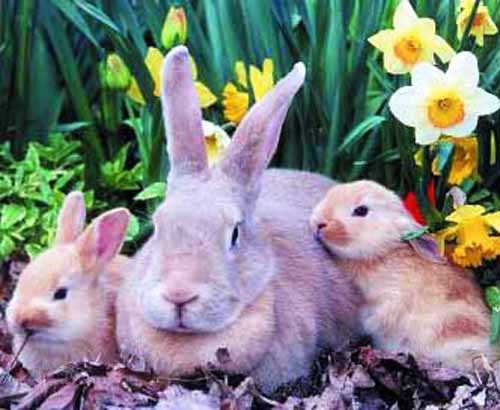 Last week I received an email from a woman who had bought two rabbits, let them turn into twenty five and then left them in the cages built illegally at a public park. Two months later she went to see them and found only three left. The gardener informed her that some had died eating the garbage people threw in and some had been taken away by people to be eaten. My hospital is full of rabbits that have been thrown away. People buy them, do not check out their sexes , allow them to mate and because they breed frequently, get fed up with the numbers and dump them in shelters to rot, sell them to people to kill or leave them in wooded areas where they are killed by jackals or dogs. The rabbit has a sacred space in all mythologies. In Hinduism he is the face of the moon: Shashanka means rabbit faced. The moon rabbit is found in Aztec and East Asian folklore. In Chinese mythology it is the companion of the moon goddess Chang’e, constantly pounding the elixir of life for her and the other immortals; Han Dynasty poets call the rabbit on the moon the “Jade Rabbit” or the “Gold Rabbit” and these phrases were often used in place of the word for the moon. Also associated with the Chinese New Year rabbits are one of the twelve celestial animals in the Chinese Zodiac. Chinese legend has it that there once was a strong, good man who became emperor. He eventually became corrupt and wanted to live forever, so he had special immortality pills made. His wife did not want such a cruel man to live forever, so she took the pills instead and floated up to the moon, taking with her favourite pet rabbit. In Japanese and Korean tradition, rabbits live on the moon where they make Mochi, mashed sticky rice, pounding on an usu, a Japanese mortar . The word for ‘rice-cake’ and ‘full moon’ are both mochi. In Aztec mythology, a pantheon of four hundred rabbit gods known as Centzon Totochtin, led by Ometotchtli or Two Rabbit, represents fertility, parties, and drunkenness. In native American Ojibwe mythology, Nanabozho or Great Rabbit, is an important deity related to the creation of the world. There is a beautiful story about the rabbit which almost every religion quotes as its own. Here is the Buddhist version: In the Buddhist Sasajâtaka (Jataka Tale 316) a monkey, an otter, a jackal, and a rabbit resolved to be charitable on the day of the full moon. An old man begged for food. The monkey gathered fruit for him from the trees and the otter collected fish. The jackal stole a pot of curd. The rabbit, who knew only how to gather grass, offered its own body, throwing itself into a fire the man had built. The rabbit, however, was not burnt. The old man revealed himself to be Sakra and, touched by the rabbit’s virtue, drew the likeness of the rabbit on the moon for all to see. A version of this story can be found in the Japanese anthology Konjaku Monogatarishu, where the rabbit’s companions are a fox and a monkey. In Hinduism, a rabbit, with nothing else to offer a hungry, weary Indra, jumps into a fire, cooking himself for the deity. Out of gratitude, Indra placed the rabbit in the moon. According to an Aztec legend, the god Quetzalcoatl, then living on Earth as a man, started on a journey and, after walking for a long time, became hungry and tired. With no food or water around, he thought he would die. A rabbit grazing nearby offered herself as food to save his life. Quetzalcoatl, moved by the rabbit’s noble offering, elevated her to the moon and told her, “You may be just a rabbit, but everyone will remember you; there is your image in light, for all people and for all times.” Another South American legend tells of the noble sacrifice of Nanahuatzin during the creation of the sun. Humble Nanahuatzin sacrificed himself in fire to become the new sun, but the wealthy god Tecciztecatl hesitated four times before he finally set himself alight to become the moon. Due to Tecciztecatl’s cowardice, the gods felt that the moon should not be as bright as the sun, so one of the gods threw a rabbit at his face to diminish his light. Another story says Tecciztecatl was in the form of a rabbit when he sacrificed himself to become the moon, casting his shadow there. A native American Cree legend recounts the tale of a young rabbit who wished to ride the moon. Only the crane was willing to take him. The trip stretched crane’s legs as the heavy rabbit held them tightly, leaving them elongated as crane’s legs are now. When they reached the moon Rabbit touched Crane’s head with a bleeding paw, leaving the red mark cranes wear to this day. According to the legend, Rabbit still rides the moon to this day. Easter brings the rabbit into focus and strangely links him with eggs.
Easter does not have anything to do with Jesus or the Christians. It is a festival of the moon. The name Easter comes from Eostre (the Phoenician Astarte), goddess of the moon and measurer of time. (Here we can make a connection between the female estrus). The monthly waxing and waning of the moon makes it the Destroyer of Darkness and messenger of new life and immortality. How is the rabbit associated with the moon? One is that the hare feeds by night; another is that the hare’s gestation period is one month long. It was believed that a rabbit could change its sex—like the moon. The Egyptians called the rabbit Un, which means to open, the opener. Un also meant period. Thus the rabbit became a symbol for periodicity in both the lunar and female sense of the word. The hare as “opener” symbolized the New Year at Easter; and fertility and the beginning of new life. And the rabbit carrying Easter eggs? No connection, merely an invention of European bakers in the 19th century who confused the two images. The ancestors of the Easter Rabbit are now lost in the giant machine of commerce. This Easter, adopt a rabbit. They make very wonderful pets.
Of Marriage Act and Amendment
Amit Kushari
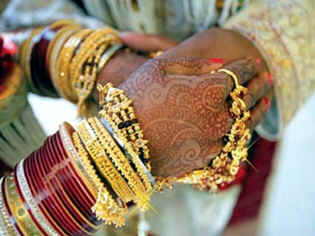 The Government of India has recently made some significant amendments in the Hindu marriage Act and Special Marriage Act to confer some more rights to Hindu and Sikh women. Women in India have traditionally remained a deprived and oppressed community and after independence the Government has taken several steps to give them more rights in society. Earlier women were deprived vis-a-vis their brothers in the matter of inheritance from their fathers. This discrimination has now been completely removed and now women get equal share in their paternal property and their brothers cannot overlook them anymore. After 2005, Hindu women are inheriting their ancestral landed property also — which was earlier a big no-no under the Hindu Mitakshara law. Divorce was an unknown concept among Hindus. There is no Sanskrit word for divorce. After independence a new word has been coined in Hindi and other Indian languages — ‘Vivah vichhed’ which literally means “cessation of marriage”. Now the urdu word ‘Talaq’ is also freely used for divorce. The concept of divorce existed in Arabia and in Islam and the word ‘Talaq’ is derived from the Arabic verb ‘talq’ which means releasing the rope by which an animal is tied!! For Hindus marriage was a sacrament and a life long affair and it even extended to all previous births too. It was believed that once in the heaven God decides as to who marries whom, this sacred bond cannot be nullified on earth. If a woman didn’t like her husband she could do precious little to rectify a wrong marriage. Like the Roman Catholics, the Hindus also believed that only death can separate a couple. While taking marriage vows the Catholics also said” Till death do us apart”.For Hindus the “saat pheron ka bandhan” is like umer quaid (life imprisonment) for a woman. ‘Jis ghar mein doli jaati hai, wahin se arthi nikalti hai.’ Readers who have seen the famous movie “Divorce Italian style” will remember how an Italian man could never get divorce in any Italian court and had to murder the wife ultimately. Divorce was also unknown in Italy. In India similar was the position till 1956 when Pandit Nehru allowed Hindu women to seek divorce in a court and put a complete ban on polygamy by men.
A lot of water has flowed down the Ganges since 1956. The Western countries and their progressive ideas have left indelible impressions on Indian society– which does not look the same anymore. Frequent breakdown in marriages is a stark reality in today’s India. In 1961 only 1% of Hindu marriages ended in divorce. Now 6% of Hindu marriages end in divorce. Men and women exposed to western education now have very little patience in marital matters and they rush to courts for divorce for matters which would have appeared trivial a few decades ago. The divorce rate is still far, far lower than in Western countries which is usually around 60%. New situations are developing in Indian society because of western influence. Men and women have started living together without the bonds of marriage to avoid the hassles of marriage and divorce and the trauma in courts regarding compensation, divisions in property and family business. Although the society frowns on it and parents do not approve of it, many young boys and girls secretly live together. Under Indian law, living together is not an offence because consensual sex between an adult man and an adult woman is not a crime if both are unmarried.
In India Hindus and Sikhs and Jains form 85% of the population and all the new laws are applicable to them only. These are not applicable to Muslims and Christians who have their own codes of conduct in marriage and divorce matters.
The new law made by the Government of India recently has given the divorced woman rights on her husbands property and bank accounts. Divorce has also been made much easier and now if a woman seeks divorce it should be possible to get it in 3 months time provided, ofcourse, if the husband consents to it. Earlier it used to take years.
The Muslims had a relatively quicker system of divorce as an amount was fixed before marriage as compensation if divorce occurs. However, even in Muslim society, divorce is taken as a highly undesirable incident. It is believed that among all the legal things in the world, “Talaq” was the most disliked happening by God.
The Government of India is now giving some legal recognition to the concept of living together. A woman who has lived together for quite a few years has been given partial rights of a wife. She may even claim a part of the property if she can prove through witnesses and circumstantial evidences the number of years they have lived together. This is a revolutionary change in Hindu society. Such changes would be considered appalling by the Muslims who form 13% of the population. For them living together is nothing better than “Zina”. In the Quran God forbids men to have sex with a woman with whom a legal nikah has not been done.
With these new revolutioary laws coming into existence, Hindu men may feel increasingly diffident while entering into a matrimonial alliance. The fear of giving property to a divorced wife may discourage him from marriage. His parents will also be wary of arranging their son’s marriage. Even the irreligious act of living together may not give the boy any relief because after a few years the same problem may arise. Many families have started considering having a legal document ready before marriage spelling out how property could be divided in case of divorce.
(The author is former Financial Commissioner, J&K and the feedback to the writer can be given at 09748635185 or amitkus@hotmail.com or twitter.com/amitkushari)
Vanishing vultures in J&K
Dr. Dhirendra Kumar, Dr. Vikas Mahajan,
Dr. R. K. Taggar and Vibha Raj Shanti
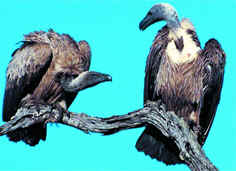 Parrots melodious sound, Pea fowls dancing step and Sparrow chirping has been entertaining every one since long. But what about Vulture? They neither have an attractive look nor melodies sound. But it has a great ecological significance in maintaining sustainable ecosystem. During the course of time, this bird has been neglected in such a way that their population has declined drastically and now population remain within sixty thousand only. Vultures in India are reeling under the threat of extinction, but seeing of a central Asian scavenger Steppe eagle in the Jammu region has brought many hopes to wildlife experts and environmentalists. The local vultures, though decreasing in number, seem to have offered the well-known Indian hospitality to the guests Vulture. It high time for this Jammu region that Steppe Eagle (guest bird) is finding a favorable environment in this region to reside and breed.
There are many reasons which led to decline in the number of population of this bird, which are as follows:
Urbanization
Environmental pollution.
Rampant use of pesticide in agricultural field. Changing habitat.
Despite all, the main culprit is diclofenac. Diclofenac is a drug which is widely used for the treatment of Animal. The residue of diclofenac remains in the body of animal after treatment. When animal dies and vulture feed on animal carcass and they dies due to urinary failure. The mortality of vulture is very high among those which feed on the carcass that had been treated with diclofenac. Due to this very one reason the population of vulture has declined sharply.
Vulture and Ecosystem: Vulture is great scavenger which feed on dead animal carcass. Carcasses which are rotting are the main source of disease spread. Vultures clean the environment by eating the carcass. It not only prevents the disease spread among the animal but also to the human being. During natural calamity like flood, drought etc. it cleans up the putrid carcasses. Major decline in population has disturbed the local environment or the ecological system.
Vulture Breeding: Vulture is slow breeder and usually lays only one egg in a year. According to expert, there is no cross group mating among vulture in one area. In turn, inbreeding reduces survivalist and fertility. Heavy use of pesticide in the field, ultimately go to the vulture which leads to reproductive disorder causing reduced breeding capacity.
Captive Breeding – Some Vulture are kept in captive and breeding is being carried out. Breeding Center’s are operating at Pinjore in Hariana, Rajabhathawa in West Bengal Rani in Assam. Experts are studying the infrastructure and protocols to replicate the breeding success of Pinjore at zoos of Junagarh (Gujrat), Nehru Zoo (hydrabad) and Van Vihar (Bhopal). Artificial Incubation has improved the breeding success of captive vulture. During incubation of eggs the temperature is maintained by the air conditioner and in the same line humidity is also maintained. Balance temperature and humidity is essential for breeding success.
Vulture Safe Zone – To safeguard vulture population, environment ministry has coined the concept named Vulture Safe Zone. It would be zone where the use of drug diclofenac not to be use in the treatment of livestock. Other reasons that also lead to the disappearance of vulture will be prohibited.
Plan for Vulture Conservation – Now the vulture is listed in the Red List of IUCN (International Union for Conservation of Nature) as critically endangered. Therefore, a planed effort is needed in this regard, which may be as follows:
A. Removal of Diclofenac
I. Notification of ban on veterinary use.
II. Search for alternate drugs.
B. Population Survey
I. Data Collection
II. Conservation Strategies
II. (a). In Situ Conservation Methods
In-situ conservation, the conservation of species in their natural habitats, is considered the most appropriate way of conserving biodiversity. Conserving the areas where populations of species exist naturally is an underlying condition for the conservation of biodiversity. That’s why protected areas form a central element of any national strategy to conserve biodiversity.
II. (b). Ex Situ Conservation Methods
Ex-situ conservation is the preservation of components of biological diversity outside their natural habitats. This involves conservation of genetic resources on a diverse body of techniques and facilities. Some of these include:
* Gene banks, e.g. sperm and ova banks, Embryo freezing banks.
* In vitro animal tissue and microbial culture collections.
* Captive breeding of birds and artificial propagation with possible reintroduction into the wild habitat.
Ex-situ conservation measures can be complementary to in-situ methods as they provide an “insurance policy” against extinction. These measures also have a valuable role to play in recovery programmes for endangered species. Ex-situ conservation provides excellent research opportunities on the components of biological diversity.
C. Establishment of Vulture Care and Management Center
D. Establishment of Captive Breeding Center
E. Awareness campaign should be carried out considering
a. Significance of Vulture in ecological balance.
b. Ban on use of diclofenac on Animal.
Make-up for working women
 If you have a clear skin, leave out foundation. After cleansing, apply a sunscreen with a built-in moisturizer. Pressed powder or powder compact is useful. Pay more attention to the oily areas of the face. Press the powder all over the face and neck, with a slightly damp sponge. This helps it to set and last longer.
If you wish to apply foundation, use a water-based one. Add one or two drops of water for a lighter coverage. The foundation should be as close to your skin colour as possible. For eye make-up stick to eye pencils, or line your eyeswith brown or gray eye shadow for a softer effect. Then, apply mascara in two light coats. Apply one coat. Allow it to dry. Comb out the lashes with an eyelash comb or brush. Then apply the second coat and comb out.
For lipstick, avoid very dark colours. They look darker in fluorescent lights. Go for pinks, copper, bronze, burgundy or wine colour. Or, use light pastel colours like mauve or pink, or wear only lip gloss. Lastly, apply a light cologne or perfume….nothing too overpowering.
Make-up for the working woman must last right through the day. In an air-conditioned office, make-up stays fresh enough, but if you travel, you need to renew your make-up, specially in summer. Carry fragrant wet tissues, to refresh the skin and remove grease and sweat. A powder compact is really handy to get rid of that oily look. First wipe with the tissues and then dab powder. You need lipstick to touch-up after lunch. Carry a small bottle of cologne, or your favourite deodorant.
Although long hair is in fashion, avoid keeping it loose at work. One tends to keep fussing with the hair. Most distracting! If you have long hair, put it up in a roll, or pin it up, tie it back in a pony tail. Actually, pony tails are the trend, whether low or high, tied back with ribbons or clip. Many kinds of hair accessories are available, but they should not be too decorative for work. You can even curl the ends of the hair with curlers and then tie them in a pony tail, or pin then up with a clip.
Braids (plaits) may also look nice for work, although it may take time. Braids for work hairstyle can be done on long and medium length hair. Divide your hair into three parts and intertwine it like a rope. Towards the end of the braid, use elastic band or a ribbon to tie it up. Braids look neat on young working women.
As far as the new trends are concerned, the more natural look in hair is making its way in, with a look of ease. Keep the hair away from the face. If you have short hair, wear it softly and naturally layered. Even in hair colour, natural colours like browns are the trend. You can have subtle colours with natural highlights.
The bob is back in fashion and will be the trend for short hairstyles in the coming seasons. For short hair, you can also go for the slightly tousled look if you wish to be in. Not, harsh or obviously structured, but rather a careless and casual look.
If you have shoulder length hair and wish to leave it open, condition it after shampoo, so that it is soft, smooth and manageable.