

Dr. Vivek Sharma
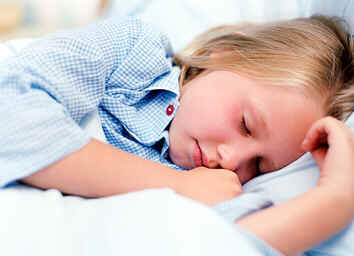 “The Smith’s dog sleeps at the noise of the hammer, and wakes at the grinding of teeth.”
~ Unknown
Sleep bruxism is an involuntary mandibular momvement with tooth grinding during sleep. The prevalence of sleep bruxism in children is high. Approximately 35% of children grind their teeth and this may lead to frequent arousals with altered day time functioning.
Bruxism comes from a greek word “bry chin”, which means to gnash the teeth. It begins in the first 5 years of life. Children who grind their teeth tend to do so at two peak times – when their baby teeth emerge and when their permanent teeth come in. Most children lose the teeth grinding habits after these two sets of teeth have come in.
Why does my child grind his teeth
Certain factors are responsible for bruxism.
* It is associated with day time anxiety & stress.
* Improperly aligned teeth or irregular contact between upper and lower teeth.
* Chronic illnesses in children.
* Medical conditions e.g. nutritional deficiencies, allergies, hormonal disorder, dehydration etc.
MYTHS
Bruxism while sleeping is a serious sleep disorder which needs early attention. There are number of myths related to Bruxism. Some of the say them worms cause this disorder while other stories that abound tell of young children recalling experiences of previous births. All these tales have no scientific bases and are more of grandmother stories.
Is it Bad for my child?
In most cases, teeth grinding isn’t harmful. It is very unlikely that your preschooler is doing any damage to his teeth, and its very likely that he will soon outgrow the habit. However, teeth grinding can cause jaw pain, headaches, wear on the teeth and temperomandilular joint damage. Untreated bruxism may create problem with dental occlusion. Persistent Bruxism requires dental treatment and may present as muscular or temperomandibular joint pain.
Can I do anything to help my Child?
Some tips to prevent teeth grinding and helping the child find ways to reduce anxiety and help in overcoming the problem.
* Bed time can be made more enjoyable.
* Child can be relieved by reading or talking to him.
* Permitting review of fears or angers experienced during the day.
* Praise and other emotional support are useful at these times.
* Make sure your childs’ diet include plenty of water. Dehydration may be harmful.
” Avoid or cut back on foods and chinks that contain caffeine, such as colas, chocolate, coffee.
* Do not chew on pencils or pens or anything that is not food. Avoid chewing gum as it allows your joint muscles to get more used to clenching and makes you more likely to grind your teeth.
* Train your self not to clench or grind your teeth. If you notice that you clinch or grind during day, position the top of your tongue between your teeth. This practice trains your joint muscles to relax.
The fact remains that bruxism is a worrying sleep disorder that must be treated with affection, care and if required with consultation of a doctor.
(The writer is consultant Paediatrician based in Jaipur and can be contacted at drvivek_sharma@rediffmail.com)
BRUXISM Tooth Grinding in sleep
Products that protect skin in summer
Shahnaz Husain
 The products for skin care should be adjusted according to seasonal needs. Here are some of the products you should look for.
Sunscreen SPF 20
Apply a sunscreen lotion 20 minutes before going out in the sun. It acts as a protective barrier between the skin and the harmful effects of sun-exposure. Look for a a non-greasy, sweat and water proof formulation, which is easily absorbed, leaving the skin with a sheer, matte (non-shiny) texture.
Skin Toner:
Skin toner is useful in summer to refresh the skin, remove sweat and oil, refines the pores and keep the skin healthy and glowing. Rose water may also be used. It is a natural coolant. Keep it in the fridge to cool and refresh the skin.
Cleansing Milk or Lotion
Choose a light cleansing milk or lotion for the summer months. It is best to select one, which contains sandalwood and lemon. This would help to reduce surface grease and also protect the skin from heat rash and related problems. Sandalwood cools and protects the skin, while lemon is a powerful natural cleanser, which restores the natural acid-alkaline balance.
Or Face Wash
A soap-free face wash containing ingredients like neem, tulsi, lemon peel, aloe vera, help to restore the normal balances. At the same time, it protects the skin from eruptions and rash. Aloe vera is a natural moisturizer, while neem and tulsi have germicidal properties. Lemon helps to reduce oiliness and add a glow.
Face and Body Scrubs
A deep cleansing treatment benefits the skin during summer, especially if the skin is normal to oily. A scrub helps to remove dead skin cells, leaving the skin cleaner, brighter and vibrant. An important benefit is that the cleansing of dead skin cells would help to improve the regeneration of new skin cells. The scrub should be rubbed gently on face, neck or any other part of the body and washed off with plain water. It can be used two or three times a week. While walnut cleanses and nourishes the skin, aloe vera is a powerful natural moisturizer. Lemon oil helps to cleanse the skin and keep it healthy.
Day Cream – A matte moisturizer, which is basically a non-oily day cream, is ideal for hot and humid weather. It moisturizes the skin and yet, prevents the oily look. It can also provide a pearly glow.
Sandalwood Protective Cream
The skin can be prone to rashes and eruptions during summer. This is a common problem with oily skins. In such cases, a non-oily cream containing sandalwood helps to soothe and purify the skin. An ideal summer treatment would be to first cleanse the skin with rose-based skin tonic and then apply the cream. Wash it off with plain water after 20 minutes. This can be an ideal preparation for the skin before applying make-up and is particularly suited to normal to oily skins, as well as combination and sensitive skins.
Sandalwood Body Shampoo
Sandalwood is ideal for the summer because it helps to protect the skin from rashes and prickly heat. A body shampoo containing sandalwood will have a gentle action on the skin, leaving the body clean and fresh, without disturbing the normal balances. Sandalwood is also fragrant, so it would help to prevent body odour and leave the body perfumed.
Waterproof Mascara – Go for a roll on waterproof mascara for summer. You can even apply it when you go swimming.
Lip Gloss – Ideal for the cool look in summer. Lip gloss gives the lips a sheer, natural and dewy look. Look for lip gloss containing natural oils and extracts.
Deodorant – Choose a scent that is light and lemony for summer. Not too overpowering!
Gidha Folk Dance
Dr S P Srivatas
 Like bhangara folk dance this folk dance is also an imported folk dance from Punjab to Jammu region. Its actual place of origin is said to be the Malba belt of east Punjab. With the influence of the Punjabi culture in lower Jammu (upto Jammu city) it seems as if this dance is very much a part of the cultural heritage of this region. Late Vishwanath Khajuria is right to say- “Because of very cordial relations with the neighbouring state Punjab the inhabitants of the lower Jammu region have adopted this dance as their own dance. It is a peculiarity of the Indian culture that every region or State of this country absorbs some aspects or tenets or customs of the neighbouring state’’ (Shiraja Dogri, Sanskriti ank P. 70).
This folk dance being very favourable folk dance of the young ladies is becoming more and more popular in the lower part of this region, especially in Educational institutions and also is adopted by the cultural troups of the cultural organisations including J&K Cultural Academy which train their troups for participating in different competitive cultural programmes at state level as well as National level.
The paes and rhythemical postures-adopted during the performance of this dance resembles very much in bhangara dance. I
I. Lok nach gidha-Itihasak te sabhiacharak paripreksha- Gurinder Kour, A dissertation submitted for M. Phil Degree in Jammu University 1998 P. 93
As both these dances are thrilling and ever green by nature yet both have disimilarity also. Whereas bhangara dance being a dance of men folk exclusively contains somewhat hardness, on the other hand the gidha dance of the women folk is very tender by nature which attracts the attention of spactators more quickly. It is a known fact that this dance is performed by the women folk only but according to Gurinder Kaur in Malba belt it is exception in this respect where it is performed by the men folk also sometimes jointly with women folk whereas sometimes exclusively by them only.
It is also a peculiarity of the gidha dance of the men folk in Malba belt that they name their dancing group either after a village or any well known person, such as Midial Ka gidha or Pal bhuloor di toli (group). It is a peculiarity of the Malba belts gidha that it is performed mainly by the professional artists who for the sake of earning their livelihood go for its performance whenever they are invited to do so.
During their performance they mostly concentrate on folk songs. With the result they are more popular as folk musicians than folk dancers of the gidha dance. Moreover, the very technique they adopt to perform this dance is also of the different nature as they perform their gidha while sitting on their feet contrary to their women counterparts who perform by standing in two circles i.e outer circle and inner circle. But it is a rare phenomenon that they ever join their women folk to perform this dance with them.
It is also to be pointed out here that this dance is performed mainly on the occasion of marriage ceremonies, betrothal ceremonies and at the time of child’s birth or during a religious or socio-cultural festivals. Even then it is not a hard and fast rule as it depends on the liking of the party concerned whenever they desire they go far its performance. In Malba belt the householders firstly do invite a well known singer so that he by his song concentrates to accelerate the mode of gidha dance to be started soon after that.
The entire group of gidha comprise eight to twenty five participants. Besides they have one folk singer two recitars of bolians one drum beater, one tumbta player, one pitcher beater and two chimata players. At the very outset all the participants of this dance (ladies) gorgeously dress themselves sin Kameaz, Salwars and chunnis of the different colours. Then barring two or more as the case may be they stand in two circles i.e outer circle and the inner circle. Thereafter, two ladies standing nearby start singing folk song or recite bolians in melodious but in sorrows voices too. Then they start moving with eight on one foot again start reciting bolian with dance. Then following them all other participants also resort to dancing movements with sheer abandon and raise their hands in unison. Thereafter, by and by they adopt an enchanting rhythm by which all the spactators standing alround become spel-bound with that bewitching scene.
Sometimes this dance is danced by a group of three girls or ladies who suddenly snap their fingures and clap their hands alternately and also clap on the hands of their partners. This is a charactistic movement of the Gujrat Garba dance also.
Thereafter another group of the two ladies come out of the circle replaced by the first one and start reciting boli or bolians. This process goes on till all of them take their turn by and by in group of two each and recite their bolians of their liking. For example some bolians are quoted here :
i) Kithon di main jammi jai
te kithon gai byahi?
Koonjan Vanger Phiran Namani
Jang Vich Gaya Mahi.
ii) Hardam Nir Vage Vichon Naina
Adon Di Chithi Na Pai
Mud Ayo Sapahiya Bhi,
Main Jindadi Ghol Ghamai
(i) Where I was born and where I have been married. O roam hither and thither in melancholy like the bird koonj as my husband has gone to attend war.
ii) The tears always role down from my eyes, as no letter has been received since long. O my soldier come back as I have spoiled my life. One more example of the bolians is as under :-
Pind Mittaran De Ai, Nach Kudie
Nach Kudie
Pa De Gidhe Ch Duhai Nach Kudie
Tere nile niie nain, Karan Dil Noon Baichain
Nach Kudie Nach Kudie
Aya Saun Da Mahina, Kare Dhak Dhak Sina
Mahindi Hathan Utte Lai, Nakka Natham Sajai
Nach Kudie Nach Kudie
I have come to the village of my friends. O girl dance and dance and again and again and give a thrilling fillip in gidha dance. Your blue eyes give a painful trouble to my mind.
O girl, dance again and again.
The month of Savan has set in which creates a palpitation in my heart. I have applied henna on my hands and nose has been decorated with nath ornament. O girl, dance and dance again and again.
After the recitations of these bolians have been completed all the ladies standing in one or two circles start dancing while clapping their respective hands. Then the drums and earthen pitchers are also used to lend enchantment and joy to the ears of dancer and spectators. During the performance the leader of the chorus sings a boli which is beaten repeatedly with very gentle strikes on it by a ring or a stone or spoon also in keeping with the quantum of the rhythem,
By singing some bolians the participants (ladies) usually outpour their feeling of anger, resentment, pain, jealously on the members of their inlaws, especially mother in law and also very tender affection, warmth and love for relatives of the parental side.
It is also to be pointed out here that in past in some areas of Punjab, lower region of Jammu region and also in remote pockets of the hilly areas some folk dances used to be performed by the women folk and men folk seperately as then women were confined to four walls of their homes. They were advised to observe the purdha tradition by which they used to cover their faces with the long veils. They however, were allowed to watch the bhangara (bhangada) and other folk dances performed by the menfolk but menfolk were not permitted to witness the gidha, jagrata and other folk dances performed by the women folk. But now the things have changed altogether. The old traditions are being abdandoned by and by and new ones are taking their places. Now in the occasions of any festivity both men and women assemble together to perform some folk dances at the fixed places in front of their houses or in the ground or on the platform of the hall of any academy of the city. However, the bhangara folk dance is still performed exclusively separately by the men-folk.
It is also a happy trend that now in our country barring some remote hilly areas the women and men of the artistic nature take part in all types of the cultural and social programme so as to promote the age old cultural traditions of our country. It is really very useful trend also to promote various educational and social welfare programmes etc.
‘I simply agree to Ramu ‘
Your voice in Department is in tune of that of Vijay Dinanath Chauhan in Agneepath (1990). Why did you think of using this tone again?
The voice you heard in the trailers of Department is a result of cough and cold. The day shooting started for the film, I had a bad cold and this was the kind of tone that came out of my throat and I had to shoot with it. Then Ramu (Ram Gopal Verma) said this is the voice which suits my character (Sarjerao Gaikwad). So I said: ‘Chaliye yehi thik hai toh thik hai’.
You have played gangster-politician earlier in Ramu’s films – Sarkar (2005) and Sarkar Raj (2008). What made you say ‘yes’ to a same character once again?
Ramu comes to me and says ‘I am making a film and you have to work in it’. And I simply agree to him.
How did you prepare for this role?
All the preparations are done by Mr Ram Gopal Verma. He nearly guides me as to how it should be patterned, how the dialogues should be spoken, where to move…I just follow what he says. There is very little contribution that I do personally.
You were also seen shaking legs with Sanjay Dutt and Rana Duggubati in the song Kammo for Department. How was the experience?
I feel this is one of the important songs in the film, not just for the value it brings as far as the tune and picturisation are concerned, but the context in which the song comes. I cannot disclose further but when you see the film you will realize there is a lot more meaning than just the wedding happening and three real men with real power dancing.
You have played an effective role in India’s pulse polio campaign. What made you promote our health sector so vigorously?
Every time I have been overseas, I have often faced certain remarks from foreigners about India as a third world country or a developing country. It’s very sad for me. You will be glad to know that now we are number 3 in the world as far as the pharmaceutical industry is concerned. I wish those foreigners would check their statistics and our accomplishments and stop looking down upon us.
You were recently honoured with Polio Eradication Champion Award. Was it easy to convince people to vaccinate their children because of your star value?
The journey has not been easy…it has been very long and stressful. In the initial days, I think those who were listening to this campaign were not taking it seriously. The numbers came down a bit and went up again. It was at that time that the agency who was designing the campaign decided that may be we need to wake up the Indian audiences. So the first video campaign showed me getting very annoyed with people for their indifference to pulse polio. And quite remarkably, the numbers came down substantially. Some of the research teams who went out to find out why this happened (it was also part of my initiative because I too wanted to know the reason), said when they went to a village and asked mother of a child why she got the baby vaccinated, she said Amitabhji was very angry and so to cool him down, I thought to give those two drops to my kid. (TWF)
Mahra crying in pain
Prof Javed Mughal
 “Don’t we figure on the map of this nation?” Haven’t we suffered for the administrative failures of our system and the oft-repeated errors of our system without even a slight murmur? Can’t we have even a single good classroom in our schools? Shouldn’t we have the comfort of road-connectivity with the nearby highway and how far have our children and old and ailing ones to continue walking a long distance to catch the bus to the instant town?” These are the questions raised by the forlorn students of a small historical hamlet namely Mahra of Tehsil Surankote, District Poonch (wading through the gravel paths pressed and done up under head-loads of daily provisions fetched from miles away) where even now, after stepping into the 21st century, people have to walk miles together for anti-fever pills and sometimes succumb to the slight head-ache for want of in-time treatment. Health Sub Center which was to be completed 17 years ago but unfortunately the money stands released and exhausted but till now there is no Health Sub Center’s building excepting a few crumbled side-walls. These are questions posed by the poor students of this tiny hamlet which dazzle everyone at the fate of this small village about 5 kilometers from Buffliaz, the Block Hqtr. History can’t bypass the fact that this small ignored village has, for a long time, remained the sojourning abode and permanent passage of Great Mughals from Akbar to Aurangzeb (who gave a proud and beautiful dimension to the history of India) and used to be the epicenter of attraction for the entire country. Apart from it, it has been the entrance of a big industrial town of ‘Tarni’ and ‘Rattan Shah’ which are now completely transformed into dense forest. But at one time a few hundred years back, this village Mahra used to be a sort of royal gate to this biggest city of Rajouri Poonch. Some of the plaques, with a beautiful calligraphy in a strange language conveying something meaningful, can still be found on the wayside in the village that speaking about the presence of civilisation even before the advent of Mughals. Also some earthen pots of typical and unique make-up, have many a time, been discovered in this far flung area of Poonch District. Village Mahra also serves as an ante-chamber to the seven famous lakes commonly known as Sars- the Nandan Sar, Suk Sar, Katori Sar, Dang Sar, Neel Sar and Kal Dachhni. After a long spell of slumber now the Department of tourism has shown some concern on the development of these natural lakes. And village Mahra is at the bottom of these lakes. The original inhabitants of this village are the only as pure descendants of the Great Mughals as are the off-spring of 24-carat Aryans at Batalik Sector in Ladakh division. The inhabitants of Mahra are original Mughals and their physical structure, their style of conversation, their royal bent of mind and their meticulous reactions and reflexes bear a testimony to the effect of their originality. But the great tragedy that has ever happened to this ill-fated village is its exploitation at the hands of local politics and routine negligence of the government. The area is intellectually fertile and agriculturally productive that is why it is still breathing otherwise long back it would have died an unnoticed death. Its intellectual productivity has ever been relegated to the backdrop due to the long pending indifference of leadership with the sectarian outlook. Despite having no facility of hospital, road connectivity, well equipped school, post office, telephone facility, electricity availability, employment, comfortable houses to live in-above all without all basic comforts, this village remained declared in ‘Privileged Category’ till the recent past bereft of all developmental schemes and special packages of the Govt. which used to be extended to the socially, economically and educationally backward areas of Jammu and Kashmir. The Panchayat Ghar that is normally a life-line of any village tantamount to a judicial court for the villagers has mercilessly been transformed into a Stable where the horses are kept now-a-days due to the oft-repeated negligence of the administration. The photo-graphic details of the village speak the heart-rending language of the hardships of the inhabitants of Mahra. No doubt this village has ever acted as one of the deciding factors in elections and that is why once in six years the political Contestants spare some time to remember them-nay to beguile and befool them for the time being. We have no answers to the questions raised by the home-spun students hereof, rather deplorable populace of this village that are genuine and heart-rending. Unfortunately, even though this region stands endowed with rich bounties of nature having preserved the centuries-old jungles, orchids, gushing springs and everything that nature has offered, it is surprising that the fruits of development have not yet reached here despite 64 years of Independence. The living conditions of the people here are far below expectations. The people seemed to be living in the ancient times. The mainstay of their survival is the little agricultural produce particularly maize crops supplemented with the wild vegetables which are also now an uphill task for them in view of the surrounding jungles being infested with the militants. During militancy this far-flung corner has been subjected to unremitting hardships at the hands of terrorists so much so that many of them were deprived of their body organs like ears, eyes and arms etc. for their open support to the Govt. but what they got in exchange was more hardships, privation, poverty without having single sigh of relief and respite. Whenever the underprivileged people of this village approach the concerned authorities, they are told that Govt. does not have adequate funds for their upliftment. It is highly surprising that despite the country primarily being the conglomeration of villages and thereby a rural nation, the villages are still smouldering on the pyre of multi-dimensional issues. Every table of our Government, from district level to the national platform, spends, on average basis, an amount of Rs 50,000/ on the celebration of the Republic and Independence Days in our country but the biggest chunk of Indian nationhood, that sacrificed its blood for freedom, is still suffering with an impractical hope of some Messiah to come and exonerate them from the shackles of their abject predicament. Though the residents of Mahra seem to feel helpless and have accepted their sufferings and exploitation as a way of life, the students are still pulsating with a difference and there seems to be spark of some divine mettle in them and that is why they not only feel but can express their feelings too . They appeal for their slice of cake as a matter of right and, if not fulfilled, they would turn violent. This streak of violence will, beyond all doubts, be suicidal for them because they will ultimately be pitted against the might of the State. The innocent faces of these small boys and girls are still in front of my eyes and always pain me whenever I am alone and compel me to write about the tale of their woe whenever I pick up the pen to drop a line. I noticed deep-down desperation and indignation in their eyes. When I followed them through and through and overpowered them, one of the students, quite natural and scared looking as innocent as a lamb retorted “Sir, Are you some CID’s informer? Have we committed some crime to have spoken of being neglected by the system? But however sufferings may be imposed on us, we shall bear with patience but will not be terrorists. It is better to die of hunger than being called the anti-nationals” These spontaneous utterances of these pastoral mealy-mouthed tiny scholars of Village Mahra sent a galvanic shock and surprise-shiver down my spine. Mahra needs to relieved of its pain and agony.
Theater in Jammu A Historical and Socio-Cultural Perspective
Lalit Gupta
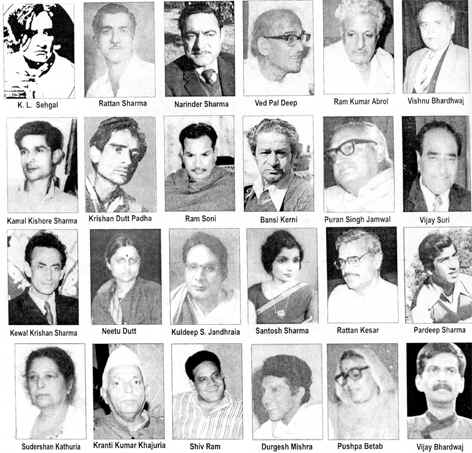 Jammu, the winter capital of Jammu and Kashmir, today boasts of a vibrant theatre scene which can be gauged by the parade of drama festivals in recent months, local groups performing in various national level prestigious theatre festivals being held in different parts of country along with some of the local theatre personalities getting eminent positions and responsibilities in the country’s nation-wide cultural programs and policies.
In last fifty years like other creative fields of visual and literary arts there has been an emergence of a kind of regional modernism in performing art of theatre that though based on the tenets of national modernism also speaks of a vernacular face.
The expression of regional modern theatre practice in Jammu is based on the sound foundation of theatre that alongside timeless folk theatre forms like Haran, Bhagtaan, Jagrana, and presence of Naqaals, Bhands, Miraasis, was laid during early 19th century.
The progressive socio-religio and moralistic ideas of the Dogra rulers also encouraged visits by Ramlila parties from Ayodhaya, Mathura and Brindavan. At the request of political elite and close confederates of the Maharaja, a local drama group, Raghunath Theatre Company, was also formed and first proscenium theatre was constructed in precincts of famous Raghunath Temple in Jammu.
The Raghunath Theatre Company followed by Amateur Theatre Company staged mythological plays along with English and Urdu dramas. The visit of Parsi theatre companies like Victoria, Alfred, Madan, Surya Vijay etc from 1890’s to 1930’s popularized Parsi theatre in Jammu and Kashmir. The realistic backdrops, melodrama, and magical realism created through ‘light and trap’ techniques, marked the first phase of modern theatre in J&K.
In the absence of proper building exclusively dedicated to performances, make shift stages were created in the Green Hall of Mubarak Mandi Palace complex.
The dramas of Aga Hashar Kashmiri, Mohammad Husain, Narayan Prasad Betab like’Bilba Mangal’, etc became popular amongst the public. Snatan Dharma Natak Smaj and construction of a stage at the Deewan Mandir in Jammu, laid the platform for public theatre. A Muslim group led by Mohammad Husain, staged plays in a Hall at Residency Road, Jammu. The plays like ‘Acchut Uddhar’, mirroring the revolutionary ideas of Mahatma Gandhi were also eacted.
It was during this time K L Saigal and Om Prakash used to act on stage of Deewan Mandir. Prithvi Theatre also held performances in Jammu. The fact that a well-known film personality like Prithvi Raj Kapoor performed with his group at Jammu, also lent a kind of social credibility to theatre.
Thus this new theatre idiom and its practice mostly influenced by Parsi Theatre style, spread to other cultural centers of the region like Basohli, Bhaddu, Ramnagar, Ramkot etc and led to Ram Lila groups. These groups also preferred the Hindustani ‘Ramayan’, written in verse form by Narayan Prasad Betab.
The decade of 1940’s when the nationalist fervor was at its peak, Jammu also witnessed the dawn of cultural renaissance in the form of and development of Dogri, the native language, to create such literature, which was true reflection of all aspects of local life and culture. The individuals who took the historic lead to resurrect the native pride by founding Dogri Sanstha included Ram Nath Shashtri, Bhagwat Prashad Sathe, Dinu Bhai Pant, Laksmi Prasad, N. D. Mishra, D.C. Prashant, and Master Sansar Chand.
In this background, first play in Dogri, Baba Jitto was performed during the Farmer’s Conference at Tikri, Udhampur as part of the Dogri renaissance movement in Jammu. Though the first Dogri drama ‘Acchut’ written by Vishwa Nath Khajuria was staged art Ramnagar in 1935.
The post partition reconstruction program under the leader ship of Sheikh Mohammad Abdullah, led to the State sponsored cultural renaissance. Many artists, poets, writers influenced by leftist ideology reflected progressive ideas in their works.
Writing of enactment of plays like Acchut Udhahar, Baba Jitto, Navan Gran etc, marked the genesis of new literature as well as theatre in Jammu. Influenced by progressive ideas that informed the literary and cultural scene of the State in general, many such plays were performed by amateur theatre enthusiasts who gave more emphasis on ‘content’.
Such plays were quite often staged on makeshift stages in towns and village Ram Lila performing spaces. In city of Jammu few of such makeshift stages were created at on spaces like one on the left of Mubarak Mandi’s southern gate, and stage platform the back of New Secretariat, Ranbir High School, where plays like Ali Mohammad Lone’s ‘Deewane Ka Khawav’, Kavi Ratan’s ‘Khotte Sikke’ and ‘Sarpanch’ were staged.
The state Department of Information was also made the de facto agency to showcase the State’s cultural heritage in different parts of the country as well as to scores of foreign and national leaders and persons of eminence who made a beeline to Jammu and Kashmir for political and other reasons. State Information department maintained a cultural wing, which employed artistes who not only presented cultural programs but also staged dramas. Rattan Sharma, one of stalwarts of modern theater in Jammu, also worked in Information Department along with Girdhari Lal Pant and acted in many plays like ‘Bahurani’, Balidan etc.
Between 1947 to early 1960 many amateur drama groups came into existence. Jammu Kala Mandir formed in 1958, by Rattan Sharma along with his associate Dhyan Singh was housed at 153, Tange Wali Gali, the rented accommodation of Rattan Sharma.
Jammu Kala Mandir was the one of first amateur dramatic clubs of Jammu, which set the local theatre scene moving. The other notable groups to join the fray were Friends Club, Bharat Kala Mandir, Snatan Dharm Natak Smaj, Jammu Arts and others. One of these, Friends Club was exclusively devoted to Dogri dramas with focus mostly on Dogri plays written by N D Jamwal.
In the year 1958, State Cultural Academy came into existence. Since it was not till 1965-66 that annual drama festival was started by the Academy, the local theatre scene remained active through the performances by Jammu Kala Mandir, which staged plays like “Seeta di Agni Priksha”, based on Bhasa’s Sanskrit play ‘Kekaiye’. This play translated by Dinu Bhai Pant was marked by modern effects like that of blazing fire created with use of cellophane, air and lights etc. which created a kind of spectacular effect for the audience who so far had seen such technical wizardry in Bombay films only. The play was performed at the stages of Youth Hostel, adjacent to Ranbir High School and at Gita Bahvan.
Academy’s initiative of holding of annual drama festivals, created a healthy competition amongst local clubs who enthusiastically competed with each other to evolve designs, costumes to suit limited budget productions. The theatre scene in Jammu got a further fillip with arrival of NSD trained professionals like Kavi Rattan, who introduced new tools of theatre pedagogy through theatre workshops and repertoires. The visits of stalwarts like Ebrahim Alkazi, Habib Tanveer, Nemi Chander Jain, along with performances of plays such as ‘Mukhya Mantri’, Begum ka Takiya’, ‘Tuglaq’, ‘Agra Bazar’, became the role models for local young theatre aspirants early 1970’s
Kavi Rattan, as in-charge of drama in Cultural Academy, played a pivotal role in training as director, generations of young persons in different departments of theatre like acting, direction, set design, costumes, through number of theater workshops and repprtoires. He also formed a drama group Bahurangi, which staged classical plays that defined modern play writing and production in the country. During 1960’s plays of Badal Sarkar, Mohan Rakesh, Vijay Tendulkar entertained the audiences of Jammu who thronged to witness ticketed performances.
The decades of 1970’s and 1980’s also witnessed hectic theatre activity by other groups like Ajayaka, Duggar Manch, Natrang, Rangyug, IPTA, Natshala, Amateur Theatre Group, etc at Gulab Bhavan and later at the newly constructed Abhinav Theatre.
The production of Natrang’s Baba Jitto and Rangyug’s ‘Lekha Bhai Da’, was characterized by a successful use of local folk elements. Performed at national and regional theatre festivals theses plays emerged as representative of contemporary Dogri theatre.
Under the National Sangeet Natak Akademy’s ‘Assistance to Young Directors Scheme’, many talented local young directors experimented with form and craft to evolve an idiom that was rooted in the indigenous tradition. This was to become a fashionable trend for many a later day groups and which very soon reduced to a clichéd effort.
With plays like Gariboo Da Shilla, Bave, Insan Dushman, highlighting the exploitation of the gullible under the garb of socio-religious practices and customs, Duggar Manch led the street theater movement in the region through performances at hundreds of villages.
The brutal murder of dedicated street worker, Safdar Hashmi and recognition of his martyrdom sent a clear signal to State apparatus about the power of the theatre as the direct tool of social critique. Taking evasive measure, soon under a nation wide funding policy, ostensibly to communicate the developmental and social issues, the ‘theatre of protest’ was cleverly manipulated to become a ‘theatre of propaganda’ through center-sponsored schemes of ministries like educations, social welfare and the ‘Border Area Development Schemes’.
Thus a foundation of modern theatre was laid in Jammu, which continued unabated till 1990’s when rise of militancy led to temporary hiatus in cultural activities in the State, especially in Kashmir.
Regular theatre festivals by Cultural Academy, along with efforts of few dedicated groups like Nartang, Rangyug, Amateur Theatre Group, Shivani Cultural Society and others, the theatre in Jammu not only has remained active and ticking but also provided space for groups from Kashmir to showcase their plays in the winter capital.
Tension grips Army Regiment at Nyoma after clashes between officers, jawans
Defence Ministry seeks detailed report from 14 Corps
* Army Chief discusses issue with GOC-in-C
Mohinder Verma
JAMMU, May 11: In an unfortunate incident, soldiers went on revolt in an Army Regiment situated in the remote Nyoma block of the Leh district and captured armory after clashes between group of officers and jawans over an alleged molestation of wife of a Major by an orderly. During the clashes few jawans and officers including Commanding Officer (CO) of the Regiment, who tried to pacify the situation, sustained injuries.
Taking the incident very seriously, the Defence Ministry has sought a detailed report on the incident from the Leh-based 14 Corps while as Army ordered Court of Inquiry to bring facts to the fore and fix the responsibility for necessary action against the erring personnel.
Army Chief General V K Singh also spoke to General Officer Commanding-in-Chief (GOC-in-C) of Northern Command, Lt Gen K T Parnaik and discussed the issue.
“Different versions have been pouring in about the reason behind the incident, which led to tension in the 226 Field Regiment of Third Infantry Division, and one of the version is that a soldier allegedly misbehaved with wife of a Major which resulted into clashes between the jawans and officers”, sources said.
Report said that following misbehaviour with his wife in the afternoon, Major beat up the ‘erring’ jawan severely and didn’t permit other soldier to allow any medical treatment for the injured. This fuelled anger among the co-jawans, who strongly objected to the action on the part of Major.
As the repeated requests from the colleagues of the injured jawan for his medical treatment failed to yield any result, the soldiers went berserk and entered into scuffle with the officer. In the meantime, some colleagues of the Major came to his rescue and started thrashing the jawans.
This led to revolt by the jawans, who started staging protest against the officers and even captured armory of the Regiment. On getting information about the unfortunate incident, Commanding Officer of the Regiment, Colonel Kadam swung into action and immediately reached the spot. When enquired by him, the jawans denied the version of the Major and said that there was no incident of any molestation.
Gauging the mood of the agitating soldiers, the CO shouted at the Major for his reluctance to provide medical treatment to the injured jawan. This infuriated the Major and his officer colleagues, who refused to budge from their stand and even abused and assaulted the CO, sources said, adding the injured CO was later shifted to Base Hospital at Leh.
Due to scuffle with the CO, the situation turned ugly with jawans turning out of control and started beating the Major rank officers with whatever thing coming in their hands. Sensing the gravity of the situation, all the five Major rank officers rushed to safety under the cover of darkness.
As if there was free for all situation, the group of agitated soldiers started looking for the officers. Two of them, later, came in the hands of soldiers, who gave the former severe thrashings.
On getting information from some other officers about the incident, local police rushed to the Regiment and rescued the officers. It was only with the intervention of local police that the situation was brought under control in the camp during late in the night. The other three Majors kept on hiding throughout night in order to save themselves from the angry and agitated soldiers.
Police also informed senior officers of the Leh-based 14 Corps about the unfortunate incident in the 226 Field Regiment Unit and General Officer Commanding (GOC) of Third Infantry Division Major General A L Chowhan rushed to Nyoma. The night long tension in the Field Regiment Unit and revolt by the soldiers came to an end in the morning after the GOC assured the jawans, who had captured the armory, that action would be taken against the erring officers, reports said.
Superintendent of Police (SP), Leh, Vivek Gupta, who too rushed to Nyoma last night after getting information about the incident and camped there along with heavy reinforcements, returned to District Headquarter this evening as the situation was completely under control and every jawan and officer was in their respective position.
“Though the jawans had armory under their control yet no withdrawal of weapons has been resorted to”, report said, adding “the injured officers and jawans have also been provided treatment in the Army hospital”.
Meanwhile, Army Spokes- person Colonel Jagdeep Dahiya told in New Delhi that Court of Inquiry has been ordered into the incident.
“The situation is under control and a Court of Inquiry has been ordered”, he said, adding “a minor scuffle took place between the officers and troops on the night of May 10 and 11 and a few minor injuries were suffered by the personnel”.
The inquiry order came after the Defence Ministry, while taking the happening in the strategically positioned base very seriously, sought a detailed report from the Leh-based 14 Corps on the incident.
CBI seeks clarification from Gen Singh
NEW DELHI, May 11:
Nearly three weeks after recording his statement, the CBI has sought certain clarifications from Army Chief Gen V K Singh with regard to the bribery allegation levelled against Lt Gen (Retd) Tejinder Singh in connection with a truck deal.
A CBI team visited the Army Chief’s office last evening as the agency was of the opinion that some more clarifications were required in connection with his bribery allegation, official sources said.
The sources said the CBI also wanted clarity on the issue of delay on part of the Army Chief in approaching the agency as the incident had taken place at least one-and-a-half years back.
The CBI has recorded a Preliminary Enquiry against Tejinder Singh on a complaint filed by the Army Chief in which he has alleged that the retired Army officer had offered him a bribe of Rs 14 crore for clearing a ‘sub-standard’ consignment of Tatra trucks.
The CBI has already questioned Tejinder Singh, who has filed a defamation case against the Army Chief for levelling baseless allegations against him.
The CBI had first recorded the statement of the Army Chief on April 20 during which the agency had sought to ascertain the circumstances that led to the offer of bribe to him by Tejinder Singh.
The Army Chief had assured the CBI that he would provide some “clinching” evidence to buttress his complaint that the retired officer had allegedly offered him a bribe of Rs 14 crore to clear supply of a tranche of the vehicles.
The agency will also examine various documents including the visitor’s register, record of discussion of Army and documents related to Tatra, they said. (PTI)
Guv takes strong note of disrespect to national anthem by KU students
Fayaz Bukhari
SRINAGAR , May 11: The Kashmir University officials and majority of the students today showed disrespect for the National Anthem by not standing up in Kashmir University convocation centre to the Anthem during the inaugural function of a 3-day International Seminar on “Impact of Peace, Conflict and Disturbances on Economic Development Processes”.
The disrespect irked the Chief Guest and Chancellor of Kashmir University, Governor N N Vohra, who took up the matter with the Kashmir University Vice Chancellor Professor, Talat Ahmad, and other officials and directed them that University should ensure that every one shows respect for the National Anthem.
Later a meeting of the Head of the Departments was held and Vice Chancellor asked them to ensure that such disrespect did not occur in future. The HODs’ told VC that they have no control over the students. However, they had no answer for the officials, who didn’t’ show respect for the National Anthem.
The Public Relations Officer of the Kashmir University, Showkat Shafi, played it down by saying that nothing of the sort happened and everything was normal.
Earlier during his address Governor NN Vohra, said that sustained peace, normalcy and stability are vital pre-requisites for securing sustained human development and economic growth of the State.
The Governor, as Chief Guest, inaugurated the 3-day International Seminar that was organized by the Post-Graduate Department of Economics, University of Kashmir, in collaboration with the Indian Economic Association.
The Governor in his address said that adverse security situation in the State besides causing huge human and economic losses, the disturbances caused grave, irreparable damage to the entire education system which had an adverse impact on the careers of youth.
The Governor said that, fortunately, the situation has been improving and the State is moving towards sustained peace and normalcy, adding that youth have an extremely important role to play in strengthening the processes of peace.
He observed that stability and sustained normalcy would go a very long way in speeding up the pace of economic development in State, enabling it to emerge as a frontline State in the whole country in the coming years.
He observed that it would be useful for the participants to particularly discuss the importance of sound education system, good governance, inclusive growth and geo-political environment on the economic development processes, as these are vital factors which would impact growth on all fronts, in any circumstance.
Mr Vohra released a Souvenir and a book titled “Some Aspects of J&K Economy” on this occasion. The book has been authored by Professor GM Bhat, Head, Post-Graduate Department of Economics, University of Kashmir.
Speaking on the occasion, Professor Talat Ahmad, Vice Chancellor, Kashmir University, said that 150 papers are being presented during the seminar. He hoped that participants of the seminar would come up with recommendations which would go a long way in securing rapid economic progress.
Professor GK Chadha, President, South Asian University, in his address, said that the seminar deals with the issue of how violence, conflict and disturbances impinge the economic advancement the world over. He extensively spoke about the genesis of conflicts resulting in instable economic environment.
Professor Sukahdeo Thorat, President, Indian Economic Association and Chairman, ICSSR, in his remarks threw light on the activities of the Association. He hoped that this seminar will generate very useful recommendations for the policy planners. He thanked the Governor for inaugurating the seminar.
Vohra reviews Amarnath yatra security
Skandan calls on Governor
Excelsior Correspondent
JAMMU, May 11: K Skandan, Joint Secretary (Kashmir Affairs), Union Home Ministry today called on Governor NN Vohra and discussed security affairs with him including arrangements for annual Amarnath yatra.
Mr Vohra and Mr Skandan discussed issues related to internal and external security management and economic development of the State, an official handout said.
However, security arrangements for Amarnath yatra also figured in the meeting.
Meanwhile, all security and related arrangements for the ensuing Shri Amarnathji Yatra were discussed at a high level meeting held at Raj Bhavan here this evening under the chairmanship of Governor N. N. Vohra. The annual pilgrimage to the holy cave shrine this year is scheduled to commence on 25th June25 , simultaneously from Baltal and Chandanwari routes.
The Governor, who is the Chairman of the Shri Amarnathji Shrine Board, stressed for ensuring that all the required security related arrangements were timely put in position. He also pointed to the need for effective day to day coordination being maintained among the functionaries of all the concerned State Government Civil and Police Departments, Army, Central Police Organizations, Shri Amarnathji Shrine Board and all other concerned agencies.
Maj. General Nimbhorkar, GOC Victor Force made a detailed presentation about the arrangements being made for the security grid being put in place, in close coordination with all other security forces. In his presentation he screened the latest photographs of holy cave area, Sheshnag, Panjtarni and other camps, all of which showed huge accumulation of snow in these Camps.
The meeting held detailed discussions in regard to all the envisaged arrangements, including the enforcement of an effective Access Control System at Baltal and Nunwan Base Camps, erection and regulation of gates at Domel and Chandanwari for effective security and regulating the onward movement of registered Yatris towards the holy cave.
The meeting also discussed the need for effective traffic regulation from Lakhanpur Check-Post onwards for ensuring smooth onward movement of the validly registered Yatris to the respective Base Camps.
Other arrangements which came up for discussion were: the deployment of Mountain Rescue Teams (MRTs) of the State Police at identified locations on both the Yatra routes; setting up of the Joint Control Rooms and Disaster Management Centres and their effective coordination with Meteorological Department; deployment of well equipped Fire Fighting Force units at identified locations; provision of adequate number of X-Ray Baggage Scanning units at appropriate locations on both the Yatra routes; installation of CCTV cameras at important locations in the Yatra area; ATC arrangements for the heli-services for the Pahalgam and Baltal routes; location of various services at pre-identified sites etc.
It was decided to put in place a foolproof mechanism of Access Control to stop over-enthusiastic personnel, pilgrims, service providers etc. from proceeding on the arduous track before the scheduled date of commencement of Yatra.
The meeting was informed that the registration of Shri Amarnathji Yatris had commenced on May 7th through 174 Bank Branches located across the country and internet based e-Registration at http://yatra.jkbank.net, which is going on smoothly. One hundred Post Offices across the country will also commence registration of Yatris from May 15th.
Lt. Gen. S. A. Hasnain, GOC, 15 Corps; Kuldeep Khoda, Director General of Police; B. R. Sharma, Principal Secretary, Home; Anirudh Uppal, Special Director General CRPF, J&K; Maj. Gen. R. R. Nimbhorkar, GOC, Victor Force; Air Commodore D. Choudhury, Air Officer Commanding, Air Force Station, Srinagar; Dr. Asgar Hassan Samoon, Divisional Commissioner, Kashmir; Navin K. Choudhary, Principal Secretary to the Governor and Chief Executive Officer, Shri Amarnathji Shrine Board; S. M. Sahai, IGP, Kashmir Zone; B. Srinivas, IGP, CID, J&K; Col. P. B. S. Lamba, Col GS, Victor Force; and Preet Pal Singh, Additional Chief Executive Officer of the Shrine Board, participated in the meeting.