

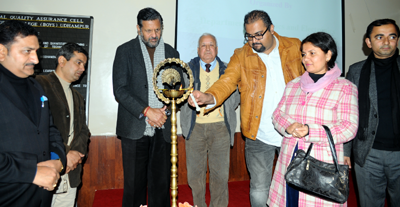
Dignitaries lightning lamp to declare open the workshop on Nano Technology at GDC, Udhampur on Wednesday.
Power Grid men rectifying faults at a tower, on snow clad Pir Panchal mountain to restore power supply to Kashmir valley.
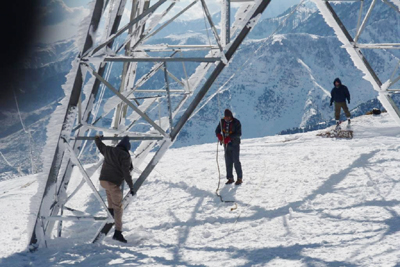
Power Grid men rectifying faults at a tower, on snow clad Pir Panchal mountain to restore power supply to Kashmir valley.
Netaji Subhash Chandra Bose continues to inspire us: President
NEW DELHI, Feb 6:
Netaji Subhash Chandra Bose’s role in India’s freedom struggle is “unique” and he continues to inspire countrymen by his single-minded devotion to the cause, President Pranab Mukherjee said today.
“Netaji’s role in India’s freedom struggle was unique. For him, the fight for India’s independence was also a part of a larger struggle against colonialism and imperialism and creation of a society that would usher in development of the masses in the widest possible sense.
“Netaji continues to inspire all Indians,” Mukherjee said at a function in Rashtrapati Bhavan here.
During the function, the President was presented a copy of book ‘Netaji Subhash Chandra Bose and Germany’, by Netaji’s daughter Prof Anita B Pfaff. The book has been brought out by the Federation of Indo-German Societies in India.
The President said he was particularly happy to see this publication as it was an extraordinary collection of records shared by Prof Anita herself as well as other eminent writers and biographers.
Mukherjee said the book portrayed some interesting facets of Netaji’s life and his extraordinary contribution to India’s freedom struggle.
“Through this book, we once again feel inspired by the single-minded devotion of Netaji in his efforts for the freedom of his motherland,” he said.
The President recalled his earlier visit to the residence of Prof Anita in Augsburg, Germany in 1995, where he said, he had the privilege of meeting with three generations of Netaji’s family.
He added that this publication was a tribute to Netaji who was one of the greatest leaders of the national movement. (PTI)
Court awards 10 yrs imprisonment to terrorist Rajoana
PATIALA, Feb 6:
A court here today awarded ten years rigorous imprisonment (RI) to terrorist Balwant Singh Rajoana in an Explosives Act case.
Additional Session Judge Sanjeev Beri sentenced him in a case registered in 1995 at Rajpura under the Explosives Act.
The court has fixed February 16, as next date of hearing in another case registered against him under the Arms Act.
Punjab police had arrested Rajoana in 1995 with around 80 kgs of RDX at Rajpura in Patiala district following which a case was registered against him. He is lodged in high security jail here.
Rajoana is also facing death sentence for assassination of former Punjab Chief Minister Beant Singh and his execution was scheduled for March 31 last year.
On March 28 last year, the Home Ministry stayed his execution following clemency appeals filed by the SGPC, a Sikh religious organisation. (PTI)
Acid attacks: SC asks Centre, states to address the menace
NEW DELHI, Feb 6:
Viewing with concern incidents of acid attacks, the Supreme Court today directed the Centre to convene in six weeks a meeting of Chief Secretaries of all states and Union Territories to address the menace and discuss framing of a law for treatment and compensation to victims.
Not satisfied with the steps taken by the Centre to regulate sale of acid and to curb its use for attacking women, a bench headed by Justice R M Lodha directed the Union Home Secretary to meet all the Chief Secretaries to formulate a policy to address the menace of the acid attacks.
The bench passed the order on a PIL filed in 2006 by Delhi-based victim Laxmi who was then a minor. Her arms, face and other body parts were disfigured in an acid attack.
In her plea, she had sought framing of a new law or amending of the existing criminal laws like IPC, Indian Evidence Act and CrPC for dealing with the offence, besides asking for compensation.
Laxmi was subjected to the acid attack by three youths near Tughlaq Road here as she had refused to marry one of them, according to the petition. The trial is going on for the offence of attempt to murder and two of the accused are out on bail.
In her petition, Laxmi had pleaded for a total ban on sale of acid as there were increasing number of incidents of such attacks on women in different states.
The petitioner had also submitted that even a small country like Bangladesh had taken measures to prevent such attacks. (PTI)
200 community colleges to come up for skill training
NEW DELHI, Feb 6:
Aiming to integrate skills in higher education, government has decided to set up on a pilot basis 200 community colleges within the existing colleges and polytechnics from the coming academic session.
These colleges will act a potent tool for implementation of the National Vocational Education Qualification Framework (NVEQF) notified last year, HRD Minister M M Pallam Raju said.
“Community colleges would offer opportunities for lifelong learning and bridge courses for level certification as well as movement from one stream to another. Industry including business, service, agriculture allied sectors will be associated integrally at all levels of activities in these colleges,” he said at a conference on community colleges here.
Industry will also have representations on the board of studies and board of management of these colleges, thus going a long way in restoring industry confidence in competence of the prospective employees, he said.
Community colleges would offer credit based modular courses to facilitate mobility of learners into the employment market, banking of credit and re-entry into the colleges for skill upgradation.
Local community would be given preference in admission in these colleges, the Minister said, adding it will create a win win situation for stakeholders, learners, industry and community besides the college.
The Minister said today the challenge before the industry is availability of skilled manpower.
According to NASSCOM, each year over three million graduates and post graduates are added to the Indian workforce, of whom only 25 per cent of technical graduates and 10-15 per cent of other graduates are considered employable.
This demand-supply mismatch of skilled workforce is a big challenge along with lack of inclination among youths to join vocational courses.
Therefore, integration of skills into higher education for making them relevant to learners is the key to addressing this mismatch and initiatives such as community colleges could help bridge the gap, he said.
He said with the notification of NVEQF, vocational course have started in 40 secondary schools in Haryana on a pilot scale while West Bengal, Karnataka and Assam are ready to launch their pilots soon.
Besides, eight other states have got their programmes approved for 2013-14. CBSE is also orienting private schools to accept the NVEQF to start vocational education programmes. (PTI)
CVC bats for police reforms,rues states not adopting model act
NEW DELHI, Feb 6:
The Central Vigilance Commission today pitched for massive reforms in police forces saying that the 150-year-old Act governing them makes police an “agent of the government” rather than a law enforcing agency.
“Police as the foremost instrumentality of the State, is required to enforce the rule of law but the Police Act of 1861, which is still the backbone of policing in the country, makes the police an agent of the government and not an agent of the law,” Vigilance Commissioner R Srikumar, a former IPS officer, said.
He rued that most of the states have failed to follow the Model Police Act, over 30 years after it was drafted by the National Police Commission.
“Six decades after Independence, four decades after the drafting of a Model Police Act by the National Police Commission and after several committees and commissions have endorsed the need for police reforms…
“Hardly a dozen out of the 30 odd states in the country have brought about any changes in the laws of policing to make it more democratic and an uphold the law, without any fear or favour,” the Vigilance Commissioner told in an interview.
Srikumar, who was part of a team which probed into the assassination of former Prime Minister Rajiv Gandhi, also pitched for a Lokpal Act and a CBI Act to make law enforcing agencies more effective.
He lamented that changes were made in Delhi Special Police Establishment Act 1946, under which the CBI functions, in 2003 making it compulsory for government approval before launching a graft probe against a joint secretary-level officer and above.
“Police do not have any compunction in arresting a sleeping Baba or an octogenarian who stage a protest against corruption and ineffective mechanisms. Not only do we not have a Lokpal Act, we also do not have a CBI Act.
“Although the maxim ought to be ‘no matter how high you are, the law is above you’, still the Delhi Special Police Establishment Act 1946 was amended in 2003 to make it mandatory to get government concurrence before a corruption case can be taken up against an officer of the level of joint secretary and above,” he said, suggesting a change in the process. (PTI)
Sonia launches child health screening for birth defects
PALGHAR,
MAHARASHTRA, Feb 6:
Congress President Sonia Gandhi today launched a new initiative of universal child health screening for birth defects and deficiencies that can lead to disabilities, as well as early intervention services that will cover an estimated 27 crore children.
Acknowledging the challenges of malnutrition among children, Gandhi expressed confidence that the Food Security Act that the UPA Government proposed to bring soon will help tackle the problem.
“UPA Government is going to bring a very important Food Security Act. I think this historic step will help in tackling the problem of malnutrition among children,” Gandhi said.
Speaking at the launch function, she said, “I am happy that this project is being launched from here and I congratulate all of you”.
“Children are the future of the country. Their well-being is our concern. That is why the Congress-led Government has started such programmes,” she said, adding “It has been an endeavour of our Government that there should be no shortage of funds for public health schemes.”
Listing out various schemes launched by the UPA Government for improving health and well being of children, she lamented that 40 percent of children still suffered from malnutrition, which is a matter of great concern.
“Though we have many achievements on one hand, we also have many challenges before us,” she said expressing concern over the high child mortality rate in the country.
She said the UPA government laid special emphasis on giving greater attention to the most backward and needy parts of the country and it also ensured there is no shortfall in funds for social welfare and human resource development.
Gandhi said the government has opened as many 270 nursing schools in backward and remote areas of the country and hoped the SC/ST women will undergo training in them and join the noble profession.
Listing out the achievement of polio eradication from the country, she said, “Some time back over two lakh children fell victims to polio. Now India is polio-free. I feel it is a very big achievement, whose beginning was made by Rajivji.”
She also listed out the Right to Education Act and the Mid-day meal scheme aimed at helping children attain free education and feed them properly while in school.
Gandhi said the Government had distributed Rs 90,000 crores to states under the National Rural Health Mission (NRHM) in the last seven years for the welfare of the masses in the rural and remote areas of the country.
The current programme is also being launched under the NRHM scheme of Union Ministry of Health and Family Welfare.
The initiative is aimed at improving overall quality of life of children through early detection of birth defects, diseases and deficiencies, which are among key factors for child mortality and out of pocket expenditure for poor families, as well as development delays including disability.
Under the programme, a set of 30 common conditions have been identified for screening and further management of child health.
These services are built on the existing school health services and will be provided through dedicated mobile health teams placed in every block who will comprise of four health personnel including two AYUSH doctors, an ANM and a pharmacist.
The teams will carry out screening of all the children in the age group 0–6 years enrolled at Anganwadi centres at least twice a year besides screening of all children enrolled in Government and Government aided schools.
Birth defects account for 9.6 per cent of all new-born deaths and 4 per cent of under five mortality.
According to the 2006 March of Dimes Global Report on Birth Defects, out of every 100 babies born in this country every year, 6 to 7 have a birth defect. In Indian context, this would translate to 17 lakhs birth defects annually.
Development delays affect at least 10 per cent children and if not intercepted timely may lead to permanent disabilities including cognitive, hearing or vision. (PTI)
Cabinet to consider SPV for TAPI project today
NEW DELHI, Feb 6:
Struggling to get global energy majors who can build the USD 9 billion TAPI gas pipeline, its four promoter nations have decided to float a special purpose vehicle to keep the transnational project alive.
The SPV, TAPI Ltd, will be formed with Turkmenistan, Afghanistan, Pakistan and India pumping in USD 5 million equity each. India will be represented by state-owned GAIL India Ltd.
The proposal for formation of the Dubai-based SPV and GAIL being India nominee is listed for consideration of the Union Cabinet for its meeting slated for tomorrow morning, official sources said.
The issue however may not be taken up as Oil Minister M Veerappa Moily is in US on a 10-day visit.
The SPV is being considered for the project as no multinational company is willing to participate in the project unless they get a share in Turkmenistan’s rich gas fields.
While Turkmenistan, Afghanistan and Pakistan are of the view that the four promoters could build and operate the pipeline on their own, India has insisted that the project be taken up only if a multinational company leads it.
New Delhi does not want to be at the mercy of Afghanistan and Pakistan for its gas needs and also feels that none of the nominee companies of the four countries have the financial and managerial capability to execute the project.
Sources said TAPI Ltd would scout for a consortium leader who will build and operate the project, while the US government would pursue Turkmenistan to get upstream equity for its multinational.
The SPV would be responsible for safe delivery of gas through the pipeline that will traverse militancy-infested areas in Afghanistan and Pakistan.
The 1,680-km pipeline will carry 90 million cubic metres a day (mcmd) of gas and is scheduled to become operational in 2018. India and Pakistan will get 38 mmcmd each, while the remaining 14 mcmd will be supplied to Afghanistan. (PTI)
Major concerns in field of education need to be addressed:PM
NEW DELHI, Feb 6:
Lamenting that standard of teachers in not up to the mark and learning outcomes are below expectations, Prime Minister Manmohan Singh today said “major concerns” in the field of education need to be addressed.
Singh also noted that “drop-out rates in schools remain high after the elementary level. Some major concerns relating to equity also remain to be addressed.”
The Prime Minister’s comments come a day after he regretted that none of the Indian universities figures among the top 200 in the world and that the focus henceforth would be on giving “over-riding emphasis on quality”.
Addressing the inaugural function of the Golden Jubilee celebration of Kendriya Vidyalaya Sangathan, he said his government has always recognised that India can emerge as a modern, prosperous and progressive country only when the citizens have access to good quality education.
“We know that our country is a young country and we can reap the demographic dividend only if we have an educated and skilled workforce that would help our economy to expand and become more productive,” the Prime Minister said.
Singh felt that Kendriya Vidyalayas can help in a major way in setting standards and benchmarks for schools that are situated in the area around them, adding that “this is one of the roles envisaged for them in the 12th plan.
“They should act as role models for neighbourhood schools, mentoring them and sharing best practices with them,” the Prime Minister said, urging KVS system to find ways and means of effectively fulfilling these expectations.
He also said that ever since UPA Government came to power, it has laid special emphasis on education increasing investment in the sector on an unprecedented scale.
Claiming that his government has rapidly expanded access to education, the Prime Minister said UPA Government has worked to improve the quality of teaching to enable better learning outcomes.
“We have endeavoured to ensure that students from weaker sections of society and the less developed regions of our country also get access to educational opportunities,” Singh said.
He also lauded KVS for discharging its responsibility with “great distinction”, saying its journey of 50 years has been a very rewarding one and it has contributed handsomely to the process of nation building.
The Prime Minister noted with happiness that the proportion of girl students in KVs is 43 percent and that women constitute the majority among teachers.
He also chose the occasion to point out that beginning with 20 Regimental schools at the time of its establishment in 1963, KVS now administers about 1100 Kendriya Vidyalayas, spread over all parts of the country and that it imparts education to about 11 lakh children and employs more than 46000 people.
“It must be a very heartening thought for all those associated with the KVS that there is tremendous demand for additional Kendriya Vidyalayas in different parts of our country… This is a pointer to the high standards of teaching that the KVS system has maintained,” he said.
He noted that KVS has taken a number of new initiatives to keep pace with the rapidly changing realities like the use of Information Technology in imparting education, exchange programmes for teachers and students with foreign countries and teaching of foreign languages. (PTI)