

NEW DELHI, Feb 6:
Aiming to integrate skills in higher education, government has decided to set up on a pilot basis 200 community colleges within the existing colleges and polytechnics from the coming academic session.
These colleges will act a potent tool for implementation of the National Vocational Education Qualification Framework (NVEQF) notified last year, HRD Minister M M Pallam Raju said.
“Community colleges would offer opportunities for lifelong learning and bridge courses for level certification as well as movement from one stream to another. Industry including business, service, agriculture allied sectors will be associated integrally at all levels of activities in these colleges,” he said at a conference on community colleges here.
Industry will also have representations on the board of studies and board of management of these colleges, thus going a long way in restoring industry confidence in competence of the prospective employees, he said.
Community colleges would offer credit based modular courses to facilitate mobility of learners into the employment market, banking of credit and re-entry into the colleges for skill upgradation.
Local community would be given preference in admission in these colleges, the Minister said, adding it will create a win win situation for stakeholders, learners, industry and community besides the college.
The Minister said today the challenge before the industry is availability of skilled manpower.
According to NASSCOM, each year over three million graduates and post graduates are added to the Indian workforce, of whom only 25 per cent of technical graduates and 10-15 per cent of other graduates are considered employable.
This demand-supply mismatch of skilled workforce is a big challenge along with lack of inclination among youths to join vocational courses.
Therefore, integration of skills into higher education for making them relevant to learners is the key to addressing this mismatch and initiatives such as community colleges could help bridge the gap, he said.
He said with the notification of NVEQF, vocational course have started in 40 secondary schools in Haryana on a pilot scale while West Bengal, Karnataka and Assam are ready to launch their pilots soon.
Besides, eight other states have got their programmes approved for 2013-14. CBSE is also orienting private schools to accept the NVEQF to start vocational education programmes. (PTI)
200 community colleges to come up for skill training
CVC bats for police reforms,rues states not adopting model act
NEW DELHI, Feb 6:
The Central Vigilance Commission today pitched for massive reforms in police forces saying that the 150-year-old Act governing them makes police an “agent of the government” rather than a law enforcing agency.
“Police as the foremost instrumentality of the State, is required to enforce the rule of law but the Police Act of 1861, which is still the backbone of policing in the country, makes the police an agent of the government and not an agent of the law,” Vigilance Commissioner R Srikumar, a former IPS officer, said.
He rued that most of the states have failed to follow the Model Police Act, over 30 years after it was drafted by the National Police Commission.
“Six decades after Independence, four decades after the drafting of a Model Police Act by the National Police Commission and after several committees and commissions have endorsed the need for police reforms…
“Hardly a dozen out of the 30 odd states in the country have brought about any changes in the laws of policing to make it more democratic and an uphold the law, without any fear or favour,” the Vigilance Commissioner told in an interview.
Srikumar, who was part of a team which probed into the assassination of former Prime Minister Rajiv Gandhi, also pitched for a Lokpal Act and a CBI Act to make law enforcing agencies more effective.
He lamented that changes were made in Delhi Special Police Establishment Act 1946, under which the CBI functions, in 2003 making it compulsory for government approval before launching a graft probe against a joint secretary-level officer and above.
“Police do not have any compunction in arresting a sleeping Baba or an octogenarian who stage a protest against corruption and ineffective mechanisms. Not only do we not have a Lokpal Act, we also do not have a CBI Act.
“Although the maxim ought to be ‘no matter how high you are, the law is above you’, still the Delhi Special Police Establishment Act 1946 was amended in 2003 to make it mandatory to get government concurrence before a corruption case can be taken up against an officer of the level of joint secretary and above,” he said, suggesting a change in the process. (PTI)
Sonia launches child health screening for birth defects
PALGHAR,
MAHARASHTRA, Feb 6:
Congress President Sonia Gandhi today launched a new initiative of universal child health screening for birth defects and deficiencies that can lead to disabilities, as well as early intervention services that will cover an estimated 27 crore children.
Acknowledging the challenges of malnutrition among children, Gandhi expressed confidence that the Food Security Act that the UPA Government proposed to bring soon will help tackle the problem.
“UPA Government is going to bring a very important Food Security Act. I think this historic step will help in tackling the problem of malnutrition among children,” Gandhi said.
Speaking at the launch function, she said, “I am happy that this project is being launched from here and I congratulate all of you”.
“Children are the future of the country. Their well-being is our concern. That is why the Congress-led Government has started such programmes,” she said, adding “It has been an endeavour of our Government that there should be no shortage of funds for public health schemes.”
Listing out various schemes launched by the UPA Government for improving health and well being of children, she lamented that 40 percent of children still suffered from malnutrition, which is a matter of great concern.
“Though we have many achievements on one hand, we also have many challenges before us,” she said expressing concern over the high child mortality rate in the country.
She said the UPA government laid special emphasis on giving greater attention to the most backward and needy parts of the country and it also ensured there is no shortfall in funds for social welfare and human resource development.
Gandhi said the government has opened as many 270 nursing schools in backward and remote areas of the country and hoped the SC/ST women will undergo training in them and join the noble profession.
Listing out the achievement of polio eradication from the country, she said, “Some time back over two lakh children fell victims to polio. Now India is polio-free. I feel it is a very big achievement, whose beginning was made by Rajivji.”
She also listed out the Right to Education Act and the Mid-day meal scheme aimed at helping children attain free education and feed them properly while in school.
Gandhi said the Government had distributed Rs 90,000 crores to states under the National Rural Health Mission (NRHM) in the last seven years for the welfare of the masses in the rural and remote areas of the country.
The current programme is also being launched under the NRHM scheme of Union Ministry of Health and Family Welfare.
The initiative is aimed at improving overall quality of life of children through early detection of birth defects, diseases and deficiencies, which are among key factors for child mortality and out of pocket expenditure for poor families, as well as development delays including disability.
Under the programme, a set of 30 common conditions have been identified for screening and further management of child health.
These services are built on the existing school health services and will be provided through dedicated mobile health teams placed in every block who will comprise of four health personnel including two AYUSH doctors, an ANM and a pharmacist.
The teams will carry out screening of all the children in the age group 0–6 years enrolled at Anganwadi centres at least twice a year besides screening of all children enrolled in Government and Government aided schools.
Birth defects account for 9.6 per cent of all new-born deaths and 4 per cent of under five mortality.
According to the 2006 March of Dimes Global Report on Birth Defects, out of every 100 babies born in this country every year, 6 to 7 have a birth defect. In Indian context, this would translate to 17 lakhs birth defects annually.
Development delays affect at least 10 per cent children and if not intercepted timely may lead to permanent disabilities including cognitive, hearing or vision. (PTI)
Cabinet to consider SPV for TAPI project today
NEW DELHI, Feb 6:
Struggling to get global energy majors who can build the USD 9 billion TAPI gas pipeline, its four promoter nations have decided to float a special purpose vehicle to keep the transnational project alive.
The SPV, TAPI Ltd, will be formed with Turkmenistan, Afghanistan, Pakistan and India pumping in USD 5 million equity each. India will be represented by state-owned GAIL India Ltd.
The proposal for formation of the Dubai-based SPV and GAIL being India nominee is listed for consideration of the Union Cabinet for its meeting slated for tomorrow morning, official sources said.
The issue however may not be taken up as Oil Minister M Veerappa Moily is in US on a 10-day visit.
The SPV is being considered for the project as no multinational company is willing to participate in the project unless they get a share in Turkmenistan’s rich gas fields.
While Turkmenistan, Afghanistan and Pakistan are of the view that the four promoters could build and operate the pipeline on their own, India has insisted that the project be taken up only if a multinational company leads it.
New Delhi does not want to be at the mercy of Afghanistan and Pakistan for its gas needs and also feels that none of the nominee companies of the four countries have the financial and managerial capability to execute the project.
Sources said TAPI Ltd would scout for a consortium leader who will build and operate the project, while the US government would pursue Turkmenistan to get upstream equity for its multinational.
The SPV would be responsible for safe delivery of gas through the pipeline that will traverse militancy-infested areas in Afghanistan and Pakistan.
The 1,680-km pipeline will carry 90 million cubic metres a day (mcmd) of gas and is scheduled to become operational in 2018. India and Pakistan will get 38 mmcmd each, while the remaining 14 mcmd will be supplied to Afghanistan. (PTI)
Major concerns in field of education need to be addressed:PM
NEW DELHI, Feb 6:
Lamenting that standard of teachers in not up to the mark and learning outcomes are below expectations, Prime Minister Manmohan Singh today said “major concerns” in the field of education need to be addressed.
Singh also noted that “drop-out rates in schools remain high after the elementary level. Some major concerns relating to equity also remain to be addressed.”
The Prime Minister’s comments come a day after he regretted that none of the Indian universities figures among the top 200 in the world and that the focus henceforth would be on giving “over-riding emphasis on quality”.
Addressing the inaugural function of the Golden Jubilee celebration of Kendriya Vidyalaya Sangathan, he said his government has always recognised that India can emerge as a modern, prosperous and progressive country only when the citizens have access to good quality education.
“We know that our country is a young country and we can reap the demographic dividend only if we have an educated and skilled workforce that would help our economy to expand and become more productive,” the Prime Minister said.
Singh felt that Kendriya Vidyalayas can help in a major way in setting standards and benchmarks for schools that are situated in the area around them, adding that “this is one of the roles envisaged for them in the 12th plan.
“They should act as role models for neighbourhood schools, mentoring them and sharing best practices with them,” the Prime Minister said, urging KVS system to find ways and means of effectively fulfilling these expectations.
He also said that ever since UPA Government came to power, it has laid special emphasis on education increasing investment in the sector on an unprecedented scale.
Claiming that his government has rapidly expanded access to education, the Prime Minister said UPA Government has worked to improve the quality of teaching to enable better learning outcomes.
“We have endeavoured to ensure that students from weaker sections of society and the less developed regions of our country also get access to educational opportunities,” Singh said.
He also lauded KVS for discharging its responsibility with “great distinction”, saying its journey of 50 years has been a very rewarding one and it has contributed handsomely to the process of nation building.
The Prime Minister noted with happiness that the proportion of girl students in KVs is 43 percent and that women constitute the majority among teachers.
He also chose the occasion to point out that beginning with 20 Regimental schools at the time of its establishment in 1963, KVS now administers about 1100 Kendriya Vidyalayas, spread over all parts of the country and that it imparts education to about 11 lakh children and employs more than 46000 people.
“It must be a very heartening thought for all those associated with the KVS that there is tremendous demand for additional Kendriya Vidyalayas in different parts of our country… This is a pointer to the high standards of teaching that the KVS system has maintained,” he said.
He noted that KVS has taken a number of new initiatives to keep pace with the rapidly changing realities like the use of Information Technology in imparting education, exchange programmes for teachers and students with foreign countries and teaching of foreign languages. (PTI)
Antony accepts defence budget cut-but no compromise on preparedness
BANGALORE, Feb 6: Defence Minister A K Antony today asked the Armed Forces to be preapred for a cut in the defence budget for 2013-14 as the country was going through difficult times due to’ fiscal difficulties’ but this, he said, will not affect the operational preparedness of the Indian defence force.
Addressing newsmen after inaugurating the ninth edition of Aero India here, he said it was a painful question and his department certainly wants to get more fuinds.
‘The union government is going through fiscal difficulties and recession in the global economy has also affected the Indian economy as well.
‘We have to tighten our belts for better future. All departments have to do it and not just the defence department.
‘Government is doing everything to overcome the problem. But I can assure you that priority areas like operational preparedness will not suffer.
‘There will not be any slackness when it comes to this,’ he said.
According to reports, the Finance Minister is likely to affect a cut upwards of 15 per cent in the budgetary allocations for the defence forces.
During 2012-13 the defence budget stood at Rs 1,93,000 crore.
He said the government was fully aware of the threats the country faced and there will not be any compromise on the preparedness of the armed forces.
When it comes to modernisation of armed forces, there is no question of any slackness in it be there a cut in the defence budget or not as it is connected with geo-political question.
‘India also faces threat and we are in a volatile situation of some sorts.
‘National security is of primary importance. India’s speedy economic growth depends on peace prevailing in the country’, he said.
On China modernising its road and other infrastructure on the Eastern parts of India, Mr Antony said China was indeed modernising its infrastructure bordering India in a big way but India was not in a position to question it.
‘We cannot complain as they are doing it in their own rea.
‘India is also strengthening its infrastructure bordering China and strengthening it borders and putting more assets there. They are doing it and we will also do. This is not for a confrontation. But we have to prepared for any eventuality and it is the duty of our country,’ he said.
Mr Anthony expressed grave concern over Pakistan handing over one of its ports to China.
‘China is constructing the port on the request of Pakistan. It is a concern for us and I want to be very straight forward in this regard, he added.’
However, the Defence Minsiter welcomed the presence of a Chinese delegation at Aero India 2013.
‘They are most welcome as there should be cooperation between the two countries in the military space as well in the lines of the two countries forging close relationship in economic, social, cultural areas.
‘We have had border management agreements and recently the Defence Secretary had taken a delegation to Beijing.
‘So they are here because of an ‘improved’ situation.
‘They have come here for the first time, I welcome them,’ he said.
(UNI)
Modi meets PM, seeks parity in gas pricing
NEW DELHI, Feb 6:
Gujarat Chief Minister Narendra Modi today accused the Centre of disparity in gas pricing as he met Prime Minister Manmohan Singh and sought his intervention in resolving a number of critical issues pertaining to his state.
Modi, who met Singh for the first time after his third successive electoral victory in December last, expressed his unhappiness over the Centre’s refusal to provide gas to the state at the same price at which it is given to Mumbai and Delhi.
Demanding the same rates for gas supplied to Gujarat as to places like Delhi and Mumbai, Modi handed over a memorandum to the Prime Minister on various issues pending Centre’ action that had a huge bearing on the country’s economy.
“It was a very good meeting and we had a long discussion during which several different issues came up. The Prime Minister gave his good wishes for the development of Gujarat and the success of the new government. I gave an assurance that Gujarat will give full support to all measures taken for the welfare of the people,” he told reporters after the 45- minute meeting.
On the gas pricing issue, he said, “A legal battle is on between us and the Government of India. Gujarat is not given gas at the price at which Delhi and Mumbai get it. We had gone to court and won the case. Despite this the order was not implemented for six months and we filed a contempt petition.”
“Instead of accepting this order, the Government of India went to the Supreme Court to delay the process. I have expressed my unhappiness to the Prime Minister over this,” he said.
He also discussed the issue of raising the height of Sardar Sarovar dam to 138.68 meter and sought Singh’s intervention to get clearance for construction of spillway piers to full height, bridge and installation of gates at the dam site.
Modi said by raising the Full Reservoir Level (FRL) of the dam the storage capacity of the dam will get enhanced to 46.8 lakh acre feet (almost three times the present capacity) and would facilitate creation of an additional irrigation potential of 6.8 lakh ha and nearly 40 per cent additional power generation.
Modi urged the Prime Minister to facilitate clearance for the long-pending project as early as possible.
Raising the issue of desert development programme (DDP) areas facing severe water problems than areas covered under the drought prone areas programme (DPAP), he said the Centre was strangely not providing assistance under Accelerated Irrigation Benefit programme (AIBP), even though it provides 90 per cent assistance in DPAP areas.
The Chief Minister said Gujarat has very large areas in Saurashtra and Kutch under DDP which falls under command areas of Sardar Sarovar and the state has made all out efforts to bring water to these areas to improve the lives of people.
He noted that the Planning Commission chaired by Prime Minister supports the proposal to bring DDP areas at par with DPAP areas but the same has not been approved by the Government of India.
Modi also raised the issues of regulating BT cotton seed prices which adversely affected the farmers in Gujarat, flip – flop in allowing cotton export, non-payment of royalty on crude oil as per statutory provisions, coal allocation to Gujarat from nearer coal mines of Western Coal fields for power generation and complete waiver on custom duty in ship breaking industry.
He said most issues not only adversely affected the economic growth and development of the State but also put common people especially farmers and marginalized sections of society in very difficult and distressful conditions.
The Gujarat Chief Minister, who had called on President Pranab Mukherjee last month, wanted the Prime Minister to look into the demand for completion of the canal network on Narmada river to provide water to farmers.
“As per the Government of India norms Gujarat should get this. I requested him that Gujarat should get the same benefits that other states get,” he said. (PTI)
Bikaner baby girl bitten by father dies
JAIPUR, Feb 6:
A five-month-old-baby girl from Bikaner, whose father had bitten off parts of her lips, nose and cheek in a fit of rage, died at a Government hospital here today.
“The condition of the baby deteriorated last night after she was breastfed by her mother.The milk entered into her lungs following which some complications developed and she was put on ventilator support but she died,” Spokesperson of the Sawai Man Singh Government Hospital here said.
The girl was operated upon on February 1.
Police said the baby’s 36-year-old father Bahadur Singh will be charged with murder.
The father had allegedly bitten off parts of her nose, lips and cheek in a fit of rage leaving her face damaged in Bikaner last month.
The accused was drunk when he reached his house in Siyana village and had a verbal spat with his wife Santosh over some domestic issue.
During the quarrel, he had bitten off the upper lip, nose and cheek of the baby in a fit of rage, according to the police.
Deepak Kalra, Chairperson, Child Rights Commission said, “It is really very sad. She developed respiratory complications last night. She was put on ventilator and we were hoping that she would come out and fight like she was fighting for the last 10 days but unfortunately she succumbed to the complications.
“As you know the surgery was five-and-half hours long. There were three surgeries that were done at one go and then she had to undergo two more surgeries. The case was complicated and unfortunately she could not go through it,” she said. (PTI)
Prime Minister, Dr. Manmohan Singh addressing at the Golden Jubilee Celebrations of the Kendriya Vidyala Sangathan (KVS), in New Delhi on Wednesday.
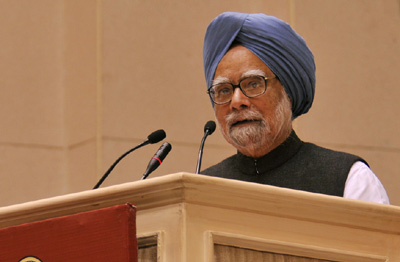
Prime Minister, Dr. Manmohan Singh addressing at the Golden Jubilee Celebrations of the Kendriya Vidyala Sangathan (KVS), in New Delhi on Wednesday.
JGBs rise as rekindled eurozone fears sap risk appetite
TOKYO, Feb 5: Japanese government bonds rose on Tuesday, with the benchmark yield backing off a three-week high hit in the previous session amid fears about the impact of political woes in Italy and Spain.
Disappointing U.S. Factory orders data, a downward revision to a report on U.S. Business investment plans and a smooth sale of 10-year JGBs also bolstered the market.
The Ministry of Finance’s offering of 2.4 trillion yen ($26 billion) of 10-year notes garnered a lowest accepted price of 100.04. The sale reopened the current issue with a coupon of 0.8 percent.
The auction’s tail – the gap between the lowest and average prices – was 0.02, matching that of the previous sale, although the sale drew bids of only 2.75 times the amount offered, down from the previous sale’s bid-to-cover ratio of 3.52 times.
‘The sale was decent, though not spectacular, and there was some follow-through buying in the cash market in the afternoon,’ said a fixed-income fund manager at a Japanese trust bank.
The 10-year JGB yield slipped 1 basis point to 0.795 percent. The 10-year JGB futures contract ended up 0.22 point at 143.90, though it still remained shy of its 20-day moving average, now at 144.09.
Most market participants had expected that the 10-year sale would go smoothly, after the benchmark yield moved away from a six-week low of 0.720 percent hit on Jan. 25 to 0.805 percent on Monday, its highest level since Jan. 15.
But some investors were concerned about the slightly larger offering size. The ministry increased the monthly offering amount by 100 billion yen this month, and will do the same next month, to fund its supplementary budget.
‘We started recommending receiving the 10-year tenor in swaps,’ said Maki Shimizu, senior strategist at Citigroup Global Markets Japan.
Spanish and Italian bond yields rose after a corruption scandal prompted calls for Spanish Prime Minister Mariano Rajoy to resign and on news of a probe of alleged misconduct involving an Italian bank three weeks before national elections.
That hit risk appetite, helping to lift U.S. Treasuries and sending the Nikkei stock average skidding 1.9 percent off Monday’s 33-month closing high.
The 20-year bond yield shed half a basis point to 1.790 percent, while the 30-year bond yield lost 1 basis point to 1.995 percent.
The chairman of Japan’s Government Pension Investment Fund told Reuters in an interview on Monday that the fund would review its portfolio allocation model around April, as yields on 10-year JGBs were languishing at around 0.8 percent.
The GPIF is the world’s biggest public pension fund, with its assets of $1.2 trillion mostly held in JGBs. ($1 = 92.6950 Japanese yen)
(AGENCIES)