

Sir,
It is submitted that under Sarva Shiksha Abhiyan, a large number of RETs have been appointed. No doubt, the scheme has not only generated ample opportunities of rural employment but has also empowered women as a large number of females are enjoying the benefits of this scheme. But this scheme needs to be reviewed as it suffers from many defeats.
While initiating this scheme, the appointees were not aware about the transfer policy of RETs. Earlier, the RETs were required to complete a period of 5 years of satisfactory service plus a mandatory period of 2 years at their parental school before claiming the benefits of transfer.
But as per the latest transfer policy in respects of RETs, they are required to stay at their parental schools till further promotions. Here the worst sufferers are married females as most of them have been married off in towns and cities far away from their schools. As such they can neither lead a peaceful married life with their inlaws nor can they also do justice to their department.
In face of the foregoing facts you are therefore, requested to review the transfer policy in favour of RETs teachers especially married female teachers on humanitarian grounds.
Yours etc….
Sanka Dass
Sarpanch
Gunda, Budhal
Plea to Dy Chief Minister
Budget Session
Sir,
In the recent times the proceedings in Parliament and as well as in the State Assemblies have remained chaotic. The members from the treasury bench as well as the opposition indulge in verbal duals to score points.
The Speaker finds it difficult to motivate the members who disrupt the proceedings at the slightest of provocation. Precious time of the Parliamentary business is lost. The focus of the issue concerning public gets diluted and delayed. The Speaker is forced to adjourn the house repeatedly to maintain order in the house. Repeated disruptions of the house lead to the loss of public exchequer which runs into crores of rupees.
The members should realize the responsibility, the faith which the people have reposed on them and the duty bound to be performed by them. The decorum of the house has to be maintained at every cost. These highest Institutions of Parliamentary democracy should set an example by maintaining discipline remaining transparent and accountable.
Fruitful utilization of the precious time has to be ensured in letter and spirit for the common good of the people. Fictitious and irrelevant issues should be discouraged. It should be mendatory for a minister of a particular department to actively participate in discussions related to his department. The countrymen of the State have lot of expectations from their elected representatives and do not let them down this time. They are watching you. Your performance is your real test.
Yours etc….
S.N. Raina
Jammu
Terror strikes again
Poonam I Kaushish
How many terror attacks need to take place before the Government becomes serious about tackling this menace. In the last ten years alone, 20 such attacks have taken place across the country. Each time the story is the same: “Never again” promises and “we are committed to fighting cowardly terror attacks”. Sic. Till the next attack occurs. Underscoring that terror has become a gulli-danda ka khel for our netagan.
Yesterday’s twin bomb blasts in Hyderabad’s crowded Dilsukhnagar area once again reiterates that we continue to be a soft state, worse are clueless about tackling it. Asserted Home Minister Shinde, “The situation is under control, the Government will combat this.” Really? How?
The political circus of ex gratia took over. Prime Minister Manmohan Singh announced Rs. 2 lakh for the deceased next of kin which the State Government upped to Rs 6 lakh. Followed by a series of high profile appear-and-vanish visits to the city to profess their angst and extract political mileage.
Undeniably, the Government has lot of explaining to do. True a specific alert warning of an attack by a Pakistan-based terrorist group was shared by Central security agencies with Hyderabad police on the morning of the blast. Along-with Bangalore, Coimbatore, Hubli, Maharashtra and Gujarat warning them that Lashkar-e-Taiba, Jaish-e-Mohammad, Hizbul Mujahideen and banned Indian Mujahideen might launch attacks post Parliament perpetrator Afzal Guru’s hanging.
But is that enough? Does the Centre’s role end after warning States about terror threats and that they should be on the alert? Not at all. It has to be proactive and take adequate preventive measures. Pertinently, when it had leads of an attack what security imperatives did it put in place? It cannot simply pass the buck by asserting it is for the States to step up vigil. Already Andhra Chief Minister Kiran Kumar Reddy has refuted Shinde and said the alerts were general in nature. .
This is only half baked truth. What Shinde left unsaid was more important. Last year, the Delhi Police announced that an Indian Mujahedeen operative had confessed to stalking areas in Hyderabad including Dilsukhnagar which was widely circulated. This begs a question why wasn’t security beefed up in Dilsukhnagar as this crowded locality had been targeted twice earlier.
The tragedy of it all is that over the years we have politicise terror to such an extent that it has become the biggest hurdle to crafting a uniform approach to security and fighting terror. A case in point Afzal Guru’s hanging. Vote banks politics is dictated our leaders’ reaction to his hanging? From Samajwadi’s Mulayam to National Conference Omar Abdullah all are touting ‘human rights violation.’
Guru’s family should have been allowed to visit him one last time. Does that mean that he should have been hanged with the knowledge of his family? Where in the world does any Government announce its intent to hang a terrorist?
Also, now that Ajmal Kasab and Guru have been executed the Congress is busy trying to draw electoral mileage with its eye on the forthcoming election by projecting their hangings as an indicator of its Government’s resolve to deal with Pakistan-sponsored terrorism.
Our Home Minister too is no better. He hoped to reap a political harvest by talking of ‘saffron terror’ recently hoping to earn brownie points by pegging terrorism on the Sangh Parivar. Only to cut a sorry figure by apologizing for his remark. He needs to focus on augmenting national counter terrorism capabilities instead of conveniently turning a blind eye that a terrorist has no religion, caste or colour.
Clearly, coordination between the Central and State Governments as also among securities agencies is lacking. The National Investigation Agency set-up with much hoopla needs to clarify how it helps various State Governments probe blasts? Yet its officials ensconced in New Delhi’s air-conditioned offices brush their responsibility by claiming lack of skilled manpower.
In this age of real politik, India will remain at the mercy of terrorist organizations which will always have the upper hand in choosing the time and place of the next attack. Time is far gone for taking moral and legal positions. Our leaders should not be under any illusion that the execution of Kasab and Guru would have any deterrent effect on the jihadis operating from Pakistan and their State sponsors. Deaths will not deter them from carrying on their irrational jihad.
The flames of fundamentalist terrorism in India are still being fanned by the Pakistan army and the ISI, though on a reduced scale. The time to debate this issue on moral and legal grounds has long since passed “Are we alert after Hyderabad blasts? Are we sure that Bangalore, Mumbai whenever terror strikes a country over and over again it emphasis that the Government lacks the political will to fight terror or does not have the capability and skills to meet the threat or any other city are now secure?”
Sadly, instead of learning lessons from previous attacks, we continue making the same mistakes: Casual indifference. Be it in intelligence gathering, not following alerts, lack of police patrolling and shooting their mouth off to score brownie points before nailing the perpetrators. All covering up their sins of commission and omission. Alas, only concerned about their own security. Shockingly, in the Union Capital there is only one policeman to every 1000 citizens. Ditto the case elsewhere.
From Kargil to Mumbai the story, comments and diagnoses have been heard before. Examples abound. Post 26/11 the National Counter Terrorism Centre is nowhere in sight. The National Intelligence Grid is behind schedule. The National Security Guards hubs in Mumbai, Chennai, Kolkata and Hyderabad for quicker response to terror strikes are yet to materialize. The Maritime Security Advisory and Maritime Security Adviser are thwarted by turf war. Our coastal security apparatus comprising registration of vessels & ID cards to fishermen are both incomplete.
On the obverse, since 9/11 twelve years ago no attack has taken place in the US. Simply because its leaders and police concentrate on fighting the ‘terror enemy’. Not each other. We need to learn from them. The time has come for the Government to stop playing footsie with the aam aadmi’s life, get its act together and proceed firmly. No longer will “work in progress” suffice.
Until we get out of this unprofessional rut, terrorists will continue to strike with impunity and innocent civilians will continue to die. How to neutralise their capability and infrastructure is a question that should engage our continuous attention. Obtaining accurate intelligence about impending attacks and then neutralizing the terrorists’ ground capability once and for all will only work.
The need of the hour is that the Government immediately finds answers to two questions: Are we alert after Hyderabad blasts? Is it sure that Bangalore, Mumbai or X,Y,Z city are now secure? It must delink national security from electoral vote bank politics and show a strong resolve to fight against terror. Remember, for Indians it is a question of life and death. INFA
Final “Twilight Saga” movie gets mauling from Razzies
LOS ANGELES, Feb 25: Popular vampire movie “The Twilight Saga: Breaking Dawn – Part 2” was savaged at the Razzie Awards on Saturday, earning seven “wins” in the annual contest for the worst movies and performances of the year. “Twilight” star Kristen Stewart, co-star Taylor Lautner and director Bill Condon were awarded Golden Raspberry statuettes for their parts in the final installment of the blockbuster film franchise. That film alone has taken an impressive $829 million at the global box office. (agencies)
Plight of Jammu Vridh Ashram
Prof V S Verma
The change of lifestyle from the traditional to a liberal, formation of nuclear families, various age related problems like declining health and income as well as emotional security are confronted by the aged people. These problems were hitherto well taken care of in our traditional joint family system. But, with the erosion of joint family custom all these problems are being confronted by different categories of aged people necessitating the need for the old age homes in our society. Vridh Ashram, the Home for the poor, helpless, destitute, aged and infirm people of the society, irrespective of their caste, creed, religion, sex or region or status was established at Ambphala, Jammu in 1964 by the noble founder Late Ram Nath Prabhakar with the motto of “Nar Seva is Narayan Seva” (Service to human is true worship of God).This ‘Home’ for aged & infirm was registered under J&K Registration of Societies Act VI in 1965 Vide No. 66 of 1965 dated 20th February, 1965. However this Home was literally adopted by Social Welfare Department of Jammu & Kashmir in 1986 obviously for the purposes of housing the elderly people who languish for home & hearth for multiple perceptibly discernible reasons. From one room at the time of its inception, the Home has now grown to two full fledged two-block buildings with the capacity to comfortably accommodating ninety people of varied sex. The Home has emerged as a premier Centre in Jammu & Kashmir State for providing humane service to such members of the society aiming to afford a respectable shelter with not only excellent boarding and lodging facilities but also free reading material, good recreational and entertainment facilities to alleviate the hardships besides medical to the best of its means.
The Social Welfare Department of J&K Government, immediately after adoption of the home in 1986, made provisions for (i) monthly salary of Rs. 500 to Manager, Rs. 300 to Clerk, Rs. 250 to Cook, Rs. 200 to Peon and Rs. 250 to Chowkidar (ii) sanctioned Rs. 5 (five rupees only) for diet, medicines and incidental daily expenses to the senior citizens housed therein and (iii) Rs. 275 for clothing of inmates once in three years. The perks may have been sufficient more than quarter of a century from now, but seem to be not only too meagre, unreasonable, but quite ridiculous as on date. A number of VIPs visiting the Home at different occasions were apprised of the odds faced but the administrators running the house on the basis of social service or voluntary service. They, no doubt, had words of praise and appreciated the management of the Home and wondered how the senior citizen were made to lead dignified life in spite of indifferent attitude of the Social Welfare Department & others, they made little effort or raised voice for improvement of the living standard of this class of people. To say the least, no one has so far raised the voice for ameliorating their condition monetarily. The help being provided to the Ambphala Home by the government since 1986 is not only insufficient, but too meagre to meet the needs of the inmates. Prices index has gone rocketing high for the past twenty years but the J&K governments, those be, have never bothered to increase even a single penny ever since. These days even a cup of tea is costlier than Rs.5 but asking the management to provide food, from breakfast to dinner with only rupees five a day is but shame that cannot be forborne members of modern society. With the fast development and rising price index in the country, the Central and State governments have increased the salaries of their employees manifold since 1986, but the senseless paltry allocation of monetary assistance to the senior citizens of Ambphalla Home continue to maintains its status quo. If I am permitted to say on the lighter side, even a beggar would return the alms of Rs.5/-.The home is being managed by its administrators due to generosity of people of Jammu but for whose help the entire Home will be shambles. It is said ‘a generation which has lost respect for its elders, cannot be respected by its young ones’. The attention of the Social Welfare Department of the State Government is invited to restructuring the financial help to the Home as per the prevailing price index including food & clothing, medical facilities, health care, hygienic makeshift, recreational avenues, buildings condition, adequate staff with genuine wages, services of permanent doctor with a round the clock dispensary headed by the super specialty doctor, adequate provisions for laundry, barber etc. The earliest done the best. May I most humbly pray to the J&K High Court extend its compassionate hand in the interests vindicating the fundamental rights of the citizens, particularly right to live with dignity & a healthy life, to treat this write-up a Public Interest Litigation (PIL) for the welfare of the weaker section of the Society in order the justice is meted out to them with a view to help them lead a respectable life comfortably.
Grasping the reality
Joginder Singh
A Government Minister has expressed dissatisfaction with the award of 35 years jail sentence to Pakistani-American Dawood Gilani or David Coleman Headley for his role in planning of the 26/11 Mumbai attacks, in which some American citizens had been killed.
He said “We would have wanted him to be produced in court here and face trial because we suffered the maximum damage from him. We will continue to strive to ensure that people like him are brought here and made to face trial because I believe that if the trial took place here, the punishment would have been even more serious…We are a bit disappointed with the verdict.
But we know that the judge also said that the punishment was limited because under their criminal justice system he (Headley) was entitled to enter into a plea bargain and evade death penalty and extradition,”
The Honourable Minister being a lawyer should know fully well that we have no law in our country against terrorism and even if a terrorist makes confession before a Police Officer, it is not admissible in the court of law. A terrorist can attack, make a confession and still get away because nobody wants to be involved with the Court cases, as a witness. (Current Pendency 3.32 Crores and less than 14000 judges in position). It takes ages to get justice. Mumbai blast cases of 1993 were decided after nearly 15 years in 2008. So is the lot of cases all States in India.
There are certain types of crimes for which it is impossible to get any independent evidence but only the Statement of the accused. This category includes terrorism or dacoity or Naxalism or Maoist killings or murder in the night, ( Remember Bhanwari Devi. Madhumita murder to conceal the sex escapade of Politicians) rape or even for fatal road accidents. When the British framed laws in 1863 they were meant only for sustaining their rule in India. At the same time, they took care to ensure that only the Britishers occupied the position of Judges or Police Officers or even Traffic Sergeants that people accused of treason were not let off.
Even Mahatma Gandhi was sentenced to imprisonment for waging war against India in which his own writings were produced. The Supreme Court itself has said that the justice is judge centric and it is right to view the gravity of crime differently.
Rajiv Gandhi, the former Prime Minister was killed in 1991.The Madras High Court’s order in November, 2011 stayed the execution of former prime Gandhi’s three killers The court also asked the government to explain why it took 11 years for the president to reject the trio’s mercy pleas, as the then President of India rejected them in early August, 2011.
The Tamil Nadu assembly then passed a unanimous resolution requesting the President to reconsider her decision. Politicians in Punjab and J&K have made similar demands, for getting the death sentence of some of their convicts commuted.
Till now that is nearly 22 years after the assassination of Rajiv Gandhi, the death sentence on the killers has not been carried out.
More than 105 people in India were sentenced to death in 2010, but not even one, has been executed so far as, human rights watchdog Amnesty International says.
The Supreme Court in its wisdom which has to be accepted by the entire Government and Nation as what it says is the law for the country refused to impose the capital punishment in the Graham Staines, Jessica Lall and Priyadarshini Mattoo murder cases on the ground that these did not fall within the category of “rarest of rare.”
Even a two judge bench of the Supreme Court said, some time ago, it was time to revisit jurisprudence behind imposition of death penalty.
The Apex court asked the Union government why provisions in some laws mandating compulsory death penalty as punishment be not struck down as unconstitutional.
The question arose in the argument the Centre’s appeal against a Bombay high court judgment diluting the mandatory death penalty prescribed under section 31A of Narcotics aw Psychotropic Substances (NDPS) Act for repeat offenders trading in huge quantities of contraband.
Though the Union Government’s appeal challenged the Bombay HC’s decision to read down Section 31A to provide the concerned judge with the discretion of imposing life sentence a Supreme Court bench decided to take suo moto notice of other similar provisions in some laws warranting mandatory imposition of death penalty. Expressing its view on statutory provisions mandating compulsory capital punishment the bench said prima facie it appeared to be violative of Article 21 (right to life) and Article 14 (non-discrimination/equality).
“Instead of declaring Section 31A as unconstitutional we accede to the alternative argument of the Union Government that the said provision be construed as directory by reading down the expression ‘shall be punishable with death’ as ‘may he punishable with death’ in relation to the offences covered under Section 31A of the Act,” the HC had said.
It said: “The mandatory death penalty provided in Section 31A is in the nature of minimum sentence in respect of repeat offenders of specified activities and for offences involving huge quantities of specified categories of nar-cotic drugs.
Would it still be open for the court to reduce the minimum sentence provided for by the legislature?” the Union Government asked and said offences falling under NDPS Act had been held by the apex court to be of such nature which had deleterious effect and deadly impact on the society as a whole.
A murder is a murder, however ghastly or non ghastly it may be. Most of the time, it is the result of well planned conspiracy. As it is the conviction rate of murders is one of the poorest in India. As per the information available in answer to an RTI application.
There have been nearly 1.27 lakh murders between 2005 and 2009 in the country. Yet, just 44,601 people have been convicted for them in the last five years, with a conviction rate of 36.2%, As it is almost only one out of three gets convicted and even for them, there is a demand that they should not meet their desserts and death penalty be abolished. It is accepted by all countries that if criminals are let off easily, the society will impose vigilante justice, which has happened more than once in India.
There is no fear of law in India and people will feel that they can get away with literally not only murder, as the above facts show, but with any crime.
Mumbai High Court observed on 12th December, 2012.
“What is happening? Something is seriously wrong. There was a time when the presence of a single constable was enough to deter crime. Now nobody is afraid.”
If Gilani had been expedited to India, chances are that he might have been discharged in the firsthearing. At least in USA, he would never see the outside the jail, unlike India, where under every plausible excuse or Republic Day or Independence Day or Gandhi Jayanti or for so called behaviour, the Government remits the punishment.
It is time to remind the Government, that the people’s good should be the highest law. Our country men, also need to be reminded that, here are not enough jails, not enough policemen, not even enough courts, too enforce a law not supported by them. Facts are stubborn things; and whatever may be our wishes, our inclinations, or the dictates of our passions, they cannot alter the state of facts and evidence. Government should heed the advice of Aristotle who once said that “Even when laws have been written down, they ought not always to remain unaltered”.
A quarrelsome state
Individuals can be quarrelsome and obstinate being prey to the vagaries of human nature. But states with an individuality cannot be either quarrelsome or obstinate in their relations with world community especially their neighbours. Sad as it is, this is the bane of our next door neighbour on the west. Among other things, Pakistan’s quarrelsomeness has been manifest in the matter of water dispute with India.
Five rivers in Northern undivided India originate in our country. Their waters flow westward. Obviously both the countries need water of these rivers. The question of sharing the water of the rivers flowing into Indus became an irritant between the two countries. Finally on the mediation of Word Bank, a formula was drawn for the share of water each country would be having from these rivers. At the same time it was also laid down in the treaty that any dispute in regard to sharing of water would be referred to the World Bank for a solution. Despite this Pakistan has been raising questions and controversies most of which are unnecessary and extraneous. There are clear instructions how the water resources from the rivers would be utilized for generation of electric power. This also includes the tributary rivers that ultimately fall into one of the major rivers. Thus when the State Government decided to built a lake from the waters of Tawi near Jammu, Pakistan raised some objections which were irrelevant from Indian point of view. But Pakistan remained adamant and finally after much hassle, which included a formal visit of a team from Pakistan, the World Bank endorsed India’s standpoint and the work was resumed.
In another case, Pakistan objected to India raising the wall for storing the water of Kishen Ganga, a tributary to Jhelum at a site near Gurez in Bandipore district of North Kashmir. The stored water was desired to be diverted into Jhelum for production of hydroelectric power. From Indian stand, what we were doing was perfectly within the stipulations of the Indus Water Treaty. But Pakistan, finding it a pretext raised objections and tried to make an issue out of it. Pakistan began objecting to the construction of hydroelectric project alleging that it was violation of Indus Water Treaty.
In 2009 Pakistan proposed to refer the matter to the Court of Arbitration, as provided in the treaty. The power plant India planned to build was on River Jhelum and the Indus Water Treaty did provide for a neutral body of experts on water to arbitrate in a matter of dispute. Now after nearly four years of discussions and field studies, the Court of Arbitration has delivered its verdict which states that there is no violation of the Indus Water Treaty by India. This vindicates India’s position once again.
Pakistan is determined to inflict economic damage to India in whatever way it can. Four precious years have been wasted on this senseless dispute. The purpose of Pakistan is to arrest the development of India wherever she can. The Court of Arbitration has reaffirmed India’s right to the diversion of water of Kishen Ganga at a site in Gurez.
It will be recalled that of late Pakistan has raised the bogey of India intending to starve Pakistan of water. Islamabad has been raising the issue in many non-formal and some formal platforms and giving an impression that the Indus Water Treaty has not done justice to her and that it needs revision. This voice is also being raised by many anti-India fanatical organizations in that country. Not only that it has also been known that some influential circles in Pakistan are now saying that water dispute with India is much more important than Kashmir issue and the core issue is water. This means that Pakistan is not satisfied with Indus Water Treaty and a day might come when it will unilaterally withdraw from the treaty. It, therefore becomes all the more important for India to warn the international community that by creating obstructions to India’s power generating projects Pakistan wants to repudiate her commitments made by signing the Indus Water Treaty. Not only water, generation of hydroelectric power is as well of highest priority to our country and the State. We cannot afford to be victims of the whims and wayward wishes of Pakistan which is behaving nothing better than a quarrelsome state on outlook for petty pretexts. The decision of the Court of Arbitration should be presented as a proof of Pakistan’s ill intentions and should be a point of reference for any dispute on water sharing in future.
Jammu needs development
Continuing with its endeavor of highlighting the various issues pertaining to the holistic development of winter capital city, the Chamber of Commerce and Industry has made significant suggestions at two different forums during the past some days. Firstly, during interaction with the new Urban Development Minister, Nawang Rigzin Jora, the Chamber members stressed the need for devising a futurist and perspective plan for planned development of winter capital. One important issue is that on one side population is increasing and on the other side colonies are coming up in a haphazard manner. Obviously owing to scarcity of land the focus has to be on vertical growth of the city in order to reduce the pressure on the land of Jammu city especially on the agriculture land and the Chamber members have rightly laid stress on this aspect. The Chamber also put forth valuable suggestions for smooth functioning of traffic system and reducing the sewage and water logging problems. We hope that the new Urban Development Minister would do well to prepare futuristic plans for planned development of the city.
Secondly, the Chamber has approached the Railway Ministry for expansion of Jammu Railway Station and creation of new Railway Division keeping in view the expansion of railway network in Jammu and Kashmir. In this column we have many a time said about the urgent need of extension of Jammu Railway Station to handle the influx of enormous number of visitors and pilgrims. Even the State High Court in the recent past issued numerous directions for development of Jammu Railway Station as model station with all facilities particularly for aged and infirm visitors. We hope the representation of the Chamber to the Railway Ministry would be taken seriously and steps taken for expansion of railway station, expediting work on double laning of track from Jammu to Jallandhar and starting of direct trains from Jammu to various destinations across the country.
As the train service has already been extended from Jammu to Udhampur and in the next few months the same would reach holy town of Katra and Banihal from Srinagar side, there is every justification for creation of separate Railway Division at Jammu and setting up of Rail Engine Workshop. This infrastructure would not only be of immense help for the smooth railway operations but also generate employment opportunities for the Jammu and Kashmir youth. Moreover, there should not be any delay on the part of Railway Ministry about setting up of Institute for Tunnel and Bridge Engineering at Jammu as was announced in the Budget Speech of 2011. We hope Railway Ministry would seriously consider the representation of Chamber of Commerce and make provision of funds for such activities in the Budget for the 2013-14 financial year.
Bollywood actress Madhuri Dixit launched the “Dance with Madhuri” an online dance academy, where you can learn to dance with Madhuri Dixit herself at www.dancewithmadhuri.com , in Mumbai on Monday.(UNI)

Bollywood actress Madhuri Dixit launched the “Dance with Madhuri” an online dance academy, where you can learn to dance with Madhuri Dixit herself at www.dancewithmadhuri.com , in Mumbai on Monday.(UNI)
Chief Minister Omar Abdullah addressing a gathering on Guru Ravi Dass Jayanti in Jammu on Monday.
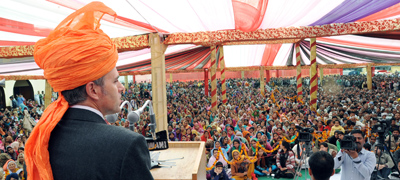
Chief Minister Omar Abdullah addressing a gathering on Guru Ravi Dass Jayanti in Jammu on Monday.