Lalit Gupta
Showcasing the engagement of creative individuals to reflect upon the contemporary reality and changing landscape of social and moral tenets in a society their effects in shaping individuals, the arts with their respective media acts like mirrors for all of us.
Theatre, by virtue its unique audio-visual form that reproduces a live enactment of life’s reality, has since time immemorial considered as most appropriate tools of social change. In above context the Theatre Festival, organized by Jammu and Kashmir Academy of Art, Culture and
Languages has emerged as an annual milestone in Jammu’s cultural life.
A site for fierce competition amongst local amateur and professional drama groups, the festival through the years have witnessed theatrical productions ranging from classical Sanskrit, Greek to William Shakespeare and contemporary works in Hindi, Dogri, Urdu, Punajbi and of lately in Kashmiri also which as its distinguishing feature reflects upon the standards of theatre and also the composite culture of Jammu.
To talk about the just concluded Annual Drama Festival-2013 (Jan 10 t Jan 24), especially in the background of recent stellar performances coming as high watermark of Jammu theatre like Natrang’s William Shakespeare’s ‘Richard III’ (Jan 10 to Jan 13) and Amateur Theatre Group’s experimental production of ‘Ghosts’ marked with creative approach in production design, it could be best called as a mix fare that ranged from skilled to weak productions.
The schedule of 12 plays in festival was decided when after receiving 18 play scripts: three each in Dogri and Kashmiri, two in Punjabi and ten in Hindustani, the scripts were reviewed by a committee of experts set up by Cultural Academy. Committee selected 12 plays for the Festival, after watching the rehearsals which commenced on December 17 and continued till December 21.
Held at Government College for Women auditorium, in view of unavailability of Abhinav Theatre due to objectionable protracted renovations, the festival started under deficient infrastructural support on January 10.
On its first day, Samooh Theatre Group presented Dogri play ‘Malika Da Khaas Salahkar’ written by Dr. Om Goswami and directed by Ravinder Sharma. The second play ‘Lahore Di Chhithi Ambarsar De Na’ was presented by Yamini Cultural Society and third was play was written and directed by
Rajneesh Gupta. NatyaKarmi presented Kashmiri play ‘Gaad Bateh’ written by Rajesh Roshan Bhat and directed by Rohit Bhat. The Natshalla Group presented Hindi play ‘Bichoo’ written by Moliere, translated by Vasi Khan and directed by Tapeshwar Dutta. Manoranjan Kala Kendra presented Punjabi play ‘Parinde Hun Jaan Ge Kithe’ written by Dr. Sahib Singh and directed by T. S. Premi.
Unison Cultural Troupe presented Dogri play ‘Khede Khede Che’ written by Parveen Kesar and directed by Vijay Malla. The Performer Group presented Hindi play ‘Julius Caesar’ originally written by Shakespeare and directed by Vijay Goswami. The Hindi adaptation was done by Ashok Grover. Naqaib Rangmanch presented Kashmiri play ‘Farz’ written by Som Nath Koul and directed by Daisy Naqaib and Vinod Chopra. The Pancham Theatre Group presented ‘Kasturi’ written by Mark and
Desh Pandey and directed by Gurmeet Jamwal. Kashmiri play ‘Graed’ written and directed by Makhan Lal Saraf was staged on January 22. On January 23, ‘An Accidental Death’ (Hindi) written by Amitabh Das Gupt was staged while the Dogri adaptation of ‘X-Reflection’ originally written by Chander Shekhar Kambar and translated into Hindi by Kumar A Bharti, staged on January 24, brought curtains on the Festival.
Lack of Original Scripts: Theatre fests are traditionally occasions for experimenting, staging new plays by emerging as well as well-known and respected playwrights. It is about creating dialogue and looking at modern issues square in the eyes. In this context Theatre Festival-2013, came short and reflected upon the fact that despite battery of writers and poets in each of the scheduled languages, there is woeful lack of such playwrights in the state. A look at the scripts performed in the festival by the groups would corroborate this fact. Out of the 12 productions, the five new scripts staged for the first time ever were Rajneesh Gupta’s ‘Lahore Di Chhithi Ambarsar De Na’, in Punjabi, Kumar A Bharti’s Dogri adaptations of Chander Shekhar Kambar’s Kannada play Siri Simpige, Paerveen Kesar’s ‘Khede Khede Ch again in Dogri and Roshan Bhat’s Gaad Bahet and Makhan Lal Saraf’s Graed in Kashmiri.
Three plays were translations of well known original works in English like Moliere’s Scarpio, William Shakespeare Julius Caesar, Dario Fo’s Death of an Anarchist and rest were acknowledged scripts already performed many times like Makrand Deshpande’s Kasturi, Dr Sahib Singh’s Hoon Prindey Kithe Jaan, Om Goswami’s Malikka da Khas Slahakar.
Experiment with Form: Innovation is defining credo of all creative arts which seek strategies not only to articulate the contemporary reality and state of affairs in any society but also evolve appropriate forms to express and communicate it. In this regard, in Jammu there is a serious lack of opportunity for young local theatre creators to produce their own work and experiment with form and story.
Govt. Apathy: In the long list of reasons for such a state of affairs, the absence of higher academic and professional courses in performing and other arts in the universities of the state tops the list. Next comes Cultural Academy which has conveniently abandoned its mandate of promotion of performing arts under which there was a grand tradition of holding theatre workshops and repertories by invited and local experts and which had led to the renaissance of theatre not only two metros of Jammu and Srinagar but in districts headquarters also. The discontinuing of inviting national level groups to perform here has also robbed the local groups of the opportunity to witness the latest trends in theatre technique and presentation. Lastly the absence of drama as a subject in schools and colleges and lopsided emphasis on so-called job oriented subject.
Individual Efforts: With the result while productions in the festival like ‘Ek Aur Durghatna’ by Mushtaq Kak’s Amateur Theatre Group, engaged in regular performances in national theatre festivals and otherwise, ‘X-Reflection’ by Natraj Natya Karmi, having the advantage of having an academically trained director in Abhishek Bharti, ‘Kasturi’ by Pancham, run by dedicated team wife-husband team of mature actors and like Gurmeet Jamwal, Bhupinder Singh Jamwal, ‘Graed’ by Bhoorang with veteran like Makhan Lal Saraf as director, topped the chart for presenting entertaining dramatic performances that reflected well thought out production design supported by preparedness of actors and coordination of technical factors like sound, light and background music, costumes and make-up.
While the productions by other groups in the festival exhibited lack of exposure and training of self-designated actor-cum directors in conceive proper appropriate production design, weak actors and little no-how of technical design of music, sound and light.
Although as compared to other centers in north-India, the overall standards of vibrant theatre scene in Jammu are much better. The overall apathy and failure of State in starting drama schools in Universities is not only letting our youth to drift to other nefarious or antisocial engagements but depriving them the creative and healthier way of expressing themselves through the language of theatre.
Till then it is left to few dedicated individuals who despite the handicap of proper training, resources and infrastructure but smitten by creative bug as well as social duty to keep theatre Jammu’s civil society.
Lack of Govt. support, bane for Jammu theatre

DEEPENING DEMOCRACY
Gopal Sharma
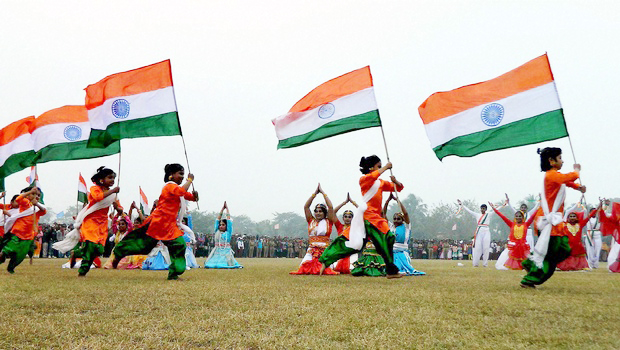
India, the largest democratic country in the world, became Republic on 26 January 1950. The nation is celebrating 65th Republic Day today. Republic is symbolized by the absolute sovereignty which a nation enjoys within the framework of its independent and sovereign constitution. The country attained political freedom from the British rule on August 15, 1947 and it took over two and half years to the constitution makers to give the country its first independent and sovereign Constitution.
Today after 67 years of independence and 65 years of attaining status of Republic, if one goes for over all analysis and compares the country with many others who got freedom after India, one does not feel content with the developments,taking place in the Country . A common man is fed up with present `polluted and infectious’ system and the level of corruption. There seems to be no end to the woes of a common man. Justice system has been allowed to be eroded by the people responsible to maintain its sanctity.
The country, no doubt, progressed a lot in many fields in last several decades and also emerged as a stronger nation but it failed to deliver real fruits of democracy to the public. The people are fed up of with the existing corruption in every sphere of life and unfair system available today. The country is poised for a major political change or in other words a great revolution and youth of the country want to lead the nation by throwing the corrupt people out.
With the greater strength of democracy, Arvind Kejriwal, a new young face admired by great social activist Anna Hazare, changed the course in Delhi’s political system and showed to the nation that democracy has great power and people of the country are looking forward for a change. The people have full faith in the democracy and by virtue of this, they have shown doors to the old rulers. With all these developments taking place in the country’s political scene, challenges ahead and next political scene emerging with sudden change in Delhi, we sought views of several intellectuals, former top bureaucrats, judges, members of judiciary, retired top Army officers and social activists on the subject.
Justice (Retd) J P Singh from J&K High Court did not paint a rosy picture of the country’s present political, administrative and judicial system scenario. True to the existing scenario emerging in the country, Justice Singh called for an over hauling of entire political, administrative, judicial/ delivery of justice, recruitment and education system. He pointed out that corruption was the main decease behind all these ills today. He says, if a man sitting at the top is honest and strong, all those operating under him will be alright. While justifying his point, he gave an example of former J&K Governor Jagmohan who set as an example for every body.
Unfortunately, even after 65 years of independence India, the people are not able to get justice.” Infact, the justice itself has become a mockery today. Will you say justice was delivered to a person if he files a suit in court of law today and continues contesting for over 15-16 years and then gets justice. No way, not at all. Have you ever heard of any Commission constituted by Government providing any justice to the public. Perhaps not. We have been forced to work under a faulty system, which needs immediate change or over hauling,” Justice Singh maintained.
The democratic/ constitutional institutions have been eroded. The recruitment and even the election system needs reforms and a major change. Favourtism galore everywhere and the deserving and highly competent people are not being properly placed. Their talent and potential is not being tapped properly. We are producing an industry of `crooks’ right from the school level and the people with such a mindset will not allow to flourish or grow the people of right attitude and those having urge to deliver good to the society. But for this, the selection system has to be reformed and made corruption/ influence free.
Maj Gen (Retd) G S Jamwal, who is also president of J&K Ex-servicemen League pointed out that the country progressed in many fields, especially in the infrastructure development, information, computer, space Technology, raising infrastructure but there are still many challenges before the country. People are not very happy with the Government and the system of governance at present. They feel what went wrong after attaining independence. Ultimate peace is missing, despite the fact that quality of life has improved.
Referring to the scene emerging at the Union capital with the rise of Arvind Kejriwal, Gen Jamwal said the people are fed up of the corruption and present system existing. The people want a major change rather a revolution. The transition infact, started in 2013 and country’s youth is today leading the masses for a mass revolution. The people see a ray of hope in the Kejriwal and the public should support him in the campaign against corrupt system, because to mend affected system men like Kejriwal should get enough public support otherwise the people at the helm of affairs would turn powerful.
Despite this, there are many challenges internal and external security before the country. The problem of terrorism and naxalism are the major issues before the country which are of serious concern and needed to be resolved rising above the petty politics. By playing dirty politics, some political parties and successive Governments allowed these issues to linger on and its consequences are now very serious. Unfortunately, the democracy gave us many wrong politicians. Sometimes, we feel embarrassment when we see criminals occupying seats in the legislature/ parliament. No doubt, India is largest democracy in the world but being role model for many countries, it should be ensured by the system in the country that entry of such people is blocked. We can not expect justice and good system of governance when we send such people at the place where laws are enacted for the public. There is restlessness and strong resentment among the people.
We have lost moral values and morally, we have gone down and turned as an unhappy nation.
Former Chief Secretary and sitting legislator, B R Kundal is of the view that India has witnessed an unparallel development in the history of any country in last six decades. Whether it is information technology, computer science, communication, roads and highways, infrastructure development, space technology or advanced warfare techniques, the country has reached new heights and is emerging as one of great powers among other top countries. The flow of information and the time consumed in forwarding an information is unimaginable. Through satellite and other channels, one can get any information and even the children are well informed.
Unfortunately, the people are getting impatient. They have developed such a tendency which is not good for the society. This, behavior also leads to corruption. They want quick results and fast delivery and do not care to shell out money to save their time. The people are lured to get their jobs done. Not body has patience to wait for the turn at hospital, public office or any other place and they give encouragement to mal-practice and corruption. The people need to mend their ways and behave like responsible and honest citizens.
Referring to the response regarding strengthening of democratic power, Mr Kundal was of the view that democracy is rather getting stronger day by day. He recalled the students agitation in Assam and emerging of young leader Mohanta, emergence of Jai Parkash Narayan, Lalu Parsad Yadav, M T Rama Rao and now, Arvind Kejriwal in Delhi. This could be possible with the power of democracy. People are infact fed up of the corruption and system available and they are looking for a change. They are experimenting and hope that new emerging leadership would provide them some relief. But pulling crowd on streets rather `street power’ is different thing and deliverance is very difficult task. Public can never be satisfied as the people are very impatient and some times very aggressive which is not a good sign. They have lost moral values and old ethos. You see most of these fast emerging leaders, have proved failure on the part of delivery of service to the people.
We hardly see any true statesman today. We know our Nehru was described as Statesman but today it is hard to find a true statesman in the country. This is only due to the erosion of moral values and principles. Institutes of very high repute are also being eroded and accountability is missing. For short term gains, the people sitting at the top positions are compromising and it has lost the faith of the people in the system. These are the issues today which the country is facing and needed corrective measures.
Senior Executive Member of Supreme Court Bar and Member National Integration Council Prof Bhim Singh says that Republic is symbolized by the absolute sovereignty that a nation enjoys within the framework of its independent and sovereign constitution. India got political freedom from the British Rule in 1947. It took nearly 2½ years for the Constitution makers in India gave Nation’s first independent and sovereign Constitution with 395 articles thus adding a unique written Constitution in the history of democracies around the world.
It was its last article 395 which commanded to repeat all other previous acts including the Independence Act, 1947, and the Government of India Act, 1935, together with all enactments amending or supplementing the later Act. This great Constitution of India was introduced to the largest democracy of the world on 26th January, 1950. Thus India was declared Republic on 26th January, nearly 64 years ago.
It was most unfortunate that Article 370 was introduced in the Constitution of Republic of India on the same day which disarmed the Parliament to enact any legislation in respect of J&K which had acceded to the Union of India like any other state in 1947. The blunder committed by the Constitution makers to let the monarchy continue in J&K even after India turned Republic in 1950 needs explanation from the historians. However, the Constituent Assembly of J&K under the leadership of Sheikh Mohd Abdullah abolished the monarchy on August 20, 1952 through a resolution of the Constituent Assembly. The abolition of monarchy brought J&K under the same constitutional arrangement vis-à-vis the Republic of India. J&K stood merged with the Republic of India.
But unfortunately, even today the people of J&K have remained denied of the privileges and benefits of the Constitution of the Republic of India which the people of other states have been enjoying. The people of J&K have been rejoicing in unfurling tri-colour on the Republic Day which is celebrated all over the states yet the people of J&K remained denied of the benefits of the Constitution of India, having a separate Constitution and separate flag. After the termination of monarchy in J&K in 1952 and the merger of the State with the Union of India, J&K became integral part of India as has been mentioned in Section 3 of the Constitution of J&K that J&K is and shall be integral part of India.
Former Vice Chancellor of Jammu University, Prof Y R Malhotra pointed out that there are many issues even today before the country when we are celebrating 65th Republic Day. He said corruption, unemployment, unequal distribution of wealth etc are the major challenges before the nation. The former VC said the country rulers are unable to contain increasing unemployment and formulating a proper policy for it. Today the country youth is frustrated even after getting higher education. There is a strong need to tackle this issue by those sitting at the top. There is growing discontent among the educated youth of the country and their issues are needed to be addressed.
The former Vice Chancellor further pointed out that unbalanced development is yet another issue which the country is facing today. Many rural areas are turning more backward and the urban areas more urban and over-crowded with massive migration from the villages. Due to lack of facilities in the villages, poor monitoring of funds meant for developmental schemes and simmering feeling of neglect among them, the people from such pockets continued to rush towards cities and towns. The pollution level is increasing in the cities and it has also become a major challenge before the country. The country planners should focus on the issue and take appropriate measures to reverse this phenomenon as it is also aggravating environment pollution.
Prof Malhotra said though there is lot of development observed in all fields but its impact is not so much which should be visible on the ground. There is lot more to do. He described that democracy was getting stronger and stronger and with its strength a lot of change is visible in the political field. The people have faith in the democratic system and a change in Delhi was possible with it.
There are many more challenges before the country but corruption is the major challenge which is needed to be thrown way from the society with collective efforts at all levels. It has been affecting our economy and every field. A strong economy is a must for the overall development of the nation. He further pointed out that there was no corruption about five decades back but with the passage of time and coming of new schemes for the public, the corruption also went on increasing. It has spread its tentacles all around, politics, administration, bureaucracy, public enterprises etc, affecting over all development and country’s economy. This evil is needed to be weeded out but the job is not so easy.
‘People made me a star’
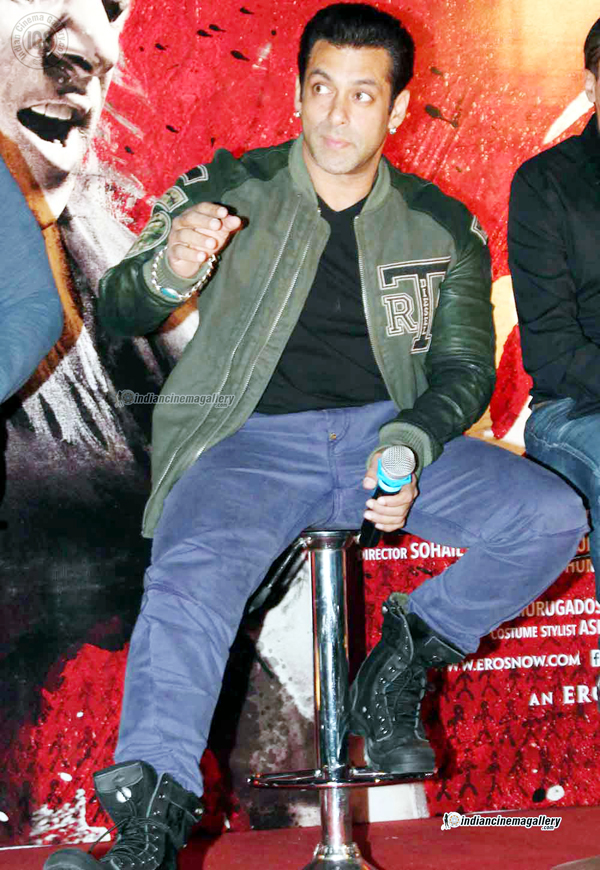
Salman Khan is back with his action hero avatar. He promises Jai Ho to be an out-and-out entertainer. Sreya Basu in conversation with the actor in Mumbai.
You are always seen wearing a chain bracelet even in movies. What’s the story behind it?
Well, my father (veteran screenwriter Salim Khan) wears a similar bracelet and it looks so good on his wrist that one day I took it off his hand and wore it. Later, I made one for myself and since then, I never take it off my wrist.
Even in Jai Ho you are seen flaunting it during your entry.
It was Sohail’s (Khan, producer-director) idea. But it was not the first time I did that.
Why was the film’s title changed from Mental to Jai Ho?
Mental was a working title. Now there is one intelligent Khan (Aamir Khan), one Badshah Khan (Shah Rukh Khan) and there is one Saif Ali Khan. There will be one or two journalists who will start calling me as Mental Khan. I don’t have a problem with that. But the other Khans might have a problem. Also my father had a problem with the title. And as you know, you must listen to your father no matter what your age is. He thought of the present title which is way good than Mental.
Jai Ho comes with a tag – People’s Man. How much do you consider yourself as a commoner?
I did not become a star due to my hard work. I was born in this industry and by luck got this platform. I did not take training to become a star. By chance, Sooraj Barjatya signed me for Maine Pyar Kiya (1989), the film did well and I came to be known as Prem (name of my character in the film). So as you can see, I, in no way, contributed to my stardom. It was you people who made me a star. In fact, I have often tried to destroy my image, which also people liked.
But you are a star.
I don’t have any addiction to be a star. I don’t want to be God. I love roaming around in rickshaws, I ride a cycle. Even when I am driving an AC car, I put the window glass down. I try to lead a normal life. Stardom is happening to me and I am enjoying it. The day there will be no stardom, that day also, I will be enjoying myself. It will hardly make a difference to me.
In Jai Ho you are standing for the people, for justice. Do you believe in protesting in real life?
If you feel something wrong is happening to you, you must raise your voice. Because if you don’t protest, then you are to be blamed equally. If a girl is being harassed in public and people are standing there as mute spectators, first that crowd should be beaten up.
When was the last time you stood for justice?
Every single day of my life.
You are considered as the Rajinikanth of Bollywood… you can make the unbelievable believable on screen. Do you agree?
I don’t know about that. But if I can come anywhere close to him, I will be happy. (TWF)
Golf in Jammu

Sunny Dua
Jammu Golf Course located amid serene beauty of Sidhra town and also on the left bank of river Tawi hosted some special guests other than politician, bureaucrats and entrepreneurs who had their week long firsthand experience at the course learning basics of Golf. The little champs joined by some youth drawn from different institutions had a wonderful experience handling clubs only to learn putting and drives on fairways and greens.
Ever since this 18-Hole Jammu Golf Course overlooking Amar Mehal Museum, Mubarak Mandi Heritage Complex and Old Jammu city on one side and Mahamaya Temple, Bahu Fort and magnificently designed rail track on other side was put to use by the professionals, this was for the first time that JK Golf Association (JKGA) brought an opportunity for the novice to learn handling clubs and learn secrets of this superlative sport.
And to top it with thrill, the Association members also organised a friendly match at the end of this week long coaching camp which was ably conducted by PGTI coach Sandeep Verma popularly known as Chimi who was especially flown in from New Delhi to train the beginners. The sport which is picking up with youth was introduced to young in Jammu most painstakingly by the organisers. It would not be wrong to admit that though it was short duration course, yet it gave the Golf an impetus.
The paramount part of this camp was that about fifty amateur Golfers of all age groups learnt fundamentals and other nitty-gritty of the sport from a professional golf coach. To begin with these young golfers were made to practice at a makeshift arrangement at the course only where they learnt ball positioning, choosing and bolding of right clubs, gripping combinations, controlling the speed of putts, correct Tee height for fairway woods, hybrids and aiming.
Chipping and putting remained an all time favourite amongst the beginners who even had a firsthand experience to play with professionals and also had a real fun in noticing their strengths and weaknesses. How to hit from fairway rough, how to make proper practice swing, how to play half golf swing, postures and correct distance from where to hit the ball were all taught to the beginners who showed keen interest in the sport.
Tough this sport is quite expensive yet the organisers from JKGA did their best in extending their moral support and also providing required infrastructure and allied material to the golfers which was highly appreciated by all. Caddies on the course and trainers sweated themselves out to help beginners have a great time learning Gold in Jammu. From this camp it was quite visible that there is definitely a potential in the sport but only if a consistency is maintained.
The JKGA officials including its Vice President, S S Wazir(Retd. ADGP), executive members Sanjay Wahi, R S Bali besides K K Khosa, Vinod Sharma, D S Bali and Deepak Handa might have let the children taste the sport by making a good beginning but they will have to maintain steadiness in caching them to finally sieve out best of the talent and launch them in the sport to represent Jammu and Kashmir.
The beginners like Muskaan, Neha, Prerna, Vedant, Narbhay, Vijay, Ragini Siddharth Dhar, Aashman Kapoor, Arsh Vimal, Vikram Kapoor, Dinesh Sharma. Divij Singh, Lavanaya, Raunak Gupta and Mehak Dua did their best yet they need consistency in their training to reach pinnacle of the sport and read their names amongst Jeev Milkha Singh or for that matter Tiger Woods. JKGA for the moment if functioning under the benefaction of its Patron Dr Farooq Abdullah, union minister for renewable energy and it is hoped that every effort would be put in to give Golfing in our state fillip.
For the moment Jammu Golf Course is having none holes ready for the play and work on remaining is also going on. The construction work on the club building also has been abandoned for paucity of funds but once it is completed, the state of the art infrastructure will come up in Jammu only to become golfers’ paradise. The state is having golf courses of international standards where ace golfers drawn from different parts of the world arrive and display their talent.
Once Jammu Golf Course is completed, it will also benefit many budding golfers and provide junior golfers a lifetime opportunity to learn incredible golf instructions from professionals. The best part of this coaching campo was that all the Golfers were provided with certificates during a short graduation ceremony. These were followed by prize distribution that encouraged beginners.
Playing lessons with PGTA coach Sundeep and senior professionals like Raghav Wahi certainly helped young golfers in learning the skills. It is believed that the next camp scheduled for summers will also host more young golfers who will be given on-course lessons about Golfing under varying conditions, reading greens, greenside and fairway bunker play, all aspects of the short game, and most importantly head to head competitions.


Now, Vaishnodevi pilgrimage on the rails
Mohinder Verma
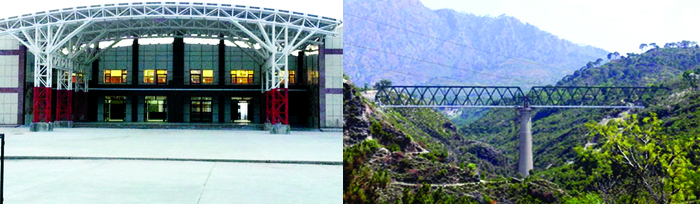
The holy town of Katra is all set to reverberate with the whistling and roaring of the trains as the dream of connecting this town, the base camp of cave shrine of Shri Mata Vaishnodevi, with the rest of country by train has finally become a reality. Prime Minister, Dr Manmohan Singh is going to present this new-year gift not only to the people of Katra but to all those undertaking pilgrimage to the holy shrine situated in the Trikuta Hills, by flagging off first ever train on 25-kilometer long Udhampur-Katra Railway Line on February 2.
Unlike other inaugurations, which are done and forgotten, this inauguration would be a memorable one as on one side this section would facilitate over one crore pilgrims visiting the shrine every year in directly reaching the holy town from different parts of the country and on the other side whole the of Jammu-Udhampur-Katra-Banihal-Qazigund-Srinagar-Baramulla railway line has come closer to the logical conclusion.
The plan to connect holy town with rest of the country via train was actually mooted way back in 1998 when Railways Ministry got the survey on the project conducted but the groundwork was actually started in 1999 setting 2005 as deadline. However, due to numerous challenges on the ground along with certain internal issues of the Railways deadlines continued to be missed one after the another and this gave an impression to the people of the Katra that dream of bringing trains to the holy town would not become a reality.
Notwithstanding criticism from numerous quarters about inordinate delays, the Railways continued struggle to meet the challenges posed by the terrain and weather vagaries and finally the dream has become a reality although after a long gap of 16 years.
The major problem encountered by the engineers on this vital section was squeezing and swelling in Tunnel No.1 due to expansive soil conditions after completion of tunnel boring work and excessive seepage problem in Tunnel No.3. In one of these tunnels, even half a kilometer portion got collapsed following which alignment had to be changed by way of constructing diversion tunnel. Thereafter, New Austrian Tunneling Method (NATM), which is also used in the construction of 11-kilometer long tunnel through Pir Panjal Range was adopted for being the most advanced technology.
The unfortunate incidents of Gool and subsequent curfew besides several problems created by unprecedented rainfall last year also resulted into delay in opening of Udhampur-Katra section, which was earlier scheduled to be inaugurated in October last year. Due to law and order problems, majority of the skilled workforce left the site while as heavy rainfall created additional works for the Railway authorities.
Anyhow, all is well that ends is well. Now, the holy town of Katra is all set to reverberate with whistling and roaring of the trains, which is certainly going to give a big boost to the economy of the town.
When contacted, Chief Public Relations Officer of the Northern Railways, Neeraj Sharma said that the mandatory inspection of the 25 kilometer railway line by the Commissioner Railway Safety, R K Kardam will take place on January 27, 28 and 29 in order to minutely check the safety parameters adopted by the Construction Division of the Northern Railways. Any railway section is thrown open for the regular chugging of trains only when the Commissioner Railway Safety certifies that the project fulfills all the laid down norms.
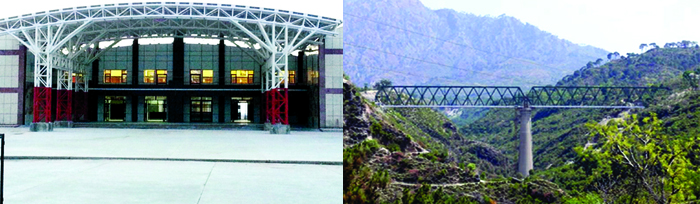
Like Jammu-Udhampur and Banihal-Qazigund sections, this 25 kilometer section too is an example of engineering marvels as pier of the bridge on Jhajjar khad is the tallest in the Indian Railways and is even tallest than the Qutub Minar. This section involves about 11 kilometer of tunneling, nine important/major bridges, 29 minor bridges and 10 ROB/RUBs in addition to about 38.86 lakh cum of earthwork. The tallest bridge in this section is 85 meter high and the longest tunnel is 3.15 kilometer long.
The train journey to the holy town of Katra will be more comfortable, cheaper and picturesque as compared to the road option though the time saved may not be significant as the train will chug to Katra through Udhampur. The train journey between Udhampur and Katra will, in several parts, be a tunnel trip as about 11 km or 44 per cent of the Udhampur-Katra section is through tunnels.
According to the Chief PRO Northern Railways, the Central Government already has a provision of three special trains to Katra in the current year’s budget. According to the available information, a set of local trains from Jammu to Katra and from Pathankot to Katra are also likely to be introduced to cater to the rush of pilgrims.
With the opening of this section, the authorities are likely to extend Jammu Mail and Uttar Sampark Kranti to Katra. Some new trains, including Katra-Kalka (Chandigarh) Express (bi-weekly), Delhi Sarai Rohilla-Udhampur Express (fully air-conditioned) and Ahmedabad-Udhampur Express, are also set to be introduced on the route subsequently.
There are three railway stations on this section including that of Udhampur and Katra. The railway station of Katra is one of the best stations of the Northern Railways. The Indian Railway Catering and Tourism Corporation Limited, a Government of India Enterprise, is running IRCTC Guest House, Food Station and Shopping Longue at First Floor of Katra Railway Station and offering their services at very reasonable rates.
The beautifully designed fully air conditioned (except two dormitories) hotel with in house shopping lounge has multi cuisine food station, double and family rooms besides dormitories. The hotel has been designed in such a way that it could cater the high end gentry on the one hand and the general public on the other. The hotel is having all the facilities of 3/4 star category hotels with full view of the magnificent Mata Vaishnodevi mountains in front with close proximity of bus stand, main market, Yatra Slip Counter and helipad.
Cipher Decipher
Hi Friends! We are back with your favourite column for the week. Please have a look at OUR MESSAGE before you send in your message to us.
1. To all from Vivek Jasrotia: “ If we love our country, we should also love our countrymen”.
2. From Anil Kumar Nanda to all: “ Hardwork, determination, dedication with focused mind and positive attitude are the gemstones which always make you winner in life”.
3. To all from Shyam Lal Mehra : “ Give according to your means, or God will make your means according to you giving”.
4. From Sanjay Dhar to all: “ Take up an idea, devote yourself to it, struggle on in patience, and the sun will rise for you ”.
5. To all from Param Bangroo: “ Don’t wait for extraordinary opportunities. Seize common occasion and make them great”.
6. From Raman Gupta to all: “ Praise was originally a pension paid by the world”.
7. To all from Abhe Gupta: “ In life, be a warrior not a worrier”.
8. From Sameer Pandita to all: “ Charity is injurious unless it helps the recipient to become independent of it ”.
9. To all from K K Gupta: “ You cannot believe in God until you believe in yourself ”.
10. From Mrs Sharda Gupta to all: “ Sometimes it is better to lose and do the right than to win and do the wrong thing”.
11. To all from Silvy: “ Aim at the stars, even if you fall you will fall short on moon”.
12. From Elvina Mantoo to all: “ When the going gets tough, the tough get going”.
13. To all from Sudhir Kumar Gupta: “ Breathing can reduce wrinkles due to improved blood circulation and oxygen flow”
BEST MESSAGE
The award of rupees 200 for this week’s best message has gone to SAHIL GUPTA R/o H.NO.151, WNO.11 NEAR BUS STAND, R S PURA, JAMMU for the message “ Life is too short to start your day with broken pieces of yesterday; it will be definitely destroy your wonderful today and ruin your great tomorrow”.
Congrats. The prize money would be sent to you through money order.