

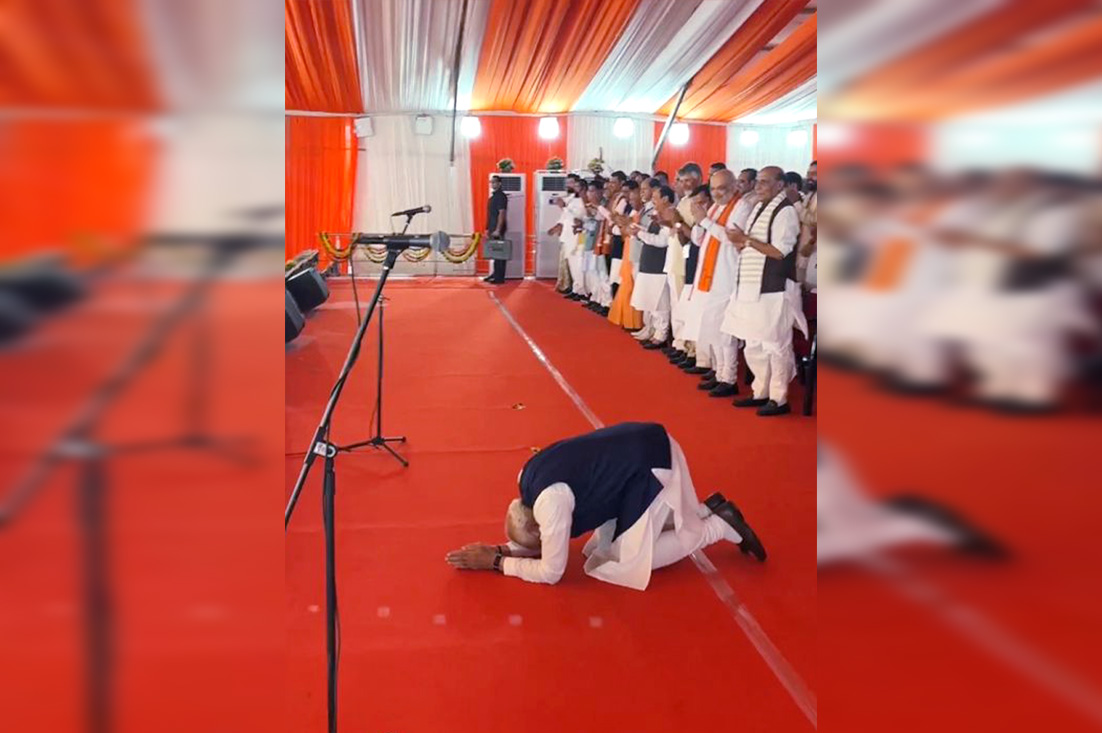
Modi, Shah share stage
KOLKATA, May 9: Suvendu Adhikari today took oath as West Bengal’s first BJP Chief Minister, ushering in the state’s maiden saffron party government since Independence and marking a tectonic political shift in a region long regarded as the party’s toughest ideological frontier.
The swearing-in at the iconic Brigade Parade Grounds — once the citadel of the Left and later a theatre of TMC dominance– symbolically sealed the BJP’s stunning ascent in Bengal politics, with Prime Minister Narendra Modi, Union Home Minister Amit Shah, chief ministers of NDA-ruled states and the party’s top leadership sharing the stage before a sea of saffron flags and chants of “Jai Shri Ram”.
Follow the Daily Excelsior channel on WhatsApp
Governor RN Ravi administered the oath of office and secrecy to Adhikari amid drumbeats, loud cheers and fluttering saffron flags across the sprawling ground in the heart of Kolkata.
As Modi walked onto the stage, he bent low, touched his forehead to the dais with folded hands and acknowledged the crowd, triggering thunderous applause from lakhs of BJP supporters packed into Brigade.
Dressed in a saffron kurta, white dhoti with a thin red border and a prominent tilak on his forehead, Adhikari took the oath first before greeting the gathering with folded hands. The BJP leader won both Nandigram and Bhabanipur and spearheaded the party’s aggressive campaign against the TMC.
Senior BJP leader and former state president Dilip Ghosh, Agnimitra Paul, Ashok Kirtania, Kshudiram Tudu and Nisith Pramanik were also sworn in as ministers in the six-member cabinet that reflected a social-and-regional balance.
While Adhikari is a Brahmin face, Ghosh represents the OBC community, Kirtania the politically crucial Matua belt, Tudu the tribal Junglemahal region and Pramanik the Rajbanshi population of north Bengal. Two ministers are from north Bengal and three from the south, underlining the BJP’s effort to consolidate its support across regions and communities.
Notably, there was no representative from Kolkata in the first list of ministers, despite the city historically producing some of Bengal’s tallest political leaders and chief ministers.
Sources said more ministers are likely to be sworn in at Raj Bhavan on Monday, when the first cabinet meeting may also take place.
For the BJP, the optics of the venue carried deep political meaning.
Once considered the ideological citadel of the Left and later appropriated by the TMC as a symbol of mass-mobilisation, Brigade Parade Grounds on Saturday became the site of the saffron party’s biggest breakthrough in Bengal, one that the BJP projected as the beginning of a “Sonar Bangla” under a “double-engine government”.
Thousands of BJP workers started arriving at the venue from early morning, carrying lotus-flags, while giant LED screens played campaign speeches of Modi and Adhikari. Chants of “Bharat Mata Ki Jai” echoed across the Maidan as the prime minister arrived for the ceremony.
A makeshift memorial carrying the names of slain party workers was erected near the venue, where many supporters paused silently before entering the main congregation area.
In a post on X, Modi said the sacrifices of BJP workers would remain “a source of strength” for the party, while Shah said the memorial reflected the long struggle of taking the BJP in Bengal “from zero to the pinnacle”.
The BJP secured 207 seats in the 294-member assembly, ending the TMC’s 15-year rule and scripting its biggest electoral success in eastern India.
The party’s rise in Bengal gathered momentum over the past few years through organisational expansion, sharp political polarisation, and aggressive campaigning and high-profile defections from rival parties.
Brigade, which once reverberated with Left slogans during Jyoti Basu’s era and later became Mamata Banerjee’s preferred arena for shows of strength, witnessed an oath-taking ceremony for the first time in the state’s post-Independence history.
Unlike traditional swearing-in ceremonies held at Raj Bhavan, the BJP chose the sprawling Maidan venue to underline the mass character of its victory and to visually frame the transition as a popular mandate rather than a routine constitutional exercise.
For Adhikari personally, the ceremony marked a remarkable political journey from being one of the key architects of the TMC organisation to becoming the man who dethroned the party in Bengal. His switch to the BJP ahead of the 2021 assembly polls altered the political grammar of the state and accelerated the saffron party’s penetration into rural Bengal.
Saturday’s swearing-in marked more than a transfer of power for the BJP. It represented the culmination of a long political project to breach Bengal’s last major resistance to saffron politics from the very heart of Brigade itself.
Soon after taking the oath, Adhikari drove to Jorasanko Thakurbari, the ancestral home of Rabindranath Tagore, and paid floral tribute to the Nobel laureate before formally beginning work as Chief Minister.
“My official work begins after paying tribute to Kaviguru,” he said.
Invoking Swami Vivekananda, Adhikari said Bengal needed rebuilding after years of decline in education and culture.
“This is not the time for criticism… I am everyone’s Chief Minister,” he said.
Later, he also visited the ancestral residence of Jan Sangh founder Syama Prasad Mookerjee and paid floral tribute.
Referring to Modi, Adhikari said the Prime Minister had long wished to see a BJP Government in Bengal and described Saturday as the beginning of a new chapter in the state’s politics.
For the BJP, Saturday was not merely the formal assumption of power, but the rewriting of Bengal’s political folklore from the very ground where its opponents once drew their greatest strength. (PTI)
 Follow our WhatsApp channel
