

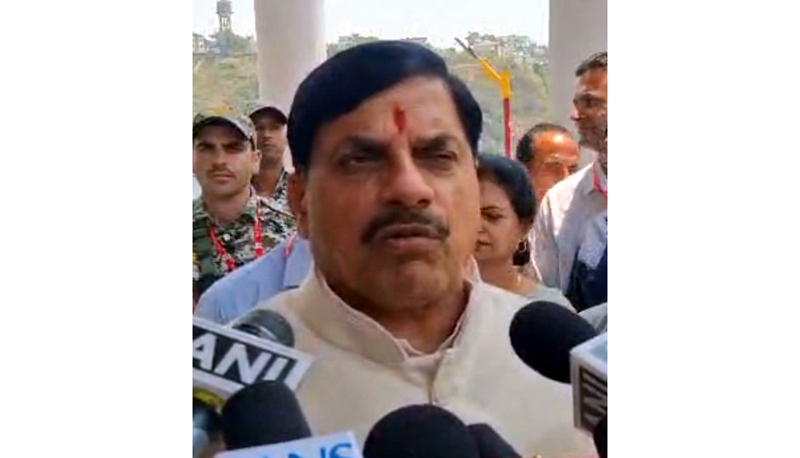
Proposed model to focus on crowd, public services
Excelsior Correspondent
KATRA, May 29: Madhya Pradesh Chief Minister Mohan Yadav on Friday paid his obeisance at the Mata Vaishnodevi shrine and said his visit, along with a team of officials, was for studying the management system here for developing an effective model project for temples in his state.
Follow the Daily Excelsior channel on WhatsApp
Yadav said that the proposed model would focus on crowd management, public services and devotional services at major temples in Madhya Pradesh.
Click here to watch video
“The Mahakaleshwar Jyotirlinga shrine, the Omkareshwar Jyotirlinga shrine, and now recently the shrine of Mother Bagdevi have, in a way, been recognised by the High Court as temple institutions. At this time, regarding our administrative arrangements, we have come here with a team to study and understand the systems in place,” he told reporters at Katra.
He said teams had been sent to various religious places across the country to study their administrative arrangements and service models.
“From the perspective of how an effective model project can be developed based on crowd management, public services and devotional service, we have sent different teams to various places across the country and studied their systems. We have come here to seek the blessings of the Mother Goddess as well,” the Chief Minister said.
Yadav said that he was informed by the shrine management that several welfare and service activities, including a university and a medical college, were being run under the shrine board.
“In addition, there is well-organised planning for pilgrims and devotees so that they can have darshan smoothly and conveniently,” he said.
Last week, the Madhya Pradesh High Court ruled that the disputed Bhojshala-Kamal Maula Mosque complex is a temple dedicated to Goddess Saraswati and quashed a decades-old Archaeological Survey of India (ASI) order that had allowed the Muslim community to offer Friday prayers at the site.
Following the court ruling, the ASI granted Hindus unrestricted access to the monument for worship and other purposes.
 Follow our WhatsApp channel
