

Sir,
The Government employees will get some relief after the intervention of Supreme Court of India by giving landmark notice to the State Governments for their transfer policy in respect of employees of their respective states. The decision is well appreciated by the employees and public at large, who without any fault have to be ready with their bed holdings to join their new place of postings to their utmost surprise without completing basic tenure that is two years. Even in some cases, without allowing the employees to avail joining time as if orders were issued on war footings.
In many cases, intelligent, honest, hard working employees are the victims of these orders. Their only fault is that they have no approach in the higher-ups and are poor medium category employees living hand to mouth. Their only source of income is their salary.
Recently, it was reported in this newspapers that employees who are serving in Ladakh and who have completed their tenure of two-three years have not been transferred till date from that area. If Government takes one decision of two-three year tenure in one place then what is the reason that they ignore, violate their own decisions causing serious problems for the employees who often have to face depression, heart problems and live on medication. We often read in newspapers, especially about Police Department that SHOs of respective stations are transferred within months. We see the officers being transferred, shuffled from one range to another even to other districts without giving them chance to settle. How law and order will be maintained when officers are not sure whether they have to complete two years at that post. There are many dedicated officers, employees who are sufferers.
But, there is another side of the story. Many blue eyed employees; Yes-men of bosses who have no semblance of merit and honesty are stationed at one place close to their bosses. After completing 10-15 years of service at that place, no higher-up dares to transfer them. These types of employees have their own groups, completely united and having networks fast like the 3G in communication with them. One can watch these types of employees in every department of the Government. They show that they are the bosses who run the government and without them, nothing is possible.
Yours etc………
Kaushal Kotwal
SDAO (Retd.), Jammu
Transfer Policy of Government employees
Knee Arthiritis

Demand for knee replacements among the age group of 45-64 has tripled since the last two to three years.
So patients getting operated at the age of 45 need Revision surgeries to be done.
As we have growing BABY BOOMERS (young population developing advanced knee OA) bigger is the pressure on industry to have systems lasting multiple decades maybe 30 years+….. This knee replacement lasting more than 30 years is a concept which is beyond just purely an implant…..its biomaterials, accuracy, alignment, gender specific design, sizing, technology and conglomeration of all these is the answer for a knee replacement which is biological, gives high bending and longevity of more than 30 years.
New technology is specifically engineered to address the unmet market need for smaller sized women population that is still younger spectrum and wishes for surgery that is high flexion, painless, minimally invasive and can last a lifetime.
High Flexion Knee Implants with special polyethylene ATTUNE™
Attune is an innovative, comprehensive and integrated knee system created as a result of more than six years of extensive research to address unmet patient, surgeon and provider needs and is latest advancement in knee replacement options. It provides the best in class knee replacement solution for highly demanding & active lifestyles. This combines the latest in design, kinematics, engineering and materials to deliver a high level of stability and motion.
* Wear resistance results in longer lasting knees.
* Allows for greater knee bending such as sitting cross-legged
* Natural-bone conserving design.
VERILAST™
* Combination of OXINIUM™ metal alloy and “highly crosslinked” polyethylene
* A knee implant technology that combines two low-friction materials
* Oxinium reduces plastic component wear by 85% when compared to cobalt chrome
Pin-less Computer Navigation
* Latest advancements in Computer assisted knee surgery is the Pin-less Knee Navigation System.
* This procedure is far less invasive for patients as compared to conventional CAS surgery.
* No incision necessary in the shin bone or the thigh bone.
* No extra stab wounds and hole marks that you have with other navigation systems.
Drastic reduction in risk of infection and chances of injury after the surgery, which likely means a longer lasting knee.
Patient Specific Instrumentation
* Use of patient specific instruments provides a tailormade solution for each patient resulting in perfectly aligned knee implant.
* Personalized solution based on a patient’s unique anatomy.
Minimally invasive TKR & Painless Surgery
Smaller incision as compared to the traditional 10 to 12 inch incision minimizes the amount of soft tissue damage that occurs when a surgeon reconstructs a knee. The potential benefits of this approach include: Less bleeding during surgery, less post-operative pain, shorter recovery time & smaller scars for improved cosmetics.
(The author is Director & Head Max elite Institute Orthopaedics).
Hair Care During Winter
Shahnaz Husain
While travelling in winter, or on a winter vacation, one should carry Hair cream with sunscreen, herbal shampoo, hair serum, hair conditioner.
The winter hair care routine should entail oil applications with warmed oil twice a week. Pure coconut oil or olive oil may be heated and applied, followed by a hot towel wrap. Wash the hair twice a week, using less shampoo and rinse well with water. If the hair is dry, apply a creamy conditioner, leaving it on for 2 minutes and rinsing with water.
In dry and cold weather, the hair may lack moisture. Use a mild herbal shampoo and conditioner to soften the hair and make it smooth and manageable. One can also use a hair serum or leave-on type of conditioner. Take very little and apply it the same way, but do not rinse off. Apply conditioners on the ends too. A hair cream with sunscreen would provide protection from the sun. A mild herbal shampoo is a must. Carry a scarf along to protect your hair from over-exposure to the sun, as well as from wind and dust. You will need it if you are out motoring, boating or even walking.
Even during your holiday, you can use natural ingredients for your hair to improve its look. Ingredients like tea and beer may be easily available and can be used to rinse the hair and add shine to it. Beer works well for winter. Add the juice of a lemon to the beer and rinse the hair with it. Leave on for a few minutes and rinse off with plain water. It softens and smoothens the hair and also adds shine.
Or, add a tea bag to 4 to 5 cups of warm water. Remove tea bag and cool the water. Then add the juice of a lemon and use it as a last rinse. This helps to make the hair silky and shiny.
Colouring and styling should be done before the vacation. However, one can carry a hair dryer, rollers or heating rod to style the hair yourself. If hair dryer and heating rods are used, it would be necessary to use oil and conditioners to reduce hair damage.
The classic ponytail is dictating trends and is ideal for holidays. It suits most face shapes, because one can wear a pony tail high or low, with a fringe or without, or with wisps or curls falling down, with that carefully-careless look. A ponytail is actually an easy hair do. With ribbons, or other hair accessories, it can even provide a touch of glamour.
Braids are also in. One can have a side brain and tie it up with a matching ribbon.
You can do up the hair in several braids and then put them up in a pony tail with ribbons. Coloured ribbons can also be used all along the braid.
If you have frizzy hair, first apply an anti-frizz cream or spray. Comb the hair by sweeping it all to one side. Then divide it into three sections and make a loose braid and secure it with a ribbon, scrunchy or rubber band. The wisps of hair that remain can frame the face, or some may be pinned up to give you the carefully careless look.
Putting the hair up is in vogue. It can be put up with the help of hair accessories, with curls and ringlets. Long hair may be put up too, in a casual knot or chignon. It may be as a top knot, or at the nape of the neck. They can be secured with decorative clips and hair accessories.
Celebrating spirit of Lohri
Lalit Gupta
Lohri which falls on January 13 this year is one such agrarian festival which marks the waning of winter and beginning of summer. Geographically speaking, the earth leans towards the sun along the Tropic of Capricorn (Makara rekha) from the day following Lohri, also known as Winter Solstice. The earth, farthest from the sun at this point of time, starts its journey towards the sun along its elliptical orbit, thus heralding in the onset of spring. It is this transition which is celebrated as Lohri in northern India, Makara sankranti in the central part of the country and as Pongal-Sankranti in South India.
In other words Lohri marks the end of winter on the last day of Paush, and beginning of Magha (around January 12 and 13), when the sun changes its course. It is associated with the worship of the sun and fire and is observed by all communities.
Lohri, a festival of rejoice and dances, is celebrated with great fervour and festivity throughout Jammu region as elsewhere in northern India. Significance of Lohri is no more restricted to celebration only but also implies a wonderful time for people to rejoice and rejuvenate themselves from their chores and unite to share some fun and relive the cultural values. People exchange Lohri wishes to spread and celebrates the spirit of festivity.
The Bonfire Ritual:
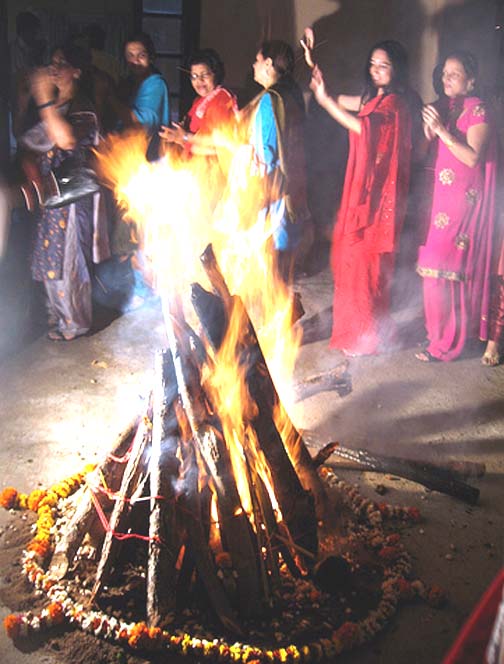
One of the essential features of Lohri is the worship of fire. The focus is on the bonfire. The Lohri fire gets sanctified and it is considered a representation of energy and spiritual strength and is lit during the festival in every household. There is puja, involving parikrama around the fire and distribution of prasad. The prasad comprises of five main items: til (sesame seed), gajak (a hardened bar of peanuts in jaggery or sugar syrup), gur (jaggery), moongphali (peanuts) and popcorn. This symbolises a prayer to Agni, the spark of life, for abundant crops and prosperity. This festival is also believed to burn all the moments of sadness and brings in warmth of happiness and love.
Legend of Lohri:
The questions like when it began and why it lost in the midst of antiquity are there to answer. There are various interesting folk stories and legends associated with this festival. The very famous story from history is that during the reign of Akbar there was a Raja of Pindi Bhattian, Dulla Bhatti. Dulla Bhatti was known, respected and loved by tribal people as he used to rob the rich and help poor. Dulla Bhatti once rescued a girl from the kidnappers and then adopted her as his daughter. Bhatti was sentenced to death by the Mughal king Akbar for revolting against him later. Since then this hero is remembered each year on Lohri and the traditional song is sung as a tribute to this hero. On this occasion, children in groups move from door to door and sing the Dulla Bhatti song:
Sunder Munderi hei!hoi
Tera kaun Bechara!hoi
Dullah Bhattiwala!hoi
Dullah di dhi viyahi!hoi
First Lohri : The festival assumes greater significance if there has been a happy event in the family during the elapsed year, like the birth of a male child or marriage. The first Lohri of a bride or a newborn baby is considered extremely auspices.
Lohri of first born daughter: Recently there is an emerging trend to celebrate the first Lohri of girl child also. This not only mirrors the changing social realities like families opting to have a single child or a family with two daughters but also testifies the phenomenal change of mindset in giving equal importance to the female child. The new value system under which daughters are considered no less than boys has found a befitting expression in Lohri celebrations.
Festivites : Lohri celebrations are never complete without music and dance, and feasting is invariably rounded off with a vigorous bit of shake-a-leg. The enthusiastic groups of young children used to go to every house and shops singings songs many days before the actual festival and the people would generally oblige them by giving them money, some eatables or even firewood as offering for the festival.
In the late evening, the people irrespective of caste, creed or faith would gather round the bonfire and do traditional dances and sing songs of joy. Logs of wood as piled up together for a bonfire in a busy chowks or a street corner and the people indulge in singings songs and dancing which symbolizes a prayer to Agni (Fire God) for abundant crops and prosperity as this festival is also associated with the harvest season.
Chajjas: Vanished heritage of Jammu
During the decades of 1960s and 70s, Lohri celebration were unique and integral part of Jammu popular culture and everyone’s childhood in the city. The festivals most distinguishing feature was Chajja, an artistic presentation of dancing peacock. Mounted on a bamboo mannequin covered with myriad shapes of ‘pattis’, flowers, made in materials like card board, colored glazed sheets, silks, crepe, satin, and decorated with pieces of mirrors, and any exotic object that was considered appropriate- these were showcases of every mohalla’s pride.
In fact making of Chhajja, was a statement of artistic and craft skills, an opportunity for local young men to hone and exhibit their aesthetic skills in handling of materials and ideas. Young boys and men of every mohalla, locality, under guidance of senior persons would get engaged in the serious business of making a Chhajja.
Since best Chhajja was also awarded on the day of Lohri, there used to be fierce competition between mohallas like Panjtirthi, Pakki Dhakki, Mastgarh etc. Every mohalla, worth its salt, would prepare a decorative and colorful Chajjaa according to available skillful hands, funds and patronage. Chhajjas would be prepared very quietly at secret destinations, without letting know the competitors details of the designs. The groups vying with each other in use of new colorful, decorative, extra shining materials would scout meticulously each city shop. There used to be extra vigil, lest the spies of the rival parties may copy details of the design, materials as the contest to come out new ideas every year was always on.
On the Lohri day Chhajjas carried by one or two young men were like flaming trails of Peacocks feathers on move and presented a spectacle for everyone. The riot of colors that moved along with group of dancers dancing in gay abundance accompanied by deafening beats of drums, would reverberate the bazaars and localities of the city.
Chajjas parties after visiting homes of relatives and friends especially those with a newlywed couple or a newly born male child, would head for their final destination of the royal palace where Maharani Tara Devi, mother of Dr Karan Singh would give away sweets and cash awards to dancing groups.
Today when Lohri celebrations have been reduced to people sending personalized Lohri greetings and fancy gifts to their dear ones, the fascinating Lohri messages and lovely Lohri SMS of ‘Happy Lorhi,, the heady days of Chajjas of Jammu in 1960s-70’s remain but only cherished memories of the vibrant folk and popular cultural practice of Duggar.
Regional Names
Lohri is celebrated throughout the country in different forms, having various regional names as a harvest festival. It is called Pongal in the South, Bhugali Bihu in Assam, Bhogi in Andhra Pradesh and Sankranti in the central part of the country. Modes of celebrating Lohri are also different, but the message conveyed by the festival, that of setting aside differences and rejoicing by celebrating the end of the harvest season and the chilly winter, is the same. The various regional names of Lohri are:
Uttarayan: Uttarayan, traditionally believed to be the starting point of the sun’s northward journey, is celebrated according to the solar calendar on 14th January. Uttarayan is celebrated all over Gujarat but the excitement is high at Ahmedabad, Surat, Nadiad and Vadodara.
International Kite Festival: From dawn to dusk, people of all ages fly kites rejoicing in the spirit of the International Kite festival of Gujarat. Falling on 14th January, the sky is enlivened by kites of different colors and hues. Kites soar in the sky, their lines moving as if alive. Crowded rooftops, fun-loving rivalry to outdo each other, and delicious Gujarati feast are the hall-marks of the day.
Pongal: In south, Pongal is a festival when god is praised with a simple faith and sincerity. Old vices are all washed out and all that is good is welcomed in this New year. This festival is of all living things, who look up to the heaven in joy and thankfulness to God for everything that He gives to man specially peace and happiness and the feeling of brotherhood.
Makar Sankranti : Makar Sankranti marks the beginning of Uttarayan, the Sun’s northward journey. Makar is called Capricorn in the western astrological calendar. Makar Sankranti falls on 14th of January every year.
Bihu/Bohaggiyo Bhishu: Bihu is the most important non-religious festival of the Assamese people. People of this state observe it every year irrespective of their class and caste.
Ganga Sagar Mela : One of the most famous festivals of India, it is held on the Ganga Sagar Island, at the mouth of the river Hooghly in Bengal. It is attended by thousands of pilgrims every year. A dip in the water at this place, during Gangasagar Mela, is considered to be extremely sacred. On the day of Makar Sankranti (January 14), when the sun makes a transition to Capricorn from Sagittarius, it is said that the bath becomes a holy source of salvation.
Healthy Foods

Prof. R.D. Gupta
Leafy vegetables : It is not possible to fulfill one’s nutrition requirements one’s nutritional requirements without having vegetables especially leafy ones in the diet. Leafy vegetables mostly consist of spinach, fenugreek leaves, drumstick, asparagus, lettuce, broccoli etc; which are available in abundance and constitute a good source of fibre besides vitamins. Main vitamins present in leafy vegetables are vitamin A, vitamin C, vitamin K and folic acid. Leafy vegetables are also a vision protector and furnish with four essential minerals viz; calcium, magnesium, iron and potassium. Always try to include one of the aforesaid leafy vegetables in diet and make darker the better.
Summer vegetables : Pumpkins are rich in beta carotene, calcium, potassium and fibre. In traditional medicines pumpkins are known to possess cooling effects and diuretic in nature, and as such, these are good for stomach upset. Yellow pumpkin is a good source of soluble fibre, which assists to fight constipation.
Bottle gourd (ghiya) and squash (tinda) contain iron and some amount of calcium. Bitter gourd (karela) possesses good quantity of iron and vitamin C, and has proved in preventing diabetes. Lady’s finger (bhindi) has good amount of calcium, folic acid and vitamin C. It is also good source of soluble fiber, and is very good for checking blood sugar levels.
Whole grains food : Whole grains food have up to 90 per cent more fibre, and essential nutrients and vitamins than refined food grains. These food grains assist to reduce cholesterol. They are also super rich in vitamins and minerals. Consuming whole grains food like wheat, barely etc; in daily diet ensure the intake of glucose immediately, which is important ingredients for brain to function perfectly as well as source of energy to various parts of the body. Whole wheat bread and pasta, and brown rice are high in essential nutrients and do not contribute to weight gain. Hence one should start for at least one day with whole wheat cereal or a whole wheat bread toast. Oats porridge or local style upma is a great breakfast option, home baked oatmeal cookies make for a mid meal snack.
Powder oatmeal and blend with milk/yoghurt for thick pan cakes topped off with dried or cut fruit and honey. It can also be mixed with dosa batter or use as dosa battar.
Nuts : Always make nuts as an essential component in the diet as they are an excellent source of proteins and vitamins especially B and E. They have proved beneficial in fighting heart disease and cancer. Although nuts are high in calories and fat yet their fat is the heart healthy kind. Nuts (chilgoza), walnut (akhroat), pumpkin and gourd seeds (coarse charmagaz) and cucumber seeds (fine charmagaz). Sesame and linseed seeds/ flaxseeds also perform the same functions as the aforesaid nuts do.
Little nuts, especially almonds are rich in antioxidants and also contain omega – 3 fatty acids. Almonds are rich in protein, healthy oils, fibre, vitamin E, magnesium and heart favourable mono and polysaturated and help to check cholesterol level. Eating a few almonds every day can be absolutely worth for them who are able to devote them, though one needs to keep an eye on the calories one consumes. About a quarter cup i.e 20-25 almonds, cashews, kernel of walnuts are good enough in a week. A handful of almonds possess 164 calories and 7g of protein which help to control what one eats. Almonds also help growing children in developing strong bones. A study done by scholars from University of Medicine and Dentistry of New Jersey, West Chester University and Loma Linda University of California (all in the US) and published in the Journal of the American College of Nutrition also confirm that almond can control diabetes if are consumed regularly.
Berries : Berries are high in fibre content and help to curb weight. They have more protective plant antioxidants than almost any other food. Antioxidants not only lower disease risks but also assist to prevent memory loss. They are rich in vitamins particularly vitamin C. Numerous studies have shown that berries offer great protection against heart disease stroke, cancer and many other diseases.
Among various kinds of berries like Indian goose berries (amla), black berries and blueberries, the last one top the antioxidant fruit in the benefits listed above. Besides, other health benefits, blueberries help to prevent high blood pressure, macular degeneration and brain damage leading to Alzheimer’s disease. Blueberry is a beautiful fruit rich not only in antioxidants but also contains vitamins which help to combat the loss of cognitive abilities that is known to deteriorate with growing age. Studies have shown that blueberries prove to be excellent in enhancing learning capacity/memory.
A cup of blueberries has 81 calories and 4g of fibre, whereas blackberries of a single cup contain 74 calories and a whopping 10 g of fibre. Raspberries contain 60 calories in one of its cup with 8g of fibre. One cup of sliced strawberries has 50 calories and 4g of fibre.
Yoghurt : Low fat or plain yoghurt is a great source of protein, calcium and vitamins. It has also healthy bacteria i.e; Lactobacilli which can fight diseases. The amino acids that yoghurt contains result in the formation of substances that are known to deal with stress and also improve memory.
horoscope
Sunday Jan 12-2014
Aries : The stars urge you to focus on your finances and savings, and today, you might remain very busy doing just that. But take care, says Ganesha, you don’t want a sulking spouse when you go home. Don’t cancel any plans; go ahead and enjoy that new film.
Taurus : Your think tank will be running on overdrive today. Your possessiveness might kick in to cause a conflict. Keep your anger under the carpet to avoid any unnecessary complications. Introspection will also play upon your thoughts, leading you to explore your problems and pry for solutions, predicts Ganesha.
Gemini : Today may not be very meaningful and productive for you, though you will get to spend plenty of quality time with yourself in the afternoon, which may not necessarily be to your liking. By evening, you may feel a little extra sensitive. A lonely day, or as an optimist would put it, you’ve got the whole day to yourself; it could have been worse (For instance, a day alone with your nagging mother-in-law!).
Cancer : You are likely to be at your inventive best today, feels Ganesha. You are likely to taste success, much to the delight of your colleagues at work and loved ones back home. However, experience counts, and if you are a beginner at something, you may face problems in your new venture.
Leo : You will pay more attention to matters at home. You may take up home renovation projects. You may end up replacing the entire furniture at your place even. You will spend the day enjoying with your family members and friends, says Ganesha.
Virgo : Open the mind gates and let your imagination flow, says Ganesha. At your creative best, you will pursue innovation and creativity today. Luck will be on your side and even those things that you took a risk on may lean your way. You energy levels will be unusually high and you will feel passionate about all that you undertake. A good day to organise social events for family and friends.
Libra : There is a very strong possibility of major improvements in your public standing and image today. But it all depends so much upon your personal character, and, therefore, you must guard it zealously, even with your own life. Those who seek to malign or dent your reputation will be disappointed, says Ganesha.
Scorpio : Today promises to be an exceptional day for those involved in business. With sheer brilliance, you will steer deals right to your door step, and will display great finesse in negotiations and bartering. Bring out the leader in you and take charge when you introduce new products or market them in business, suggests Ganesha.
Sagittarius : You need to increase your tolerance power as you may have to face criticism from close ones. However, it is not feasible to please everyone around. You may just be happy doing basic favours for your loved ones. Ganesha asks you to be patient.
Capricorn : The most intimidating of ventures can prove successful if fortune favours you; you will be fortunate today, says Ganesha. Those of you dealing in stocks and shares can expect a profitable day ahead, but don’t forget to give credit to your spouse; it will be their luck working wonders for you.
Aquarius : Bursting with new ideas, you want to make the world a better place! You will give your best in a team and will come up with great schemes and solutions. At gatherings and social dos, says Ganesha, you will remain your charming self, impressing people with an amazing social grace.
Pisces : Home is where the hearth is, in which the troubles you need to deal with today are smouldering. Running away from your problems will simply have you out of breath; it would be wiser to take a stand and find solutions to petty conflicts without losing your perspective. Make no mountains out of mole hills, says Ganesha.
DEDH ISHQIYA a must watch

Taran Adarsh
It’s a well-established trend to have a franchise or a sequel as a meritorious follow up to a triumphant prequel. The year 2013 ended on a high, with the third installment of the lucrative DHOOM franchise rewriting the record books. Now, in the second week of 2014, a sequel to the immensely likable ISHQIYA [2010] is out to woo the spectators — DEDH ISHQIYA. But unlike most franchises/sequels, which have an urban backdrop, DEDH ISHQIYA, much like its predecessor, is set in the hinterland, has an unassuming, homespun feel and an old-world charm to it. But let me make one thing clear: Cosmetically, the two films may be in the same space, but the stories are in sharp contrast to one another.
Abhishek Chaubey created an out of the ordinary world in his directorial debut ISHQIYA. The tale of a love-lorn and ruthless woman Krishna [portrayed by Vidya Balan], who uses Khalujaan and Babban to settle scores, caught the attention of cineastes for varied reasons. Besides a differing plot and an enthralling screenplay, that film had wit, conspiracy and romance that was so unconventional and individualistic on the Hindi screen then. DEDH ISHQIYA continues the escapades of Khalujaan and Babban, but the duo has the extremely desirable, sophisticated, but a secretive woman [Begum Para] and her confidant [Muniya] for company. In addition, while the first part was a love triangle, with both Khalujaan and Babban falling in love with Krishna, DEDH ISHQIYA has two love stories running concurrently.
ISHQIYA was sharp, spicy and volatile, with impulsive characters and a storyline taking a somersault every few minutes. DEDH ISHQIYA is no different. It transports you to a diverse world, but like the first part, this one focuses on love and deceit as well. Also, it’s far more complex this time around… and the truth hits you like a ton of bricks!
Begum Para [Madhuri Dixit-Nene] of Mahmudabad is hosting a festival of poetry and music in her mansion. The country’s best poets are in town. Khalujaan [Naseeruddin Shah], posing as the Nawab of Chandpur, is participating as a poet in the festival. He is not there merely to show off his poetic wares, but to impress the widowed Begum who, as the grapevine suggests, is scouting for a husband — preferably a poet.
Babban [Arshad Warsi] arrives in Mahmudabad to take Khalujaan back to their old life, but his plans alter the moment he sets his eyes on Begum’s maid and confidant Muniya [Huma Qureshi], a brash and sexy young woman. Muniya too has plans of her own. She leaves the palace every now and then in a disguise to meet gangsters in dark alleys. The palace is rife with intrigue…
Unlike the promos of the first part, which communicated quite a bit about the film, the promos of DEDH ISHQIYA maintain the element of mystery around the characters and its plot. Sure, one is familiar with Khalujaan and Babban, but the new characters that Abhishek Chaubey introduces us to in DEDH ISHQIYA — Begum Para and Muniya specifically — are shrouded in secrecy/ambiguity. While ISHQIYA was earthy and rustic, one gets to witness an alternate universe in DEDH ISHQIYA. There’s a lot of poetry, music and color this time around. At the same time, there are layers to the story that baffle you. Garnished with chaste Urdu and peppered with unconventional humor and simmering sexuality, the characters indulge in a treacherous game yet again. This time, it’s even more dicey and perilous.
Abhishek Chaubey deserves colossal admiration for taking the story forward by retaining some characters and adding several new ones. The screenplay is capricious and unpredictable, imparting a flavor that’s distinct and one you most certainly haven’t experienced heretofore. Also, a section of the audience may find the chaste Urdu a tad strenuous to comprehend [although the sub-titles make it quite effortless to decipher], but come on, when you have a film based in Punjab or a South Indian state, the essence of that sector has to come to the forefront, right?
The music [Vishal Bhardwaj] is a sore point and one misses winsome tracks like ‘Dil To Bachcha Hain Ji’ and ‘Ibne Batuta’ from ISHQIYA. This film deserved an entrancing score, also because the emphasis is on poetry this time. Dialogue, also penned by Vishal Bhardwaj, are the mainstay and the backbone of the enterprise. The lines are loaded with wit and the usage of Urdu is prudently juxtaposed in several sequences. The DoP captures the old-world charm wonderfully well and the visuals are absolutely stunning.
Expectedly, Naseeruddin Shah is supremely efficient as Khalujaan. Getting into the skin of the character, the actor gives it all to the film, delivering a performance that’s sure to be recalled amongst his premium works. Matching Naseer is Madhuri Dixit-Nene, a powerhouse of talent. Cast in an unconventional role, it’s a colossal leap for the actress who has several power-packed performances in her repertoire. She also deserves kudos for opting for an unconventional, avant-garde character, which will only win her tremendous admiration and honour in times to come. Arshad Warsi is in terrific form yet again. The actor, a spontaneous performer, wows you with his brilliant act. In fact, Naseer and Arshad are a delight to watch in several sequences, with both complimenting each other from commencement to conclusion. Huma Qureshi is fantastic and if one were to say so, catches you with complete surprise. Her sequences with Naseer, Madhuri and Arshad reiterate that she can stand on her feet, despite being pitted against top notch actors. Yet another performance that stays with you is that of Vijay Raaz. One of the finest talents around, I am sure, DEDH ISHQIYA will make the film fraternity realize that you cannot ignore him for long.
Salman Shahid is top notch in a cameo. Ravi Gosain does a decent job. Manoj Pahwa registers a solid impact.
On the whole, DEDH ISHQIYA is a worthy follow up to the widely admired ISHQIYA. Powerful writing, superb direction and outstanding performances make DEDH ISHQIYA a must watch. Just don’t miss it!
http://www.bollywoodhungama.com.
Sant Bhai Rocha Singh Ji

B S Mahant
Sant Bhai Rocha Singh Ji commonly known as Thakar Sant Bhai Rocha Singh Ji. This is due to his century long preaching and spreading of Gurmat teaching and attaining a very high level of Sant and Spayee after appointment for the purpose by Guru Gobind Singh Ji himself. He served Sikh Panth during his life period stretching upto to 115 years.
Sant Bhai Rocha Singh was born at village Kossa Zilla Hazara near Rawalpindi. His father Bhai Punjab Singh was a Gursikh and professionally a businessman. He grew up in the Gurmat atmosphere because of regular visits to their place by Sant Bhai Pheru Singh Ji and Sant Bhai Punjab Singh Ji who both were baptised Amrit by Guru Gobind Singh Ji. These two saints one after other were looking after Sikh Sangat regularly and advocating adoption of Sikh religion. This way Sant Bhai Rocha Singh Ji found a very favourable atmosphere at his home itself. Sikh Sangat used to gather daily as per the instructions of Guru Ji Maharaj. Gurbani was recited and Kirtan was performed. A Gurudwara was also constructed for the purpose in his village Kossa by Bhai Punjab Singh Ji father of Sant Bhai Rocha Singh Ji.
When Guru Gobind Singh Ji after leaving Anandpur Sahib stayed at Sabo Ki Talwandi, Sant Bhai Rocha Singh at the age of 17 years went there and offered himself for baptising Amrit and service to Guru Ji. Guru Ji was very pleased to see such a beautiful young man fond of Amrit and offering Guru Ji service for his whole life. Guru Gobind Singh baptised him Amrit and observing him suitable for spreading Sikhism, bestowed him Saropa and Kirpan and deputed Sant Bhai Rocha Singh Ji to Jammu & Kashmir, Poonch, Muzaffarabad, Pothohar Zilla Hazara near Rawal Pindi for preaching Sikh religion.
Therefore, Sant Bhai Rocha Singh started his mission of serving Guruji and common masses. Since, it was period of cruelty, suppression and also superstition, people in these hilly areas were living a life not better than animals in any way. The public in general and Hindus in particular were having no way to get their grievances redress anywhere. But Sant Bhai Rocha Singh on his return from Sabo Ki Talwandi joined Sant Bhai Punjab Singh at Dera Chhatter class and remained there till the death of Sant Bhai Punjab Singh who appointed him as Mahant of Dera before his death and therafter Sant Bhai Rocha Singh carried on responsibility given to him by Guru Gobind Singh Ji.
Sant Bhai Rocha Singh in order to prepare himself for the task undertook Tapasya (regular recitation of Guru Nam) for 12 long years in a hollow portion of a very old Deodar tree at village Panjla which is now known as Tapyana Sahib Shallkot village Panjla at Baramulla in Kashmir. Thereafter, Sant Bhai Rocha Singh Ji started preaching Sikh religion in every nook and corner of Jammu and Kashmir, Muzaffarabad, Poonch, Zilla Hazara and adjoining areas by visiting them time and again so as to take regular care of the devotees and save them from the cruel hands of rulers. Realising that his task was very difficult under the prevailing situation, he thus raised a contingent of 400-500 armed devotees who could face all type of eventualities thrusted upon him while performing his duties, by the notorious people in the garb of rulers, nawabs and chowdries.
And when people observed that Sant Bhai Rocha Singh has come to save them and is the first and last hope of their safety, they joined his mission of Gurmat and willingly/gladly joined him in good number within a decade period. Most of Hindu population adopted Sikhism and thus Sant Bhai Rocha Singh saved the minority population from the cruel rulers. But the arrival of Sant Bhai Rocha Singh on the seen as a revolutionary was not acceptable to those people who used to treat public in an inhuman way. Rocha Singh who was very wise to foresee attempts on his life by the rulers and nawabs and he had already an armed force. These rulers were either defeated or killed during their thrusted battles on Thakar Bhai Rocha Singh. A number of battles in which many nawabs lost their lives include.
In battle with nawab Chhatla Khan at Kothian, Chhatla Khan was defeated and killed.
In the battle at Kala Di Gand, the Japtu Jabial who wanted to stop Thakar Ji too was defeated and killed along with many of his companions.
Again at Kam Raj, Kashmir the ruler of Kashmir was advised by his councellors to stop Sant Bhai Rocha Singh who was stated to be spreading Sikhism at the cost of Islam and was stated to be a danger to the ruler.
Thakar Ji’s armed sewadar faught with dedication and defeated Dilwar and killed him.
These battles though thrusted on Thakar Bhai Rocha Singh created a favourable atmosphere as people from all religions and sects realised that he is neither territory hungry nor he is establishing his rule anywhere. He was just preaching Sikhism and fighting for the total population against all types of suppression on them. Even the Sultan of Kashmir realized his folly and bagged apology from Thakar. He assured that henceforth no resistance would be made for his movement and preaching of Sikh religion.
Sant Bhai Rocha Singh thereafter established a Dera i.e Sikh preaching centre at Dehri Sahib Rawla Kot on a big Jagir offered by Salawant Khan, King of the area. Observing the end nearer, Thakar Bhai Rocha Singh Ji appointed his nephew and senior most disciple Sant Bhai Hakeekat Singh as Mahant after him who also very ably carried on the responsibility and created many astonishing achievements by virtue of his very high degree of spiritual level. One of such happenings is well known to everybody when on the request of Maharaja Gulab Singh, Sant Bhai Hekeekat Singh Ji performed ARDAS and got the big boulder broken into pieces in a fort at Bagh.
Sant Bhai Hakeekat Singh Ji appointed his only son Sant Bhai Jeet Singh Ji as Mahant of Dera Dehri Sahib after him who also proved to be a spiritual saints under whose able guidance Sikh Panth flourished and Sant Bhai Jeet Singh appointed his four sons as Mahant of Dera Dehari Sahib and allotted each one separate areas for their work who performed their duties very suitably till the time of partition in 1947. This centre of Sikh pilgrimage is in Pakistan now. Now a Dera under the same name of Dera Dehri Sahib is under construction for carrying on the responsibilities further as per the wishes and directions of Guru Gobind Singh Ji Maharaj.
Steel prices remain quiet in thin trade
NEW DELHI, Jan 11:Quiet conditions persisted on the local steel market today as prices moved in a narrow range in the absence of worthwhile activity due to slowdown in constructions activity and negligible demand from engineering units.
Traders said lack of worthwhile activity from constructions units due to adverse weather conditions mainly kept steel prices quiet.
The following are today’s quotations per tonne:
Saria Kamdhenu: 8-mm 48,300, 10-mm 46,900, 12-mm 45,900, 16-25 mm 46,500
Saria Jai Bharat (TMT): 8-mm 45,800, 10 mm 45,500, 12-mm 44,700, 16-25 mm 44,900.
Amba shakti (TMT): 8-mm 45,500, 10-mm 43,200, 12-mm 42,200, 16-25 mm 42,700.
MS Angle: (50×5) (50×6) 42,000, (40×5) (40×6) 42,800.
Angle Capital (ISI) (40X5) (40×6) 43,800, (35X5) (65X6) 36,900. Girder 125X65 41,000. (AGENCIES)
Kidney failure in dogs
Maneka Gandhi
Four of my dogs have died of kidney failure this year. I have no idea of what to do. I discussed this with Ingrid Newkirk of PETA who dropped in to Delhi for one evening and she immediately said Leptospirosis. Then two days later this opinion was reinforced by two other foreign vets, visiting India. If I don’t know about it, I am fairly sure no one else does. So this is a technical article.
The largest killer of dogs in India is kidney failure and no one can explain it. It stretches across dogs that are fed badly or well, fat and thin, pet or stray, young or old. Scientists are coming to the opinion that a little known but very rampant disease called Leptospirosis may be the killer. Through this article I would like to address anyone who has pets or runs a shelter or has a vet friend.
How Would a dog catch Leptospirosis?
Leptospirosis affects many kinds of animals besides dogs. The organism that causes leptospirosis belongs to a group of organisms called spirochetes.
Dogs and cats pick this up from rats, wildlife as well as domestic livestock. More cases occur after heavy rainfall. Leptospira persist in standing water, dampness, mud and alkaline conditions.
Most infected animals that spread leptospirosis do not appear ill. In these animals, the leptospira have taken up residence in their kidneys. When they urinate they contaminate their environment with living leptospira. Animals can become infected by sniffing this urine. The leptospira are washed by rains into standing water. Animals wading, swimming or drinking the contaminated water develop the disease. They can also enter through a bite wound or through the pets eating infected materials.
What Happens A Dog Catches Leptospirosis ?
Not all dogs that are exposed to leptospirosis become visibly ill. Chronic kidney inflammation is a leading cause of kidney failure and death in dogs. This form of kidney damage can be one outcome of leptospirosis.
When leptospirosis does cause sudden disease in dogs, it tends to be most severe in dogs that are younger than 6 months old. These are the pets most likely to suffer life-threatening liver and kidney damage. It takes about 4-12 days after exposure for the pet to feel ill.
In dogs that become ill, the leptospira spread rapidly through the pet’s blood stream, usually causing high fevers, depression and joint pain. Leptospira produce powerful toxins that attack the liver and kidneys, leading to failure of these organs. Some varieties primarily cause liver damage, while others concentrate in the kidneys. In other pets, blood fails to clot normally – leading to bleeding.
What Are The Signs To See In The Dog?
The most common signs are fever and depression. These pets are cold, shivery, and stiff. They may carry their tummies tucked up due to pain. Some drool and vomit and most lose their appetite. Fever causes many dogs to drink excessively.
Later in the disease, a few pets will develop eye inflammations (uveitis), nervous system abnormalities, or pass red-tinged urine. As the disease progresses, the pet may become dehydrated due to the fever, vomiting and disinterest in drinking. A drop to subnormal body temperature is a very grave sign. A few dogs, particularly pups, will die suddenly before many of these signs occur.
When the liver has been damaged, the pet’s skin may take on a yellowish tinge and show all the symptoms of hepatitis. When the kidneys have been severely damaged, the pet may show the signs of uremia.
How Can Other Dogs Be Prevented From Catching It?
You have to find a way to deal with the urine of an infected dog so that it does not infect others. Because recovered pets can shed leptospira in their urine for months, this has to be monitored even after the animal has recovered.
Confine the animal to an easily-sanitized area of your house. Take your dog out on a leash frequently to urinate. Only allow the pet to urinate on dry concrete surface that can be easily sanitized with bleach.
How Will The Vet Treat Leptospirosis?
The treatment of leptospirosis is much easier than the diagnosis. Many common antibiotics kill leptospira – ordinary penicillin, tetracycline and erythromycin all work well. Most vets keep infected pets on a tetracycline-class antibiotic for an extended period after recovery to prevent a carrier state from developing.
Sick pets require intense supportive care to get them through the early severe stage of the disease. Dogs with stomach involvement need anti-emetic medications to lessen vomiting. Dogs that vomit need intravenous fluids to stem dehydration and correct blood acid / base balance. Rigorous fluid therapy also helps flush out the pet’s kidneys. Some animals recover. Some go on to suffer chronic renal failure or develop chronic active hepatitis – neither of which is curable.
How Can A Pet Be Prevented From Catching Leptospirosis ?
How Long Do Leptospirosis Organisms Survive In The Environment ?
Leptospira are very dependent on water, mud or damp clay soils to survive. They die almost immediately on dry surfaces – even if those surfaces could be contaminated with urine from other infected animals. Temperatures at or above 131 deg.F (42 deg.C) kill leptospira as well. All common household disinfectants (bleaches, alcohol based products, vinegar, lemon juice etc.) kill leptospira quickly; as does a liberal application of detergent or boiling for 5 minutes. Standing water can be disinfected using swimming pool chlorine tablets.