

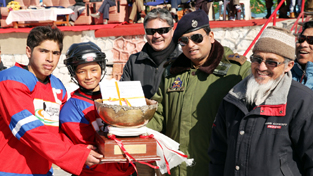
Tip-Top Sporting Club players receiving prizes.
National ambition
Sir,
It is no sin to nurse an ambition. It is ambition only that makes things move.
Aam Aadmi Party (AAP) which recently came to power in Delhi has started working on national level. However, one would like to caution the Aap that it is not easy to go national. Instead of frittering away the goodwill of people, the party should focus entirely on the capital city and live by all promises that it has made with the public.
They should consolidate their position first, gain full confidence of people and then go on national objectives. People have not yet tested their performance. If they fail to achieve what they have embarked on, they will fall like a pack of cards – never to rise again. People have given them a chance. They should not make good use of this opportunity and create a viable option in the country that earn respect and confidence of people who are a dissatisfied lot.
Yours etc…
Shiv K Sharma
Udhampur
ii
Sir,
AAP, by its recent views on national issues, has shown that it is too young to take on the reins of the nation. Our country is varied in culture, in political ideologies, has been riddled with terrorist and secessionist activities, has regional parties indulging in vote-bank politics, and has cross-culture migrations across the country, etc. Referendum cannot, therefore, be a solution to our problems. Many countries elsewhere whose size is much smaller than Mumbai city can have different type of Governments. Our problems are different which are compounded by some unfriendly neighours. AAP has a long way to go before it can think of entering the national stream.
Let AAP prove its credential by effectively governing Delhi for five years, by implementing the 17 points that Kejriwal has listed, by initiating action against the alleged corrupt practices of Sheila Dixit, Suresh Kalmadi and others, by ending the water-mafia raj in Delhi, etc. Governing and governance are easier said than done. The way AAP is manoeuvering itself, Mulayam may prove right in observing that the ‘bubble of AAP will burst very soon’.
Yours etc….
Harischandra Parshuram
Mumbai
Vivekananda An Icon For Indian Youth
Dr. Vishiesh Verma
Ravinder Nath Tagore once told a group, “If you want to know India, read Vivekananda”, He could well have said to the youth of today: “it is the time to read Vivekanand again”. May be some of his enthusiasm and vigour to bring about a transformation-in the way we relate to one another, think and act-will motivate those among us who need just that little bit of inspiration to start ticking right.
January 12, which is the birthday of Swami Vivekananda is observed as “National Youth Day” every year in our country. In fact India is a country of young people. Over 65% of India’s population is under 35 years now. Data suggests first time voters in India, between 18-23 years, comprise 14% of the electorate. That is a staggering number. The difference it could make to this election and our polity is huge. The Indian youth today are sorely in need of an icon, they can look up to. Swami Vivekananda for everyone and forever is a first choice. Brought up in the intellectual climate of late 19th century Calcutta and touched by the simplicity of Ramakrishna Paramhansa, Vivekananda focussed on social uplift-he was deeply perturbed by the terrible poverty of rural India. He had experienced hunger after the death of his father. He would roam streets of city in search of livelihood and then sleep on an empty stomach so that his family members could have the meagre food at house.
He gave clarion call to the youth to ‘Arise’ and ‘Awake’ and stop not till the goal is achieved. This cyclonic monk is widely remembered as the awakener of modern India whose burning words from ‘Colombo to Almora’ thrilled the sleeping nation, roused it to an intense awareness of its long neglected cultural and spiritual heritage and inspired the great freedom fighters: Tilak and Gokhale, Sri Aurbindo, Gandhiji, Nehru and Subash Chander etc. Swamiji was a thousand petalled lotus in the luminous and in his own summing-up he was condensed India. What made Swamiji so powerful and irresistible was his deep spiritual realisation, the indubitable knowledge of the divine within.
The impact of Vivekananda’s personality on youth has always been great. They are at once convinced that there is a man who has light, who sees things beyond darkness, who has prophetic vision, and this man is not afraid of truth but is ready to go along where the truth leads, sacrificing on the way all cherished dogmas. The youth is convinced about his utter sincerity of purpose, absolute selflessness, and catholicity of views, his scientific temper and his intellectual powers. Vivekananda’s call to youth has deep roots in his great life. It had come from the depth of his soul- this call itself is to the soul for its awakening and his call straight goes to the youth so let them listen directly from him.
Vivekananda wanted the youth to be physically strong, mentally vigorous, intellectually alert, and spiritually awakened. He wanted them to reject all that is weakening. He taught that morality and purity are the only strength and proclaimed that character is the foundation of great and good lives
Vivekananda was a man with a mission. His plan was to “Rebuild India”. He set out a work programme: want less, give more, others first, self last.
Be not nostalgic. Earn courage from the outcomes of your mistakes. Be not afraid. Every hallow is followed by a crest.
Analyse your present. In India, the essence of all our progress, be it politics, science and technology or society, is religion. And what is religion? It is the manifestation of the divinity within. The realisation of divinity is spirituality and the practical manifestation of this spirituality is religion. The aim of all our political motives, scientific and technological progress and social developments should be to attain religion, as defined by Swamiji.
Vivekananda advocated body building and exercise to help ones morale and strength.
He said, “it would be better to play football than read The Gita .. ” and the statement was a powerful metaphor for the youth . He wanted the youth of his time to evolve – fearless, strong and independent in the right sense. It was a call to action, to karma.
Vivekananda saw the world as a gymnasium where one learns to become strong and fearless. He dared to attempt to revamp all that was rotting in Indian society, and to enrich and learn from all that was noble.
He was a man with mission, and he was the first to present Vedanta thought in the simplest terms possible. Romain Rolland said of him:” his words are like great music, phrases in the style of Beethoven”.
The parliament of religions that opened in Chicago in Sept 1893 was a notable event in mankind’s long search for spiritual harmony. It emphasised the accord between “Unity in Diversity” and Diversity in Unity” of religious outlook and urged a cultural fellowship and mutual understanding between the western and eastern worlds.
Vivekananda attended the Parliament assisted by the families of American philanthropists. Harvard Professors had already written about him,” Here is a man who is more learned than all our learned professors put together”. His address started with greeting the audience as sisters and brothers of America was received with a prolonged applause and unprecedented enthusiasm, a spontaneous realisation of spiritual oneness of mankind. The tone had been set in right perspective. His discourse on Hinduism set forth basic ideas concerning the nature of the soul and man’s destiny pointing out that the goals towards which human beings we striving is the realisation of oneness or unity of existence.
“We believe not only in universal toleration” said Swami Vivekananda, “but we accept all religions true”. I am proud to belong to a nation which has sheltered the persecution and the refuges of all religions and all nations of earth.
The writer is a former reader Coordinator of University of Jammu.
Copper, nickel strengthen on increased demand

NEW DELHI, Jan 11: Copper and nickel prices strengthened by Rs 2 per kg on the local non-ferrous base metals market today on increased demand from consuming industries.
Traders said rising demand from consuming industries mainly supported the upside in copper and nickel prices.
In the national capital, copper mixed scrap and nickel (4×4) advanced by by Rs 2 each to Rs 432 and Rs 1,077-1,078 per kg, respectively.
The following are today’s metal rates per kg:
Zinc ingot 113-119, nickel plate (4×4) 1,077-1,078 gun metal scrap 227, bell metal scrap 229, copper mixed scrap 432, chadri deshi 285.
Lead ingot 136,lead imported 134, aluminium ingots 150, Aluminium sheet cutting 151, aluminium wire scrap 153 and aluminium utensils scrap 150. (AGENCIES)
Mess in Forest Department
An unnoticed nexus is at work in the Forest Department that manages administrative affairs not according to departmental and service rules and regulations but according to the will and likes of the authorities at the top. The underground nexus has made the department a private fief where juniors are placed in charge of ranges and are given lucrative postings, all in a clandestine manner. Vacancies of higher posts are deliberately left unfilled enabling the juniors to grab these under adhocism. This is administrative nepotism.
It will be noted that officials of lower categories are working against higher posts meaning Foresters are working against not only the posts of Forest Rangers but no fewer than 20 of them are working against the posts of DFOs. Out of 170 Forest Ranges only 36 are manned by Range Officers and the remaining are placed in the charge of Foresters. Thus not more than 20 per cent of the Ranges are run by the Range Officers while 80 per cent are in the hands of Foresters. Actually the position is that there is no shortage of manpower to run the administration of forest department. But there is a strong nexus somewhere within the department that is working behind the curtain on the behest of political leaders or persons with clout in the higher circles of power. Why are not the vacant posts of Rangers filled regularly under normal procedure? Why is recruitment deferred? If the Foresters who are officiating as Range Officers are competent and qualify the tests, they will be promoted to next higher step which is of Forest Rangers. But if they are not qualified according to rules, they won’t be selected. But as they don’t want to face the selection process, they manage through their individual resources to be appointed in-charge of the Ranges. Thus they enjoy the privileges associated with the post viz. enhanced salary and allowances plus other benefits. If posted at crucial places, they have the additional benefit of misusing their position and obtain pecuniary benefits.
This happens only when there is a widespread nexus in the entire department. If the seniors and upper layers of officers are honest and dedicated, none of these irregularities can take place. But as we said the nexus is fairly widespread and even those who have the last word on administration of the Department could also be part of the nexus. The Department is woe-begotten and only overhauling the entire structure is the solution. Forest Department seems to have been turned into a fief of a handful of insiders where rules and regulations are spurned and trampled under foot. Why is undue favour shown to some of the officials when they are put in charge of vacant higher posts and the vacancies are not filled? It exposes malfunctioning of the department and consequent indiscipline seeping into its ranks. This all speaks that political interference is at work and some with clout in the administration can manage to place themselves in lucrative positions.
The rust has set in the department, meritorious and deserving staff is ignored and there is no accountability anywhere why this mess is allowed to continue. We would earnestly suggest the Government to constitute a committee to assess the irregularities in the Forest Department and recommend corrective measures. Maybe there is the necessity of modifying and amending rules and regulations especially those that are old and outdated. Above all accountability is the litmus test of delivery. Forest Department has a vast human resource at its disposal. What is expected of them is that they should give a new lease of life to our dying forest wealth. As against this expectation, our forests are turning into barren lands as these are getting depleted at a fast rate. Forests are the backbone of ecological balance and contribute to the stabilization of climatic conditions.
Palmolein, soyabean oils up on fresh buying
NEW DELHI, Jan 11: Prices of palmolein and soyabean recovered by Rs 100 per quintal on the wholesale oils and oilseeds market today on emergence of buying at existing lower levels.
However, other edible and non-edible oils held steady in restricted activity.
Marketmen said emergence of buying at prevailing lower levels mainly led to recovery in palmolein and soyabean oil prices.
In the national capital, palmolein (rbd) and palmolein (Kandla) oils recovered by Rs 100 each at Rs 6,300 and Rs 5,900 per quintal, respectively.
Soyabean refined mill delivery (Indore) and soyabean degum (Kandla) oils also moved up by similar margin to Rs 7,200 and Rs 6,900 per quintal, respectively.
The following were today’s quotations per quintal:
Oilseeds: Mustardseed 2,950-3,050 and Groundnut Seed 2,150-2,900.
Vanaspati Ghee (15-litre tin) 1,160-1,290.
Edible oils: Groundnut Mill Delivery (Gujarat) 7,900, Groundnut Solvent Refined (per tin) 1,950-2,000, Mustard expeller (Dadri) 7,200, Mustard Pakki Ghani (per tin) 1,280-1,360, Mustard Kachi Ghani (per tin) 1,365-1,465, Sunflower 6,300, Sesame Mill Delivery 11,400, Soybean Refined Mill Delivery (Indore) 7,200, Soyabean Degum (Kandla) 6,900, Crude Palm Oil (Ex-Kandla) 5,300, Cottonseed Mill Delivery (Haryana) 6,200, Palmolein (RBD) Rs 6,300, Palmolein (Kandla) 5,900, Rice Bran (phy) 3,800 and Coconut (per tin) 1,380-1,430.
Non-edible oils: Linseed 7,200, Mahuwa 4,000, Castor 9,400-9,500, Neem 5,200-5,300, Rice Bran 3,170-3,270 and Palm Fatty 3,225-3,300.
Oilcakes: Groundnut Dehusk 800-850, Sesame 950-1,150, Mustard (New) 1,000-1,025, Mustard 1,200-1,210 and Cottonseed 1,075-1,175. (AGENCIES)
Sports Sphere
SUNDAY, january 12, 2014
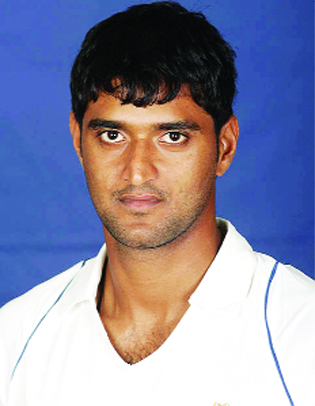 Born on May 6, 1995, Pankaj Singh is an Indian first-class cricketer, who was born in Sultanpur, Uttar Pradesh. Pankaj is a fast bowler. He was selected to the Indian Test Cricket squad for the Border-Gavaskar Trophy series of 2007-08 in Australia, but was not selected to play. He plays for the Rajasthan Royals in the Indian Premier League (IPL).[2] [3] A tall and strapping right-arm medium-fast bowler from Rajasthan, has progressed from the Under-19 level to the India A side with consistent performances since he made his first-class debut in August 2003. By 2006 he started showing signs of having matured, taking Rajasthan to the final of the Ranji Plate league, with 21 wickets at 20.95. In 2007, he was part of India A’s twin tour of Zimbabwe and Kenya, and a total of 18 wickets in the unofficial Tests and ODIs in Kenya earned him a spot for the home series against South Africa A. With Sreesanth and Munaf Patel injured, he earned a call-up to India’s Test squad to tour Australia. He signed with the Rajasthan Royals in the inaugural IPL before transferring to Royal Challengers Bangalore for the second season. His next big break came when he was included in the limited-overs sides for India’s tour of Zimbabwe, when the selectors decided to rest several senior players.
Pankaj has the distinction of swinging the ball both the ways and has the ability to hit the deck.
He has been a good performer for Rajasthan at the domestic circuit for many seasons.
Identify the Player:

Write a brief description about him in 250 words.
Questions of this week:
1. Name the all-rounder who is new comer selected for the New Zeeland Tour of India recently?
2. For which team Iqbal Abdullah played in Indian Premier League (IPL) Season-6?
3. Who was the top scorer of the 2nd Test match of India-SA Series, which concluded recently?
4. Who scored century for J&K in the Ranji trophy quarterfinal match at Vadodara in Gujarat?
5. Who is Richard Hadlee?
Answers of the last week:
1. 29 runs 2. Pune Warriors 3. Dale Steyn 4. Jammu and Kashmir 5. Indian First Class cricketer.
The best entry of this week was received from Tushar Mahajan, H No 55 Lower Laxmi Nagar Sarwal, Jammu.
The other entries of the week were from Sanjay Dhar, Lane-1, H No-3, Upper Laxmi Nagar, Sarwal, Jammu; Rohit Bhat, Janipur, Jammu; Rajan Singh, Vijaypur, Samba: Satish Kumar, New Plot, Jammu; Dheeraj Sharma, Patoli Brahmana, Jammu and Nipun Verma, Krishna Nagar, Jammu.
Land grabbing act foiled
Thanks to prompt and determined action by the District Administration of Jammu, attempts of a land mafia to grab and damage the state land Khasra No.219 at village Pargalta close to Bajalta railway station have been stymied. A brazen faced attempt was made under cover of darkness and in a drizzle to deploy machinery to change the face of the land and inflict damage to Government property. Obviously such audacious acts take shape only when the perpetrators have covert support of sections of officialdom, be it the revenue or the police department. Apart from this, a second attempt made by the land mafia shows that they also enjoy support from sections of political leadership. Without these agencies extending clandestine support, the miscreants cannot muster courage to do what they had planned to do. The DC has rightly taken full notice and ordered filing of FIR, which has already been done. Additionally, he has ordered inquiry into the criminal act. This is the correct and legal action which he is expected to do as the head of the administration in the district. We have no doubt in our mind that the inquiry committee will submit a report of its finding and then proper and legal action will follow. We appreciate cooperation offered by the police in thwarting the conspiracy.
It may be reminded that we have, in these columns, taken up the case of land mafia spreading its tentacles in Jammu. The mafia has grown substantially and is always on the prowl to grab land wherever it can. They have developed nexus in the Revenue and Police and Forest Departments. This menace has to be eradicated once for all. Unless the involved persons are apprehended and given exemplary punishment, they may not abandon their nefarious activities.
Cipher Decipher
SUNDAY, january 12, 2014
Hi Friends! We are back with your favourite column for the week. Please have a look at OUR MESSAGE before you send in your message to us.
1. To all from Abhhe Gupta: “ The darkness is what inspires us to reach for the light”.
2. From Ruchika Jandial to all: “ A meaningful silence is always better than a meaningless words”.
3. To all from Khemlata Koul: “ Success always comes when preparations meets opportunity”.
4. From Sanjay Dhar to all: “ When there is good, there is also evil. Where there is wealth, there is bound to be poverty. Where there is health, we also find sickness. Joy and sorrow are two sides of the same coin”.
5. To all from Anil Kumar Nanda: “ Luck is nothing but a sense to recognize that right time to do what is right”.
6. From Rishab Gupta to all: “ Additional risks in life is not taking risk” .
7. To all from Rishika Raina: “ Happiness is not only how to make yourself happy but it is also how to draw a smile on others face ”.
8. From Usha Raina to all: “ Never compete with someone who has nothing to lose”.
9. To all from Neeraj Gupta: “ It is not best that we should all think alike, it difference of opinion which makes horse races”.
10. From Dr Poonam Nanda to all: “ It is not the problem, but the attitude towards problem that makes the difference”.
11. To all from Manorama Sharma: “ What lies behind us and what lies below us are tiny matters, compared to what lies within us ”.
12. From Monika Mishra to all: “ When we try to degrade others, is so doing we degrade ourselves”.
13. To all from Mrs P Jain : “ Always welcome the opportunity gifted by almighty God, once you miss it, it may be lost for ever”
BEST MESSAGE
The award of rupees 200 for this week’s best message has gone to MAHIMA SINGH R/o V.P.O. PALLANWALA, TEHSIL AKHNOOR, DISTRICT, JAMMU for the message “ Try to recapture the happiness within yourself; think of all the beauty in yourself and in everything around you and be happy”.
Congrats. The prize money would be sent to you through money order.
our message
Please do mention pin code number of areas while sending your message to EXCELSIOR.
Your message must reach us by Friday evening.
To send your message, use CIPHER-DECIPHER message chit.
Your entries should be brief and original. We use those messages devoid of hurting the sentiments of the people.
Out of the messages we receive, one of the message is selected for the award.
Haresh Singh
Swami Vivekananda in Kashmir
Rakesh Kumar Pandit
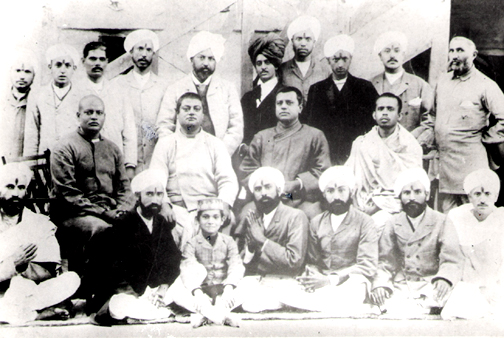
As the grateful nation celebrated the year 2013 as the 150th birth anniversary year of Swami Vivekananda and on 12th January 2014, the grateful nation will celebrate 151th birth anniversary of this Prophet of Modern India. I take this opportunity to highlight some of the important events of his Kashmir visit. During his stay in Kashmir Swami Vivekananda was in a different world altogether. He was deeply touched by the beauty of Kashmir. Swami Vivekananda visited Kashmir twice and it was on 10th September 1897, when the lotus feet of this great saint touched the beautiful and pious land of Rishis, once called as Reshver. His first visit of Kashmir was short and was not so eventful although he visited some of the places of religious and historic importance. People from all spheres of life like Sadhus, Kashmiri Pandits, students, officials went to meet him. The second visit of Swami Vivekanand to Kashmir valley was more eventful. This time a party of Europians was accompanying him. Prominent among them was Sister Nivedita (Margret Noble). He stayed in Kashmir from about mid of June 1898 to the mid of September 1898. During this stay he visited the places of religious and historical importance like Shankaracharya Hill, Hari Parvat, Martand (Matan or Bhawan), Panderthan (Pandresthan, Place of Pandavas), temples of Avantipora, Bijbehara, Moghul Gardens of Nishat and Shalimar . But the focus of this article is his visits to shrines of Shri Amarnath Ji Cave and Mata Kheer Bhawani in Tulmulla. The visits of Shri Amarnath and Mata Kheer Bhawani proved to be very unique and the visions he had at both the places remained always with him. Such was the spiritual experience of Swami Vivekananda at these places that it is very difficult to put that into words but can only be felt from the actual words of Swami Vivekananda. It also reflects the essence of both these energy centres charged with God’s presence in the vale of Kashmir.
Swami Vivekananda had great fascination for God Shiva during his childhood. As he grew older his love for Shiva, the God of monks and yogis deepened. Now in the Himalayas, the abode of God Shiva, the thought of God Shiva was uppermost in the Swami Vivekananda’s mind. It was at Achabal in Anantnag on July 25, 1898 that Swami Vivekananda expressed his intention to visit Amarnath and Sister Nivedita was allowed to join him. On 27 July, 1898 they left for the pilgrimage. Enroute they camped at various places like Phahalgam, Chandanwari, Wavjan. On August 1st, after crossing Sheshnag, Mahagunus top they reached Panchtarni (Place of five streams). On August 2, they reached the Shri Amarnath Ji Cave. When Swami Vivekananda reached the cave he was full with emotion and devotion. Swami Vivekananda entered the shrine nude except his loin-cloth and prostrated before the God-Shiva in the form of Ice-Lingam. An exalting spiritual experience came to him of which he didn’t spoke much in detail but only said, “I thought the Ice-Lingam was Shiva Himself.” When he entered the cave and came face to face with the God-Shiva, Swami Vivekananda had never felt such spiritual exaltation in visiting a holy place as in Amarnath Ji. Afterwards he also said to Sister Nivedita that the God Shiva appeared before him and granted him the grace of Amarnath, means not to die till he himself a the consent. On the journey back Swami Vivekananda and party returned to Anantnag and from there they reached on August 8, by boat to Srinagar.
Following the pilgrimage to Shri Amarnath Ji, Swami Vivekananda’s love for the Divine Mother grew intense. At Srinagar he worshipped the four year daughter of his Muslim boatman ( Swami was staying in a houseboat at Srinagar) as “Goddess Uma”. When he left Kashmir, she, tiny one carried a tray of apples for him all the way to the tonga herself. On September 30, Swami Vivekananda left for Mata Kheer Bhawani at Tulmulla, leaving strict instructions to his party not to follow him. He stayed there almost for a week. He daily performed Havan there, and worshipped the Mother with offerings of Kheer. Every morning he worshipped a Brahmin Pandit’s little daughter as “Uma Kumari.” One day at Kheer Bhawani while worshipping, the thought of the ruination and desecration of the temple by the Muslim invaders left him distressed at heart. He thought that Mother has been manifesting Her presence here for untold years, “How could the people have permitted such sacrilege without offering resistance.
If I had been here then, I would never have allowed such a thing. I would have laid down my life to protect the Mother.” Thereupon he heard the voice of the Mother Goddess saying, “What if unbelievers should enter My temple and defile My image? What is that to you? Do you protect Me, or do I protect you? Another day, in course of his worship, another thought flashed through the Swami Vivekananda’s mind that he should try to build a new temple in the place of a present dilapidated one. He even thought of trying to raise funds for this. At once the Divine Mother said to him, “My child, If I so wish I can have innumerable temples and monastic centres. I can even this moment raise a seven-storied golden temple on this very spot.” Referring to these experiences after his return, he said to his disciples, “All my patriotism is gone. Everything is gone. Now it is only Mother! Mother! I have been very wrong. I am only a little child.” Since I heard that divine voice, I have ceased making any more plans. Let these things be as Mother wishes.” It is often said that the vision at Tulmulla made him realize, what he is and for what he is in this world? Ramakrishna Parmahansa his Guru had once prophesied during a discourse with his close disciples that when Vivekananda realize who he is, he will not like to live anymore in this world and would depart from it. On July 4, 1902 Swami Vivekananda at the age of 39 years, 5 months and 24 days left his mortal cage, to reunite with the Supreme Energy of this Cosmos, thereby fulfilling his own prophecy, ” I shall not live to be forty years old.”
(The author is Assistant Professor of Physics at GDC- Bhaderwah).