

Sir,
There was a time when women used to enjoy dignified and supreme position as for as religious and social norms were concerned. The women folk who constitute nearly 50 percent of our population should have complete freedom to move here and there fearlessly.
No doubt women have forayed into every field like science, technology, governance etc so much so that she excels man in so many fields. It is simply because she has been endowned by God with so many qualities such as sobriety, humility, patience, co-operative nature, organizing capacity and above all tolerance. There are certain fields of achievement where she has surpassed man. Though the administration brags of having strict rules for protection of women but the ground reality is something quite different. The Tehlka case, Snoop gate case, retired Supreme court judge case are some of cases which act as eye openers as to how the women folk are treated.
Yours etc….
Dwarika Nath Raina
H. No. 131 Upper Muthi, Jammu
Position of women
Provincial president NC Devender Singh Rana and other dignitaries during Blood Donation Camp at New Era Environmental School on Saturday.
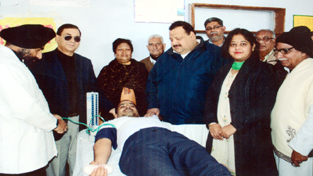
Provincial president NC Devender Singh Rana and other dignitaries during Blood Donation Camp at New Era Environmental School on Saturday.
Race to woo Kashmir voter !
TALES OF TRAVESTY
DR. JITENDRA SINGH
It is hilarious. While the National Conference (NC) describes People’s Democratic Party (PDP) as a creation of Bharatiya Janata Party (BJP), the PDP describes National Conference as the “B” team of BJP with an additional allegation that the top NC leadership received its grooming in the lap of BJP.
The war of words goes on and on with both the NC and the PDP seeking to project themselves as more loyal than the other to the cause of Kashmir and simultaneously both the parties also trying their best to outdo each other in distancing themselves from the BJP as if that was the best way to woo the Kashmir voter and perhaps the best way to prove their own “Kashmiriat”. As the election time draws closer, the BJP becomes an untouchable for the Kashmir-centric regional parties, even though in the event of BJP capturing power in New Delhi, both NC and PDP may vie with each other in inching towards it.
So, that about all is the politics of Kashmir valley. Whoever finds himself slightly distanced from the seat of power or faces the threat of political isolation, overnight turns a votary of Kashmir’s aspirations using separatist or semi-separatist jargon whether it be in the name of “Azaadi” or “self-rule” or “autonomy”. These slogans conveniently take a back-seat when one of them becomes a party to power… sharing the patronage of the Center irrespective of whichever the party in power at the Center.
As an election approaches, these slogans are once again pulled out for expedient use. Meanwhile, there is a very thin line of demarcation between a socalled mainstream and a socalled separatist politician in the Valley. Interestingly, there have been atleast three Jammu and Kashmir chief ministers in the last 30 years who spoke of Kashmir being an integral part of India when they were in power only to discover that Kashmir was an “unresolved” issue when they found themselves out of power.
In many ways, the socalled separatist politicians and socalled mainstream politicians of Kashmir are two sides of the same coin exchanging roles between themselves as and when required. What is more, many a prominent separatist leaders of the Hurriyat brand have been in the thick of mainstream politics at one time or the other in the past and they drifted into separatist politics primarily to sustain their relevance instead of being pushed into wilderness.
Be that as it may, the race of one-upmanship in a bid to woo the Kashmir voter often ends up causing damage to the very cause of Kashmir which these protagonists claim to serve through their self-righteous if not selfish means. And, by the way, is this the best way to serve the common man? That is the question. Is this also the best way to redeem an unrequited Umapathy whose contribution to socio-political fabric has always remained understated, a La, ‘‘Daur Ki Kaenaat Mein, Mujh Se Bhi Roshni Rahi…’’ ? That is the question.
AAP transforms electoral scene
S. Sethuraman
The transformational change under way in India’s political scene, bringing people’s concerns to the fore in governance, that has been demonstrated in the national capital, has set new challenges to the long-established parties, ruling at the Centre and states.
They have to become not only pronouncedly pro-people but also action-oriented to maintain credibility and strike the right balance between populism and other obligations of the state to both development and evolution of a knowledge society to take the nation forward in the 21st century.
Efficient and corruption-free governance, safeguarding internal security and protecting the borders are the other postulates. Growth and price stability have to be equal imperatives and growth has to be job-intensive and convincingly redistributive.
Transparency, speedy disposal of business, accountability and greater decentralization with enforceable norms for achieving results on the ground – whether in terms of real reduction of poverty, employment and effective spread of social development services like education and health-care, both qualitatively too, and provision of basic infrastructure – roads, communications, drinking water and sanitation.
It is the level of commitment to these objectives as would get reflected in the political manifestoes that would determine how far the national, regional and state parties become more relevant to the needs of the common people. All this would mean a total change away from the manner in which the so-called democratic governance has gone on for decades with a virtual disconnect between policies proclaimed with some authority in air-conditioned comfort and ground realities.
There are vital lessons to be drawn from the failures of UPA-II for which the nation is paying heavily through unaffordable high prices, not only of food and drugs but even manufactured goods across the spectrum, hitting the limits of tolerance of the vast majority of population, and yet helplessly watched by the Congress-led Government at the Centre for its full term.
Both corruption scandals and high inflation over five years in continuity were slurred over by power-wielders, all the time chanting reforms and high growth but with little impact on investors, domestic and foreign. The Congress rout in recent state polls resulted from the twin maladies cited. The Prime Minister himself admitted failure in controlling prices.
From the start, UPA-II had become too complacent with a tally of 206 seats for the Congress, which was more a fortuitous outcome through its alliances across the country than a real mandate for its claim of standing up for “aam aadmi”, its watchword pinched away by Arvind Kejriwal to name his party and build and win power in Delhi.
This unique formation, Aam Aadmi Party (AAP) – made up largely of citizens, rapidly building itself on a national scale and buttressed by a growing tribe of scholars, technocrats and ex-CEOs joining the party – is now ready to spread itself all over and contest the Lok Sabha elections in April-May in at least 20 states with 300 and odd candidates.
This will be the real third force that both the national parties, the Congress and the BJP, have to contend with and perhaps lose ground to a sizeable extent in the 2014 battle. AAP is also likely to cut into the support base of regional or state-level parties. Thus, the 2014 election could yield an even messier outcome than seen before.
Despite its decade-long hold on power, the Congress, wedded to growth and “reforms”, whatever it may mean, has failed to be relevant to the needs of common people. No longer electoral gains are to be regarded as a general mandate for the parties to follow their own framework of policies, as at present, unless these reflect to a large extent the day-to-day concerns of the vast majority of the rural poor and urban low-income earners.
In the changing electoral dynamics brought about by AAP, ethics for individuals and parties seeking votes has gained greater importance than before and no longer is it a given that the first-past-post candidate, once elected, can resort to his old ways. He would have to remain loyal to the electorate that puts him in the legislature in the first place.
As the country gets galvanised for the elections in April-May, the long-recognised national and state-level political parties have necessarily to redraw their electoral strategies to take note of the vastly-changing mood of the electorate, as typified in recent state polls, and also meet the challenging demands for ethical conduct, observance of austerity and rooting out corruption.
The leading opposition in the present Parliament, BJP, is far advanced in its preparations for the epic battle, mobilizing support with a hectic campaigning by its Prime Ministerial candidate Mr Narendra Modi. The Congress is yet going through in-house exercises under the leadership of the party vice-President Mr Rahul Gandhi, who is likely to be named to lead the party to the battle ahead when AICC meets in Jaipur on January 17. The Congress manifesto for a renewed mandate in 2014 is also expected to be finalised by then.
Relatively, the Congress has to go through a more difficult terrain this time in the vastly changed political conditions in the country, with the strong anti-incumbency wave prevalent and the BJP and other parties arrayed against it exploiting its sins of omission and commission. Though neither of the two national parties would be in a position to hit the 272 mark, even with some allies, the Congress would find it tougher this time to forge alliances which would at best be confined to a couple of states and this may not make much of a difference.
BJP is clearly perceived to be ahead in the race toward 272 mark. The Congress is being shunned by its major allies in 2009 and there is no region of the country where the party looks dominant. The Finance Minister P Chidambaram, who not long ago talked of returning to implement his reforms with more vigour after the elections, says now no party will get a solid majority.
With the entry of AAP which can make substantial inroads, the post-electoral scene may become more intriguing while the country continues to remain in the grip of low-growth, high inflation syndrome under the watch of an assertive policy-maker in UPA-II.
It is to be hoped that the Congress would move away from its faith in ‘trickle-down’ effect from the elusive high growth, discredited globally, which has only widened economic and social disparities, as well as from its permissiveness of crony capitalism. If this is to be the route for ending poverty, it would take several decades with insurmountable social consequences.
India’s progress has to be built from within, not by opening floodgates for foreign capital, but mainly from our exports of goods and services, FDI being confined to strategic areas unlike retail trade opened up for monopolies from abroad with disappointing outcome. The new manufacturing policy would bring “billions of dollars” and create “millions of jobs” as claimed by Commerce and Industry Minister Mr Anand Sharma but such policies and programmes like training in skills nationwide are in doldrums.
Employment, which would add to purchasing power and demand, remained a secondary objective of UPA-II. Often, the UPA Government had specialised in announcing policies, not following them up, and reinventing them as if a sense of urgency had come over it. Normal executive actions have now become “reforms” to get things moving.
Where governance faulted is exemplified by the way projects approved in principle were allowed to languish for years and now being revived with time and cost over-runs by a Cabinet Committee on Investment and yet cited as a path-breaking reform. (IPA)
Table tennis coach Ramesh Magotra honing skill of players at Jammu Tennis Academy on Saturday.
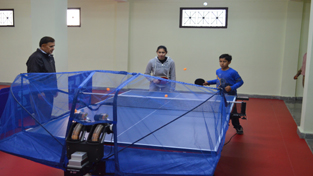
Table tennis coach Ramesh Magotra honing skill of players at Jammu Tennis Academy on Saturday.
A world which spun on the axis of the heart
M.J. Akbar
Nostalgia is not very good news for the nostalgic. The elegy of age lies a layer below the surface, trying hard but unable to hide. As the present hurries along towards the future at its usual frenetic pace, the draw of the past persuades one to pause in contemplation, unredeemed by any practical definition of utility. But nostalgia is not the sadness of an end; it is search, melancholic maybe, for nuggets in the rubbish dump of time.
Suchitra Sen has entered the last days of her life, in some Calcutta hospital. This is no longer news. In the 1950s and 1960s there seemed to be no other news worth bothering about in Bengal except the enchanting Suchitra Sen, particularly when she appeared on screen with her great paramour and thespian partner Uttam Kumar. Suchitra Sen was married to someone. No one knew who, and no one cared: Suchitra and Uttam possessed chemistry beyond science. Marriage seemed irrelevant. Everyone was married, including all – unlike today, when the operative if ebbing word is most – parents. But how many gorgeous women and handsome men were in love that was both subversive and flagrant? The world spun on the axis of the heart.
I had not put razor to chin when I first saw them in a movie, in a cinema hall called Jyoti. The seats confirmed my knowledgeable view that bedbugs were misnamed; they had quite a life outside bed as well.
We lived, or were locked, in a hamlet outside a jute mill on the banks of the meandering river Hooghly; but the imagination always escaped into an interwoven collage of dreams unbridled by any boundary. Nothing set fantasy on fire more quickly than a Suchitra smile, subtle, mischievous, and in full command of the relationship. Uttam Kumar was happy to become an adult boy before the goddess.
I cannot recall the name of that film; perhaps Saptapadi, perhaps not. It would be easy to check through the smooth alleys of modern internet technology. But that is only as necessary as a shrug. It was a time of black-and-white. It was an age of grain and velvet, and the sheen of velvet became a separate colour. Memory is better served in diffusion than in the particular.
The 1960s were draped by a grainy peel of shifting dots: nothing was clear, not a job in sight, not a prospect in place, the economy as disconsolate as aspiration. Little wonder then that the decade was marked by insurrection and violence, some in a Maoist cause, others for ethnic or communal reasons. A large comfort zone was the company of Suchitra Sen – and, to be fair, Uttam Kumar.
It was not the only one, of course. Dev Anand’s jaunt, his street-smart zigzag through petty crime [selling black market movie tickets, picking pockets, finding courage in a gambling den] as the only option for survival, was equally irresistible. I never understood why Suchitra Sen and Dev Anand looked so distant from each other in their one film, Bombai Ka Babu. Every part of the construct was separately perfect: hero and heroine at the top of their game; the music divine; the plot far better than the soporific nonsense that was the usual diet for scripts. There could be only one reason. Suchitra and Dev were cold. There was nothing personal. We who knew Bengali cinema felt relieved. It was Suchitra and Uttam or Suchitra or nothing. Suchitra and Uttam even did a Bengali rendition of Othello in one film. Through some human miracle, it worked.
Suchitra never adapted to Hindi cinema; and nor did Uttam. Suchitra succeeded only when she did not need a stand-in for Uttam, in films where she was stellar rather than co-star. If you have not seen her brilliant performance in Mamta, order a copy now. It is a moving story of love lost and life betrayed. Two songs are classics: Lata Mangeshkar’s Rahte thhe kabhi jinke dil mein hum jaan se bhi pyaaron ki tarah/Baithey hain unhi ke mehfil mein hum aaj gunahgaaron ki tarah, and Hemant Kumar’s immortal Chupa lo yeh dil mein pyaar mera. The second success was Aandhi, where Suchitra portrayed a politician modelled on Mrs Indira Gandhi. Suchitra belonged to Bengal and Bengali.
Uttam Kumar died, suddenly, more than three decades ago. I was editor of the newsweekly Sunday then. The commemorative issue in his memory sold out the moment it reached the stands, and not just in Calcutta. His funeral had an element of insanity, as young crowds fought to touch their idol on his final trip through the city he loved. Suchitra is still with us, and may the inevitable be delayed as much as a generous Providence can manage. But her memory will not die, as long as admiration is alive.
Tip-Top Sporting Club players receiving prizes.
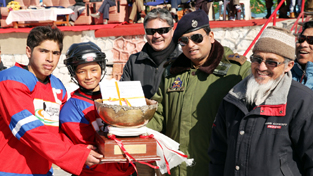
Tip-Top Sporting Club players receiving prizes.
National ambition
Sir,
It is no sin to nurse an ambition. It is ambition only that makes things move.
Aam Aadmi Party (AAP) which recently came to power in Delhi has started working on national level. However, one would like to caution the Aap that it is not easy to go national. Instead of frittering away the goodwill of people, the party should focus entirely on the capital city and live by all promises that it has made with the public.
They should consolidate their position first, gain full confidence of people and then go on national objectives. People have not yet tested their performance. If they fail to achieve what they have embarked on, they will fall like a pack of cards – never to rise again. People have given them a chance. They should not make good use of this opportunity and create a viable option in the country that earn respect and confidence of people who are a dissatisfied lot.
Yours etc…
Shiv K Sharma
Udhampur
ii
Sir,
AAP, by its recent views on national issues, has shown that it is too young to take on the reins of the nation. Our country is varied in culture, in political ideologies, has been riddled with terrorist and secessionist activities, has regional parties indulging in vote-bank politics, and has cross-culture migrations across the country, etc. Referendum cannot, therefore, be a solution to our problems. Many countries elsewhere whose size is much smaller than Mumbai city can have different type of Governments. Our problems are different which are compounded by some unfriendly neighours. AAP has a long way to go before it can think of entering the national stream.
Let AAP prove its credential by effectively governing Delhi for five years, by implementing the 17 points that Kejriwal has listed, by initiating action against the alleged corrupt practices of Sheila Dixit, Suresh Kalmadi and others, by ending the water-mafia raj in Delhi, etc. Governing and governance are easier said than done. The way AAP is manoeuvering itself, Mulayam may prove right in observing that the ‘bubble of AAP will burst very soon’.
Yours etc….
Harischandra Parshuram
Mumbai
Vivekananda An Icon For Indian Youth
Dr. Vishiesh Verma
Ravinder Nath Tagore once told a group, “If you want to know India, read Vivekananda”, He could well have said to the youth of today: “it is the time to read Vivekanand again”. May be some of his enthusiasm and vigour to bring about a transformation-in the way we relate to one another, think and act-will motivate those among us who need just that little bit of inspiration to start ticking right.
January 12, which is the birthday of Swami Vivekananda is observed as “National Youth Day” every year in our country. In fact India is a country of young people. Over 65% of India’s population is under 35 years now. Data suggests first time voters in India, between 18-23 years, comprise 14% of the electorate. That is a staggering number. The difference it could make to this election and our polity is huge. The Indian youth today are sorely in need of an icon, they can look up to. Swami Vivekananda for everyone and forever is a first choice. Brought up in the intellectual climate of late 19th century Calcutta and touched by the simplicity of Ramakrishna Paramhansa, Vivekananda focussed on social uplift-he was deeply perturbed by the terrible poverty of rural India. He had experienced hunger after the death of his father. He would roam streets of city in search of livelihood and then sleep on an empty stomach so that his family members could have the meagre food at house.
He gave clarion call to the youth to ‘Arise’ and ‘Awake’ and stop not till the goal is achieved. This cyclonic monk is widely remembered as the awakener of modern India whose burning words from ‘Colombo to Almora’ thrilled the sleeping nation, roused it to an intense awareness of its long neglected cultural and spiritual heritage and inspired the great freedom fighters: Tilak and Gokhale, Sri Aurbindo, Gandhiji, Nehru and Subash Chander etc. Swamiji was a thousand petalled lotus in the luminous and in his own summing-up he was condensed India. What made Swamiji so powerful and irresistible was his deep spiritual realisation, the indubitable knowledge of the divine within.
The impact of Vivekananda’s personality on youth has always been great. They are at once convinced that there is a man who has light, who sees things beyond darkness, who has prophetic vision, and this man is not afraid of truth but is ready to go along where the truth leads, sacrificing on the way all cherished dogmas. The youth is convinced about his utter sincerity of purpose, absolute selflessness, and catholicity of views, his scientific temper and his intellectual powers. Vivekananda’s call to youth has deep roots in his great life. It had come from the depth of his soul- this call itself is to the soul for its awakening and his call straight goes to the youth so let them listen directly from him.
Vivekananda wanted the youth to be physically strong, mentally vigorous, intellectually alert, and spiritually awakened. He wanted them to reject all that is weakening. He taught that morality and purity are the only strength and proclaimed that character is the foundation of great and good lives
Vivekananda was a man with a mission. His plan was to “Rebuild India”. He set out a work programme: want less, give more, others first, self last.
Be not nostalgic. Earn courage from the outcomes of your mistakes. Be not afraid. Every hallow is followed by a crest.
Analyse your present. In India, the essence of all our progress, be it politics, science and technology or society, is religion. And what is religion? It is the manifestation of the divinity within. The realisation of divinity is spirituality and the practical manifestation of this spirituality is religion. The aim of all our political motives, scientific and technological progress and social developments should be to attain religion, as defined by Swamiji.
Vivekananda advocated body building and exercise to help ones morale and strength.
He said, “it would be better to play football than read The Gita .. ” and the statement was a powerful metaphor for the youth . He wanted the youth of his time to evolve – fearless, strong and independent in the right sense. It was a call to action, to karma.
Vivekananda saw the world as a gymnasium where one learns to become strong and fearless. He dared to attempt to revamp all that was rotting in Indian society, and to enrich and learn from all that was noble.
He was a man with mission, and he was the first to present Vedanta thought in the simplest terms possible. Romain Rolland said of him:” his words are like great music, phrases in the style of Beethoven”.
The parliament of religions that opened in Chicago in Sept 1893 was a notable event in mankind’s long search for spiritual harmony. It emphasised the accord between “Unity in Diversity” and Diversity in Unity” of religious outlook and urged a cultural fellowship and mutual understanding between the western and eastern worlds.
Vivekananda attended the Parliament assisted by the families of American philanthropists. Harvard Professors had already written about him,” Here is a man who is more learned than all our learned professors put together”. His address started with greeting the audience as sisters and brothers of America was received with a prolonged applause and unprecedented enthusiasm, a spontaneous realisation of spiritual oneness of mankind. The tone had been set in right perspective. His discourse on Hinduism set forth basic ideas concerning the nature of the soul and man’s destiny pointing out that the goals towards which human beings we striving is the realisation of oneness or unity of existence.
“We believe not only in universal toleration” said Swami Vivekananda, “but we accept all religions true”. I am proud to belong to a nation which has sheltered the persecution and the refuges of all religions and all nations of earth.
The writer is a former reader Coordinator of University of Jammu.
Copper, nickel strengthen on increased demand

NEW DELHI, Jan 11: Copper and nickel prices strengthened by Rs 2 per kg on the local non-ferrous base metals market today on increased demand from consuming industries.
Traders said rising demand from consuming industries mainly supported the upside in copper and nickel prices.
In the national capital, copper mixed scrap and nickel (4×4) advanced by by Rs 2 each to Rs 432 and Rs 1,077-1,078 per kg, respectively.
The following are today’s metal rates per kg:
Zinc ingot 113-119, nickel plate (4×4) 1,077-1,078 gun metal scrap 227, bell metal scrap 229, copper mixed scrap 432, chadri deshi 285.
Lead ingot 136,lead imported 134, aluminium ingots 150, Aluminium sheet cutting 151, aluminium wire scrap 153 and aluminium utensils scrap 150. (AGENCIES)