

Sir,
At a time when fundamentalists are spreading their venomous tentacles everywhere and making this world a dangerous places to live in, the only way these forces can be contained is through secular ethics as has been advocated by His holiness Dalai Lama while addressing the special session of General Council meeting of LAHDC, Leh.
If there is chaos in the world today, it is primarily because secular teaching has either been shunned or not taught in right earnest in educational institutions whether private or public.
Inculcating the spirit of living in harmony among students from the beginning of their academic career will go a long way in building a pluralistic society in which there is no scope for communalism.
The spiritual Guru firmly believes that education based on secular ethics, ancient Indian traditions befitting to modern will promote amity between different religious faiths.
Therefore, the State Government should consider imparting education based on secular and moral teachings to students right from the day they enter the institutions.
Yours etc…
Tashi Namgyal
Leh
Secular ethics
India’s Ishant Sharma, left, celebrates wicket of England’s Joe Root on the fifth day of the second cricket test match between England and India at Lord’s cricket ground.
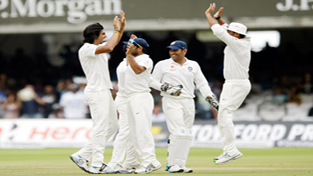
India’s Ishant Sharma, left, celebrates wicket of England’s Joe Root on the fifth day of the second cricket test match between England and India at Lord’s cricket ground.
Union Budget 2014-15
Dr Ashwani Mahajan
Common man, who was disgusted by the mismanagement under the ten year long UPA’s rule, was looking at the Budget 2014-15 with a great hope. Whereas salaried class was hoping for raising of exemption limit to rupees 5 lakh and reprieve from inflation, SSI’s for raising exemption limit for excise duty, youth for employment, and industry at large for kick start of manufacturing growth; almost all sections wanted something from the government for happy days.
Though health of the economy has been said to be not good; Finance Minister had aroused the hope for 5.4 percent to 5.9 percent growth in GDP. It is true that rate of inflation has come down marginally, however manufacturing sector has been passing through worst condition. Danger of monsoon failure is also, not a good sign for economy in general and agriculture in particular.
Different people evaluate the budget differently. If we ask salaried youth, budget has helped him to reduce his tax burden by raising exemption limit; and more deductions allowed in terms of savings, home loan interest repayment etc. Foreign investors may be happy due to raising of caps on FDI in defence and insurance; and some more facilities for FIIs. However evaluation of the budget is never good, if it is done partially. It would be better to evaluate budget according to the aspiration of the people in general.
Employment and Employability
According to the census 2011, 4.7 crore youth between 25 and 34 years of age are unemployed. Situation is even worse in care of Adivasi and dalit youths. They need employment. Budget does talk about apprenticeship scheme and skill development to improve employability; however for the creation of more employment opportunities we will have to change the production system and the overall development model. Everybody accepts (even the supporters of globalisation), that the model of development adopted under LPG, is a model of jobless growth. But it is ironical that the present budget is not in much variance with the budget/policies of the previous regime.
Manufacturing
The experience in the last two decades has been that the share of agriculture in GDP has come down from 25 percent to 13.5 percent. The share of manufacturing which had started increasing marginally, has again come down to around 15 percent of GDP. People in the government had been talking about raising the same to 25 percent. In the last one year the rate of growth of manufacturing has come down to -0.7 percent, after remaining near zero percent in two years before that. It was obvious expectation from the budget that it would boost manufacturing. It is correct that steps have been initiated for National Investment and Manufacturing Zones, 4 industrial corridors, including Delhi-Mumbai Industrial Corridor, creation of additional capacity in main manufacturing industries etc.. However budget has failed to identify and address major causes for manufacturing downfall namely high interest rates and huge imports especially capital goods from abroad. If we really want to boost manufacturing, we will have to reduce interest rates. High rate of inflation is the major cause of high interest rates. Therefore, combating inflation should be top on government’s agenda, apart from curbing imports, especially from China which include imports of electronics, electrical goods, power plants, capital goods, telecom equipments etc. Budget has failed to address this major irritant to the growth in manufacturing.
Inflation
It is good that the FM has not increased taxes and has also tried to limit government expenditure and keep fiscal deficit within 4.1 percent of GDP. In fact the best way to combat inflation is keeping check on expenditure by rationalising subsidies. But at the same time supply side is also very important, especially supply of food products. To boost production of food products we need to encourage agriculture. But this budget despite talking high about agriculture and farmers (especially 7 lakh crore of farm loans), fails to give new lease of life to farmers. It is unfortunate that the budget provides less than one percent of the budget for agriculture.
Social sectors
Social sectors like health, education, women and child development, SC/ST or even minorities, drinking water etc. all have continuously been neglected and this budget is also no exception with hardly 9.5 percent of budget being allocated for the same. In fact if we want to reap the demographic dividend, we need to increase expenditure on social sector.
External Sector
For the last so many years, our external balance is badly disturbed. Due to high current account deficit (CAD) in our balance of payment, our rupee is continuously stressed. Weak rupee increases industrial costs partly by way of costly imports and partly due to increase in interest cost of foreign loans raised, by our corporates. There was an urgent need to curb imports for strengthening rupee, in which this budget has failed miserably.
We do need Smart Cities, however more important is to improve the education and health services in cities and rural areas alike. It is imperative to raise the level of living of 30 percent of our population, living below poverty line by providing them the opportunity to earn more. Census data clearly reveals that in the era of globalisation, poor the deprived, dalits, aadivasis are all losing their traditional land and becoming landless labourers. There is a need to reverse this trend. For the same we need to change the present day model of development, the model which is based on FDI and big corporates, as this is a model of jobless growth and encouraging the deprivation further. It is unfortunate that the present budget is no different from the budgets of previous regime.
Corruption in country
Dr.Banarsi Lal and Dr.Shahid Ahamad
Before we begin to enquire into the subject, it is pertinent to ask what exactly is understood by corruption. Can we define it? What are the causal factors for its spread? Can we eliminate this cancer from our society? What are remedial measures against this menace? These are the questions that need to be answered effectively to eradicate this menace. There is no evil, which is pervasive today as corruption. Corruption is making its vitiating presence in our all walks of life. Many of us are unaware about its impact on our lives and its negative consequences in future. Corruption is easier to identify than to define. There is no need to elaborate corruption as we all are exposed to various types of corruption, its different methodologies directly or indirectly by way of either dealing with the corrupt people or by way of being corrupt. Corruption is behaviour which deviates us from the normal duties of public role because of private cliques, violates the rules due to certain private influence. This type of behaviour includes bribery, misappropriation and nepotism. If we look back our history, corruption was prevalent in old days also and it has been described by Kautilya in Arthasastra during the Mauryan period.
The corrupt people in our country brazenly retard the economy of the country. Our country is rich in natural resources, rich honoured civilization, rich in man power resources but still our country remained poor and backward due to rampant corruption in Government and private services. We celebrate 15th August as our Independence Day. But our celebrations are for what and for whom? Does it signify Independence from corrupt and unfair system? Or from nagging persistent poverty and social injustice? Or from the political leaders who mislead the people with insincere and false promises? The fact is that the true independence of the country has been stolen by the corrupt people. These corrupt people of the society have made the honest people incompetent. We must come forward to weed out corruption from our society. Corruption presently in our country threatens administrative, political and economic system of the nation. This cancer has become the matter of grave concern for all of us. While public awareness about this problem has been increased by the different sources and persons like social activist Anna Hazare over the years but very little progress has been made to implement the remedial measures that can nab the severity of this menace. The Government efforts are also in piecemeal. Periodic scandals are observed every year.
Corruption is considered as the biggest problem in our country. Even after long time of independence, we experience the existence of severe form of corruption in our country. The Indian citizens now think that they cannot get the services done without bribe or references from the influential people. Corruption has now engulfed every walk of life and it enjoys its own social dignity. Now the people have the psyche that there is nothing wrong in giving or taking the bribe. There is general feeling of skepticism and cynicism against the Government by the people. Directly or indirectly, we all are responsible for the existence of corruption in our country. Every individual now have become self-centred because every individual thinks for his own concern and wants to fulfill his own interest through any means.
Now, we should think that from where and how we should start the anti-corruption efforts? We should try to understand the causal factors and incentives which start the corruption. We should dispel the myth that corruption exists in our culture. The Swiss bank account has become traditional culture in our country. Mostly we think that political leaders are responsible for corruption. Should we wait for elusive leaders and let the degeneration continue or take the responsibility to make vibrant modern India? The question still remains unanswered that can we get rid of corruption? The answer should be the big “YES”. Everything is possible in this world. It is well known proverb that where there is will there is a way. We should be optimist to eradicate the corruption from our country. The word ‘impossible’ itself says that ‘I am possible’. Our Jammu and Kashmir state is at number two position in case of corruption while Bihar is at number one position in India. In 2005 Transparency International conducted a study and observed that 62% of the Indians had firsthand experience of paying bribes or influence to get the services done in the public offices. Presently India is at 85th position in the corrupt nations in the world. Let us hope that India would be considered as corruption free country. This task is arduous but not possible to achieve. There is no need of anti-corruption army to eliminate this menace. The people of the country are the real power of the country. The vote of each individual is like drop and each drop is equally important. Many drops are needed to fill the ocean. We should select the honest and clean public image politicians. We should have anti-corruption package. There is need to reform our political system, restructuring the Government machinery and create the awareness on corruption among the people. We need to have social activists like Sh. Anna Hazare who could awake the people against this menace. There is need to inculcate good ethical values in our young generation and also need to give quality education to them to become the honest citizens of the country. We should make strenuous efforts to make our country corruption free. We don’t want our country to be named the country of illiterates, unemployed and sick people. We don’t want our country to be said as the country of poor, incompetent and dishonest people. We want our motherland to be known for its honest, spiritually very strong and economically rich people.
Winners alongwith dignitaries during ‘Jammu Fashion Night’ on Monday.

Winners alongwith dignitaries during ‘Jammu Fashion Night’ on Monday.
Uniform Civil Code No Ram-Rahim poll cut outs
Poonam I Kaushish
Secularism has always been the Hindutva Brigade’s bug bear and political untouchability the Congress catch word. But Modi’s ascendency to India’s Raj gaddi has turned the tables via the chants of Sarva Dharam Sambhava. Whereby Ram, Allah and Jesus might need to take a back seat if the BJP has his way and say: Of knitting India’s diverse social fabric into one nation. Akhand Bharat, Sampooran Samaj slogans are resounding in Delhi’s political corridors. What’s new?
An inkling that the Centre is likely to bring the contentious Uniform Civil Code (UCC) was given during Question Hour last week. In an innocuous reply, the Law Minister talked of the Government holding “wide stakeholder consultation” on the issue as per Article 44 of the Constitution. No big deal as the UCC is part of BJP’s election manifesto which argues that there cannot be gender equality till such time India adopts the Code which protects the rights of all women.
Undeniably, this is the first time the Modi Government has formally put forth its stand on the controversial issue in Parliament since coming to power. And the stars and the Supreme Court seem favourably inclined. Given, that it has thrice tried to resurrect the campaign for enactment of a common civil code, the last effort in 2003. Every time the result was zilch.
Article 44 simply states: The State shall endeavour to secure for the citizens a uniform civil code throughout the territory of India”. Arguably, what is it about the Code that makes the political tribe other than the Hindutva Brigade see red? Why the Congress’s predictable pantomime of puerile lame excuses which add up to “appeasement of the minorities” (read Muslims) at all costs.
Raising a moot point: Why should a common civil code be viewed as encroaching on the right of religious freedom? Or being anti-minority? If Hindu personal law can be modernized and a traditional Christian custom struck down as unconstitutional, why should Muslim personal law be treated as being sacred to the secular cause?
Alas, over the years deliberate distortions of religion to suit narrow personal and political ends had vitiated the country, which shamelessly, has everything to do with vote-bank politics. Whereby, Ram and Rahim have been reduced to election cut-outs.
Remember 1985, when a five-member Constitution Bench of the Supreme Court while disposing off the famous Shah Bano case rued the fact that Article 44 has remained a “dead letter”, and allowed divorced Muslim women to seek legal remedy under their personal law, Criminal Procedure Code or the Muslim Women’s Act.
But, the then Congress Prime Minister Rajiv Gandhi hurriedly first amended the law to curry favour with the Muslims, next performed Shilanyas for a temple at Ayodhya to woo the Hindus. In the end, he was divested by both. In 2003 again, the Court while striking down Section 118 of the Indian Succession Act 1925 which discriminated against Christians vis-à-vis restrictions on their right to bequeath property for religious or charitable use rued that “Parliament is still to step in” and frame the UCC.
In fact, the Court underscored Dr. Ambedkar’s advocacy of an optional common civil code. Whereby, according to him there was no connection between religious and personal law in a civilized society. Pertinently, during the Constituent Assembly debate on Article 35 (now 44) on November 3, 1948, he made two observations: One, the Muslim Personal Law is not immutable and uniform throughout India, contrary to what had been stated in amendments (moved by Muslim members).
Reminding all that up to 1935 the North West Frontier Province was not subject to the Shariat Law instead it followed the Hindu Law in succession and other matters. So much so that it was only in 1939 that the Central Legislature abrogated the application of Hindu Law to the Muslims of the North West Frontier Province and applied the Shariat Law to them. In North Malabar, the Marumakkathayam Law, a matriarchal form of law and not a patriarchal form of law is applicable.
Two, the Article merely proposes that the State shall endeavour to secure a civil code for its citizens, not that after the code is framed States shall enforce it upon all merely because they are citizens. It is possible that a future Parliament might make a provision in the initial stage of the Code being purely voluntary.
Not only Ambedkar, but Nehru, too, held the same view and was vigorous in his support for Article 44. Should this make him communal, even a Hindu fundamentalist? Today’s Congressmen have conveniently forgotten that the Constitution was framed by their leaders to ensure the country’s secular fabric remained intact. Can the Party claim to be secular when it has no qualms of conscience in joining hands with the Indian Union Muslim League in Kerala to form a Government.
Regrettably, Article 44 has remained a dead letter. As things stand both Hindus and Muslims have lot sight of the essentials of their respective religions and are largely misled by bigots and fundamentalists. Worse, even the educated are speaking the language barely distinguishable from that of Hindu-Muslim fundamentalists. Their stock answer to every critique: Religion is in danger.
Should they not support Ambedkar’s middle path of a voluntary civil code. Are they not aware that many Islamic countries have codified and reformed the Muslim Personal Law to check its abuse? Polygamy has been banned in Syria, Tunisia, Morocco, Iran and even Pakistan.
But in today’s politico-social reality, Ambedkar’s sound advice is more than likely to be dismissed as an utopia hypothesis. For, successive Governments have failed to draw a distinction between politics, caste and religion. Forgetting, there is no mysticism in the State’s secular character. It is neither pro or anti God and is expected to treat all religions and people alike ensuring that no one is discriminated against on the ground of religion.
Where do we go from here? It all depends on whether the Government is willing to get rid of its excess baggage of isms and instead bank on genuine secularism. The Apex Court has shown the way once more. The Government can now fire the gun from its shoulder.
India and its secularism deserve a voluntary common civil code for gradual acceptance without further delay. Enlightened opinion among the Muslims will then have a choice’ be liberal and progressive or remain obscurantist and backward. Goa already has had a common civil code willingly accepted by all.
Ultimately, no one community should be allowed the veto or block a progressive legislation. Especially, if it is voluntary and does not seek to impose any view or way of life on any one arbitrarily. Time to implement Article 44. India needs genuine secularism. What gives? INFA
Exchange of fire on IB
For last five days, cross firing along International Border in Arnia and R.S. Pora has been going on between BSF and Chenab Rangers of Pakistan. As usual, it started with unprovoked firing from Pakistan’s Sialkot sector. Actually, villagers close to this sector on our side in Arnia were engaged in cutting the sarkande grass to prepare the field for cultivation of paddy. Pakistani Rangers have always shown hostility when Indian famers are engaged in cutting the tall grass. Since tall grass or sarkande helps infiltrators to sneak in hiding, the Ranger would not like cutting of the grass as it exposes the infiltrators to the vision of BSF manning the border.
BSF returned the fire from its side of the border. Obviously, exchange of fire causes casualties and damages. On our side also, detailed reports of the damage caused has come in. In latest firing that happened on Sunday, Pakistani Rangers targeted about 15 Border Posts along the 30 km long International Border in Arnia and R.S. Pora sector. Pakistani forces used mortar shells which caused large scale damage to a large number of house and cattle though there was no human casualty. However the panic stricken villagers ran for shelter while mortar shells landed on houses and compounds or the cowsheds causing them damage. Civil authorities have rushed to the spot and made an assessment of the damages done. Some unexploded shells were found in the compound which our expert team detonated later on.
This is not the first nor shall be the last cease fire violation by Pakistani troops of the agreement of 2003 between the two countries. India has repeatedly told Pakistan that cease fire agreement should not be violated because cross border firing inflicts much damage to life and property and vitiates the atmosphere for peaceful talks between the two countries. The precise problem with Pakistan is that the restive non-state activists or better calls them by their proper name of jihadi legions are goaded into sneaking into Indian Territory to carry on the tempo of violence in J&K. Rangers resort to fire to divert the attention of Indian BSF personnel and then push the jihadis across the line. Many of them get killed in their dangerous adventure though some of them escape with their lives.
During past two years and more, security forces have achieved much success in liquidating the infiltrators either on the border or later on when they moved deep inside the valley. The result is that many top commanders of the LeT and other militant outfits have been done away with. Firing by Pakistani Rangers is closely linked to the situation in Kashmir valley.
In recent months, insurgents have been re-surfacing in parts of Southern Kashmir and in Sopor area of North Kashmir. They were engaged in fierce gun battle with the security forces. Several bids of infiltration have also been foiled during past couple of months. Unprovoked firing on International Border in Arnia and RS Pora could be an attempt at boosting the sagging morale of jihadis in the valley whose ranks are fast shrinking.
At the same time, Pakistan must be trying to cash on the massive protest rallies across the valley against Israeli bombing of Gaza. Pakistan, fully aware that Kashmiris are a mass of sentimentalism, always looks out for such opportunities to add fuel to fire.
It will be remembered that during their short meeting on the occasion of swearing in ceremony in New Delhi, Narendra Modi had told Mian Nawaz Sharif that when guns were booming, dialogue would be lost in the deafening din. It was clear that India would want a dialogue to be resumed but the condition certainly was that firing on the borders or inside our territory in Kashmir should cease. Ceasing of firing inside our border was only possible if Pakistan stops sending infiltrators into our side of the border.
Though the field commanders have talked on the hot line for a few minutes and are willing to silence the guns, the fact remains that Indian security forces cannot trust when and where Pakistani security personnel would strike. They want to keep the pot boiling thinking that this keeps the moral of the jihadi insurgents boosted. The Government has rushed 2000 additional BSF jawans to the scene of firing along with upgraded weapons and equipment that is meant to control border infiltration and skirmishes. We cannot afford to be complacent with what we have in hand so far. We need to be very cautious. We need to keep our powder dry.
Crude palm oil declines 0.31% on profit-booking
NEW DELHI, July 21: Crude palm oil prices fell 0.31 per cent to Rs 513.40 per 10 kg in futures trade today as speculators booked profits amid a weak trend in spot markets on falling demand.
Further, adequate stocks in the physical market on increased supplies from producing belts also put pressure on the prices.
At the Multi Commodity Exchange, crude palm oil for delivery in far-month September eased by Rs 1.60, or 0.31 per cent, to Rs 513.40 per 10 kg in a business turnover of 29 lots.
Likewise, the oil for delivery in August shed Rs 1.10, or 0.21 per cent, to Rs 520.30 per 10 kg in 150 lots.
Market analysts said besides profit-booking by speculators at current levels, fall in demand in the spot market against sufficient stocks, weighed on crude palm oil prices at futures trade. (PTI)
horoscope
Tuesday July 22-2014
Aries : So, busy bee, you finally realise you’ve been ignoring your near and dear. And now, it’s going to cost you a lot of effort to make it up to them. Dinner at the finest restaurant, a trip to the theatre, shopping at a posh boutique… be ready to splurge, says Ganesha!
Taurus : Your vision today will have a hue of green as you will draw to money like a fly to sweets. Taste the power of money with fortune as the monkey on your back. You may buy a pendant or a necklace today and your haggling skills will save you from being swindled, says Ganesha.
Gemini : You will spend the day safeguarding sentiments of others and it is in your own interest. For most part of the day, probably the entire day, you will be away from your family, mostly on a trip for business or leisure purposes. Today, having a successful career will be only thing on your mind.
Cancer : You are a master of deception, and your sugar-coated comments play a pivotal role in your methods. Today, you will be able to smell trouble from a distance, and will know when to take a U-turn. Your methods may not make you very popular with the so-called moral brigade working with you, but you may think that this is the easiest way to the top. Ganesha, however, is not too sure that these tactics will work on a long-term basis.
Leo : You will relentlessly try to find means to progress at the workplace today. You will remain steadfast in your resolutions. You will not allow those working under you to slack. You will need to let go of your inhibitions and fears to be happy in life. You will receive the benifice of highly placed superiors, says Ganesha.
Virgo : You will shine exceedingly well in all the activities that you undertake today. Your dream of starting business operations on foreign shores will fructify today, says Ganesha. You may pay more attention to your personal appearance, which will boost your morale considerably.
Libra : Call it your generous side, but today is the perfect day to give back to all those from whom you have received so far. With roots set firmly in community service, it might do you well to extend that helping hand and return something back to them, preferably in the double. Go along with the spirit of an early thanksgiving today. Ganesha reminds you that giving is always more fulfilling than receiving. May today be a fulfilling day for you!
Scorpio : An upcoming project of a new joint venture will capsize your personal life and keep you on your toes today, says Ganesha. You may not find the results in proportion to the efforts that you put in, but be patient because everything will fall in place only in due time. If all things in life came at an easy cost, then they would be grossly undervalued, reminds Ganesha.
Sagittarius : To do or not to do? That will be the question for most of today as you find yourself pulling out of one dilemma only to trip into the next one. Controversy will surround you and you may find yourself at the crossroads, where you are unsure of which direction to take. Turn to the wisdom of the experienced for proper guidance, advises Ganesha.
Capricorn : You may have sweated your guts out for an opportunity to pursue higher studies abroad, and met with disappointment. Try again today, advises Ganesha. For those of you engaged in speculation, transaction in stock and shares is likely and may fetch substantial gains. Opportunities galore, but you won’t progress until you exploit them to the best of your interest.
Aquarius : The day is taxing. You may find that others have dumped their share of work on you. But you are not one to admit defeat, and will deal with the challenge squarely, says Ganesha. You will outwit your opponents, and toast your success by starlight!
Pisces : Arguments lead nowhere, and why argue when, at the end of the day, you can step back and watch them end up with egg on their faces, break a leg, get crushed under a falling safe, or otherwise suffer the numerous disasters you wish them to, for disagreeing with you. You will end up having the last laugh, so you might as well use your time more effectively, says Ganesha.
Cardamom futures fall 0.40% on sluggish demand
NEW DELHI, July 21: Cardamom prices moved down by 0.40 per cent to Rs 927.50 per kg in futures trade today as speculators reduced positions amid a weak trend at spot market on subdued demand coupled with adequate stocks in the physical market.
At the Multi Commodity Exchange, cardamom for delivery in August fell by Rs 3.70, or 0.40 per cent, to Rs 927.50 per kg in a business turnover of 114 lots.
Likewise, the spice for delivery in September shed Rs 1.40, or 0.15 per cent, to Rs 908.20 per kg in six lots.
Market analysts said offloading of positions by speculators on the back of subdued demand in the spot markets against adequate stocks position led to the fall in cardamom prices at futures trade. (PTI)