Sunday, May 10, 2026
E-Paper
Home Blog Page 77

Red Lines Redrawn; Need For Stronger Air, Cyber Warfare Capabilities: Experts On Op Sindoor Lessons

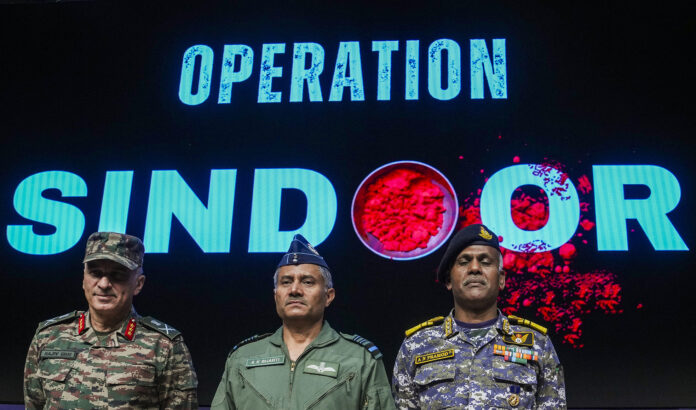
FILE PHOTO: Director General of Military Operations (DGMO) Lt General Rajiv Ghai with Air Marshal AK Bharti and Vice Admiral AN Pramod during a press conference on 'Operation Sindoor', in New Delhi, Monday, May 12, 2025.
NEW DELHI, May 6: Operation Sindoor has not only redrawn red lines when it comes to India’s response to acts of terrorism, but also offered some key military lessons, including joint and cohesive use of air power, bolstering of drone technology and building a robust communication system, say experts.
Recalling the decisive military action launched exactly a year ago on the intervening night of May 6-7, several defence and strategic affairs experts concurred that the military operation also emphasised that future conflicts would play out not only in airspace, but also in cyberspace and information and cognitive domains.
And, indeed, the Indian military wasn’t just battling against a barrage of hostile drones that came from across the western border, from Leh to Sir Creek, in multiple waves during the nearly four-day conflict, but also countering an intense misinformation campaign that sought to damage the morale of the forces and the masses.
Air Commodore Gaurav M Tripathi (retired), who also played a role during the operation, while acknowledging the criticality of air power in deciding the outcome of a conflict, underlined that in any future scenario, “combined air power” of the three services should be leveraged so that it can work cohesively against a “capable adversary.”
“During (Operation) Sindoor, we saw a mass of drones used by Pakistan. Most of them were harmless, just to engage Indian weapons and munitions so that attack drones could come in later.
“But the enemy is smart. Next time, what they will send will be hardened drones, which will probably be more difficult to jam… have better navigation at the end, might not need GPS, (and) they might have electro-optical homing devices. And, they will probably collaborate as a swarm,” Air Commodore Tripathi told PTI.
The former IAF officer, who took an early retirement last August, has flown multiple kinds of fighter jets and commanded a Hawk Mk 132 squadron, and also served as a chief operations officer of a fighter base.
In the IAF, there has already been some investment in anti-drone capabilities, “but anti-drone capabilities will really have to be proliferated, and cover all important points,” he said, on the military lessons learned from the operation.
The former air officer praised the S-400 and Akash weapon systems, BrahMos and other missiles, in securing the Indian skies and dealing a potent blow to the adversary, which also allowed Indian fighter jets to play their role.
“We used them (S-400 system) very offensively; we moved them around very frequently. We camouflaged them as well and used their decoy forms to deceive the adversary. This technique in military parlance is called camouflage, concealment and deception or CCD,” he said.
Sharing his own experience of being part of the operation last year, the former IAF officer underlined that what was “probably pioneered in this operation, and I think it will become part of IAF’s concept of operations, is offensive utilisation of long-range surface-to-air missiles”.
Military experts said another lesson from the operation is to “expedite and complete the networking of aerial assets”, which the Indian Air Force would draw from it.
Former Army officer Lt Gen Dushyant Singh (retd) said Operation Sindoor has demonstrated that “red lines have been pushed further” when it comes to counter-terrorism stance of India, and New Delhi is ready to “call the nuclear bluff of the adversary.”
“One of the major military lessons from Op Sindoor is that we moved from strategic restraint to strategic proactiveness. We have to be prepared to respond in a very, very quick time, in case something like that happens next time,” he told PTI.
The retired army officer, also the director general of Delhi-based think-tank Centre For Land Warfare Studies (CLAWS), underscored that “speed, depth and level of response, all those red lines have increased” and that requires military preparedness.
In that context, certain structural lessons and military policies have emerged from it. And certain logistic lessons can also be derived from the conflict, he said.
Operation Sindoor was launched to avenge the deadly Pahalgam terror attack, with Indian forces conducting precision strikes on multiple terror infrastructure in Pakistan and Pakistan-Occupied-Kashmir (PoK).
After launching the decisive military operation, the Indian Army in a post on X at 1:51 am on May 7 had said, “#PahalgamTerrorAttack Justice is Served. Jai Hind!”
Pakistan later also launched offensives against India, and all subsequent counter-offensives by India were also carried out under Operation Sindoor.
The military conflict between the two nuclear-armed neighbours, lasting nearly 88 hours, halted after they reached an understanding on the evening of May 10.
On the first anniversary of the Pahalgam attack, the Army in a post on X said, for acts against India, “the response is assured”, and carried a digital poster bearing an image portraying three armed soldiers in uniform standing next to each other against a backdrop that depicted a large red circle, with a caption “OPERATION SINDOOR CONTINUES…”.
One of the ‘Os’ in the word ‘SINDOOR’ was depicted by a bowl carrying a dash of ‘sindoor’ (vermilion), and a red line at the bottom printed in crimson hue.
Lt Gen Singh (retd) underlined that future operations are going to be multi-domain, “from space to undersea”, with a “web of communication” functioning simultaneously and not just as a “chain communication”.
Therefore, military communications will have to be robust and resilient to electronic warfare, cyber warfare and disruptions from space, he said, pitching for speeding up the indigenisation process.
Dinakar Peri, Fellow, security studies programme at Carnegie India, argued that “Op Sindoor was a watershed moment for India and the subcontinent in the way it established a military threshold, and the asymmetry between India and Pakistan.”
“That said, it also holds several lessons for India to maintain that superiority in the next conflict. Pakistan, and by extension China, knows what the Indian military is capable of and, more importantly, what the limitations are. The next conflict or Op Sindoor 2.0 will not be like the last one,” he said.
Days after the operation, the defence ministry approved several emergency procurements, including precision munitions, replenishing S-400 missile stocks, several drones, counter-drone systems, loitering munitions and Javelin anti-tank guided missiles, which would be under induction now as per the provisions, Peri said, underlining how India is implementing some of the key lessons.
“These will plug immediate gaps while several major capital procurement programmes approved recently, like the 114 Rafales under the medium multi-role aircraft deal, additional S-400 systems, new air defence guns, (and) aircraft, among others, take shape over the next few years,” he said. (PTI)


HC seeks comprehensive plan for crowd management in Mathura

PRAYAGRAJ, May 6:  Taking note of crowd-related disasters in Mathura during festivals, the Allahabad High Court has asked the district authorities as to whether a comprehensive plan for crowd and crisis management exists for the city.
Hearing a petition filed by Swami Shiv Swarupanand Ji Maharaj, Justice Vinod Diwakar has also sought details of the strategies and management principles in place for handling crowd-related disasters for sensitising stakeholders and for enhancing institutional capacity through training and awareness.
In 2022, a stampede-like situation occurred at the Banke Bihari temple during Janamasthami celebrations, leaving two dead and several others injured.
Maharaj has filed this petition against the state government as well as the Mathura Vrindavan Development Authority (MVDA) contending that the authorities are undertaking demolition actions, which are arbitrary and discriminatory amounting to a case of “pick and choose”.
He submitted that while demolition orders have been passed against 23 people for alleged unauthorised constructions, such demolition proceedings have been selectively executed only against the petitioner and certain others.
The high court on Tuesday granted MVDA a final opportunity to file a comprehensive affidavit and sought details on the issue like the status and action taken by MVDA in respect of demolition proceedings concerning all 23 properties against whom demolition orders have been passed.
It also sought the number and details of properties booked for unauthorised construction during the last five years and the policy framework, statutory guidelines, standard operating procedures, and administrative mechanisms adopted by the authority to regulate, prevent, and curb unauthorised constructions within its jurisdiction
While expanding the scope of the petition, the high court noted that the heavy influx of devotees during festivals in Mathura led to dangerous overcrowding raising serious concerns regarding public safety at historically significant sites.
The high court observed that unauthorised constructions further aggravate the situation by obstructing rescue and emergency operations on such occasions.
The court directed the Mathura district magistrate to disclose whether any expert body exists in the district for understanding crowd behaviour, coordination among stakeholders with clearly defined roles and responsibilities and methodologies adopted for effective crowd management.
The court directed all officers concerned to specifically state whether any scientific studies, academic research, or institutional analyses have been conducted regarding the recent stampede-like incidents.
Besides, the municipal commissioner and the senior superintendent of police of Mathura were directed to outline the measures taken to ensure the city remains safe and livable.
The matter will be heard next on May 19. (PTI)

Elon Musk greets on  launch of GalaxEye’s satellite

WASHINGTON, May 6:  SpaceX founder Elon Musk congratulated Bengaluru-based space start-up GalaxEye on the successful launch of the Mission Drishti satellite.
“Congratulations,” Musk said on X on Tuesday in response to Prime Minister Narendra Modi’s post greeting GalaxEye on the launch of Mission Drishti.
Modi, in a post on X on Sunday, hailed the launch as a major achievement in India’s space journey and a reflection of the country’s growing innovation ecosystem.
The prime minister said the mission underscored the passion of India’s youth towards nation-building and technological advancement.
“Mission Drishti by GalaxEye marks a major achievement in our space journey. The successful launch of the world’s first OptoSAR satellite and the largest privately-built satellite in India is a testament to our youth’s passion for innovation and nation-building,” the Prime Minister said.
The satellite was launched aboard SpaceX’s Falcon 9 rocket from California on Sunday. (PTI)

Jammu: BJP Opposes Anti-Encroachment Drive, Seeks Regularisation Of Illegal Structures

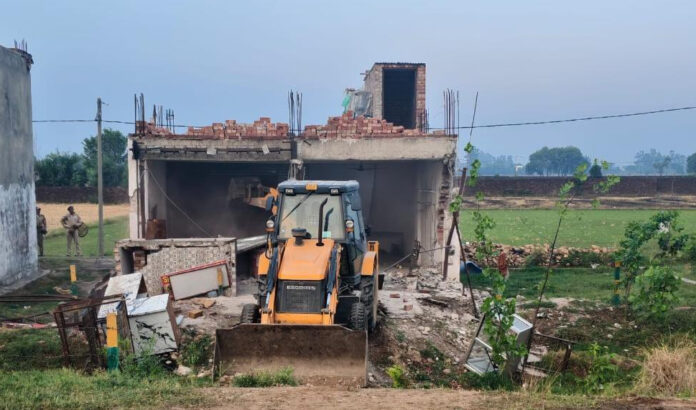
JAMMU, May 5: The BJP has opposed the ongoing anti-encroachment drive carried out by the Jammu Development Authority (JDA), demanding a halt to the operation, regularising existing constructions and action against “erring” officials.
On May 4, the JDA demolished more than 15 structures built without permissions on the Ring Road, along the Jamm-Samba belt, to curb illegal constructions and enforce planning norms.
Tensions escalated when BJP MLA Rajeev Kumar Bhagat, along with locals, intervened and stood in front of bulldozers in the Bisnah area to stop the demolition of a three-storey structure. Several party leaders joined the protest.
Later, a delegation of BJP leaders, comprising Rajeev Kumar Bhagat, Garu Ram Bhagat, Surinder Bhagat and former MLA Chander Prakash Ganga, met JDA Vice Chairman Rupesh Kumar on May 5 and sought suspension of demolition drives and called for registration and regularisation of existing structures.
Addressing reporters, Rajeev Kumar Bhagat alleged that JDA’s enforcement wing failed in its duty and accused the lower-level staff of misleading people. “We have repeatedly said JDA should inform people where construction is permitted. Instead, staff took money, allowed structures to come up, and then demolished them when the buildings reached the third floor (exceeding permitted height limits),” he said.
He questioned the timing of the drive, saying, “What kind of emergency was it that officials arrived at 4 am to carry out demolition?” Bhagat also cited the case of a farmer whose land was partly acquired for the Ring Road, leaving him with limited land on which he had begun construction.
The MLA demanded strict action against JDA officials, including suspension of enforcement staff, alleging that illegal constructions had flourished due to administrative lapses.
He also sought a probe by the Anti-Corruption Bureau into alleged irregularities by them.
Garu Ram Bhagat said the meeting with JDA authorities was held in a “positive atmosphere” and claimed that assurances were given that already constructed structures would not be demolished immediately.
He said that people would be allowed to apply online for No Objection Certificates and resume construction after approvals.
BJP MLA Surinder Bhagat said they had intervened to prevent demolition and protect people’s interests while maintaining that they support lawful action. “We will not support any illegal activity, but harassment of poor people in the name of law will not be accepted,” he said.
The legislators also flagged a lack of coordination between departments, particularly between JDA and Revenue authorities, claiming conflicting land-use classifications were creating confusion for residents.
They said a joint meeting with the district administration would be convened to streamline land records, clarify jurisdiction and ensure transparency in permissions.
JDA officials maintained that the demolition drive was carried out after due notice and was aimed at enforcing building regulations and ensuring planned urban development. (Agenciese)

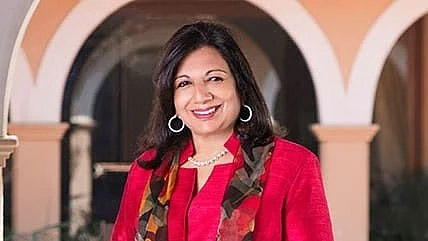
Kiran Mazumdar-Shaw names niece Claire as  successor, not hanging up her boots just yet

NEW DELHI, May 6:  Biocon Founder and Executive Chairperson Kiran Mazumdar-Shaw has chosen her niece Claire Mazumdar to succeed her as the biotech entrepreneur laid out a succession plan for India’s leading biotech firm.
Mazumdar-Shaw (73), who has no children, in a post on X, confirmed reports about the succession planning in Biocon and that she has choosen niece Claire as successor.
However, she clarified that the succession is not happening anytime soon.
“Not planning to hang up my boots for a while! Claire will gradually transition into my role in time,” Mazumdar-Shaw wrote in a post.
Daughter of Mazumdar-Shaw’s brother Ravi Mazumdar, 37-year-old Claire Mazumdar founded Boston-based Bicara Therapeutics in 2018 — a clinical stage cancer therapy company. She led it to a Nasdaq listing in 2024.
Ravi Mazumdar is a non-executive director at Biocon. Claire also sits on the boards of Relay Therapeutics and Noora Health.
A graduate in Biological Engineering from MIT, Claire is also both an MBA and a PhD in cancer biology from Stanford University.
Her parents are both computer science professors in the United States. Her brother Eric is a professor at the California Institute of Technology and an AI expert.
Mazumdar-Shaw, the face of the Indian biotechnology industry, had founded Biocon in 1978 in a garage in Bengaluru with Rs 10,000 and built it into India’s largest biotechnology company over four decades.
She married Scotsman John Shaw in 1998.
John Shaw, who passed away in 2022 due to cancer, was Vice Chairman and Non-Executive Director of Biocon and was a foreign promoter of the company.
While naming Claire as her successor, Mazumdar-Shaw said that, being the sole promoter of Biocon, she needed to make sure that the company is put in good hands.
On why she saw Claire as her successor, Mazumdar-Shaw said her niece has proved to her that she can run a company.
Built by one woman over four decades, Biocon will be led by another woman as the baton is set to pass from the aunt to the niece. (PTI)

Carrier global lays foundation for Rs 1,000 cr chiller manufacturing facility at sri city

SRI CITY (Tirupati District, Andhra Pradesh), May 6: Carrier Global performed the groundbreaking for its advanced chiller manufacturing facility at Sri City on Wednesday.
Andhra Pradesh Minister for IT Nara Lokesh laid the foundation for the proposed facility involves an investment of around Rs1,000 crore and is expected to strengthen Andhra Pradesh’s growing digital infrastructure manufacturing ecosystem.
Speaking on the occasion, Lokesh said Carrier’s entry into Andhra Pradesh would further strengthen the ecosystem by bringing advanced cooling technologies essential for next-generation data centres, AI infrastructure and high-performance computing facilities.
He said the state government was focusing on creating a complete value chain for digital infrastructure, including cooling and thermal management systems, power and energy management solutions, precision engineering components, electronics and control systems.
The Minister said the Carrier facility marked a defining moment in the state’s efforts to build a full-stack data infrastructure ecosystem covering energy, data centres and component manufacturing.
Lokesh said industrial ecosystems such as Sri City, coupled with supportive government policies and rapid industrial expansion, were helping Andhra Pradesh emerge as a global hub for next-generation manufacturing and digital infrastructure.
He expressed confidence that the Carrier project would attract further investments, deepen global partnerships and accelerate Andhra Pradesh’s emergence as India’s data centre capital and a key manufacturing backbone for the digital economy.
Stating that the investment reflected Andhra Pradesh’s strategic shift from merely hosting data centres to manufacturing the critical components powering the digital economy, Lokesh said the state was positioning itself strongly in the global digital infrastructure value chain.
Sri City has emerged as a major HVAC and electronics manufacturing hub with investments worth Rs12,000 crore in cooling and air-conditioner manufacturing, generating around 25,000 direct jobs.
The supplier ecosystem in the region has attracted investments worth Rs4,600 crore and is projected to contribute nearly 60 per cent of India’s AC production by 2027.
(UNI)

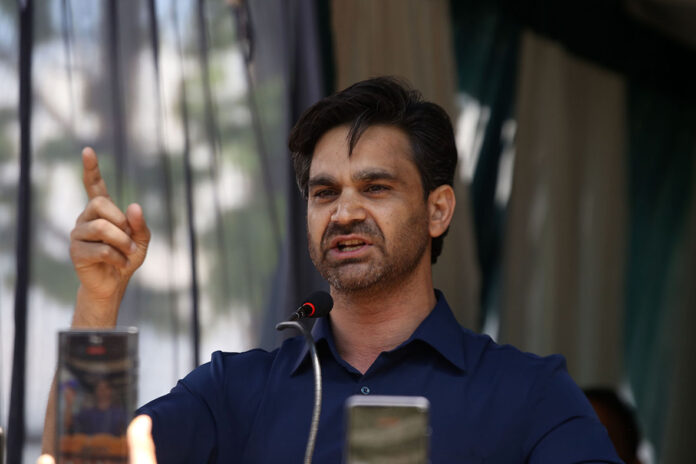
Are People Of J&K Being Punished For Not Electing A BJP CM? Omar Abdullah On Statehood Delay

SRINAGAR, May 6: It is deeply unfair to the people of Jammu and Kashmir that the promise of statehood is not being kept, says Jammu and Kashmir Chief Minister Omar Abdullah while going on to ask if they are being punished for not electing a BJP chief minister.
“If that is the case, the BJP should have stood up in Parliament or told the Supreme Court that till a BJP chief minister sits in Jammu and Kashmir, you will not get statehood… Then I would have believed that these people are telling the truth,” Abdullah, who was elected to power nearly 20 months ago, told PTI.
Expressing acute disappointment over the Centre’s delay in restoring statehood, the National Conference leader said it amounted to deceit and a breach of promise “Of course it is disappointing. We are well past the point of early. Early would have been soon after the elections. We are, as you said, 20 months into the government. It’s no longer early. It has been needlessly delayed. And the sad fact is nobody is able to explain why. You hear every time that Jammu and Kashmir statehood will be restored at the appropriate time.
But nobody tells us when the appropriate time is.” Though he continues to meet with Prime Minister Narendra Modi and Home Minister Amit Shah, there is no clear indication of what Jammu and Kashmir must do to satisfy the Centre’s “appropriate time” criteria, leaving the issue of statehood restoration in limbo, Abdullah said.
“What is the yardstick to measure appropriate time? At least if we knew what the appropriate time would be, how to measure it, we would work towards it… So we are chipping away. We keep the demand alive. We keep talking about it. But I think it’s deeply unfair to the people of J&K that this promise is not being kept,” the chief minister said.
He said the Centre had repeatedly outlined a three-step roadmap for Jammu and Kashmir — delimitation, elections and statehood. The first two steps are done and his government will complete two years in office this October, Abdullah pointed out.
The timeline, he stressed, has moved well beyond the “early” restoration promised in Parliament and to the Supreme Court.
“Is it because the BJP was not allowed to form a government here? Is that why the people of J&K are being punished?” Abdullah asked.
“They should have stood up and said that till the BJP’s chief minister does not sit in Jammu and Kashmir, you will not get statehood. Then the people of J-K at least know what to expect. Then they can decide whether they want a BJP chief minister or not. This is still deceit,” he said.
He referred to statements by Leader of Opposition in Jammu and Kashmir Sunil Sharma’s statements to buttress his point. Sharma had recently asked why statehood should be restored to Omar Abdullah and his government. In August 2019, the Centre abrogated Article 370 giving Jammu and Kashmir special status and bifurcated the then state into the union territories of Jammu and Kashmir, and Ladakh.
The National Conference, he asserted, remains committed to its core ideology and he refuses to lie to the public about what is achievable with the current dispensation in New Delhi.
“Talking to the current government of India about Article 370 is a waste of time; it is tantamount to befooling people,” Abdullah said. “Those who are not ready to give you statehood, will they be ready to give you Article 370?” In 2023, the Supreme Court said statehood should be restored “at the earliest”.
“That’s the problem with at the earliest. It’s so vague,” Abdullah said. Asked whether the state government would approach the Supreme Court for clarity, he was cautious. “Let’s see. Such things are also fraught with risk. I don’t want to say too much because it then gets misinterpreted. Let’s just say that all our options are on the table.” Addressing critics, including a few within his own party, who claim his government has abandoned the push for Article 370, Abdullah said, “Look, critics are a dime a dozen and they are a natural part of democracy. Everyone is entitled to an opinion and everybody has an opinion about almost everything. So I have no problem with that. The fact is that we have not abandoned our core principles.” In a dig at the Mehbooba Mufti-led PDP and detractors within his party, Abdullah said, “Now I can understand some of these critics are masters at befooling people. It’s all they have ever done
“In the case of some of them, their entire political career is founded on lies. I am not going to join them. I am not going to be the one to befool people that I am going to Delhi to get Article 370 for you.”

AI boom drives a rally in buying of tech  shares, pushing South Korea’s Kospi to a record

TOKYO, May 6: South Korea’s Kospi soared nearly 7% to a fresh record on Wednesday as Samsung Electronics’ stock jumped nearly 13% in a rally driven by expectations of strong growth in artificial intelligence.
Shares in SK Hynix, another major Korean computer chipmaker, shot up 10% early Wednesday.
South Korea’s market was closed Tuesday for a holiday.
Shares mostly rose in other Asian markets.
On Wall Street, stock prices rose to records Tuesday after oil prices eased and companies kept reporting bigger profits than analysts expected.
The S&P 500 climbed 0.8% to top its prior all-time high  set at the end of last week. The Dow Jones Industrial Average added 356 points, or 0.7%, and the tech-heavy Nasdaq composite set its own record after rallying 1%.  (AP)

Blaming PDP For Loss Of Rajya Sabha Seat Counterproductive: Waheed Para To NC

SRINAGAR, May 6:  PDP leader Waheed Para on Wednesday said the NationalConference outcry over the Rajya Sabha polls in Jammu and Kashmir last year was “counterproductive” and a ploy to “divert attention” from substantive issues like attachment of the Sirajul Uloom school under the UAPA.
The National Conference (NC) has accused the PDP of helping the BJP in the Rajya Sabha polls.
The NC had won three seats in the polls while the BJP had got one. The loss of one seat was blamed on cross-voting.
“The National Conference’s outcry over the Rajya Sabha vote is misplaced. This is not fundamentally about the Rajya Sabha – it serves as a diversion from substantive concerns, notably the Siraj-ul-Aloom controversy and the erasure of Urdu from official records,” Para said in a post on X.
The Darul Uloom Jamia Sirajul Uloom at Imam Sahib in Shopian was last month declared an unlawful entity under the UAPA.
The administration had said the school allegedly run by individuals affiliated with a banned organisation in Shopian district has been declared an “unlawful entity” under the Unlawful Activities (Prevention) Act (UAPA).
The PDP MP also accused the National Conference or disintegrating the People’s Alliance for Gupkar Declaration, an amalgam formed for restoration of Jammu and Kashmir’s special status.
“The National Conference disintegrated the PAGD. It further strained electoral unity by ensuring that the PDP was excluded from the INDIA alliance arrangement during the J-K Assembly elections,” he said.
Para said against this backdrop, it is clear that the PDP did not owe cooperation to the NC in the Rajya Sabha elections to four seats of Jammu and Kashmir last year.
“Yet, we extended unconditional support, even while being aware of internal dissent within the National Conference. Hence blaming the PDP for the Rajya Sabha outcome is both inaccurate and counterproductive. The failure, Omar Sahab must realise, lies close to Nawai Subh,” he added.
The MLA from Pulwama said by making these accusations, the NC has responded adversely to the “magnanimity” of PDP president Mehbooba Mufti.
“She neither abstained – an act that could have indirectly aided the BJP- nor imposed conditions. Her only suggestion was to secure the third Rajya Sabha seat and avoid turning the uncertain fourth seat, declined by Congress, into a blame game,” he said.
Para said it was the responsibility of the National Conference to appoint an agent for the three votes of PDP.
“If their reason for crying foul against the PDP is that the PDP didn’t appoint an agent for its three votes, then may I ask the esteemed CM that what would make him magically trust the PDP-appointed agent if he is not willing to trust the PDP members who voted?” he asked.
The opposition leader said during the Vice Presidential elections, ruling party Lok Sabha member from Srinagar Aga Ruhullah stated that the National Conference did not clearly communicate its position to its MPs.
“Does that mean that the NC is hand and glove with the BJP?
“In targeting the PDP, the National Conference has not weakened a rival but has instead undermined the trust extended to it in good faith,” he said.
Para said there is a deeper problem as well.
“Some voices, like the NC’s Kulgam spokesperson, had previously sought to join the PDP after being denied mandate but was denied entry because strategic considerations. Many seniors from the NC continue to meet our party leadership, and she (Mufti) is the one who does not encourage this, believing that any instability is instability for all,” he said.
The MLA said targeting the PDP risks playing directly into a broader BJP agenda to fracture electoral unity in J-K.
“If the NC were to implode tomorrow and @OmarAbdullah finds himself needing the support of PDP’s four MLAs to stay afloat, he will face an awkward moment – having to turn to the very legislators and @MehboobaMufti whom he hasn’t stopped bad mouthing ever since he assumed Office,” he said.
Para advised the chief minister to focus on governance rather than dwell on one lost Rajya Sabha seat.
“Omar Sahab, I wish you stability and strength at this critical juncture. Rather than dwelling on the one lost Rajya Sabha seat and attributing blame to the PDP, the government would do well to focus on ensuring that your pre-existing 50 MLAs and 5 MPs deliver effective governance,” he said. (Agencies)

Breaking Up with Your Favorite Team: Why Emotional Gaming Is Financial Self-Harm

Let’s not sugarcoat it—betting on your favorite team feels like writing a romantic poem on a grenade. There’s loyalty, nostalgia, and blind hope, all packed in one dangerously unstable emotional package. It’s not just about sports anymore.

It’s about identity, pride, and that old college hoodie with your team’s logo that’s been through more heartbreaks than your last three relationships combined. Even at Raj.bet, where the odds sparkle and markets tempt with every click, loyalty still doesn’t pay—literally.

It bleeds your bankroll dry and leaves you in the fetal position, refreshing a score app like it owes you rent. When emotion meets odds, reason doesn’t walk away—it sprints.

Why Your Brain Is Set Up to Fail You

Think you’re making a calculated decision when placing that bet? Think again. Your brain, lovingly unreliable in matters of bias, is set up to root for familiarity even when it’s mathematically unsound. Enter the confirmation bias, where every piece of news (even a player’s haircut) becomes proof your team will win.​

Bias How It Manifests in Betting Financial Consequence
Confirmation Bias Seeking out information that supports your belief in your team’s victory, ignoring contrary data. Overconfidence in bets, leading to potential losses.
Availability Heuristic Overestimating the likelihood of your team winning based on recent memorable victories. Inflated expectations and misguided betting choices.
Sunk Cost Fallacy Continuing to bet on your team due to prior investments of money or emotion, despite poor performance. Escalating losses by chasing after previous bets.
Overidentification Bias Equating your personal identity with your team’s success, leading to emotional decision-making. Making irrational bets that align with personal feelings rather than logic.

So every time you think you just know they’ll turn it around, what you’re actually meaning are: “I’ve stopped using my prefrontal cortex and I’m now investing based on Netflix montages and anthem chills.”

One striking example of confirmation bias in action emerged during the 2014 FIFA World Cup, when Brazilian fans—and many bettors—continued to back their national team emotionally, even as data showed signs of defensive collapse.

The infamous 1–7 loss to Germany wasn’t just a tactical disaster—it was a psychological blindside. Top sport betting companies reported an unusual spike in bets favoring Brazil right before that semi-final, despite expert predictions leaning toward Germany.

Similarly, research from the International Journal of Forecasting revealed that tennis bettors disproportionately backed players who had won their last match, ignoring opponent quality and surface type—pure availability heuristic. What we have here is more akin to sentimentality than betting, and the house is absolutely lovin’ it.

Ledger of Loss: Real Numbers from Unreal Expectations

Emotional bettors often track their favorite team’s record like a religion—but rarely log the cold math of what that devotion has cost them. Let’s strip the sentiment and open the spreadsheet of heartbreak. Signs you’re emotionally betting and losing because of it:

  • You’ve never bet against your team, no matter the odds. (Would you rather be right, or happy—and broke?)
  • You double down after a loss “to prove they’ve still got it.” (Hint: They don’t. At least not against that defense.)
  • You celebrate a win more than the payout. (Translation: It’s about the feeling, not the financials.)
  • You refuse to research the opposing team. (You’d rather be loyal than informed.)
  • You use phrases like “they owe me one.” (Teams are not your ex. They don’t owe you closure.)

​It’s like keeping a toxic relationship alive by pointing at one good weekend three years ago. Meanwhile, your bank account is gaslighting you with every transaction.

Need proof this isn’t just dramatic metaphor? Enter: Patrick Chester. A die-hard Seahawks fan who, in the 2015 Super Bowl, decided that a $45,000 bet on his team was just good faith in action.

Spoiler: the Seahawks lost, and Chester spiraled into over $1 million in debt. Loyalty? More like financial free-fall in a team-colored parachute.

Or take the 21-year-old college student who stealthily racked up $2,000 in losses using a hidden credit card, betting on games he “just felt good about.” Mom found out. Mom bailed him out. Lesson learned? Hopefully. Just telling your folks that the Patriots really should have covered is the quintessential example of financial wisdom.

Divorce Proceedings: Rewiring Your Betting Habits

It’s not about giving up on your team. It’s about drawing boundaries—the same way you’d draw the line between watching a drama and living inside one. You can still wear the jersey, scream at the TV, and treat game day like a sacred ritual.

Just don’t let your emotional allegiance dictate where your money goes. Emotional detox begins not with abandonment, but with awareness: recognizing the pattern, rewriting the rules, and rebuilding your betting strategy like a disillusioned romantic with a calculator and a spreadsheet.

Trait/Behavior Emotional Bettor Rational Bettor
Team Bias Bets only on their team Bets on value, regardless of team
Stake Decision Based on feeling/urgency Based on calculated bankroll management
Loss Response Chasing losses with loyalty Adjusts strategy post-analysis
Research Method Relies on fandom and media hype Uses stats, matchup data, weather, etc.
Outcome Satisfaction Celebrates a team win over profit Focuses on ROI and long-term success

Reddit’s betting communities are basically group therapy for people learning to divorce their fan identity from their wallets. One redditor laid it out bluntly: Betting on your favorite team is like texting your ex after two glasses of wine.

You know how it ends, and you still hit send. Another practical gem from the forums? Create a ban list of teams you’re too emotionally compromised to evaluate rationally. If seeing their name makes your pulse spike or your memory rewind to a childhood game-winning goal, don’t bet—watch.

Some users even fade themselves, flipping every emotional instinct like it’s a bad impulse stock trade. And here’s the kicker: it works. Because betting isn’t about faith—it’s about forecasts.

Conclusion

It’s time to break up—not with the team, but with the version of yourself that believed love was a strategy. Betting is a business decision. If you wouldn’t invest in a failing company just because you like their logo, don’t do it with sports.

Love your team. Cheer them on. Cry when they lose. But when money’s on the line? Be ice. Be logic. Be a spreadsheet with a soul.

And if you must bet on them—do it with eyes open, stakes low, and a Plan B for when they break your heart again. Because they will. They always do.