

Nawang Tsering Shakspo
sntsering52@gmail.com
Unlike other tribal areas of India, the tribal people of Ladakh are the inhabitants of what they call “cold desert”; while in the rest of the country tribals are found in deeply-forested areas, mingling with nature. Interestingly, Ladakh is a Buddhist-dominated area where the Mahayana form of Buddhism flourished as it had taken firm roots in the region in the seventh century A.D onwards. In the region, besides Buddhists, one can find a large number of followers of Islam, particularly hailing from Shia sect, locally known as Balti, and both the communities possess their own socio-cultural history and heritage inheriting from the Buddhist foundation which goes back to as early as the tenth century A.D., all the way from the first Ladakhi king who was a defected Tibetan prince by the name of Skildey Nyimagon. Before his departure, he divided Ladakh, then known as Ngari, to his three sons and amongst them the eldest one called as Palgi mGon inherited the throne of Ladakh.
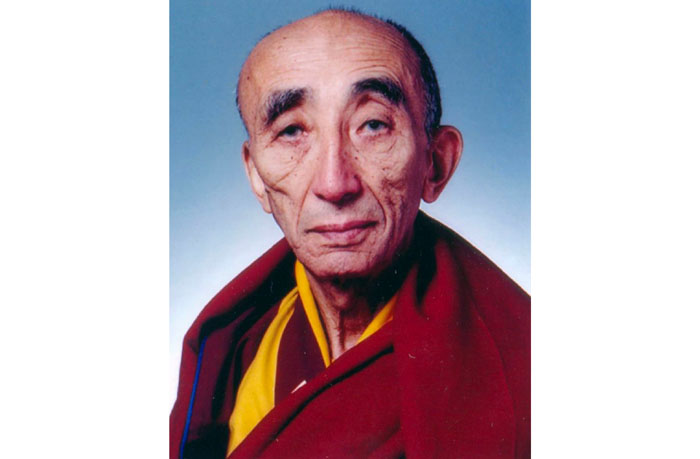
It is said that the first king of Ladakh, Palgi mGon’s ancestors had their roots in the mythical Tibetan king Nyathi Tsanpo, and according to Ladakhi history, the parentage of the hero of this article, Kushok Bakula, was a descendent from the king lineage Nyathi Tsangpo, who reigned in 127 B.C. Therefore, the people of Ladakh popularly address Kushok Bakula as Prince or Gyalsras Bakula, having been born in the royal lineage of Matho palace, not far from the Leh city.
Gyalsras Bakula was born in the year 1917 and obtained his higher education in Buddhist philosophy and metaphysics at the prestigious Drepung Loseling Monastery at Lhasa and returned to Ladakh in the year 1943. As such, with his return to Ladakh, he turned out to be the most revered tribal leader and protector of the present tribal population of Ladakh from severe political upheaval all the way from the time of India’s Independence in the year 1947 onward. Particularly, his role in protecting Ladakh from the Pakistani invaders in 1948 is noteworthy. The Pakistani invaders entered the region and could reach as close as 27 Kms away from Leh city until they were pushed back by the Indian army along with the local militia organized with the initiatives of Kushok Bakula and other like-minded heroes of the time. For that event, Kushok Bakula was deservedly granted credit by not less than that of Prime Minister of India Pandit Jawaharlal Nehru – the first Prime Minister of India, Dr. Bhim Rao Ambedkar – the first Law Minister of India and General Cariappa – the Supreme Head of the Indian Army, and he was invited to New Delhi to take up his political role in shaping the destiny of Ladakhi people who were living in isolation, as well as to play their role in the democratic setup of independent India.
The present population of Ladakh as per the latest census was found categorised as Bot or Boto, Nomadic Changpas, Baltis, Purigpas, Drokpa/Brokpa along with artisan groups like Mon, Beda and Gara, etc. In this division, we find both Buddhists and Muslims.
Now a few words about the family in which our hero Gyalsras Bakula was born. As mentioned earlier, Gyalsras Bakula was born into the ancient royal family of Ladakh. And to see which tribe he belonged to, a little explanation is needed.
According to my recent research, the family from which he belonged to could be place under the category of Bot/Boto tribe, although in the past, the members of royalty had their distinct identity, they being the ruler; but in the changed democratic system today, these families, unlike in the past, do mingle with the rest in regard to the observance of social costumes and traditions and their carrying of matrimonial or patrimonial ties with the Bot/Boto or the general or common inhabitants of the region. But in case of Gyalsras Bakula, though he was born in a royal family, and yet we have to take the case differently due to the fact that he relinquished the life of royalty or worldly affairs including ties with his family to become a monk or Lama and eventually to be the throne-holder of Bakula or head Lama of the prestigious Pethup Gonpa of Ladakh.
Now a question arises as to what is the meaning of the Bakula title that the newly-born young child inherited. Buddhism, particularly in the Tibetan form of Buddhism, has a custom of the observance of rebirth of a high lama or a scholar of repute after his death, which in religious terms, is found addressed as reincarnation. As we know, the present 14th Dalai Lama of Tibet in series recognises as the incarnation of the Buddha Avalokiteshvara, the Buddha of compassion. Similarly, Bakula is known as the incarnate of the 19th Arhat Bakula. In Sanskrit or Pali, the word Arhat applies to a “perfect person” who has attained enlightenment or alternatively the worthy one, and was one of the 16 Arhat or disciples of Lord Buddha. Arhat Bakula is popularly assumed by his followers as continuously taking rebirth all the way from Buddha’s time and he is the 19th in succession and hold the throne of the spiritual and temporal head of prestigious Pethup Gonpa of Ladakh, linking his first birth as one of the 16th Arhat or disciple of Lord Buddha.
Now the issue arises how he got recognised as the reincarnation of the previous 18th Bakula or Head of the Pethup Gonpa. It is recorded in the religious texts that with the passing away of the 18th successive incarnation of Pethup Gonpa or the head Lama, the monks of the monastery began a search for his new birth. For that, they approached the 13th Dalai Lama of Tibet, as well as two oracles of Matho Gonpa in Ladakh, popularly addressed as Rongtsan Kar- Mar, who appear in public on the occasion of the annual festival of Matho village called Matho Nagrang , the festival which continues to be observed even today for two days on the 14th and 15th day of Ist month according to the Tibetan calendar. So, on the request put forward to the oracles by the representing Lama of Pethup abouts of, where about the birth of new Bakula, the Rongtsan Kar-mar, oracles predicted that now onwards the monks do not have to go to any other place to enquire about the birth of previous Bakula. In fact, the oracle told, Bakula had already taken birth in Matho village itself in the royal family of Matho as a prince. So, with hearing this great predication from the two oracles, the monks of Pethup monastery visited Matho Palace to have a glimpse of the child and his parents. With those auspicious events, the parents gave consent to the monks to grant the prince to the Pethup Gonpa to become the lineage holder of Arhat Bakula as well as to become the head of the monastery.
Finally, at the age of 8, the young prince Bakula was brought to Pethup monastery for education and at the age 15, around 1930, he was sent to Tibet for higher education in Buddhist Philosophy and metaphysics. As a monk now the young Bakula spent almost 20 years in Tibet studying at the prestigious Drepung monastery in Lhasa, the capital city of Tibet, where he obtained the highest degree in Buddhist philosophy through Tibetan/ Ladakhi language medium. However he had no grip in modern languages such as Hindi, Urdu or English and yet he emerged as the greatest leader of pre and post-independence Ladakh. Above all, principally, as a legislator of J&K Assembly, Kushok Bakula delivered a historic speech in Ladakhi language against the discrimination policy adopted by the State Government headed by Sheikh Abdullah regards to Ladakh’s development, on December 12, 1952, and with that Kushok Bakula Rinpoche emerged as one of the most influential Buddhist tribal leaders of the country.
 Follow our WhatsApp channel
