

B D Sharma
bds.jmu@gmail.com
The Maharaja was a religious person with lot of fear of God in his mind. But he was very secular also. In fact he was too credulous a person and bowed before the spiritual and supernatural powers of mystics and religious guides of all religions like the Pandits, the soothsayers, the Pirs and Faqirs. Mallika Pukhraj in her biography Song Sung True illustrates beautifully this aspect of the thinking of Maharaja. There was a Baba namely Baba Roti Ram in village Hamirpur Sidhar (in the then Tehsil Akhnur), where her maternal grand parents lived, to whom the “Maharaja would send two sets of Bhengis (having two large wicker baskets hung at both ends of a sturdy bamboo carried on the shoulders) at the start of every winter. In the baskets were placed the offerings of sweets, a velvet mattress and quilt, pillows and bolsters, a Pashmina robe, a Dhussa, an ears covering Pashmina cap, woolen socks and gold-embroidered shoes”. The Maharaja knew that the Baba was so intoxicated with divine ecstasy that these gifts didn’t carry any meaning to him. He would therefore send four men also to make the Baba accept the gifts and also to persuade him to use them. It would take some days for the four men to persuade the Baba to start putting on the costly robe and to sleep in the silken bed. After the needful was done, the four men would leave the village. The Baba reverted back, interestingly enough, to his old ways and would again be found half-clad. The costly robes and bedding were littered around his Kuttiya and the dogs were seen cozily sitting on them. She further tells us that when she was born her grandfather went to the Baba to tell about the new arrival. The Baba predicted a bright future for her and pronounced her to be a Mallika-i-Muazamma, Persian/Urdu words spontaneously coming to him even when he knew nothing beyond Dogri. In this way, she tells us that Mallika was incorporated in her name. In a recently released podcast a reputed Kashmiri educationist Syed Habib (?) tells us that Maharaja Partap Singh was very popular with many Syed families of Kashmir. The Syeds represented the priestly class and the Maharaja was naturally enomoured of them because the holy men of all religions were holy to him.
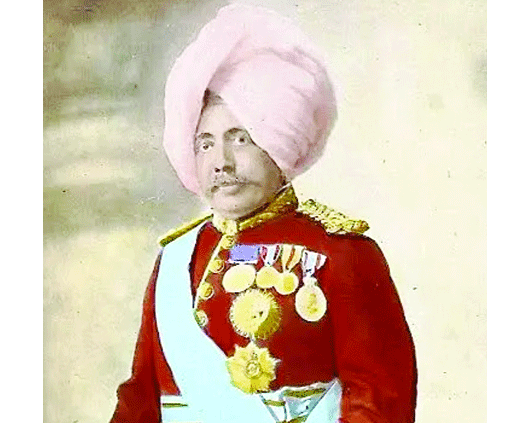
The Dogra rulers were much maligned particularly during the years of struggle for freedom. There is no doubt that monarchy had many shortcomings but all this has to be evaluated in the light and context of the order of governance prevailing at that time. The Dogra rulers didn’t indulge in the opulent lifestyles and didn’t indulge in lavish and extravagant spending habits. Out of the last four Dogra rulers only one can be termed as somewhat extravagant. The other three spent the public money prudently. The only peculiarities a commentator could find in Maharaja Pratap Singh’s behaviour were that he wore a disproportionately very big turban. And further more he would play cricket while bearing the large turban. Another funny thing pointed out about him was that while batting if he struck a ball around the wicket then the fielder instead of stopping the ball would take it out of the boundary by kicking it. In this way even a no run would be converted into a four to exalt the batting prowess of the Maharaja and manage a lot of applause for him.
Out of the four Dogra rulers the two namely Maharaja Gulab Singh and Pratap Singh used to intermingle freely with common people and lot of Dogra folklore sprout out of them. Maharaja Ranbir Singh exercised restraint after a deadly attack was attempted on him and Maharaja Hari Singh was by nature a reserved person. In our childhood we used to hear many anecdotes associated with the life and rule of Maharaja Pratap Singh. Though he never indulged in lavish pleasures yet he got addicted to taking opium. Many people think that it adversely effected governance also and feel that Raja Amar Singh would have governed the State in a better way if he had been given the reins of power.
An interesting nugget about Maharaja’s having opium and how he made use of it to score his point occurred when he was to be bestowed with the Doctorate degree by the University of Punjab. Actually his father had donated a large amount of money for the establishment of Punjab University and the Dogra family used to be highly appreciated and respected by the University authorities. When the convocation was organized, the Maharaja was seated in the front row amongst the privileged recipients of the honours. The degrees were being distributed by an English dignitary. Incidentally the Maharaja didn’t shake hands with the Englishmen those days, perhaps because of his acrimony with the English. But the convention demanded that the recipient would shake his hand with the dignitary after receiving the degree. Everybody was anxious to see as to how the Maharaja would screw out of this piquant situation. The names of the recipients were being called one by one and when the turn of the Maharaja was approaching he started to doze off, closed his eyes and jerked aside his head. The compere called out his name two/three times but no response came. Sensing the Maharaja might be in opium hangout, the ADC was called to receive the degree on Maharaja’s behalf and when the ADC came back he found the Maharaja in all alertness. Maharaja had devised an interesting subterfuge to avoid shaking hands with the Englishman.
His skirmishes with the English gave rise to many interesting tales. When the English divested him of many of his powers, he obviously found himself powerless to do anything to harm the English. In this state of helplessness he devised an ingenious way to denigrate the English king. At the time additions and alterations in the famous Panj Bakhtar temple were being carried out. The Maharaja got a number of rupee silver coins embedded on the floor in front of the deity. The coins had the images of the English king, Edward Vll, engraved on them. So all these images of the English king were footed under the large number of devotees every day. In order to avenge his humiliation, the Maharaja had invented an interesting and ingenious way. What a way of taking revenge. In the process the temple came to be known as Rupion wala mandir also.
Late Rajinder Singh Parihar worked as Additional Deputy Commissioner Jammu for a number of years. He was an upright and seasoned officer and the senior officers depended much upon him for getting critical tasks accomplished. The slow pace with which the papers move in the tehsil level in the department would always bring annoyance of the seniors which would often fall upon him to explain despite no fault on his part. But he bore it all with fortitude and at times with amusement. He would often tell us that he was being treated as a Khushi Mohammad by his seniors. In this context he would explain that Khushi Mohammad was Revenue Minister of Maharaja Pratap Singh and whenever the English officials would come to discuss about the unpleasant official matters with him, he would call Khushi Mohammad and start blasting him right and left. That no work was being done in the department under him, that no progress was being made in the Settlement operations, that his ministers were simply parasites on him and his government. The shrewd Minister understood all the designs of his master and hear all the rebukes quietly. The English officials would feel that the Maharaja was in an agitated state of mind and put off their negotiations for a future date. So whenever a subordinate is rebuked for no fault of him it is assumed that he has become a Khushi Mohammad of his boss. Another adage linked with Maharaja Pratap Singh Vs Khushi Mohammad was that, “Dastkhat Meray tey Zimawari Khushi Mohammad di” i.e the signature on the papers be mine but the responsibility would lie on my minister Khushi Mohammad. Later people refined the adage to Dastkhat Meray tey Zimawari Munshi Di. Late Pt Mangat Ram former Dy Chief minister used to utter this adage often when papers were placed before him for signature.
During the time of the Maharaja a goldsmith used to run his small shop in the Lakhdata bazar and as was the wont those days he used to place his small capital in an underground excavation. One of his acquaintances came to know about this and one day while the goldsmith was away his friend stole his savings from the underground chamber. The goldsmith got the shock of his life when he came to his shop. He lost his sense and would cry that the thieves become active and such a stealing took place only when a place became kingless. For him the king was as good as dead, he would often utter. These lamentations were carried to the Maharaja by the informers. The Maharaja decided to visit the shop of the goldsmith. Many people gathered at the place during the royal visit. The Maharaja heard the tale of melancholy of the goldsmith and did also had a glance over the people gathered there. While leaving the place he called the Thanedar aside to arrest a particular person and question him. The person in question was bearing a new pair of Dogra Joda/Jutti and a beautiful coloured silken Pyjama string had been noticed flowing down to his feet. During those days the fashionable persons used to use brightly coloured Pyjama strings which flowed beyond their shirt. On rigorous questioning the arrested person turned out to be the thief and recovery of the stolen property was made. People started praising the discerning sense of the Maharaja. An experienced police officer will tell you that it is ingrained in the thinking of a thief that he starts spending the stolen money lavishly immediately after committing the theft.
The most intriguing and bizarre fable told by our elders used to be with regards to Maharaja’s birth. This fable is not based on any historical evidence. It has, however, been heard from a large number of people and is part of our oral history. As such it is being recorded. It is said that daughter after daughter was being born to Ranbir Singh, the only surviving son of Maharaja Gulab Singh lovingly called as Mian Phina. It was naturally a matter of great concern and anxiety to Maharaja Gulab Singh because the State had been got by him a year or two earlier. It must be remembered that the State had been transferred and made over to Maharaja Gulab Singh and the heirs male of his body only in terms of Amritsar Treaty of 1846 by the English. In case his son didn’t have a male heir then the State would revert back to the English. This assertion had further been strengthened by the Doctrine of Lapse promulgated by the then newly appointed Governor General Dalhousie which stipulated that princely States without a direct male heir would be annexed to the English. It is said that Maharaja Gulab Singh was very worried when his daughter-in-law had again to give birth to a child. The family was stationed at Reasi those days. A very scheming person as he was, Maharaja Gulab Singh asked his servants to conduct survey and identify the expecting women in the town at that time. It is said a female child was again born in the royal family and incidentally a boy had born on the same night in a family in the neighborhood. The two children were swapped and it was announced that the heir apparent had born. The child was named Pratap Singh and all the celebrations associated with the birth of heir apparent were held. Incidentally two sons were later born to Maharaja Ranbir Singh. They were named Amar Singh and Ram Singh. Amar Singh was a very dashing person with modern outlook and Maharaja Ranbir Singh even wanted Amar Singh to succeed him. But Raj Yog was so powerful in the constellation of Pratap Singh’s stars that he ultimately succeeded his father. As already mentioned there is no historical evidence or record corroborating this fact. But the folktale motif and local oral history traditions are so strong that this tale is being recorded.
Unfortunately there is no comprehensive biography dedicated solely to Maharaja Pratap Singh and the details of his reign are known to us from the works of general nature written in respect of Dogra rulers as a whole. Dr Karan Singh in the capacity of Trustee of Maharaja Gulab Singh Trust did assign the writing of a comprehensive biography of Maharaja Pratap Singh to some historians some time back and it is hoped that the same shall see the light of the day shortly.
The folk tales narrated above may look to be trivial and unimportant to an educated and a modern mind. Such tales must however be heard and shared because they help us to connect us with our past and help us to know as to how we and our system have evolved. How our forefathers lived and how they reacted to a given situation. They tell us about the social norms and the oral traditions of the past, majority of which are at the risk of disappearing. They show how culture responds to new situations and how the problems were tackled. So whatever advancements we may make and whatever changes we may bring about, recapitulating our past will always be gripping and absorbing. We must not, as such, get peeved if we spare some moments for reading and knowing it. Such narrations must also not be seen as an attempt of glorification of the monarchical system. It is beyond doubt that monarchy had many shortcomings and fortunately it has left us for good. We have now opted for democracy which with all its defects is the best form of government for a modern and free society.
 Follow our WhatsApp channel
