

Ssamridhi Gulati
Kashmir has always been a place of stories long before it became a literature festival. Its rivers remember songs. Its winters speak in metaphor. Its silence carries poetry with a depth few landscapes in the world possess. There are places that create literature, and then there are places that are literature. Kashmir belongs to the latter.
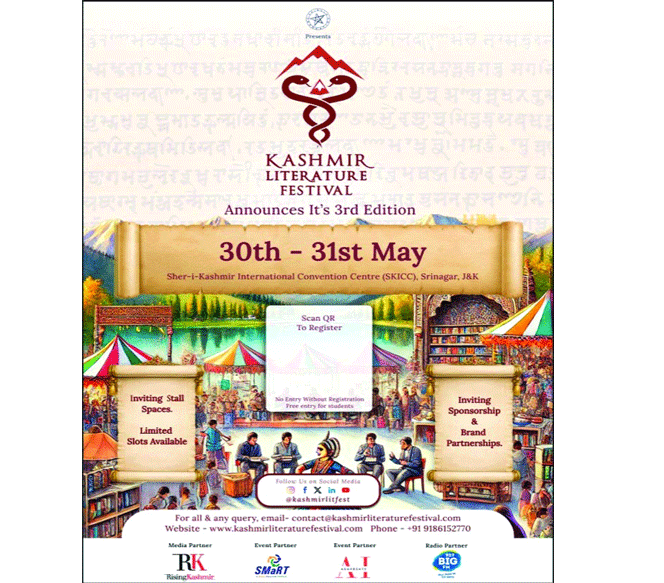
On the 30th and 31st of May, the Kashmir Literature Festival returns not merely as a cultural event, but as a space where Kashmir once again begins telling its own stories – authentically, emotionally, and unapologetically. For years, Kashmir has often been spoken about more than it has been listened to. Narratives arrived from outside before voices within the valley were given space to emerge fully. Somewhere in that process, generations grew up carrying stories they did not always know how to articulate. The Kashmir Literature Festival hopes to change that. It aims to create a space where Kashmir is not simply the backdrop of conversations, but an active participant in them. A space where voices from the valley stand alongside national and global voices not as cultural footnotes, but as equal contributors to the literary imagination of our time. At its heart, KLF is not merely about representation. It is about reclamation.
Because literature has always been about understanding what it means to be human. And few places understand layered humanity the way Kashmir does. Here, beauty and grief coexist so closely that even the landscapes feel emotionally alive. Joy is rarely loud. Pain is rarely simple. Memory never leaves quietly. That emotional complexity creates storytellers. It creates poets who learn to write between silences, artists who understand absence as deeply as presence, and writers who know survival itself can become narrative. What makes this festival deeply exciting is that KLF is not trying to imitate existing literary festivals. We deeply admire literary ecosystems across India and the world – from Jaipur Literature Festival to Hay Festival and Edinburgh – but Kashmir does not need to become a replica of those spaces. Kashmir needs to become fully itself. And that is where innovation begins. Because storytelling today no longer exists only inside books. Literature now lives inside podcasts, spoken word performances, digital narratives, cinema, music, reels, online communities, and conversations happening at midnight between strangers trying to understand themselves. A poem can go viral before it gets published. A voiceover can emotionally reach millions in seconds. A single honest sentence can travel across continents overnight.
The Kashmir Literature Festival therefore hopes to become a bridge between traditional literary culture and the evolving language of modern storytelling. This means conversations that go beyond publishing and academia. Conversations involving psychologists, filmmakers, digital creators, journalists, musicians, social commentators, regional storytellers, and young voices redefining how narratives are consumed today. Because stories no longer belong to one format. As Assistant Director of KLF, one of the ideas closest to my heart is accessibility within literature. We want young people sitting quietly in the audience to feel that literature belongs to them too. We want aspiring writers from Kashmir to understand that their accents, memories, emotional realities, and regional truths are not limitations – they are strengths. For too long, many creators from smaller regions have believed important stories only emerge from metropolitan spaces. But some of the most profound literature has always emerged from places carrying longing, identity, resilience, spirituality, migration, and conflict. Kashmir carries all of those realities simultaneously. And therefore, Kashmir carries stories the world needs. KLF is also rooted in preserving emotional heritage. Because preserving literature is not only about preserving books – it is about preserving memory, language, and identity itself. This year, audiences can expect conversations around literature, cinema, psychology, mythology, women’s narratives, mental health, regional storytelling, youth culture, speculative fiction, spirituality, and storytelling in the digital age. Because literature has never existed separately from life.
And in a world where attention spans are shrinking but emotional loneliness is growing, storytelling matters more than ever. People are searching for connection again – not algorithmic connection, but human connection. The kind found in stories that make people feel understood. For me personally, this journey feels deeply intimate because I have always existed between psychology and storytelling. I believe narratives shape collective consciousness. The stories we inherit become the identities we grow into. And when a place begins reclaiming its own narratives authentically, something shifts. You move from silence to articulation. From invisibility to presence. From survival to expression. That is the shift I hope KLF contributes toward. As we prepare for the Kashmir Literature Festival on the 30th and 31st of May, my hope is simple: that people arrive expecting a festival and leave carrying an experience. An experience of conversation. Of emotion. Of belonging. Because Kashmir is not merely scenery. It is memory. It is metaphor. It is resilience wrapped in softness. And perhaps now, the world is finally ready to listen.
(The author is Assistant Director, Kashmir Literature Festival)
 Follow our WhatsApp channel
