

Ravinder Kaul
ravinderkaul07@gmail.com
The first Dogri feature film ‘Gallan Hoiyaan Beetiyaan’ released in the year 1966, raising the hope that, like Punjabi cinema, Dogri films will also become the harbingers of showcasing Dogri language and Dogra culture across the globe. However, these hopes were never fulfilled. The next Dogri film ‘Maa Neyi Mildi’ came after a gap of 44 years in the year 2010. 60 years after the release of the first feature film, the score of Dogri films is still in a single digit.
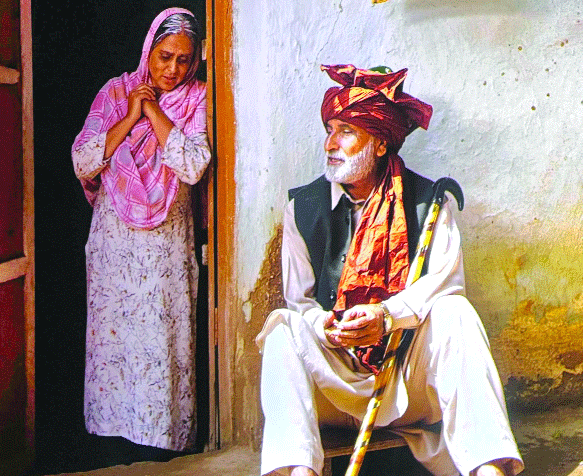
In this backdrop, the release of the film ‘Shah Shahni’ here today is a major step forward towards filmmaking in Dogri language. ‘Shah Shahni’ is a significant milestone in Dogri cinema, marking a major effort to preserve and promote the Dogri language, culture, and regional identity. The film is adapted from a highly acclaimed Dogri stage play of the same name, which explores the deep emotional scars, silent sacrifices, and unheard human stories of families uprooted from the Jammu and surrounding regions during the Partition of 1947.
‘Shah Shahni’ is a poignant film that begins as a teenage love story, taking birth in Jammu region but disrupted due to partition. After a gap of about 60 years when relations between India and Pakistan become somewhat cordial the male lover Shah visits Jammu in search of his lover. He succeeds in locating her. Both have not married and are again separated as his time of visit to India gets over. Through their recollections, Shah and Shahni evoke nostalgia, pain, and the irrevocable damage caused by the partition. Their meeting after 60 years is brief but kindles hope of reunion and better times ahead.
Rajneesh Gupta’s script is rich in chaste Dogri. Not only the language, the film also recollects long forgotten games like Gilli-Danda or Lukka-Chhippi that children used to play in olden times. The film makes a sincere attempt to recreate the life in pre-partition Jammu in which people of all communities lived in peace and harmony. This reviewer has personally met many Jammu residents who were forced to move to Pakistan in 1947 and witnessed tears in their eyes whenever they spoke about life in Jammu of those days.
Because the feature film is closely adapted from the original celebrated stage production by the same creative team, the core cast and technical credits consist of prominent regional theater personalities and artists. J.R.Sagar as older Shah and Meera Tapasvi as older Shahni excel in their respective roles and give ample proof of their histrionic abilities. Veteran actors Janak Khajuria, Madan Rangila, Kusum Tikoo, Sapna Soni and Rajesh Raina also shine in their respective roles.
Even the younger actors, most of them making their debut on the big screen, also excelled in their roles. Mukesh Bakshi as young Shah and Preeti Verma as young Shahni deserve special mention. Other actors Amit Bhalla, Bindia, Tarun Charak, Suhani, Amanjit Verma and Rishab Manhas also deserve special mention.
Music is the soul of the film and some beautiful song and dance sequences embellish the film and make it a ethereal experience. The writer and director of the film Rajneesh Kumar Gupta is a veteran and one of the most accomplished writers and theatre directors of Jammu. He lives up to his class and reputation in his maiden foray into films.
Apart from art and aesthetics, filmmaking is an expensive medium of creative expression. It is now time for all lovers of Dogri language and Dogra culture to shower their love and appreciation on this film so that the next film in Dogri language does not take such a longtime to hit the screen. It is also learnt that till now no Dogri film has received a national film award.
Although included in the Eighth Schedule of the Indian Constitution and recognized by the Sahitya Akademi, Dogri language films are not considered for the national film awards in Dogri language. Only recently Kashmiri language has been included to be considered for this honour. It is time that all Dogri lovers take up this demand at the highest level to realize this long overdue recognition.
 Follow our WhatsApp channel
