

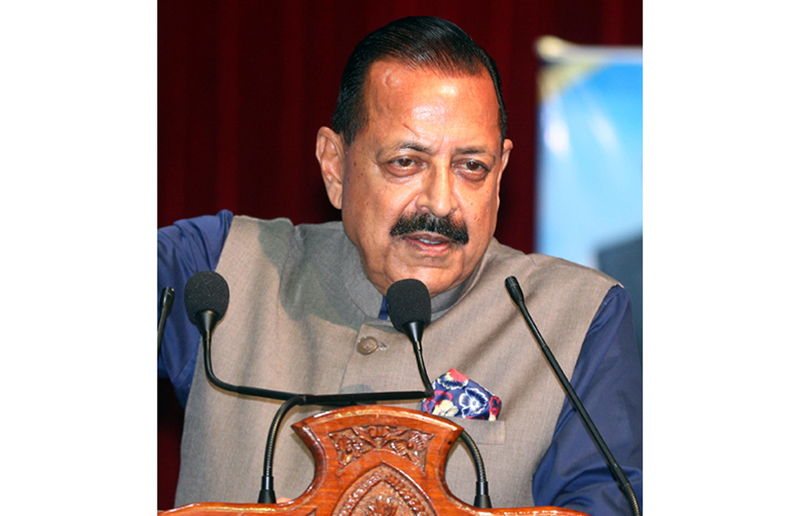
‘It is a new chapter in history of IMD’
Avtar Bhat
JAMMU, June 5: Union Minister in PMO with independent charge for Science & Technology and Earth Sciences Ministries, Dr. Jitendra Singh today inaugurated the new Regional Meteorological Centre (RMC) at Jammu and termed it a new chapter in the history of Indian Meteorological Department which started from here.
He said the Jammu Metrological Centre will be the seventh in the country and will serve Jammu & Kashmir, Ladakh and Himachal Pradesh, providing specialised weather services, disaster warnings and climate support tailored to the Himalayan region.
Click here to watch video
The Minister announced that a similar centre would be established in Lucknow in UP on June 8 expanding India’s regional weather forecasting network. This Meteorological Centre will serve the UP and Uttarakhand in providing weather forecasting services.
The Union Minister said presently 500 sq meters land is available for Jammu centre and he expressed the hope that the UT Government will allot more 700 sq meters of State land which is lying adjacent to the site.
Follow the Daily Excelsior channel on WhatsApp
Dr Jitendra Singh highlighted the remarkable achievement made in the Meteorological infrastructure over the last 12 years of Narendra Modi rule. He announced that the number of Doppler Weather Radars has increased in the country to 50 and an equal number would be added in coming years to further enhance weather monitoring and forecasting capabilities. Dr Jitendra Singh reiterated the Government’s commitment to strengthen the scientific infrastructure, enhancing disaster preparedness and leveraging advanced technology to protect lives and property while promoting suitable development across the region.
Highlighting the strategic importance of the new facility for J&K, Ladakh and HP, Dr Jitendra Singh said that the establishment of the Regional Meteorological Centre in Jammu reflects the Government’s commitment to enhancing scientific infrastructure and strengthening weather and climate in geographically sensitive and disaster prone areas. It will serve as a key hub for advanced metrological services across the North Western Himalayan forecasting and early warning capabilities, he added.
The Minister said the new centre would strengthen in weather monitoring, forecasting and early-warning systems in a region characterised by diverse terrain ranging from plains to high-altitude mountains. It will provide district-level forecasts, mountain weather forecasts, tourist advisories, city-specific weather services and warnings for flash floods, cloudbursts, avalanches, heavy snowfall, thunderstorms and landslides. The services are expected to benefit pilgrims undertaking Shri Amarnath and Mata Vaishno Devi yatras, farmers, transport operators, hydropower projects, disaster management agencies and security forces operating in difficult terrain.
Highlighting the expansion of meteorological infrastructure in Jammu & Kashmir and Ladakh over the past decade, Dr. Jitendra Singh said there was no Doppler Weather Radar in the region in 2014, whereas four are now operational at Jammu, Srinagar, Leh and Banihal Top. Under Mission Mausam, five additional Doppler Weather Radars have been proposed for Anantnag, Rajouri, Baramulla, Kishtwar and Doda.
The observational network has also expanded substantially. The region currently has 56 observatories, including 15 manual observatories, 25 Automatic Weather Stations (AWSs) and 16 Automatic Rain Gauges (ARGs), compared to 13 AWSs and 14 ARGs in 2014. Recently, AWSs have been installed at Kargil, Ukhral in Ramban district and Mata Vaishno Devi Bhawan. During the current financial year, nearly eight more AWSs and five ARGs are expected to be installed. The number of stations under the Daily Rainfall Monitoring Scheme has increased from 30 in 2014 to 85 at present, significantly improving rainfall monitoring and forecasting capabilities.
Dr. Jitendra Singh said the establishment of RMC Jammu marks an important restructuring of the India Meteorological Department’s regional operations. Until now, the Regional Meteorological Centre in Delhi coordinated weather and climate services for Jammu & Kashmir, Ladakh, Himachal Pradesh, Uttarakhand, Punjab, Haryana, Uttar Pradesh and Rajasthan. With the creation of the Jammu centre, weather services for Jammu & Kashmir, Ladakh and Himachal Pradesh will be managed from Jammu, while the proposed Lucknow centre will cater to Uttar Pradesh and Uttarakhand.
The Minister also highlighted several scientific and institutional initiatives undertaken in the region. The Meteorological Centre at Srinagar has signed collaborations with Sher-e-Kashmir University of Agricultural Sciences and Technology (SKUAST)-Jammu, SKUAST-Kashmir and the Islamic University of Science and Technology to strengthen research and capacity-building in weather and climate sciences. He also referred to the High Altitude Cloud Physics Laboratory established at Patnitop in collaboration with Swiss scientific institutions for cloud and aerosol studies in the Himalayan region.
On earthquake monitoring, Dr. Jitendra Singh said the Jammu and Kashmir seismological network has undergone major modernisation, with seismic stations at Jammu and Kashmir upgraded to digital systems and an additional observatory established at Udhampur. A new seismological observatory has also been proposed in Kishtwar. At present, five seismic stations are operational across Jammu & Kashmir and Ladakh, transmitting near real-time data to the National Centre for Seismology.
The Minister announced that an Automatic Weather Station and a seismology centre would be established in Kishtwar following last year’s disaster in the district. He also noted that the Srinagar Meteorological Observatory, which has been functioning for over a century, has been recognised by the World Meteorological Organization as a Centennial Observing Station.
“Now there will be regional forecasts, district-wise forecasts, separate forecasts for tourists and separate mountain forecasts,” Dr. Jitendra Singh said, adding that customised forecasting would help address the specific needs of the Himalayan region.
Emphasising the role of weather services in disaster management, he said, “Flash floods, cloudbursts, avalanches, heavy snowfall, thunderstorms and landslides – all of these will be forecast in a timely manner.”
He said in last 12 years all institutions of national repute have come to J&K which included medical colleges, AIIMS, Satish Dhawan Institute of ISRO in CUJ, Nathatop Relay Station, construction of Shahpur Kandi which was stalled for 40 years by previous governments, sanctioned construction of Ujh Multipurpose Project. Kishtwar is emerging as North India’s power hub as various power projects in the district will generate 4000 mws of electricity, besides Sangaldan where it was difficult to visit by foot has now become a tourist resort, he added.
Speaking on the occasion, MP Lok Sabha Jammu-Reasi constituency, Jugal Kishore Sharma termed the establishment of Regional Metrological Centre at Jammu a great milestone and gave credit for the same to Prime Minister, Narendra Modi and Union Minister , Dr Jitendra Singh.
Jugal said the last year human tragedy and loss of property at Chasoti due to cloudburst could have been averted had there been such a mechanism in place. He said in J&K development in leaps and bounds has taken place during last 12 years of Modi rule and Dr Jitendra Singh has also made a lot of contribution in this regard.
MLA, Jammu West, Arvind Gupta said establishment of the New Metrological Centre was a long pending demand of the party as people were facing problems over here. He lauded role of Union Minister for taking keen interest in development of J&K.
Dr Mrutyunjay Mohapatra, Director General Indian Metrological Department also spoke on the occasion while the welcome address was read by Dr G R Pathak, Head of Metrological Centre Delhi and vote of thanks was given by Mukhtar Ahmed, Director Indian Metrological Centre, Srinagar.
 Follow our WhatsApp channel
