

Sameer Rekhi
rekhi7sameer@gmail.com
A city’s soul resonates with the conscience-or the lack of it-of its inhabitants. In Jammu, one of the most telling oversights lies in plain sight: its cremation grounds.
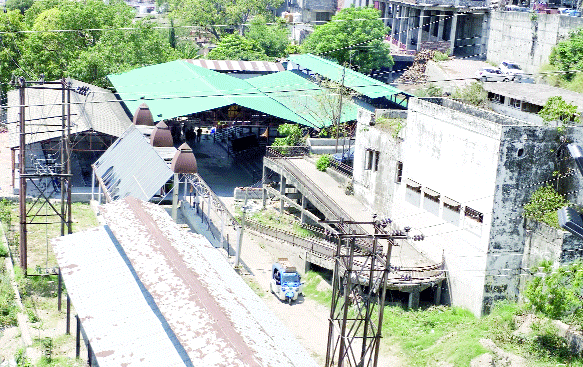
These are not marginal or rarely used spaces.The chitas or pyres in each one of them are mostly crowded. They are part of the city’s essential civic fabric, present at moments of greatest sorrow and vulnerability. Yet across key sites-Jogi Gate, Shastri Nagar, Shakti Nagar, and Channi Himmat-the same pattern repeats: filth, congestion, poor planning, and gross mismanagement.
At Shastri Nagar and Shakti Nagar, the problem begins on the road. Funeral processions and private vehicles converge on narrow approaches from all sides, with little or no enforcement. What should be a quiet, dignified movement turns into gridlock. Vehicles pile up, tempers fray, and families are left navigating confusion in moments that demand peace. This is not an occasional lapse; it is routine enough to be anticipated.
At Channi Himmat, the issue runs deeper than traffic management. The location of the cremation ground itself creates a bottleneck that effectively shuts down the approach road to the adjoining residential colony during peak activity. Vehicles are parked at will-on the road and at the main junction. Residents are cut off, mourners are delayed, and the entire area becomes a site of avoidable friction. Urban planning is meant to prevent precisely such situations. Here, it has done the opposite.
The oldest and most visited cremation ground of Jammu-Jogi Gate, by the banks of the Tawi-should have been its best. Instead, it reflects years of uneven attention and poor utilisation of prime space. The adjoining riverbank, which must be accessed for certain last rites, is often marked by slush and muck. Within the premises, maintenance struggles to keep pace with use-pathways, waste disposal, and basic cleanliness remain inconsistent. This is not a sudden decline; it is the result of neglect that has accumulated quietly over time.
Individually, each of these issues can be explained away-traffic pressure, limited funds, overlapping jurisdictions. Seen together, they form a pattern that is harder to dismiss. These are not failures of imagination. They are failures of routine governance.
What makes the situation more striking is the contrast with other cities that face equal or greater pressure but manage these spaces with a degree of order. In Delhi, major cremation grounds such as Nigambodh Ghat operate with structured layouts, managed entry and exit, and staff presence that prevents spillover chaos. Chandigarh’s facilities reflect planning-clear access, designated areas, and functioning infrastructure. In Haridwar’s Kankhal, where the volume of last rites is far higher, movement is regulated and the system, however strained, does not collapse into disorder. These places, if not perfect, at least inspire confidence.
The difference is not one of culture or even resources. It is one of administrative discipline-as much as it is of collective conscience. Systems are expected to work-and are made to work through planning, execution, follow-up, and correction. An aware citizenry, supported by responsive institutions, ensures that urgent issues are not allowed to drift.
In Jammu, responsibility is spread thinly enough to lose sharpness. The Municipal Corporation, local management committees, and other agencies all have a role, but synergy and coordination are largely absent or lackadaisical. Maintenance is intermittent. Traffic is unmanaged. Design flaws remain unaddressed. Plans are announced, but execution often evaporates.
Ghalib’s lines come to mind:
“Bas ki dushvar hai har kam ka asan hona, admi ko bhi mayassar nahin insan hona.”
Though written in a different context, they capture the irony well. It should not be this difficult to get the basics right. Yet in Jammu’s cremation grounds, even the basics-clear access, clean surroundings, functional facilities, regulated movement-leave much to be desired. Not because they are complex, nor because they require extraordinary funding, but because they demand something far more elementary: consistency and self-correction. A system that shows up every day, not just after complaints. An authority that is identifiable, not diffused. A standard that is enforced, not pleaded for.
What exists instead is a familiar systemic drift. Responsibility is shared, which in practice means it is diluted. Everybody’s responsibility becomes no one’s responsibility. The Municipal Corporation points to constraints; committees cite limited means; the citizenry expects someone else to act.
Meanwhile, traffic continues to choke Shastri Nagar and Shakti Nagar. The Channi approach continues to lock up under pressure. The Tawi bank at Jogi Gate continues to gather what no one clears. None of this escalates into a crisis. It simply persists-functional enough to be tolerated, inconvenient enough to irritate, but never urgent enough to be fixed. That persistence is the real indictment.
Because this is not a problem of ignorance. Everyone knows what is required. It is not even a problem of resources in any meaningful sense; the interventions needed are modest and well within the reach of a functioning local body. It is, instead, a lack of insistence-within the administration and outside it. A slow erosion. A quiet lowering of expectations until the unacceptable begins to feel normal.
When disorder becomes acceptable, it stops provoking response. When inconvenience becomes predictable, it is absorbed into routine. When spaces associated with the final journey are treated as peripheral, they slip out of the city’s moral and civic priorities. What remains is not dramatic collapse, but a steady, unremarked erosion of dignity.
It does not have to remain this way.
The first step is recognition-of the importance of these spaces as sites of dignity, reflection, and collective responsibility. They must be treated as civic utilities, no less essential than roads, water supply, or public health infrastructure. They require clear ownership-one accountable authority per site. They require dedicated maintenance budgets that cannot be diverted. They require basic traffic protocols during peak hours, enforced through coordination between civic authorities and the police. They require on-site supervision that is present, not nominal. And they require periodic, visible inspection-because systems that are not inspected rarely function well.
Equally, they require a shift in public behaviour. The absence of complaint is not satisfaction; it is disengagement. Cities improve when citizens insist-not episodically, but consistently. The same voices that demand better roads and cleaner markets must extend that demand here, to the city’s Swarg Ashrams.
A funeral is not just a private ritual; it is a public passage. It moves through roads, occupies shared space, and seeks order and dignity. When systems fail at that moment, the failure is not abstract-it is immediate and deeply felt.
“The true measure of any society can be found in how it treats its most vulnerable moments.” Every life must pass through this last mile. Who would not expect it to be dignified? To accept anything less is to accept less of ourselves.
Let Jammu-and its citizens-demand better. Not in rhetoric, but in resolve. Not once, but consistently.
Because dignity, even at the end, should never be left to chance.
(The author is a retired IPS officer)
 Follow our WhatsApp channel
