

Phagun Sharma
“Are you Kashmiri?”
No. I am Dogra. I am from Jammu. And I have been answering this question innumerable times, and every single time, something small inside me breaks just a little. I realized the question bothered me for a reason larger than irritation. It came from the feeling that Jammu is constantly spoken over, flattened into a geography people recognize only through Kashmir. People know the conflict. They know the headlines. They know the valley. But Jammu often exists only in the background, as if it is just a route people cross before reaching somewhere more important.
I grew up in Jammu, the City of Temples. To me, it has never felt like a place lacking identity. It has always felt full of one. The temples, the language, the hills, the stories older people tell so naturally, the way faith is woven into everyday life here, all of it carries a history that feels deeply rooted and deeply ours.
Yet outside the people who belong to it, so much of Jammu remains unseen. I am writing this because I do not want my home to survive only in fragments or footnotes. Jammu is not simply an attachment to Kashmir’s story. It has its own voice, and it deserves to be heard.
This is my ode to a place that deserves one. This is my attempt, however small, to say: we exist. We have always existed. And we are worth knowing.
The Land That Was Called Duggar
Before this region became a political discussion, it was called ‘Durgara’. Kalhana mentions it in the Rajatarangini, and from Durgara came the word Dogra. That identity still shapes the region today, even if people outside it rarely notice.
Dogri, our mother tongue, is one of India’s scheduled languages. Jammu traces its origins to Raja Jambulochan, and over centuries the region developed a culture deeply connected to spirituality, especially Shaivism.
The Dogra rulers understood culture as something that had to be protected and built upon. Maharaja Gulab Singh, Maharaja Ranbir Singh, and Maharaja Pratap Singh established temples, schools, libraries, and centres of learning across the region. They supported Sanskrit scholarship and patronised Pahari miniature paintings that later became recognised as the Jammu School of Art.
Religion here was never only ritual. It shaped art, architecture, education, and identity itself. That is why it feels frustrating when Jammu is spoken about as though it has no distinct cultural presence of its own.
The Temples No One Talks About
Whenever people speak about temples in Jammu and Kashmir, the conversation almost always begins and ends with Vaishno Devi. And of course, the recognition is deserved. The devotion surrounding the shrine is real and powerful.
But Jammu’s spiritual history is far larger than one pilgrimage site.
There are temples across the region carrying centuries of history, faith, and cultural memory, yet many of them continue to exist in neglect and near silence.
Purmandal: Chhota Kashi
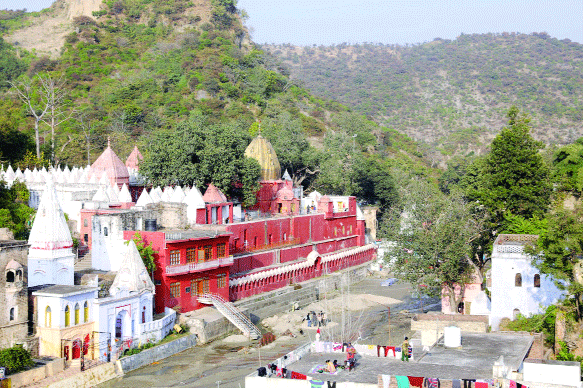
Around thirty kilometres from Jammu lies Purmandal, often called Chhota Kashi. Situated along the Devika river, the temple complex carries immense religious and historical significance. The 108 Shiva temples built by Maharaja Gulab Singh still stand there, carrying generations of devotion within them.
But the neglect is visible the moment you arrive. Poor roads, damaged murals, limited facilities , Place this historically important should not feel forgotten.
Uttarbehni : The Northward River
Close to Purmandal is Uttarbehni, where the Devika river flows northward, something considered spiritually significant in Hindu tradition.
The place carries a quiet sense of sacredness, but outside nearby communities, very few people even know it exists. The roads remain underdeveloped, and the lack of attention around the site feels difficult to justify considering its cultural importance.
Sudh Mahadev
Near Patnitop stands Sudh Mahadev, one of Jammu’s most important Shiva shrines. Associated with ancient legends surrounding Lord Shiva, the temple houses an Akhand Jyoti believed to have remained lit for generations.
Every year, thousands visit during festivals. But beyond those moments of gathering and celebration, the larger issues remain the same: lack of infrastructure, lack of preservation, and lack of visibility.
These temples are not secondary sites. They are central to Jammu’s spiritual and cultural identity. They deserve more than occasional attention and inherited devotion. They deserve preservation, investment, and recognition.
Development Shouldn’t Make Us Disappear
I genuinely admire the infrastructural changes taking place in Jammu and Kashmir. The Chenab Rail Bridge and the Vande Bharat connection to Srinagar are remarkable achievements, and they represent progress in very real ways.
But sometimes I wonder what gets left behind when development moves too quickly.
Earlier, travellers passing through Jammu often spent time here before continuing north. They visited temples, markets, and local sites. Now the city increasingly risks becoming a place people move through rather than a place they experience.
The issue is not connectivity. Better transport matters.
The issue is that nobody has invested equally in making Jammu visible to the people crossing it.
Until places like Purmandal, Uttarbehni, and Sudh Mahadev are treated as cultural landmarks rather than forgotten local sites, Jammu will continue to exist in the shadow of somewhere else.
A City Cannot Forget Its Own Story
I support the idea of Jammu becoming more modern and better connected. Better roads, infrastructure, public facilities, and development matter. Culture and progress are not opposites.
But development without memory feels incomplete.
A smart city that does not know its own temples is not that smart. Varanasi built better roads and kept its ghats. It modernised and never stopped telling its story, which is why twelve million people still go there every year.
Jammu has a story just as ancient and just as extraordinary. The 108 Shiva temples of Purmandal. The river that flows north against all reason. The eternal flame at Sudh Mahadev that has never once gone out. The Trishul inscriptions that scholars have not yet fully deciphered.
This is the story. It is here, it is real, it is waiting. It just needs to be told with the urgency and the love and the funding it deserves.
I study literature, which means I spend a lot of time thinking about what stories get told and which ones do not, which voices get amplified and which ones get absorbed into the silence. And I think about Jammu in those terms more and more. We are not a people without a story. We are a people whose story has not yet been told loudly enough, consistently enough, with enough tenderness and enough insistence.
The Devika is still flowing beneath that sacred earth at Purmandal, surfacing where it chooses, indifferent to neglect, carrying its holiness forward the way rivers always do. The flame at Sudh Mahadev is still burning. Someone lit it millennia ago and it has not gone out. The bell at Uttarbehni is still hanging there, still capable of ringing, still waiting for more hands to pull the rope. These things are alive. They have survived longer than any of us will. I just want the people who are supposed to protect them to act like that matters. And I want the rest of the world to turn its face toward this land, even briefly, even just long enough to understand: Jammu is not a transit stop. It is not an airport waiting room on the way to Kashmir. It is a world entire, ancient and sacred and ours, and it is far too beautiful to lose quietly.
I am Dogra. I am from Jammu. And I will keep saying it until it no longer needs explaining.
 Follow our WhatsApp channel
