

T N Ashok
There was a time when Indian cricket moved at the rhythm of five-day Test matches – white uniforms, red balls, patient batting, and slow-burning legends. Then came coloured clothing and One-Day Internationals, followed by the explosion of white-ball T20 cricket that changed everything forever. Stadiums became louder, cricket became faster, and the Indian Premier League transformed into the biggest talent factory in the world.
Today, Indian cricket no longer belongs only to the sons of metropolitan privilege or established cricketing dynasties. It belongs equally to boys from dusty maidens, small towns, cramped middle-class homes, and families that sacrificed everything for one dream. The IPL has become the cradle where unknown youngsters become overnight sensations.
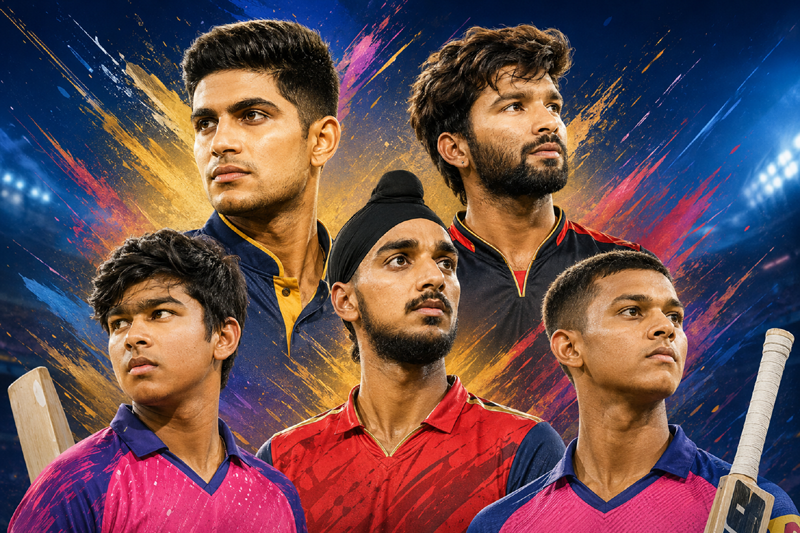
Players like Shubman Gill, Sai Sudharsan, Yashasvi Jaiswal, Dhruv Jurel, Rajat Patidar, Arshdeep Singh, Venkatesh Iyer, Shreyas Iyer and teenage prodigy Vaibhav Suryavanshi are now symbols of a new India – ambitious, fearless and impatient for greatness. The IPL did not merely give them money and fame. It gave them a stage.
Among the brightest stars of modern Indian cricket stands Shubman Gill, elegant and composed beyond his years. He is the shy prince from Punjab. Born in Fazilka in Punjab, Gill came from a farming family. His father, Lakhwinder Singh, recognised his son’s extraordinary talent early and reportedly built a cricket pitch on their farm so the boy could practise endlessly. Gill grew up idolizing Sachin Tendulkar and later modelled aspects of his batting on Virat Kohli. His batting carries the old-world grace of classical Test cricket blended perfectly with the aggression of T20 cricket. In the IPL, he matured into a match-winner capable of anchoring innings and destroying attacks with effortless timing.
Fans admire Gill because he looks calm even in chaos. In an era of muscular hitting, his elegance stands out. Sai Sudharsan represents another face of modern Indian cricket – educated, disciplined and technically polished. Hailing from Chennai, he comes from a sporting family. His father was an athlete while his mother played volleyball at a high level. Sport was never forced upon him; it was part of everyday life. Unlike many flamboyant T20 stars, Sudharsan built his reputation quietly. But once he entered the IPL, cricket watchers quickly noticed his temperament. He could rotate strike like a classical batter yet accelerate like a modern T20 specialist. The left-hander’s calmness reminds many of former Indian great Rahul Dravid. Fans love him because he appears grounded and unaffected by hype. He represents the modern professional cricketer – fit, mentally composed and tactically smart. No IPL success story is more dramatic than Yashasvi Jaiswal. The boy who slept in tents to realise his dream of becoming a cricketer. Born in Uttar Pradesh, Jaiswal moved to Mumbai as a child chasing cricketing dreams. The struggle was brutal. Stories of him selling panipuri and living in tents near the Azad Maidan cricket grounds became part of cricket folklore. Many nights, hunger and uncertainty nearly ended his ambitions.
But talent eventually forced the cricketing world to notice him. The IPL changed his life forever. His fearless batting at the top of the order, especially against international fast bowlers, turned him into one of India’s biggest young stars. He attacks bowlers without fear, hooks bouncers aggressively and plays with street-fighter intensity. Jaiswal’s story connects deeply with fans because he represents survival. Millions of Indian youngsters see their own hardships reflected in him. His inspiration reportedly came from legends like Tendulkar and Kohli, but his greatest motivation was poverty itself. Dhruv Jurel’s rise carries the discipline of a military household. Because he is a soldier’s son. The wicketkeeper-batter comes from Agra, and his father served in the Indian Army. Cricket was not always viewed as a stable career option in the family, but Jurel’s persistence slowly convinced them. He emerged as one of the IPL’s coolest finishers under pressure. Whether chasing impossible targets or rescuing collapsing innings, Jurel developed a reputation for clarity under stress. Fans admire his confidence. He speaks softly but bats boldly. In many ways, Jurel reflects the changing Indian cricket culture – small-town players who no longer feel intimidated by reputations or international stars. Unlike teenage sensations, Rajat Patidar’s journey was built on patience. Born in Indore into a business family, Patidar did not arrive with massive hype. For years he remained on the fringes, grinding through domestic cricket. But the IPL became the turning point. His breathtaking stroke play for Royal Challengers Bengaluru transformed him from an unnoticed domestic player into a national figure. Patidar’s success is important because it proves IPL stardom is not only for teenage prodigies. Persistence still matters. He idolised elegant batters like Dravid and Rohit Sharma, and his batting reflects that classical balance between timing and aggression. Fans connect with Patidar because he appears relatable – a quiet middle-class cricketer who waited years for one opportunity and seized it spectacularly. Patidars aggression was seen in the play offs when the team he led, RCB trounced a mighty team like Gujarat Titans and his own 33 ball 97 stole the show and won the game.
Fast bowlers in India once struggled for recognition. But T20 cricket changed that equation completely. Arshdeep Singh from Punjab emerged through the IPL as one of India’s best death bowlers. Coming from a modest Sikh family, he grew up idolising left-arm legends and dreaming of bowling in pressure situations. He is a man sculpted from ice. The IPL sharpened his temperament. Bowling the final overs in front of packed stadiums requires nerves of steel. Arshdeep developed the rare ability to remain calm while defending tiny totals against world-class hitters. Fans love his fearlessness and simplicity. There is no drama around him – just accuracy, intelligence and courage. Venkatesh Iyer brought a refreshing image to Indian cricket. Coming from Madhya Pradesh, he balanced academics and cricket seriously, even studying finance and management. At one point, he reportedly considered leaving cricket for a stable career. Then the IPL happened. His explosive batting for Kolkata Knight Riders made him one of the most dangerous all-rounders in white-ball cricket. Tall, powerful and aggressive, he symbolises the modern T20 cricketer – athletic, versatile and fearless. Fans admire Iyer because he broke stereotypes. He proved that educated middle-class youngsters could pursue cricket professionally without abandoning academics. Unlike some others, Shreyas Iyer came from a relatively comfortable urban background in Mumbai. Yet his rise was not easy in a city overflowing with cricketing competition. Inspired heavily by Tendulkar and later Kohli, Iyer built his reputation through fearless strokeplay against pace bowling. The IPL gave him leadership responsibilities early, helping him evolve into a mature captain. His stylish batting and confident personality made him immensely popular among younger fans. Whether in pressure chases or captaincy decisions, Iyer exudes self-belief. He represents the polished, metropolitan face of modern Indian cricket. He is the aggressive captain of an equally aggressive cricketing team representing an aggressive state – Punjab.
Every IPL season now produces teenagers who appear astonishingly fearless. Vaibhav Suryavanshi belongs to this emerging generation shaped entirely by T20 cricket. Unlike older cricketers raised on long-format cricket, these youngsters grew up watching sixes, scoops and power-hitting highlights on television and social media. They enter professional cricket already believing they belong there. Suryavanshi’s aggressive batting and fearless attitude have made him one of the most exciting young names in franchise cricket. He reflects how the IPL has accelerated cricketing dreams. What makes these cricketers special is not merely talent. It is relatable. Reliability and why do fans love them that they will travel all the way to the hills and watch the cool climes of Dharamshala — because cricket is not a slow game any more, it has evolved into the fast paced soccer or football bringing the same enthusiasm and popularity and attention. Indian fans see fragments of themselves in these young stars – middle-class ambition, family sacrifice, educational pressure, financial struggle and relentless hard work. Mothers skipped comforts to pay coaching fees. Fathers travelled hundreds of kilometres for matches. Coaches invested years in uncertain dreams.
The IPL turned those dreams into reality. It also transformed Indian cricket socially. Earlier, opportunities were concentrated in major cities like Mumbai, Delhi and Bengaluru. Today, talent scouts travel into smaller towns, villages and state academies. A boy from Punjab, Bihar, Uttar Pradesh or Tamil Nadu can now dream realistically of becoming an IPL star.
And the money changed lives instantly. One successful IPL season can lift entire families into financial security. But with fame also comes pressure – social media scrutiny, endorsements, expectations and constant comparison. Yet these youngsters continue to thrive because they belong to a generation raised in competition. They have grown up watching Kohli’s aggression, Dhoni’s composure and Rohit Sharma’s elegance. They understand that Indian cricket is no longer just a sport. It is an industry, a spectacle and a national obsession. From white uniforms in Test cricket to blazing floodlights in IPL stadiums, Indian cricket has travelled across eras. But one thing remains unchanged – the hunger of young Indians chasing impossible dreams with a bat and ball. And somewhere tonight, on another dusty ground in a small Indian town, another child is preparing to become the next IPL sensation. Can you beat IPL has captured the imagination of not Bollywood which has made biopics on Sachin Tendulkar and Mahendra Singh Dhoni but Hollywood which shows a baseball team coach and manager all the way to India to find the perfect fast bowler from the dusty villages of India who could form the perfect pitcher in star studded baseball games in the USA. John Ham of Madison Avenue fame played the coach who travels to India. It’s a riveting film that draws global attention of non-cricket playing nations to the game introduced to the world by Britain and stays alive under the commonwealth. (IPA)
 Follow our WhatsApp channel
