

Excelsior Correspondent
NEW DELHI, Apr 24: Union Minister of State (Independent Charge) for Science & Technology and Earth Sciences, MoS PMO, Personnel, Public Grievances, Pensions, Atomic Energy and Space, Dr. Jitendra Singh today said that the 21st century will be India’s century and will be driven by a biology-led economy, with the country’s bio-economy projected to grow to $1 trillion by 2047.
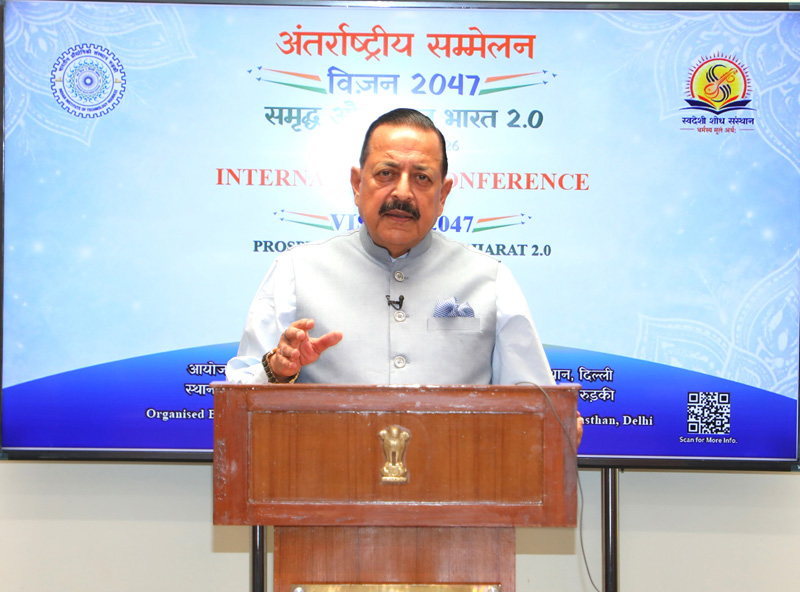
Addressing an international conference at IIT Roorkee , Dr Jitendra Singh said India is moving decisively towards full-spectrum technological capability, from gene to qubit, from ocean depths to outer space, supported by policy reforms, strong institutional frameworks and a rapidly expanding innovation ecosystem.
The Minister was delivering the keynote address at the International Conference on “Vision 2047: Prosperous and Great Bharat 2.0” held at IIT Roorkee. The conference is jointly organised by IIT Roorkee and Swadeshi Shodh Sansthan, with participation from over 100 institutions across India and abroad. Among those present were IIT Roorkee Director Prof. K.K. Pant and Padma Shri awardee Shridhar Vembu.
Referring to Prime Minister Narendra Modi’s vision of Viksit Bharat 2047, Dr. Jitendra Singh said India’s development pathway is anchored in a civilisational ethos that integrates economic progress with ethical values, guided by the principle “Arthasya Moolam Dharmam”. He said the themes of the conference, ranging from employment and economic growth to science leadership, sustainability, security and global cooperation, reflect a comprehensive national transformation agenda.
Highlighting the Government’s policy thrust, the Minister spoke about the BioE3 Policy (Biotechnology for Economy, Environment and Employment) approved in 2024, describing it as a defining step towards bio-manufacturing-led growth. He said India’s bio-economy has expanded from $10 billion in 2014 to over $165 billion today, growing at nearly 18% annually, with a target of $300 billion by 2030. The number of biotech startups has increased from around 50 to more than 11,000. He also referred to the Anusandhan National Research Foundation (ANRF) with a Rs 50,000 crore corpus and the Rs 1 lakh crore Research, Development and Innovation (RDI) Fund, designed to provide long-term, low-cost financing for deep-tech innovation.
Dr. Jitendra Singh presented a series of major scientific advances achieved in recent years, including progress under Genome India, indigenous CAR-T cell therapy, development of mRNA vaccine platforms, India’s first indigenously developed antibiotic, establishment of a National Biobank, and space biotechnology experiments carried out in collaboration with ISRO. He also highlighted the expansion of nuclear medicine facilities to deliver affordable cancer care and progress in deep ocean exploration through missions such as Samudrayaan.
Referring to developments in emerging technologies, he said the National Quantum Mission has achieved key milestones ahead of schedule, while India has entered the top ranks globally in several critical technology domains. He noted that India’s Global Innovation Index ranking has improved from 81 to 39, and that research and development expenditure has more than doubled over the past decade, reflecting sustained national prioritisation of science and innovation.
 Follow our WhatsApp channel
