

by Dr. D.K. Giri
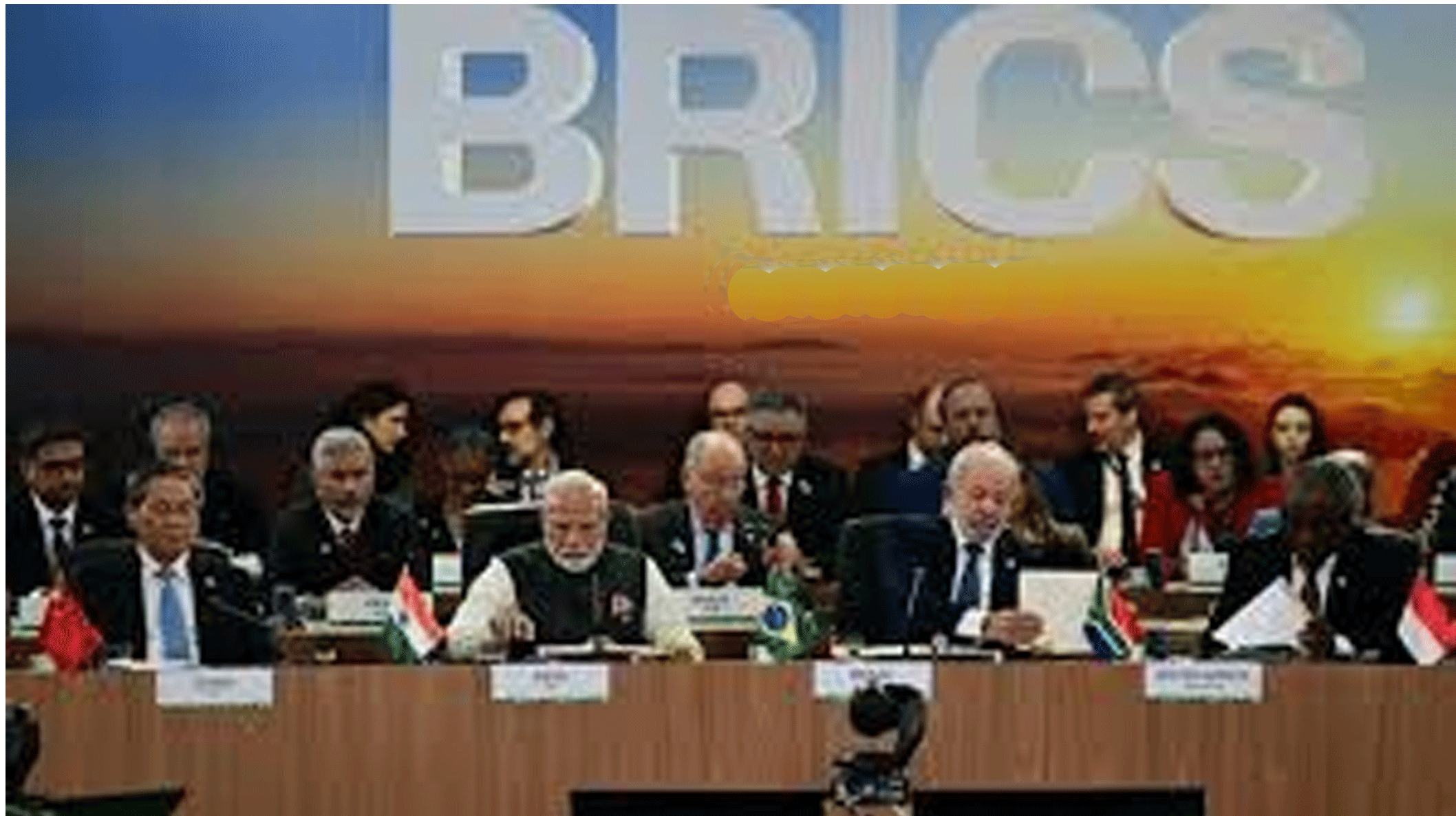
In 2001, Goldman Sachs coined the acronym BRIC – Brazil, Russia, India and China – to do an investment story. Twenty five years later, India is chairing the BRICS in 2026 as a governance story. From asset creation, it has moved to agenda setting. India is leading it in most turbulent times in the life of BRICS as two of its members Iran and Russia are at war. The tremor of the war in Iran was felt at the meeting of Foreign Ministers of BRICS +. Usually, a communiqué is issued after such meetings; but due to divergence of opinions and the choice of language, a joint declaration could not be issued. Only a Chairs Summary was released. This indicates challenges forthcoming for India’s presidency of BRICS +.
On December 24, 2010, South Africa joined the grouping making it BRICS. Its inclusion was aimed at enhancing African representation in global economic forums. Now it is BRICS + after Egypt, Ethiopia, Iran and United Arab Emirates joined the bloc on 1 January 2024 and later in early 2025, Indonesia officially joined. Now, BRICS + consists of 11 countries, encompassing 47 per cent of world population and 41 per cent of global GDP as per the purchasing power.
The popular perception among observers is that BRICS was created or is being developed as an alternative framework to the Bretton Woods Institutions, and a route to de-dollarisation of the global economy. Some members like India and UAE may have reservations to this approach but the actions of countries like Russia and China point to such aspiration as just mentioned. However, BRICS is facing challenges on several fronts, institutional, delivery, strategic planning, conflict management and so on.
Admittedly, BRICS is intuitionally inchoate affecting its functioning and delivery. It does not even have a permanent secretariat. It was proposed in the past, in 2015 when India objected. Now, in 2026 what is India’s thinking on institution building? Comparing it to the European Union, which is by far the most successful example of regional grouping, EU has a Commission, a Parliament, a Council, and a Court; whereas BRICS + has only a rotating chair.
In the light of the challenges, it is perhaps in order that questions are raised about the evolution of BRICS +. I would like to raise six questions that need to be addressed by the current Chair of BRICS +, that is India. New Delhi will obviously like to continue in BRICS in line with its foreign policy strategy on maintaining strategic autonomy while engaging in multi alignment. I have critiqued these concepts in this column multiple times. For now, we focus on India’s role in BRICS.
Taking the cue from the successful G-20 Summit in 2023, India’s slogan was, “One Earth, One Family, One Future”. The family which consists of many families is asking for a rule book to conduct in these turbulence times. So the question number one is, “will India use this opportunity in 2026 to write a page of that rule book, the page representing the voice of Global South”.
Recall that 67 countries applied for the membership of BRICS. Only six were admitted. So many applicants presented a scene of Kumbha Mela in India. The only difference was that in Kumbha Mela everyone, despite the chaos and the crowd, has a chance to take a dip in the Ganges. But here only six took the dip whilst others were debating the depth and the quality of the water that is BRICS.
Even the 11 countries that constitute BRICS today do not speak in the same voice. India wants reform of UNSC, Brazil would like to see the revival of WTO dispute mechanism as South Africa demands climate finance. The question that follows is when will the BRICS countries speak in one voice, or have consensus on various points. The third question which automatically follows the second is who will have the microphone when BRICS speaks.
Will BRICS reform the international organisations or rebuild the world with new institutions? In other words, will BRICS fix the United Nations or flank it? Will India stop asking for a seat around the table or start building the table itself? Taking a minimalist position, one may ask what is one institution that India could conceive and create in its presidency of BRICS.
On de-dollarisation, some countries in BRICS are trading in local currency. Is it conceivable that BRICS + conducts transactions upto 30 per cent in local currency by 2027? There is a view that de-dollarisation was not an attempt consciously made by BRICS. Example cited is the introduction of Euro in 1999 as a currency operating in the global market not as a substitute to any currency including Dollar. BRICS + does not have any currency of its own. So where is the question of de-dollarisation?
On delivery, BRICS needs to rewire cooperation especially in embracing speed in decision making, scale in its impact and sovereignty in setting and maintaining standards. At the moment, BRICS has no technical secretariat and no political triggers. Should India push a BRICS liquidity line in 2026 with automatic triggers or allow BRICS to remain hostage to a consensus? It is necessary to set systems, for example having dispute rails before payment rails. In India, billion transactions are happening to UPI system because NPCI runs grievance redressal in 48 hours. Who is NPCI of BRICS?
The delivery has to follow certain speed. To illustrate, EU Nextgen Fund disbursed 144 billion Euro in two years for 27 countries. The BRICS Bank, NDB disbursed 35 billion USD in nine years for five countries. The delay may be caused by the consensus mechanism and decision making. Can BRICS move on from consensus to qualified majority voting (QMV) like it happened in the European Union? Seeking consensus on each decision is not practicable; and progress is stalled.
On BRICS projects should 2026 mandate that 50 per cent of new NDB lending is multilateral not bilateral. BRICS will have to do cross border projects for the sake of synergy and solidarity. Can India announce a BRICS project and fix the implementation with a timeline? Without addressing these questions BRICS will be like another G-7 with better weather.
Expansion of any initiative is desirable as well as inevitable. But widening without deepening entails grave risks. BRICS has just taken that risk by expanding thrice without solid institutional foundations. Also, politics is under rated and downplayed in BRICS dialogues. The mismatch between politics and trade or economics will hamper the growth the viability of BRICS. From India’s own experience, New Delhi could correct this disconnect.
On an optimistic note, while G-7 talks about saving the world, grouping like BRICS, or to be politically correct, the Global South focuses on building the world. New Delhi claiming to represent the Global South, should steer BRICS in that direction.—INFA
 Follow our WhatsApp channel
